Quotulatiousness

October 6, 2026

Humour and the British Green Party

Filed under: Britain, Humour, Media, Politics — Tags: , , , , — Nicholas @ 06:00

In the Daily Sceptic, Steven Tucker discusses the state of comedy in Britain today, in the light of the recent Green Party internal report on what members are supposed to deem funny or not funny. Not joking:

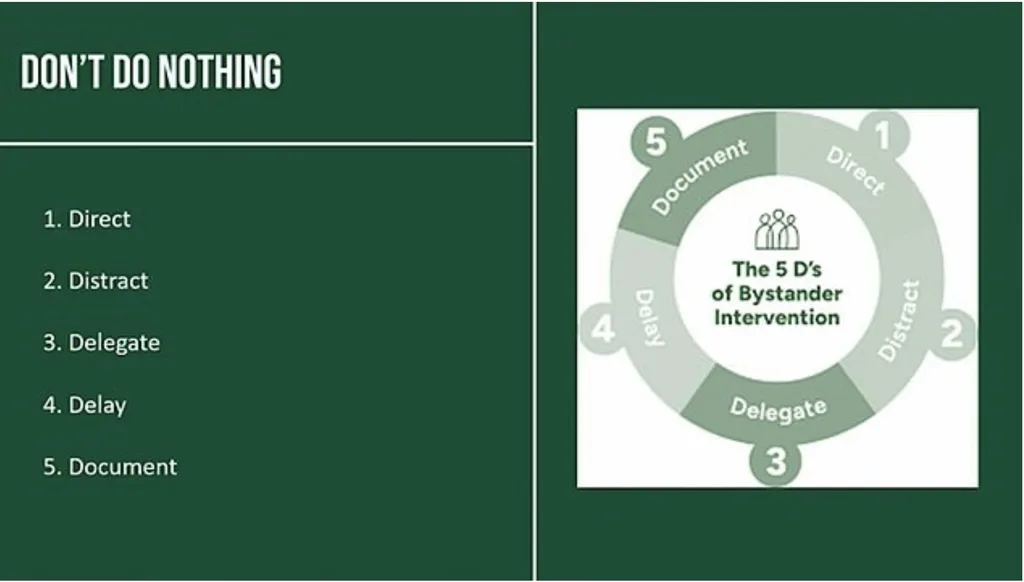
In the very same week these letters were publicised, the UK Green Party did actually launch its own internal in-depth report on what was and was not funny, with party activists receiving training informing them they should maintain detailed records of any jokes fellow members had told to them, “including dates, times [and] locations”, in case anyone later found them to be offensive – particularly if they touched upon sensitive issues like race, religion, sexuality or class. Even if the particular big fat black lesbian affected made a joke about themselves, this was still to be noted down and eliminated, as it nonetheless created “an environment in this space where derogatory jokes are allowed to happen”.

To prevent such jocular genocide occurring again in future, Greens were advised to perform an “audit” of their friendship groups to ensure they were diverse enough so that this simply would not happen: an Englishman, an Irishman and a Scotsman all walk into a pub, and nobody says anything even remotely untoward whatsoever, as diversity is clearly our strength.

Official Green Party advice on what to do if you happen to hear a joke one day. Nowhere does the option “laugh” appear

For a preview of what a future Green-led Ministry of Laughter might one day look like, we should look towards a current controversy involving the quasi-state-run BBC (Bowdlerising British Comedy), which in September decided to mark 20 years since the first broadcast of award-winning sketch-show That Mitchell and Webb Look – by cutting out several sketches, and deeming the show to be “racist”. The now samizdat sketches involved scenarios like English Civil War re-enactors getting bored and deciding to black up and recreate modern-day conflicts in the Democratic Republic of Congo, a brownface Amazonian tribe found secretly living behind flower-pots in a garden centre and a woman wearing a burka being an unsuccessful participant in a TV makeover programme.

Even more primly, the BBC also wiped or butchered entire episodes of popular children’s comedy history series Horrible Histories, as they featured jokes about sensitive topics like slavery – despite the fact they pretty obviously were not of a “Let’s bring it back!”-type perspective, but attempting to satirise the practice’s brutality.

One horrified reaction came from Graham Linehan, the cancelled Anglo-Irish comedy writer who today lives in exile in America, as nobody in the UK industry will now touch his work with a bargepole. Not only does it commit the cardinal post-2010s sin of actually being funny, Linehan’s writing is also deemed to be “transphobic”; Channel 4 refuses to re-show an old episode of his sitcom the IT Crowd, as it features a joke about a cross-dresser (see my review of his 2023 autobiography).

Writing in the Telegraph, Linehan observes that most British comedians who get their back-catalogues politically ruined these days, like Mitchell and Webb, either keep silent and go along with it for an easy life, or else actively denounce themselves in classic Soviet show-trial fashion, so as to keep raking in the cash on the panel-show circuit. Because of this cowardice, he says, “somewhere out there, the next generation of comedy writers and performers, the ones who might have pushed the form further, taken bigger risks, made the joke nobody else would touch, will quietly decide it isn’t worth it, and nobody will have to ban anything ever again”. Sounds a bit like how Islam operates in such matters, too …
The Great Exhibition shows Victorians were anything but “stuffy”

Filed under: Books, Britain, History — Tags: , , , , — Nicholas @ 05:00

That’s not to say they didn’t like accumulating “stuff”, however, as the Great Exhibition was in many ways a celebration of “stuff”:

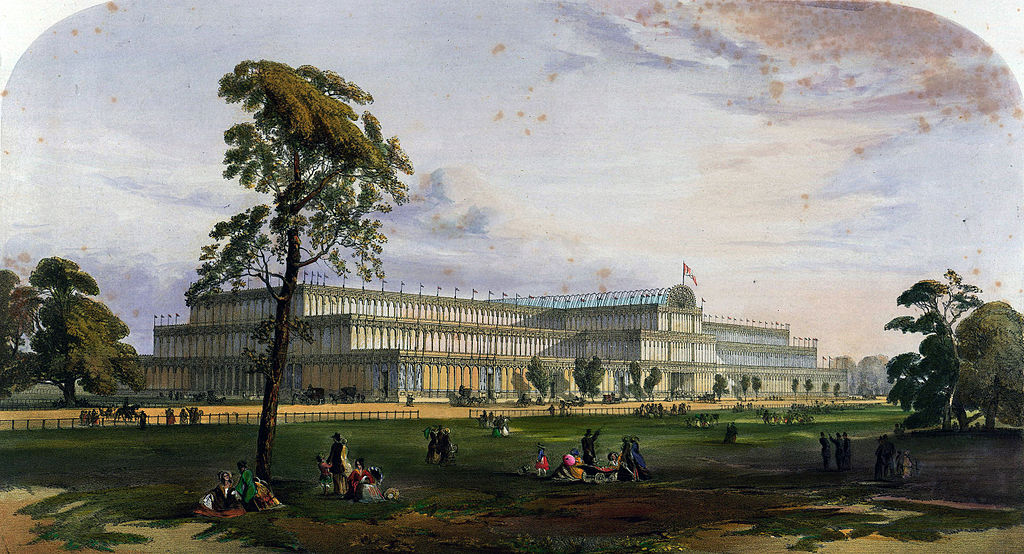
The Crystal Palace from the northeast during the Great Exhibition of 1851.
Image from the 1852 book Dickinsons’ comprehensive pictures of the Great Exhibition of 1851 via Wikimedia Commons.

One wonders whether enough time will ever elapse for our Victorian ancestors to break free from the prevailing stereotype that they were demure, dull, prudish, obsessed with death and weirdly repressed. Still, a full 125 years after the death of the eponymous Queen, “Victorian” remains a word synonymous with “stuffy”, “insular”, “puritanical” and “sanctimonious”.

Despite many attempts at historiographical rehabilitation, the popular conceptualisation of the Victorians sadly remains the same. The truth, however, as A.N. Wilson proves yet again with The Wise and Their Works — his latest foray into the age of Empire and top hats — is far more colourful.

Wilson’s subject is the Great Exhibition of 1851, which famously brought the whole world to Britain’s door for one giddy summer, to see the accumulated ingenuity of 19th-century manufacturers crammed under the vast glass roof of the Crystal Palace in Hyde Park. The east half of the building was given over to foreign exhibits, the west to British curiosities. That this was a quite coherent and acceptable division of spoils tells us something about Britain’s status as technological and political hegemon at the time.

The Exhibition was an epic testament to Victorian production and scientific experimentation. Within and without the exhibition hall, visitors could gawk at giant lumps of coal, pearls from Aberdeenshire and china clay from Cornwall. Glittering above all this raw material was the most valuable gem ever dug from the earth, the now controversial Koh-i-Noor diamond. Apparently, it wasn’t shiny enough or big enough for our supercilious Victorian brethren. Such valuable nuggets give us an insight into what eventually did for the Victorians: they were always wanting more.

Part of the point of the Great Exhibition was that the human ingenuity on display outdazzled even the wonders of the natural world. There were innumerable clocks, cameras and barometers, a printing machine capable of churning out five thousand copies of the Illustrated London News an hour, a steam hammer that could crack an egg on its lightest setting or forge a warship’s bearings on its heaviest, alongside such delightful curiosities as a collapsible piano built for yacht cabins.

Even Queen Victoria found the siamese piano with two players at each end a step too far, but I suspect it’s the sort of thing that would go viral overnight on TikTok today. It is perhaps by focusing on their obsession with the weird that we can learn that the Victorians were not so different to us after all.

There can be no better guide to the Exhibition and broader era than Wilson — a veritable time traveller and arch-Victorian himself, whose acclaimed biographies of Victoria, Albert and Dickens, as well as his more contentious life of Charles Darwin and his superb general histories, all point to a man for whom the 19th century remains a never-ending source of inspiration. This lively narrator is a boon in a history that can feel acute in scope at times.

And Wilson doesn’t beat around the bush: the Exhibition was in his words, “a monument to consumerism”. And 19th-century consumerism was not without its dark underbelly. On display, in a detail that wreaks havoc upon cosy nostalgia, were shackles and leg irons manufactured in Birmingham for export to the slave-owning American South.

As much fun as this time-travelling escapade proves to be, wandering the stalls, marvelling at taxidermied frogs, Wilson’s deeper concern lies in the bureaucratic machinery that made the whole enterprise possible. It’s easy to glaze over the grant values, leases, committee votes and acreage negotiations, but it is essential to show exactly how a project of this magnitude could ever come into being.

As Wilson puts it, in one of the book’s loveliest lines, “It is from small things … that some of the most remarkable achievements have grown”. Forget the history buffs, it’s today’s civil servants, project managers and bureaucratic naysayers who have most to learn from the Great Exhibition of 1851.

The insanity of the Kamloops Residential School allegations

Filed under: Cancon, History, Religion — Tags: , , , , , — Nicholas @ 04:00

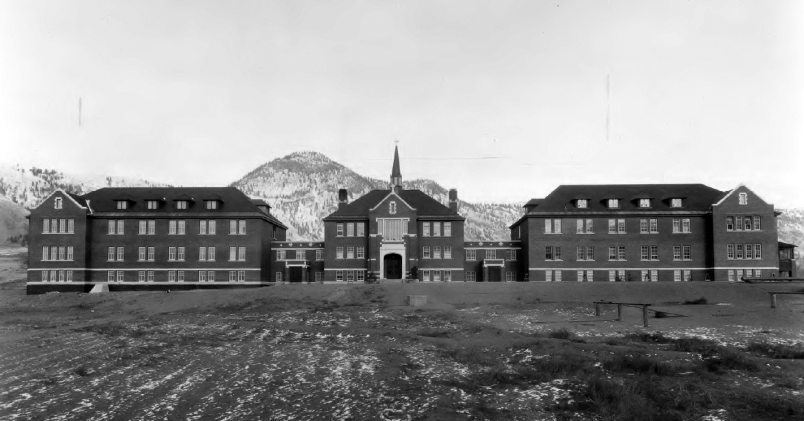
For whatever reason, the Canadian government decided to not challenge the claims that 215 First Nations children had been buried in unmarked graves (media often changed that detail to a “mass grave”) at the former Kamloops Residential School in BC. On X, Tristin Hopper outlines the story as it was relayed to the public:

Kamloops Indian Residential School, 1930.
Photo from Archives Deschâtelets-NDC, Richelieu via Wikimedia Commons.

I still don’t think Canadians appreciate just how crazy the unmarked grave allegations at Kamloops were. So I tried to sum it up as best as I could …

The unmarked graves at Indian residential schools mentioned by the Truth and Reconciliation predominantly refer to students who died of disease, usually tuberculosis and usually before 1930. They were then buried in onsite cemeteries with wooden markers, with the result that the grave location was lost when the marker rotted away. When you hear about graves being excavated at IRS sites, it’s usually something like this.

The Kamloops 215, from the start, was an entirely different thing. It purported to provide evidence of an insane blood libel that the Catholic Church was secretly murdering Indigenous children en masse as late as the 1960s. The specific “knowing” was that staff were disappearing Kamloops Indian Residential School students and burying them in the school’s apple orchard in the middle of the night. This was despite the fact that nobody could actually name a specific student that had been disappeared in this fashion.

What Kamloops did was equivalent to claiming that we finally had physical evidence of the Satanic ritual abuse panic. So, think of it like a Canadian hospital publicly claiming that they’d found an onsite mass grave filled with babies murdered by Satanists in the 1980s.

Actual residential school deaths were employed as cover for an utterly bananas urban legend. And that’s why, in 2021, Canada was thrown into a profoundly destructive cultural revolution from which we may never recover.

The World Economic Forum

Filed under: Bureaucracy, Economics, Government — Tags: , , — Nicholas @ 03:00

On the social media site formerly known as Twitter, Handre looks at the amazing — and sinister — success of the World Economic Forum:

The World Economic Forum.

Every January, roughly 2,800 executives, finance ministers, and central bankers fly private jets into Davos, Switzerland, to discuss how you should use less fossil fuel, practice sustainability, and pursue “equitable growth”.

Klaus Schwab founded the Forum in 1971, and for 55 years it has perfected a singular trick: dressing up cartelization as collaboration. When BlackRock’s Larry Fink sits across from Christine Lagarde and three heads of state, the outcome is never deregulation. It is always managed markets, stakeholder capitalism, and what the Forum itself calls “public-private partnership”, which is the polite term for incumbent firms writing the rules their competitors must follow.

The 2030 Agenda the Forum relentlessly pushes centralizes energy allocation, monetary policy, and food production under supranational bodies that nobody elected and nobody can remove. Prices no longer signal actual scarcity; they rather reflect political priorities. Farmers in the Netherlands lost land to nitrogen regulations lobbied into existence by parties with no skin in Dutch agriculture. You absorbed that cost through food prices, quietly, with no vote cast.

The Forum redistributes access to governments, and access to governments is worth more than genuine productivity when regulations make genuine productivity nearly illegal. Regulatory capture operating at a global scale.

Hayek identified the fatal conceit in 1988: the belief that a committee of sufficiently credentialed people can allocate resources better than dispersed price signals. Davos proves him right annually, producing white papers while the people funding those flights, through taxes and inflation, get poorer.

Sako M92S: Finland’s Last Civilian AK (now being imported to the US)

Filed under: Europe, History, Military, Weapons — Tags: , , , , — Nicholas @ 02:00

Forgotten Weapons
Published 5 Jun 2026

The M92S is the semiautomatic civilian version of the Finnish military rk95 rifle. The rk95 was intended to be a modernization of the Finnish AK platform, but it fell victim to military funding cuts as a result of the collapse of the Soviet Union. Only a small number were procured by the Finnish Defense Forces, and Sako only made about 2500 of the semiautomatic model for civilian and reservist use.

The M92 uses a brand new milled receiver design and includes a reinforced dust cover with rear aperture sight, a gas cutoff for rifle grenades (albeit never used), and mounting points for an optics siderail. The military rk95s all had side-folding stocks, but the civilian model got a fixed stock as the folder would have made it much harder to register and own in Finland at the time.

These rifles, along with all the other Valmet factory semiauto rifles, just recently became importable thanks to the efforts of Postrock, of Garden City Kansas.

Military rk95 video: • RK95: Finland’s Ultimate AK

QotD: The decline of academic standards over the years

Filed under: Education, Quotations, USA — Tags: , , — Nicholas @ 01:00

… while I was on the road, I went to visit a buddy who’s still deep cover in academia. He teaches at a really SPLAC-y SPLAC, the kind that bills itself as “Minnesota’s answer to Princeton”. He’s part of a team running this course that, back in my undergrad days thirty years ago, would’ve been called “Paideia” or something similarly pretentious, taught to the “honors college” (or equivalent). Twenty years before that, it would’ve been called “Western Civ I” and required of all incoming freshmen, regardless of major.

Twenty years before that, and it would’ve been called “basic cultural literacy”; the kind of thing any college man — indeed, any graduate of a remotely decent high school — would know cold. I’ve written many times that the not-elite-but-certainly-very-respectable school which awarded my PhD wouldn’t have admitted me as an undergrad as late as 1960; they would’ve been sticking me in some serious remedial classes as late as 1980. Watching my buddy struggling mightily — and failing miserably — to get even the ridiculously watered-down, extremely fake and utterly gay version of this stuff across to the brown-nosing test-acers of the Current Year sent me sobbing into the arms of Jack Daniel.

Not because I would’ve done better, mind you, but because I would’ve done so much worse. The only way I got through my last few semesters in academia was to regard it as acting. The University is paying me to stand on stage and say my lines, so I’ll stand there and say them. Aside from that, all they want to do is check the appropriate box: Students have attended thus-and-such class, taught by someone with a PhD (crucial for those “best college” rankings!), and … there it is.

What actual knowledge am I supposed to be conveying? What skill set? What world view?

Category error. If it doesn’t fit on the standardized test, which is the only thing that matters to the bottom line, then it’s useless.

Severian, “On the Absurdity of Life”, Founding Questions, 2022-09-12.

Powered by WordPress