
That’s not to say they didn’t like accumulating “stuff”, however, as the Great Exhibition was in many ways a celebration of “stuff”:
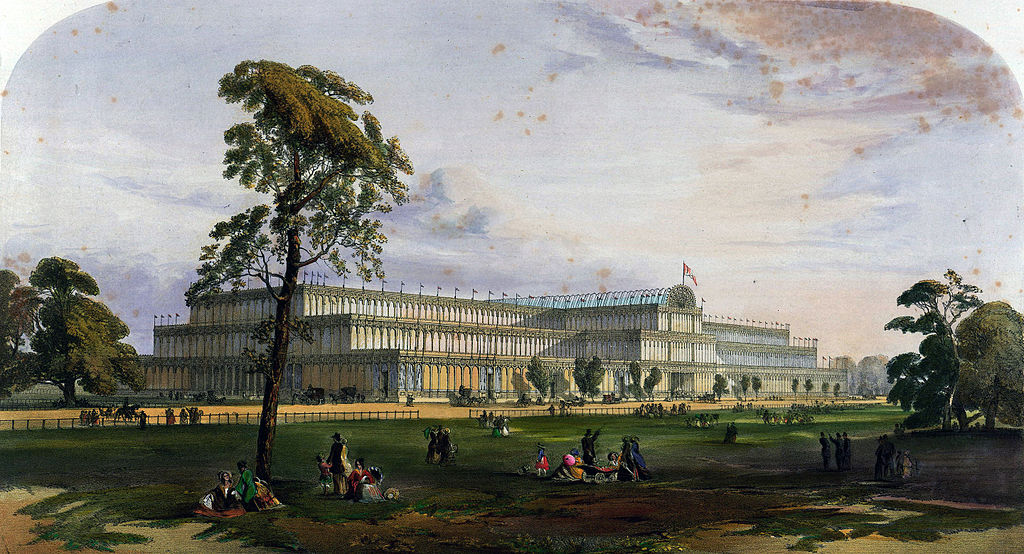
The Crystal Palace from the northeast during the Great Exhibition of 1851.
Image from the 1852 book Dickinsons’ comprehensive pictures of the Great Exhibition of 1851 via Wikimedia Commons.
One wonders whether enough time will ever elapse for our Victorian ancestors to break free from the prevailing stereotype that they were demure, dull, prudish, obsessed with death and weirdly repressed. Still, a full 125 years after the death of the eponymous Queen, “Victorian” remains a word synonymous with “stuffy”, “insular”, “puritanical” and “sanctimonious”.
Despite many attempts at historiographical rehabilitation, the popular conceptualisation of the Victorians sadly remains the same. The truth, however, as A.N. Wilson proves yet again with The Wise and Their Works — his latest foray into the age of Empire and top hats — is far more colourful.
Wilson’s subject is the Great Exhibition of 1851, which famously brought the whole world to Britain’s door for one giddy summer, to see the accumulated ingenuity of 19th-century manufacturers crammed under the vast glass roof of the Crystal Palace in Hyde Park. The east half of the building was given over to foreign exhibits, the west to British curiosities. That this was a quite coherent and acceptable division of spoils tells us something about Britain’s status as technological and political hegemon at the time.
The Exhibition was an epic testament to Victorian production and scientific experimentation. Within and without the exhibition hall, visitors could gawk at giant lumps of coal, pearls from Aberdeenshire and china clay from Cornwall. Glittering above all this raw material was the most valuable gem ever dug from the earth, the now controversial Koh-i-Noor diamond. Apparently, it wasn’t shiny enough or big enough for our supercilious Victorian brethren. Such valuable nuggets give us an insight into what eventually did for the Victorians: they were always wanting more.
Part of the point of the Great Exhibition was that the human ingenuity on display outdazzled even the wonders of the natural world. There were innumerable clocks, cameras and barometers, a printing machine capable of churning out five thousand copies of the Illustrated London News an hour, a steam hammer that could crack an egg on its lightest setting or forge a warship’s bearings on its heaviest, alongside such delightful curiosities as a collapsible piano built for yacht cabins.
Even Queen Victoria found the siamese piano with two players at each end a step too far, but I suspect it’s the sort of thing that would go viral overnight on TikTok today. It is perhaps by focusing on their obsession with the weird that we can learn that the Victorians were not so different to us after all.
There can be no better guide to the Exhibition and broader era than Wilson — a veritable time traveller and arch-Victorian himself, whose acclaimed biographies of Victoria, Albert and Dickens, as well as his more contentious life of Charles Darwin and his superb general histories, all point to a man for whom the 19th century remains a never-ending source of inspiration. This lively narrator is a boon in a history that can feel acute in scope at times.
And Wilson doesn’t beat around the bush: the Exhibition was in his words, “a monument to consumerism”. And 19th-century consumerism was not without its dark underbelly. On display, in a detail that wreaks havoc upon cosy nostalgia, were shackles and leg irons manufactured in Birmingham for export to the slave-owning American South.
As much fun as this time-travelling escapade proves to be, wandering the stalls, marvelling at taxidermied frogs, Wilson’s deeper concern lies in the bureaucratic machinery that made the whole enterprise possible. It’s easy to glaze over the grant values, leases, committee votes and acreage negotiations, but it is essential to show exactly how a project of this magnitude could ever come into being.
As Wilson puts it, in one of the book’s loveliest lines, “It is from small things … that some of the most remarkable achievements have grown”. Forget the history buffs, it’s today’s civil servants, project managers and bureaucratic naysayers who have most to learn from the Great Exhibition of 1851.


