
Quotulatiousness

October 24, 2026

The Winter War, 1939-40

After joining with Hitler’s Third Reich to dismember Poland, and occupying the Baltic states of Latvia, Lithuania, and Estonia, Stalin turned his attention to Finland. From the Soviet point of view, the Finnish border was uncomfortably close to Leningrad and the fortified defensive lines along the Karelian Isthmus were a reminder that the Finns could cause trouble if a war came. Stalin’s solution was to demand that the Finns give up the region northwest of Leningrad (including the defences), along with several islands in the Gulf of Finland and allow a Soviet naval base to be established on the Finnish coast near Helsinki. All this in exchange for a larger chunk of Soviet territory north of Lake Ladoga and the “firm friendship of the Soviet Union” for whatever that might be worth. The Soviets backed up their claim with an overwhelming military superiority in men, tanks, artillery and air power. The Finns declined the generous offer, which took Stalin aback:
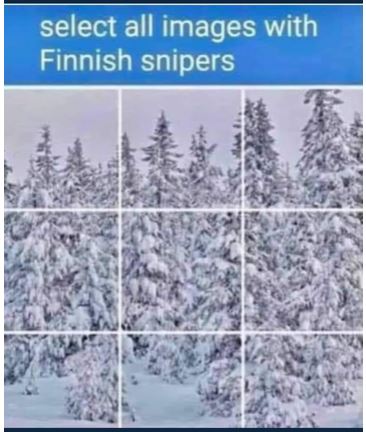
Not actually much of an exaggeration: Finnish snipers were a constant threat to Soviet military operations in Finland during the Winter War and the Continuation War.

On 30 November 1939, the Soviet Union invaded Finland through an immensely samey, tree-covered morass. Across hundreds of miles of deep snow and borderland, the Red Army unleashed 450,000 men, roughly 1,100 tanks, and hundreds of combat aircraft, expecting to overwhelm its smaller neighbour through sheer weight of armour, heavy artillery, and manpower.

Joseph Stalin overturned the original campaign plan, discarding the slower but sounder 4-month plan for a lightning campaign in just two months. Beneath that rigid political deadline lay an atmosphere of terror. No senior Soviet commander dared challenge Stalin, correct his unrealistic timetables, or point out that the Red Army was unready for a winter invasion. Officers who raised logistical concerns risked being branded defeatists or traitors—a real possibility the purges proved.

This fear spread in the ranks.

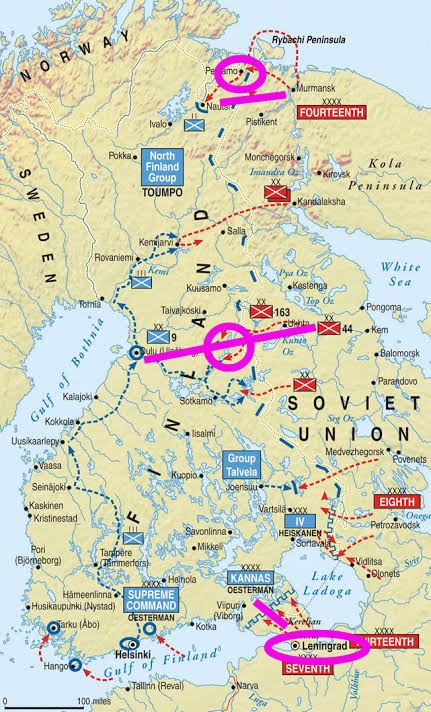
Despite the low state of morale, the Red Army struck along three operational axes:

  • The Southern Main Effort (Karelian Isthmus): The heavy Soviet 7th Army would drive toward Helsinki, intent on punching through the main Finnish defences: the Mannerheim Line.
  • The High North (Lapland & Arctic Coast): The 14th Army would advance across the tundra to seize Finland’s ice-free Arctic port at Petsamo, to cut off fears of foreign supplies inbound to aid the Finns.
  • The Central Thrust (the “Waist” of Finland): The Soviet 9th Army would strike west across the country’s narrowest stretch toward Oulu on the Gulf of Bothnia.

Soviet pressure in three main spots, excuse my art!
Image and caption from WW2 Matters

In the central sector, Soviet planners harboured an ambitious but possible objective: advance west toward Oulu, reach the Gulf of Bothnia, and slice Finland in two.

The plan looked reasonable on map overlays at Leningrad headquarters. The target was Suomussalmi — a quiet logging settlement enveloped by lakes, swamps, and primaeval pine. Its importance lay not in its economic value, but in its position on the regional dirt road network running west toward Oulu. A successful Soviet drive here would sever the rail network connecting northern and southern Finland, cutting the vital land artery to neutral Sweden through which western supplies flowed.

To execute this strategic cut, Soviet planners committed two heavily reinforced divisions under the 45th Rifle Corps — the 163rd Rifle Division and the 44th “Blue” Rifle Division. With their attached tank battalions, corps artillery, and massive logistical columns, this combined force brought nearly 50,000 men into the narrow forest corridors.

In the Suomussalmi sector, the Finns initially faced fewer than 1,000 local Civil Guardsmen, later reinforced into Colonel Hjalmar Siilasvuo’s 9th Division to total 11,000 to 17,000 men. Outnumbered more than four to one, the Finns had no tanks and only 11 outdated artillery pieces — some dating back to the 1904 Russo-Japanese War — and severely rationed shells.

The Soviet plan depended on numerical dominance. But in the dense taiga forests of northeastern Finland, it became a bloody lesson in the difference between possessing a large army and knowing how to use it.

March 29, 2023

Will Finland Leave the War? – WW2 Special

World War Two
Published 28 Mar 2023

The Finns have been fighting the Soviet Union since the Winter War. But now, Marshal Mannerheim and Prime Minister Risto Ryti look like they might pull out of the Eastern Front commitments they agreed upon with their Axis allies. German-Finnish relations seem to be at breaking point, and Red Army troops are threatening the borders. How long will Finland stay in this war?
(more…)

March 21, 2023

Born in the Heart of Besieged Leningrad: the PPS-42

Filed under: History, Military, Russia, Weapons, WW2 — Tags: , , , , , , — Nicholas @ 02:00

Forgotten Weapons
Published 11 Nov 2022

One would think that the Shpagin PPSh-41 was as simple as a submachine gun could get, but that wasn’t the case in World War Two USSR. Barely had the PPSh gotten into real production than the Army was looking for something even simpler. An answer came from young designer Aleksey Sudaev with a completely-stamped gun that used about half the raw material and a third the machine time to produce as the PPSh. After winning the competitive trials, Factory 828 in Moscow was chosen as the lead production facility. They produced a series of drawings and preproduction guns in the summer of 1942.

Sudaev took those drawings into besieged Leningrad with orders to et up production in three factories within the city. The main one was Factory 209, and after fixing a few minor design flaws, the gun went into production in the spring of 1943. Sudaev PPS-42 SMGs pretty much went out the doors of the factory and right into combat trying to break the siege of the city. In total, about 46,000 would be produced before that siege was finally broken.

Meanwhile, Factory 828 in Moscow put a higher priority on policing the design than on immediate production. They implemented a substantial number of improvements, although the lack of communication into Leningrad prevented them from being used in the production going on there. Instead, the improvements culminated in the PPS-43 design, of which more than a million were made by the end of the war.
(more…)

February 5, 2023

Leningrad: NO STEP BACK! – Week 232 – February 4, 1944

World War Two
Published 4 Feb 2023

The Allies begin a new operation in the Pacific this week: assaulting the Marshall Islands. They also make big attacks from their beachhead in Italy at Anzio, but these are called off after only a few days in the face of heavy enemy resistance. However, in the USSR there are several successes against the Axis, as they are pushed back both in the far north and the far south of the front, and still surrounded near Korsun.
(more…)

February 4, 2023

Poland’s Descent into Civil War – War Against Humanity 097

World War Two
Published 2 Feb 2023

Poland, occupied, abandoned or even threatened by her allies is left to fight her own war. A war that under the influence of internal and external forces looks more and more like a full blown civil war inside the world war.
(more…)

January 29, 2023

Anzio Begins – Allies Already Pinned Down – Week 231 – January 28, 1944

World War Two
Published 28 Jan 2023

Some big news is the Allies amphibious offensive to hit the Germans behind their lines at Anzio in Italy, some other big news is that after nearly two and a half years, the Soviets have broken the siege of Leningrad and their twin northern offensives keep pushing back the enemy. Yet more big news is that the Soviets have managed to surround and cut off over 50,000 Axis troops near Korsun. This is one big week of action!
(more…)

January 23, 2023

Monte Cassino, the Battle Begins – Ep 230 – January 21, 1944

Filed under: Britain, Germany, History, Italy, Japan, Military, Pacific, USA, WW2 — Tags: , , , , , — Nicholas @ 04:00

World War Two
Published 21 Jan 2023

The Allies have reached the linchpin of the German defenses in Italy, but a first attack proves disastrous. It does, though, divert troops from where they soon plan to make landings behind enemy lines. Meanwhile in the USSR, the huge Soviet offensive in the north makes great gains against the stunned Axis forces.
(more…)

January 21, 2023

When the SS Go Too Far – War Against Humanity 096

World War Two
Published 20 Jan 2023

The internal conflict between Poland and the other United Nations Allies deepens as Churchill faces them with diplomatic defeat over Soviet land grab. In the Occupied Netherlands and Poland the Nazis continue their atrocities.
(more…)

January 15, 2023

Time to Liberate Leningrad! – Ep 229 – January 14, 1944

World War Two
Published 14 Jan 2023

Three Soviet Fronts launch major offensives to try and finally free Leningrad, under siege for nearly two and a half years now. The Soviets are, in fact, making attacks along most of the Eastern Front. In the South Pacific, the Allies step up their aerial assault to wreck Rabaul’s air power, thus neutralizing it as a base.
(more…)

April 3, 2022

Patton Has a Plan, and it’s Bad – WW2 – 188 – April 2, 1943

World War Two
Published 2 Apr 2022

American attacks in Tunisia meet with local disaster, but in general the Axis forces are withdrawing there. The Allies learn about the German rocketry plans this week, and both sides are making plans for action in the Pacific.
(more…)

March 27, 2022

American Army Finally Does Something Right – WW2 – 187 – March 26, 1943

World War Two
Published 26 Mar 2021

The British are attacking the Mareth Line in North Africa while the Americans hit the Axis flank, but the Allies are withdrawing in Burma. It’s the Germans who are pulling back in the USSR, though, and there is another attempt from within German Command to assassinate Adolf Hitler.
(more…)

March 20, 2022

Kharkov Falls Once Again – WW2 – 186 – March 19, 1943

World War Two
Published 19 Mar 2022

The British are attacking the Mareth Line in North Africa while the Americans hit the Axis flank, but the Allies are withdrawing in Burma. It’s the Germans who are pulling back in the USSR, though, and there is another attempt from within German command to assassinate Adolf Hitler.
(more…)

January 16, 2022

Food for Leningrad, Breaking the Siege! – WW2 – 177- January 15th, 1943

World War Two
Published 15 Jan 2022

Soviet attacks are launched this week to destroy the Hungarians, all while the German desperation at Stalingrad and Velikie Luki continues, but in the far north the Soviets have broken through the siege of Leningrad after 16 months. And the Casablanca Conference begins, a meeting to guide the war’s future progress.
(more…)

August 11, 2021

The Symphony That Defeated the Wehrmacht – WAH 040 – August 1942, Pt .1

Filed under: China, Europe, Germany, History, Japan, Military, Russia, USA, WW2 — Tags: , , , , , , — Nicholas @ 04:00

World War Two
Pubished 10 Aug 2021

The Big Action at the Warsaw Ghetto continues, while The Japanese carry out retaliations against the Chinese for aiding American airmen. Dmitri Shostakovich’s “Symphony no. 7” premieres in the besieged city of Leningrad.
(more…)

February 12, 2021

Britain Chooses War Crimes – RAF Strategic Bombing – WAH 028 – February 1942, Pt. 1

World War Two
Published 11 Feb 2021

As the winter of 1942 continues, many Soviet civilians suffer under the German Siege of Leningrad. Meanwhile, the British are shifting their bombing strategy from targeting factories to targeting homes.

Join us on Patreon: https://www.patreon.com/TimeGhostHistory
Or join The TimeGhost Army directly at: https://timeghost.tv

Follow WW2 day by day on Instagram @ww2_day_by_day – https://www.instagram.com/ww2_day_by_day
Between 2 Wars: https://www.youtube.com/playlist?list…
Source list: http://bit.ly/WW2sources

Hosted by: Spartacus Olsson
Written by: Joram Appel and Spartacus Olsson
Director: Astrid Deinhard
Producers: Astrid Deinhard and Spartacus Olsson
Executive Producers: Astrid Deinhard, Indy Neidell, Spartacus Olsson, Bodo Rittenauer
Creative Producer: Maria Kyhle
Post-Production Director: Wieke Kapteijns
Research by: Joram Appel
Edited by: Miki Cackowski
Sound design: Marek Kamiński
Map animations: Eastory (https://www.youtube.com/c/eastory​)

Colorizations by:
Norman Stewart – https://oldtimesincolor.blogspot.com/​
Daniel Weiss

Sources:
USHMM
Bundesarchiv
Yad Vashem 2695/7, 5761/12
IWM MH 24747
RIA Novosti archive, image #762, #244
from the Noun Project:
Skull by Muhamad Ulum

Soundtracks from the Epidemic Sound:
Reynard Seidel – “Deflection”
Fabien Tell – “Last Point of Safe Return”
Farrell Wooten – “Blunt Object”
Jo Wandrini – “Dawn Of Civilization”
Wendel Scherer – “Defeated”
Jon Bjork – “Icicles”
Gunnar Johnsen – “Not Safe Yet”
Peter Sandberg – “Document This 1”

Archive by Screenocean/Reuters https://www.screenocean.com​.

A TimeGhost chronological documentary produced by OnLion Entertainment GmbH.

From the comments:

World War Two
4 hours ago
We are covering the RAF’s bombing campaigns in the War Against Humanity series because it concerns warfare against the civilian population. On previous occasions, we have been accused of relativizing Nazi’s war-crimes by covering Allied atrocities in the same space, but we argue that for a fact-based reporting on how WW2 impacted the civilian population we need to be complete and unbiased.

The facts speak for themselves, and we document those facts that by providing an exhaustive record with equal coverage of all events and parties. Covering one event doesn’t relativize or justify the other and vice versa. We will not tolerate any whataboutism in the comments.

We will also not tolerate a justification of these crimes based on pragmatism, or equal proportionality — on an absolute moral level the goal never justifies the means. In this case we look at our comment section from a 21st century perspective and hold ourselves and anyone using our forums to the modern standards laid down in the laws of war. Explaining, analyzing and discussing war crimes and crimes against humanity is fine, even desired — celebrating, hailing, or justifying them is not.

Older Posts »

Powered by WordPress

