In Quillette, an excerpt from Guy de la Bédoyère’s new book, Brief Lives of the Ancient World: Rulers, Rebels, and Robbers, on Sejanus, Praetorian Prefect for much of the reign of Tiberius Caesar:
The story of Sejanus is dependent on the accounts of Roman historians, in particular Tacitus, who indulged himself with an unforgettable tale of treachery and dissimulation. His main purpose was to portray Tiberius as a sinister and manipulative tyrant, but he also succeeded in creating an allegory of cynicism at the heart of power.
Shortly after Tiberius’ accession in AD 14, the son of praetorian prefect Seius Strabo — Lucius Aelius Sejanus (born Lucius Seius) — was appointed co-prefect. Like his father, he was an equestrian, Rome’s second aristocratic tier, but had been adopted into the senatorial Aelii clan, hence his name change.
The adoption entitled Sejanus to a senatorial career, but he must have decided that the prefecture of the Praetorian Guard offered him more real power and personal access to the emperor. It also allowed him to avoid the suspicion that surrounded ambitious senators. Tiberius chose a few trusted equestrians to form part of his most intimate circle.
Within a year, Sejanus held the position on his own when his father was promoted to the prefecture of Egypt. Enjoying a trusted pedigree, he quickly inveigled himself into Tiberius’ favour. Sejanus was the first of the praetorian prefects to experiment with the power and influence the position enjoyed, and thereby also with the potential power of the guard as a political force.
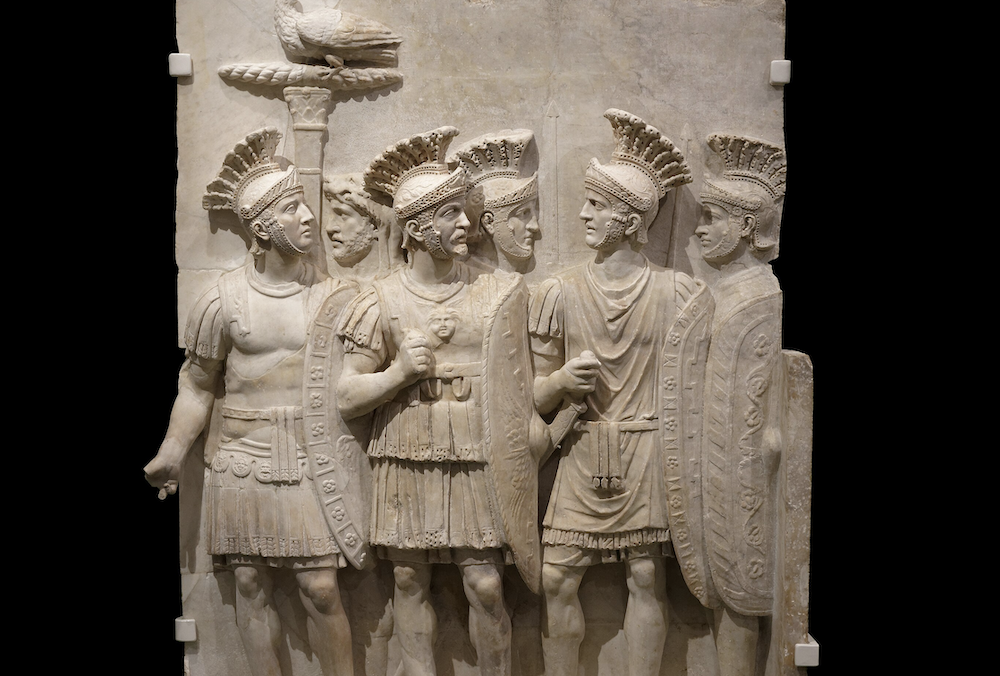
Detail from the Praetorian Relief, a Roman marble relief dated to c. 51–52 AD from the Arch of Claudius in Rome.
Sejanus was helped by chance, so often the principal agent in realising ambition. The huge theatre that had been built in Rome by Pompey Magnus in 55 BC burst into flames in the year AD 22. The fire was contained thanks to quick work by Sejanus, who used his position to tackle the emergency. Tiberius heaped praise on Sejanus for averting a catastrophe. The senate voted that a statue of Sejanus be erected on the grounds of the theatre.
In time, the career of Sejanus would expose how dangerous the commander of the guard could become. Tiberius ignored the signs, preferring to take as little interest as possible in the job of being emperor.
Sejanus made his first significant move in AD 23 when he installed all the praetorian cohorts in the Castra Praetoria, a fortified military camp in the northeastern part of the city. Under Augustus, they had been based at several locations in Italy, safely dispersed away from Rome, but may have already been brought into various barracks around the city under Tiberius. Their new dedicated fortress transformed the significance of the prefecture of the guard. The Castra Praetoria, which would remain a permanent feature until the guard’s disbandment under Constantine almost three centuries later, meant that the men were now directly and immediately under Sejanus’ control.