
Forgotten Weapons
Published 19 Jun 2026The Aimpoint CS is an optic designed specifically for the Swedish Home Guard, which wanted a red dot that was extremely durable and also capable of being left on for 10 years on a single battery. This was a very challenging requirement, and Aimpoint considered two paths to meet it. One was a pulsed LED to reduce actual “on” time of the dot, but this did not prove successful. The other was a traditional red dot, with improved design and power circuitry to allow an extended battery life. The new system was integrated into Aimpoint’s other optics (including the US M68CCO contract).
Along with the improved electronics, the CS used a large (approximately AA size) 3.7V battery hard-wired into the case. Per Swedish request, the battery was not user serviceable, and the optics are returned to Aimpoint for battery replacement every 10 years (they are on their third such cycle now). It also includes a set of hard rubber backup sights on top and a small length of picatinny rail that was never really used (it was intended for accessories like laser modules).
The Aimpoint CS was developed in 2001, adopted in 2002, and deliveries of about 60,000 total began in 2003. It was used on Home Guard AK4 rifles, and also on AK5s. They were not sold on the commercial market, and are very scarce in the US.
(more…)
October 19, 2026
Aimpoint CS: Revolutionary Battery Life for the Swedish Home Guard
August 2, 2026
“Cash for Clunkers” – the seen and the unseen
French economist Frédéric Bastiat explained why the “Cash for Clunkers” program would fail … and he wrote about it more than a hundred years before it happened – “That Which is Seen, and That Which is Not Seen”. The US government publicized the “seen” … removing older cars from the roads in pursuit of lowering pollution. Nobody publicized the “unseen”, as Handre explains:
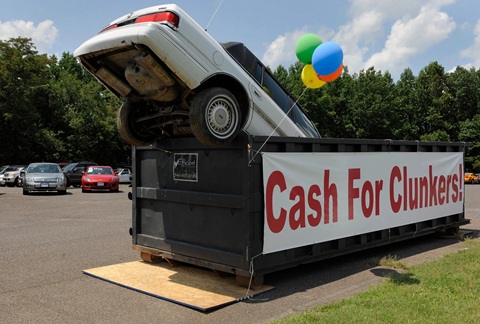
The Cash for Clunkers program, which Congress passed in June 2009 and burned through its $3 billion budget in under two months, destroyed functional wealth on a national scale, and somehow they called it “stimulus”.
The mechanics were simple: trade in a working car, receive up to $4,500 toward a new one, and watch government employees pour sodium silicate into the old engine to make it seize permanently. Around 700,000 vehicles got crushed. These were not rusted-out death traps. The eligibility rules required the trade-in to be drivable and insured. You were watching the state systematically annihilate usable capital because Keynesian demand theory told it that destruction generates recovery. Frederic Bastiat explained why this is wrong in 1850, in an essay short enough to read on your lunch break. Congress ignored it.
The ripple effect hit people the government never mentioned in its press releases. Mechanics lost repair work. Used-car dealers watched their inventory evaporate. Low-income buyers who depend on the sub-$5,000 market faced prices that jumped roughly 10% in the years after the program. Free market economists call this “seen versus unseen”. Politicians only showed you the gleaming new Chevy Malibu driving off the lot. They never showed you the single mother in Akron who needed a $3,000 Corolla and found nothing affordable left on the lot.
Even the environmental justification collapsed under basic scrutiny. A 2009 study by Resources for the Future calculated that the program cost between $237 and $365 per ton of carbon dioxide reduced. The voluntary carbon credit market at the time priced a ton around $10 to $20. The government spent up to thirty times the market rate to achieve an environmental outcome the market was already pricing far more efficiently.
This is what central planning always does. It takes your money, destroys real assets, and transfers wealth from the poor to auto manufacturers and their financiers. The program’s designers received awards. The Akron mother paid higher prices. The engines sat crushed in junkyards. Nobody in Washington answered for any of it.
July 30, 2026
Equilibrium: 198451 with Gun-Fu Fighting
Feral Historian
Published 27 Mar 2026Equilibrium (2002) is a curious mix of early-aughts action movie and mid-20th Century dystopia. While it does feel a bit overwrought and derivative at times, it ends up being more than the sum of its parts.
00:00 Intro
03:17 Gun Kata
04:44 198451
06:45 Endings
07:07 Anti-Human Systems
(more…)
August 11, 2025
Smug Canadian boomer autohagiography rightly antagonizes the under-35s
Fortissax had an argument with one of his readers over a smug, self-congratulating meme about how wonderful Canada was in the 1990s and early 2000s:

What we lived through long before Trudeau was the Shattering, the breakdown of Canada’s social cohesion, driven by left-liberalism with communist characteristics applied to race, ethnicity, sex, and gender, and punitive almost exclusively toward visibly White men. My generation, those millennials born on the cusp of Gen Z, saw post-national Canada take shape not in the comfortable suburban rings of the GTA or the posh boroughs of Outremont and Westmount, but in self-segregated, ghettoised enclaves of immigrants whose parents never integrated and were never required to.
Memes like that are dishonest because they feed a false memory. The 2000s were not normal. Wages were stagnant, housing was already an asset bubble, and immigration was still flooding in under a policy that explicitly forbade assimilation. Brian Mulroney had enshrined multiculturalism into law in 1988. Quebec alone resisted, carving out the right to limit immigration under the 1992 Quebec–Canada Accord. After Chrétien, Stephen Harper brought in three million immigrants, primarily from China, India, and the Philippines in that order.
The Don Cherry conservatives of that era were Bush lite. They were rootless, cut off from their history, their identities manufactured from the top down since the days of Lester B. Pearson. They conserved nothing. For Canadian youth, it was the dawn of a civic religion of wokeness, totalitarian self-policing by striver peers, and the quiet coercion of every institution. My memories of that decade are of constant assault — mental, physical, spiritual — from leftists in power, from encroaching foreigners, and from the cowardice of conservatives.
Your 2000s might have been great. For us, they were communist struggle sessions. In 2009 we were pulled from class to watch the inauguration of Barack Obama, a foreign president, as a historic moment for civil rights. Our schools excluded us while granting space to every group under the sun: LGBT safe spaces and cultural clubs for Italians, Jamaicans, Jews, Indians, Indigenous, Balkaners, Greeks, Slavs, Portuguese, Quebecois, Iroquois, Pakistanis — every culture celebrated except our own. Anglo-Quebecers and Anglo-Canadians got nothing but an Irish club, closely monitored for “white supremacy” and “racism” by the HR grandmas of the gyno-gerontocracy of English Montreal. Students self-segregated, sitting at different cafeteria tables and smoking at different bus shelters. At Vanier, Dawson, and John Abbott College, these divisions were institutionalised. I remember walking into the atrium of Dawson, my first post-secondary experience, greeted by a wigger rolling a joint while a Jamaican beatboxed to Soulja Boy.
We became amateur anthropologists out of necessity, forced to navigate a nationwide cosmopolitan experiment from birth. We learned the distinctions between squabbling southeastern Europeans of the former Yugoslavia, and we did not care if Kosovo was Serbia or whether Romanians and Albanians were Slavic, they all acted the same way. We learned the divides within South Asia, the rivalries between Hindutva and Khalistani, the differences between a Punjabi, a Gujarati, a Telugu, a Pakistani, a Hong Konger, a mainlander, and a Taiwanese. We know the shades of Caribbean identity, the factions of the Middle East, and the intricacies of North African identity. We should never have needed to know these things, but we do.
For us, childhood in this cesspit was the seedbed of radicalism. We never knew an era when contact with foreigners was limited to sampling food at Loblaws. All we know is being surrounded by those who hate us, governed by a state that wants to erase us, with no healthcare, no homes, no jobs that are not contested by foreigners, and no money to start families.


