
As a child, I was a very early fan of C.S. Forester’s series of novels on the career of Horatio Hornblower, so I was a bit wary about reading Patrick O’Brian’s new-to-me stories set in the same period. A friend from Halifax practically forced Master and Commander on me during my first visit to Nova Scotia and I quickly picked up Post Captain, HMS Surprise and a few more in the series. At Athena’s Bridge, Mike Hennelly makes the case that there are valuable leadership lessons that can be learned from O’Brian’s work:
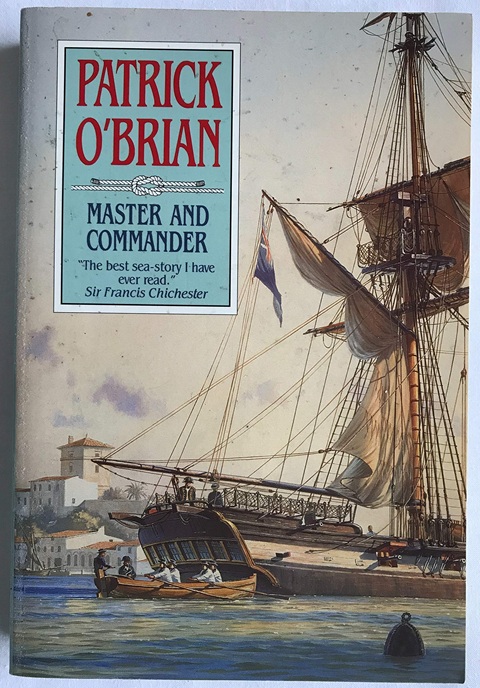
Cover from a later printing than the one I read in 1982.
In the study of leadership, there are many who say that there is nothing to be gained from novels or movies. Their argument is that only the study of reality (real CEOs, real generals, real political leaders) will yield insights of value for the study and practice of leadership. The purpose of this essay is to argue the opposite case. One of the most remarkable literary achievements of the 20th century was Patrick O’Brian’s multi-volume depiction of British naval life during the Napoleonic Wars. Eventually stretching to twenty books, O’Brian gives us the lives of Captain Jack Aubrey and his great friend, Doctor Stephen Maturin. A reviewer from the New York Times stated (rather categorically) that O’Brian’s books are “the best historical novels ever written”. O’Brian’s characters finally appeared in a movie entitled Master & Commander and the film faithfully captures much of the atmosphere and spirit of this maritime world.
O’Brian’s world, both in the books and the movie, is surprisingly faithful to the world of the Royal Navy during the Napoleonic Wars. He brings to life the nature of the great naval leaders of the time, the victories they achieved and the hardships they endured. As O’Brian himself notes, “I have gone straight to the source for the fighting in this book. I have log-books, official letters, contemporary accounts or the participants’ own memoirs“. What follows is not a review of the movie nor a synopsis of the plot. This is an essay that uses one particular movie to frame a discussion of leadership in realistic, uncertain and risky circumstances. Our focus is the character of Jack Aubrey – created by Patrick O’Brian, visualized by director Peter Weir and brought to life by actor Russell Crowe. An examination of Aubrey’s behavior and attitudes throughout the movie provides a wealth of insight into the mystery that is called leadership.
To begin at the beginning, a consideration of the term “master and commander” brings two curious facts to light. First of all, in the early days of the Royal Navy, this term applied to two people – not one. When English warships fought the Spanish Armada, for example, they had a “master” who was a life-long mariner with the nautical experience to sail the ship and a “commander” (frequently a noble) who was entrusted with the combat performance of the ship. Over time, this phrase was combined and came to describe the responsibilities of a warship’s captain. The second curious fact is that this term (as a job description) is incomplete. When Patrick O’Brian brought the character of Captain Jack Aubrey to life, he did so in a way that clearly shows that the term “master and commander” was an incomplete description of a captain’s responsibilities. HMS Surprise might be a ship (that needed a master to sail her) and she might be a weapon of war (that needed a commander to fight her) but she was also a collection of almost two hundred sailors of all sorts (who needed a leader to direct and influence their actions). To carry out all the responsibilities of a ship’s captain, Jack Aubrey needed to be a “master, commander and leader”. Without the ability to take a random set of landsmen and mold them into a cohesive, disciplined and skilled crew, he would not have been able to sail the ship safely nor would he have been able to exert any combat power.
“She’s a vastly heavier ship. She’s out of our class” (or, how leaders get others to face existential risk)
As the movie begins, it is the spring of 1805 and we are aboard HMS Surprise, a small Royal Navy frigate of 28 guns with a crew of 197 souls. The Surprise is under orders to find the French frigate Acheron and “sink, burn or take her as a prize”. The Surprise is off the coast of Brazil and approaching a fogbank when she is ambushed by the Acheron. Captain Aubrey is energized by the prospect of combat (“straight at ’em, Mr. Mowatt!“) but events soon take a turn for the worse as Surprise‘s rudder is shot away and the British barely escape safely into the fog.
We learn more about Aubrey as he faces a serious leadership challenge after this disastrous encounter with the French. The ship’s officers, somewhat in shock, are discussing the engagement and they observe that Acheron was “more like a ship of the line than a frigate” and “our shots couldn’t penetrate“. Their misgivings are understandable. HMS Surprise, with twenty-eight guns, is about as small as a ship can be and still be called a frigate. The forty-four guns of the Acheron make it far larger and more heavily armed than the Surprise and what this means in combat is that every broadside fired by the Acheron is almost four times the weight of a broadside from the Surprise. Aubrey’s command team assumes that the clear superiority of the French ship means the Surprise will have to abandon her mission and head home. But their misgivings are not in line with the attitudes of a) the British Admiralty, b) the British public and c) their captain. At this point in the war, most Britons and the Admiralty operate under the assumption that their navy should always project an aura of invincibility. This has been a British naval characteristic since the great British sea-victories at Camperdown (1797) and the Nile (1798). Furthermore, we find out that Jack Aubrey’s mental model of an ideal officer is Lord Nelson who was famous for his relentlessly aggressive behavior at sea. One of Nelson’s most famous sayings was “no captain can do very wrong if he places his ship alongside that of an enemy” and that is exactly what Aubrey intends to do to the Acheron. Aubrey quickly disabuses his officers of the idea of abandoning their mission. Positively radiating with decisiveness, he tells them there is not a moment to lose if they are to carry out repairs and catch up with the French.
Aubrey faces two challenges as he attempts to lead his ship into a situation of existential risk. First, he must gain the support of his officers and secondly, he must ensure the willingness of his crew. He addresses these concerns in turn. To gain the support of his officers and bolster their morale, he addresses their concerns with a discussion of battle tactics in a way that provides reassurance. Although the French ship has far more guns, Aubrey explains that the Surprise possesses intangible advantages that level the killing field. He is convinced that the Surprise is more maneuverable than the Acheron and he intends that his gun crews be better-trained and more effective than their French counterparts. Without any further dissent from his officers, the Surprise carries on with its pursuit of the bigger and more powerful enemy ship – which is a testament to the effectiveness of Aubrey’s leadership.
Aubrey’s approach to the crew about the threat of the Acheron is intensely practical in nature. The crew spend much of their time engaged in gunnery drill. Captain Aubrey has very high standards for the ship’s gunnery because he expects his gun crews to be both fast and accurate. Accuracy in naval gunfire is always a challenge because ships are inherently unstable firing platforms, but, in addition, the faster the rate of fire, the sooner a gun crew is exhausted with a corresponding reduction in accuracy. Aubrey’s standards, while achievable, are higher than the standard in naval fleets of the time. His standards require intensive, dangerous training which is the only way to produce highly disciplined and effective gun crews. To keep his crew motivated while they are training so hard, Aubrey gives them a rousing talk (Do you want to see a guillotine in Piccadilly? NO!, they roar back. Do you want your children to have to sing “La Marseillaise”? NO!). He also states his expectations in terms that every sailor can grasp – the gun crews of the Surprise must be able to fire two broadsides for every broadside fired by the Acheron. Over time, the crew of the Surprise is welded into a cohesive and effective fighting force; they take pride in their achievements and their confidence grows as they face the prospect of future combat.


