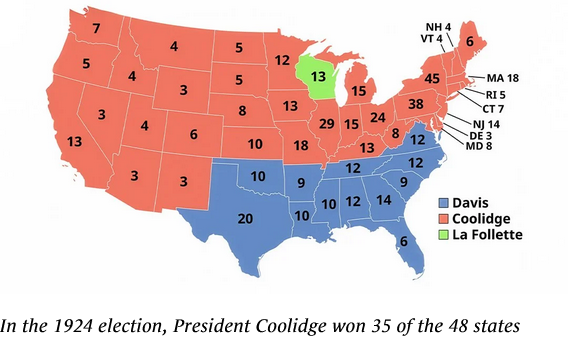
While I wouldn’t agree with the statement in the title of this post, it has been a common enough reading of the US 1924 presidential election — that it wasn’t an endorsement of Coolidge and his policies but merely a reflection of voters’ overall satisfaction with the economy. The editors of the Coolidge Review would beg to differ:
From the distance of more than a century, a political scientist has taken a fresh look at the 1924 presidential election.
In an article published last year in Presidential Studies Quarterly, Christopher Devine questions the conventional wisdom about how and why the incumbent, Calvin Coolidge, won that election in a landslide. Coolidge had assumed the presidency little more than a year earlier, after the unexpected death of Warren Harding. In 1924’s three-way race, he received more votes than the other two candidates combined and carried thirty-five of the forty-eight states.
As Devine points out, most historians say that a robust economy was by far the biggest reason Coolidge won. Strong economic conditions did work in the president’s favor. But Devine notes that many historians adopt a form of economic “determinism”. In this very common view, Coolidge “does not deserve credit for winning the 1924 election”. Rather, “thanks mostly to the economy, it just happened to him”.
That argument is too simplistic, Devine suggests. He presents both qualitative and quantitative evidence to challenge the standard narrative of the 1924 campaign.
Old Assumptions, New Data
For his empirical analysis, Devine examines “county-level political, economic, and demographic data” alongside county-by-county voting results. Using these data, he tests three common explanations for the election’s outcome:
Did Coolidge win primarily because of the economy? Scraping the data, Devine concludes that the answer is largely yes. And he shows it’s misleading to claim that — as one history textbook put it — Coolidge merely rode “the crest of a wave of economic prosperity for which he was given undeserved credit”. Devine demonstrates that from behind the scenes, Coolidge “took an active role in coordinating campaign messaging” that showcased the administration’s and Republicans’ achievements. For example, Coolidge worked closely with his running mate, Charles Dawes, to keep the famously free-range vice-presidential candidate focused on the economic message. “In the matter of economy and tax reduction”, Dawes declared, “the Federal Government is headed in the right direction”. Moreover, as Devine reports, Dawes argued that the administration’s work to stabilize Europe via the Dawes Plan spared America from “the depths of an inevitable and great depression” while also ensuring that “the whole world enters upon a period of peace and prosperity”.
Did third-party candidate Robert M. La Follette hurt Democratic nominee John W. Davis more than Coolidge? Devine concludes that this effect appeared only in the Great Plains and the Mountain West. It probably wasn’t large enough to change the election’s outcome.
Did internal divisions cost the Democratic Party votes in 1924? The Democrats were so fractured that they needed 103 ballots to choose a nominee at their convention. Devine says it would be hard to imagine that such disarray did not hurt Democrats in the election. Yet he notes that quantitative evidence on the reasons for Democratic losses in 1924 is hard to find because “scientific polling did not exist in the 1920s”.
Seeking an alternative approach, Devine looks at patterns of defection from the Democratic Party by state. He finds that northern states that voted to defeat the anti-Ku-Klux-Klan plank at that year’s Democratic National Convention — in other words, states whose delegations supported the Klan — saw heavier defections in the general election. From that, Devine extrapolates to suggest that Coolidge “benefited from the resurgence of the Ku Klux Klan — or, perhaps one might say, Democrats lost ground because of it”.