
On Substack, Janice Fiamengo explains why the very different strengths and weaknesses of men and women will always lead to what appear to be unequal results, and fighting against biology is always a bad idea:
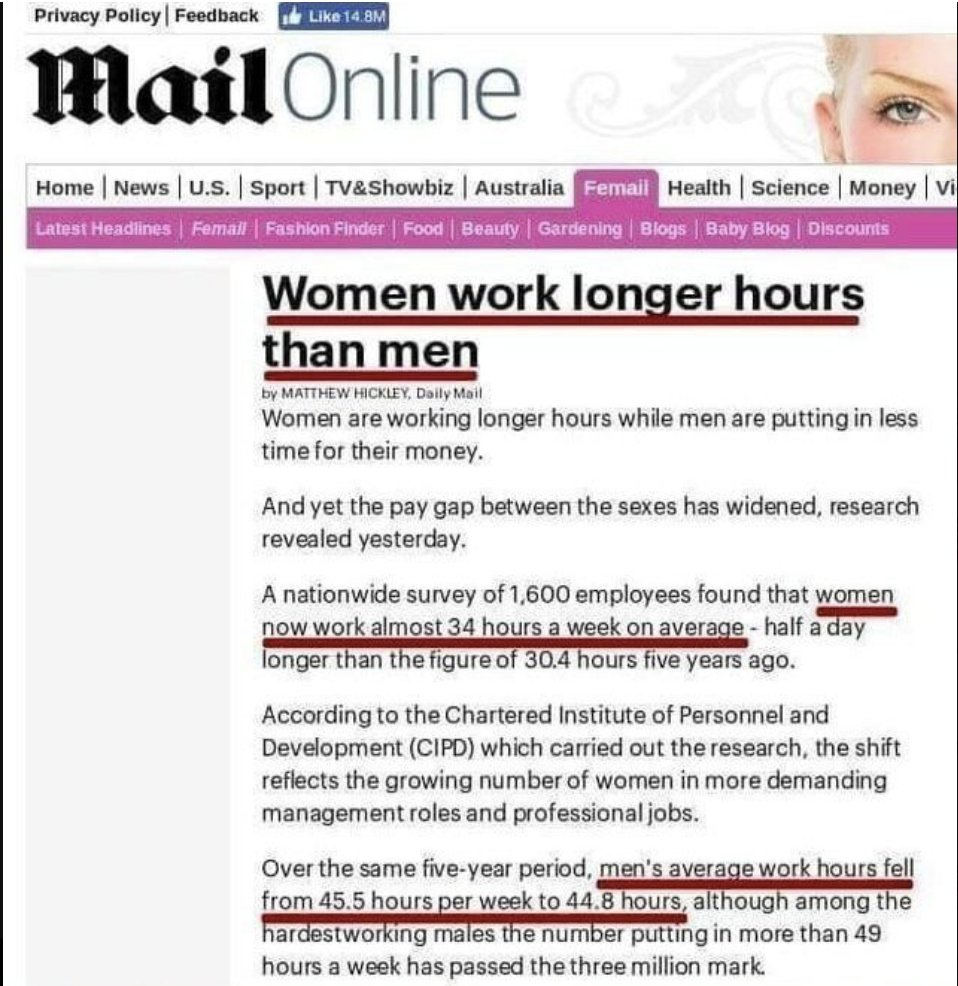
Even if the numbers don’t back it up, women feel that this is so true.
Social psychologist Roy Baumeister explored the relevant research in Is There Anything Good About Men (2010), a cautiously non-feminist book in which the author readily asserted that he, like most everyone else, prefers women to men. Women are more lovable, he claimed, and more pleasant to be around.
But he was not quite willing to accept the now-mainstream thesis that women can replace men in all areas of society.
His thesis is summed up in the book’s sub-title: How Cultures Flourish By Exploiting Men. Men are the foot soldiers of civilization as well as its leaders. They are the ones who make things work or make new things.
Men are the ones who must prove their utility to society. Their drive to be useful has powered centuries of back-breaking work, risk-taking, tool-building, self-sacrifice, and outstanding performance of a sort that has never been expected of women (and still isn’t).
Women in the main tend not to work as hard as men to succeed because they don’t have to. Women developed different strengths and tendencies.
Women’s strength, for good and ill, is in the inter-personal arena: not only in caring for those who are weaker but also in being cared for by those who are stronger. Women are good at reading people’s emotions and desires, and at expressing their own.
Men are not rewarded for expressing emotions and desires; men are oriented to acting, often under pressure to perform competently, in large groups and systems.
“The female brain,” according to Baumeister, “tends to be geared toward empathy, which includes emotional sensitivity to other people and deep interest in understanding them and their feelings. In contrast, the male brain is oriented toward understanding systems, which means figuring out general principles of how things operate and function together, and this applies to inanimate objects as much as social systems” (p. 85).
Baumeister supports his argument in a book-length exploration of men’s system-building. He shows how men are driven to work with, and in competition with, other men to make it possible for large numbers of human beings to live together in complex, efficient networks. The large social institutions that have characterized western cultures, from the army to churches, from corporations to unions, and from market places to police forces, give evidence of men’s system-building.
Women can work well within the systems that men devise, but they rarely devise new systems on their own. This is not because women are, on average, less intelligent than men (except at the very highest levels). It is because women’s motivations and sources of satisfaction are generally different from men’s.
Women’s contribution to culture in nurturing children, providing companionship, and looking after the family home has been a crucial one. But it does not drive innovation or invent new technologies.
Even the most intelligent women are rarely compelled, as highly intelligent men often are, to pursue scientific and other breakthroughs with the single-minded focus necessary for greatness. Often, as in the case involving Matt Taylor discussed above, many women do not seem to value or understand the nature and importance of such breakthroughs.
Women’s main contribution in the male civilizational sphere has been to lobby for admission and then to complain about, and work to undermine, the male culture of competitive excellence.



This about as historically accurate as Young Earth Creationism and Flat Earthism.
The reality is that women contributed more than 50% of all economic activity in pre-industrial settings and were absolutely critical to developing the modern world. Fiber arts–washing, carding, spinning, weaving, dying, sewing, knitting, etc–were almost exclusively the domain of women, as were dairies and poultry. Cloth represents one of the main trade goods throughout history, as it’s relatively easy to ship and highly variable due to point of origin (what you use for fiber depends on where you live). There were numerous innovations in this area, enough that cloth can be used to identify time periods the way Pepsi bottles can. The reason you don’t learn about this in the history books? To be blunt, it was biased bigots who systematically downplayed the contributions of women to the world.
And it doesn’t stop there. Like wifi? Thank Heady Lamar, Ava Lovelace, and others. And it’s not just computers, female contributions to every area are trivially easy to find. A great example is the tongue twister “She sells sea shells by the sea shore”–the “she” in question was Mary Anning, someone who was a huge influence on paleontology but who’s contributions were systematically marginalized–and to be clear, that’s not speculation or editorializing, that’s documented history.
This is classic abusive logic: Excluding someone from something, then blaming them for not contributing to it. You see it a lot in cases of financial abuse, for example. The abuser systematically excludes the victim from financial decisions, then uses their lack of familiarity (which is caused entirely by their exclusion) as justification for continuing to deny them access to their own money.
I’m not someone who believes men and women are identical. But the modern trends from the Red Pilled crowd to downplay contributions of women to history is flat-out factually wrong, in ways that are thoroughly documented and easily found by anyone with a library card. What is presented here isn’t history. It’s a modern myth, and the “evidence” is cherry-picked to fit this a priori conclusion, while leaving the massive amount of evidence to the contrary unstated in the hopes that no one notices.
DO BETTER.
Comment by Dinwar — April 20, 2026 @ 10:58