
On Substack, Upper Canadian Cavalier examines “The Irish Question”:
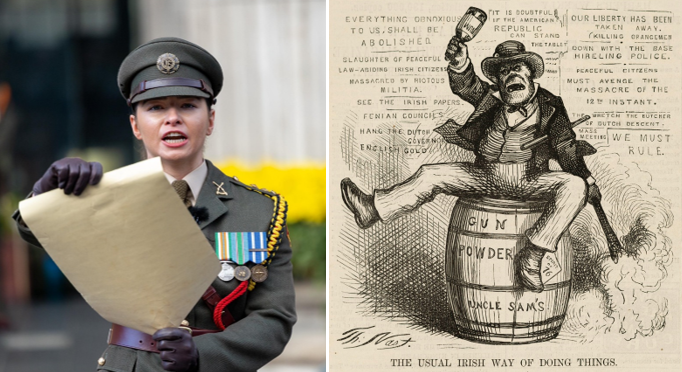
Every confidence scheme requires three things. A mark who is sympathetic. A grievance real enough to be credible. And an operator whose entire livelihood depends on ensuring the grievance is never actually resolved. Resolution ends the game. The operator does not want justice. He wants the next fundraising dinner.
Irish nationalism, in its mature institutional form, is one of the longest-running confidence schemes in the history of democratic politics. This is not to say the underlying grievances were invented. English rule in Ireland produced genuine catastrophes, and anyone who tells you otherwise has not read much history. The point is not that the wounds were fake. The point is that a very specific class of people discovered, sometime in the nineteenth century, that a bleeding wound is worth considerably more than a healed one, and they have been salting it professionally ever since.
The operators of this scheme are not a conspiracy in any tidy sense. They do not meet in a room. They are, rather, an ecosystem: the Sinn Féin political class, the Irish-American fundraising establishment, the Gaelic cultural bureaucracy with its language boards and arts councils and grant committees, and undergirding all of it for most of its history, the Catholic Church, which managed the remarkable trick of positioning itself as the spiritual soul of Irish resistance while simultaneously running the country’s schools, hospitals, orphanages, and laundries with the administrative efficiency of a medium-sized colonial power. They share no common mailing list. They share something considerably more durable: a common interest in a people who define themselves entirely by what was done to them, because such a people will always need someone to explain what it means.
That someone, naturally, has a salary. Sometimes several.
Part One: The Invoice That Never Clears
The foundational text of Irish identity is not a poem or a legal document or a philosophical treatise. It is an invoice. The Eight Hundred Years of Oppression, presented at every available occasion, never stamped paid, accruing interest at a rate that defies actuarial calculation. It is invoked at pub tables and university seminars and Boston fundraisers and Sinn Féin press conferences with the solemn regularity of a liturgical response, which is appropriate, since it has become one.
Eight hundred years. Let us sit with that number for a moment, because it deserves scrutiny rather than reverence.
The Poles were partitioned entirely out of existence for a hundred and twenty-three years, absorbed simultaneously by three empires, had their language banned, their nobility liquidated, their clergy persecuted, and their country removed from the map of Europe with a finality that the Irish situation never approached. They rebuilt it. They were then invaded again from both sides at once within living memory, occupied by The Nazis and Soviets losing somewhere between five and six million citizens in six years. They do not, as a general rule, organize their entire national identity around the experience. They built things instead.
The Armenians experienced something so total it required the coinage of an entirely new word to describe it. The Acadians were physically deported. The Welsh had their language suppressed for centuries by a state apparatus that regarded Welsh-speaking children as candidates for corrective intervention, which is considerably more systematic than anything the Penal Laws produced. The Greeks spent nearly four centuries under actual Ottoman administration, not the notional suzerainty that characterized much of the Anglo-Irish relationship, and emerged and got on with being Greeks.
None of them made Eight Hundred Years into a brand.
What distinguishes the Irish accounting of oppression is not the severity of the oppression, which was real but not historically singular, but the extraordinary care with which it has been packaged, maintained, and exported. The Famine, which ended in the 1850s, is still discussed in certain Irish-American circles as a recent bereavement requiring ongoing condolences and, more usefully, ongoing donations. The emotional statute of limitations has never been permitted to run. Each generation receives the invoice freshly printed, as though the debt were personally owed to them and personally owed by someone who can still be made to feel bad about it.


