Quotulatiousness

June 28, 2026

Multiculturalism in Australia: theory and practice

Filed under: Australia, Bureaucracy, Government, Media, Politics — Tags: , , , , , — Nicholas @ 06:00

Australia, like the rest of the Anglosphere (with the notable exception of the United States) has adopted multiculturalism as a secular national religion, yet all is not well Down Under, as Celina illustrates:

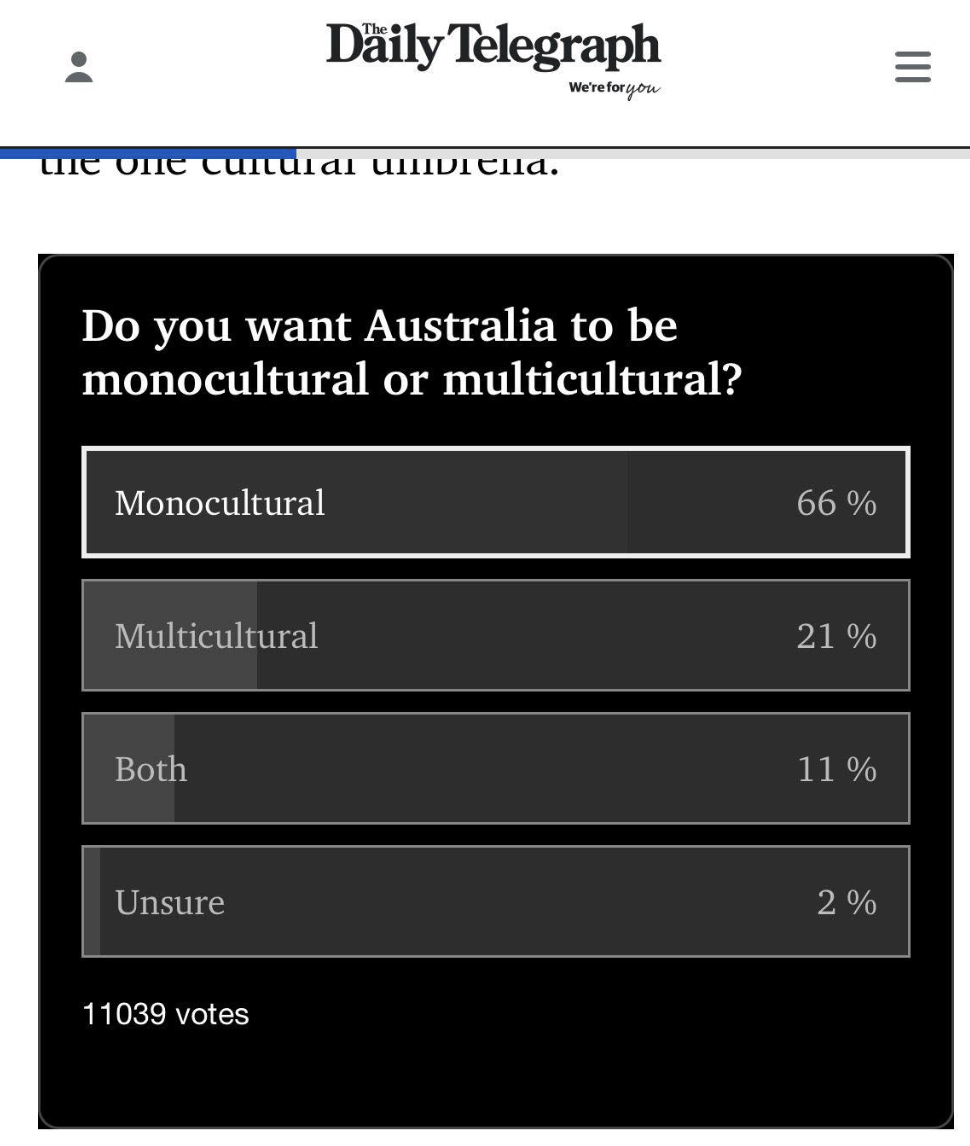
Pauline Hanson’s National Press Club address last week has thrust the conversation of multiculturalism back into the centre of Australian politics. With One Nation now the most popular party in the polls, her pledge for a “monoculture” is no longer being pushed into the fringes. Yet, as it stands One Nation doesn’t really have any concrete policy on how to abolish multiculturalism.

Firstly, we must distinguish what is meant by multiculturalism in relation to politics. Multiculturalism is not just the presence of different cultural practices in Australia. That is a deliberate straw-man. “Abolish multiculturalism and you lose your Bah mi or Chinese takeaways” is a lazy reductionism pushed by people who are either stupid or as a sarcastic question from the left about the lack of One Nations ability to provide actual policy.

Multiculturalism, as it operates in Australia, is the institutionalisation of minority ethnic and religious lobbying. It is a system in which governments treat organised ethnic, religious and minority identity-based groups as permanent stakeholders with privileged access to policy-making. These groups receive taxpayer funding, sit on advisory bodies, submit formal recommendations, and see their priorities turned into law on hate speech, anti-discrimination, social cohesion and diversity policy. The broader Australian public is expected to accept the resulting consensus.

The Machinery That Actually Exists

Australia maintains a Minister for Multicultural Affairs, an Office for Multicultural Affairs inside the Department of Home Affairs, an Australian Multicultural Council, and a Ministerial Forum on Multicultural Affairs. States have their own legislation: the Multicultural NSW Act, Victoria’s Multicultural Victoria Act, South Australia’s Multicultural Act, Queensland’s Multicultural Recognition Act and others. They create recurring funding streams, annual reporting obligations, advisory councils and grants programs that sustain an entire ecosystem of peak bodies, settlement providers and advocacy organisations.

Commonwealth multicultural grants run into tens of millions annually. Additional streams exist for “social cohesion”, security upgrades for specific communities and settlement services. Peak bodies such as the Federation of Ethnic Communities’ Councils of Australia (FECCA), the Executive Council of Australian Jewry (ECAJ), the Australian Federation of Islamic Councils (AFIC) and the Hindu Council routinely prepare submissions, appear before inquiries and maintain ongoing relationships with ministers and bureaucrats. Personnel overlap between federal and state advisory structures is visible and recurring.

This is what political scientist Theodore Lowi called “interest group liberalism“.1 Lowi’s insight was that the pluralist system does not represent the public interest but rather rewards whichever organised groups can gain access to the machinery of government. The democratic problem is that the state has granted specific groups a structural position that ordinary, unorganised citizens do not enjoy. This results in something called mobilisation of bias, as coined by E.E. Schattschneider. described this form of power as the “mobilisation of bias“, where “some issues are organised into politics while others are organised out“.2,3


  1. https://en.wikipedia.org/wiki/Interest_group_liberalism
  2. https://www.powercube.net/analyse-power/forms-of-power/hidden-power/
  3. (2011). “Mobilization of bias”. In K. Dowding (Ed.) Encyclopedia of power (pp. 424-424). SAGE Publications, Inc., https://doi.org/10.4135/9781412994088.n234

“Human writing has a unique shape” and the the end of social media

Filed under: Books, Media, Technology — Tags: , , , , — Nicholas @ 05:00

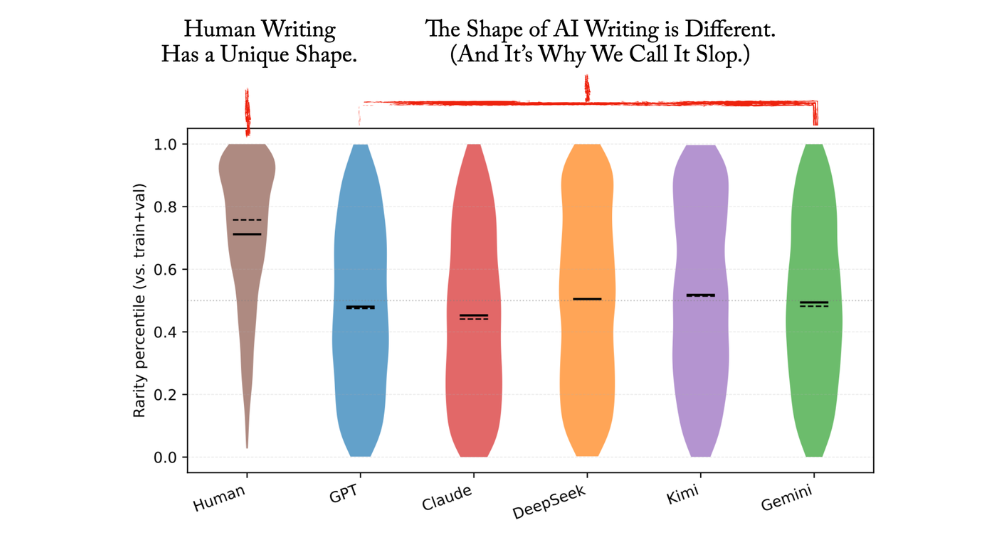
On Substack, Ryan Levesque explains the major differences between human writing and AI-trained-on-human-writing:

Graphic from The Digital Contrarian

It turns out, slop has a shape.

And it’s the reason why AI generated writing sounds the way it does.

In a new study, a team of researchers at the University of Maryland and Google DeepMind ran an experiment.

They took 10,272 writing prompts and gave each one to a human author and to five AI models: Claude, GPT, Gemini, DeepSeek, and Kimi.

They generated 61,608 stories, at around 5,000 words each.

Then, they looked at the underlying structure of each story: how the plot progresses, where the tension and conflict is placed, etc. etc.

And from that structure, they could identify a human-written story from AI-generated slop nearly 93% of the time.

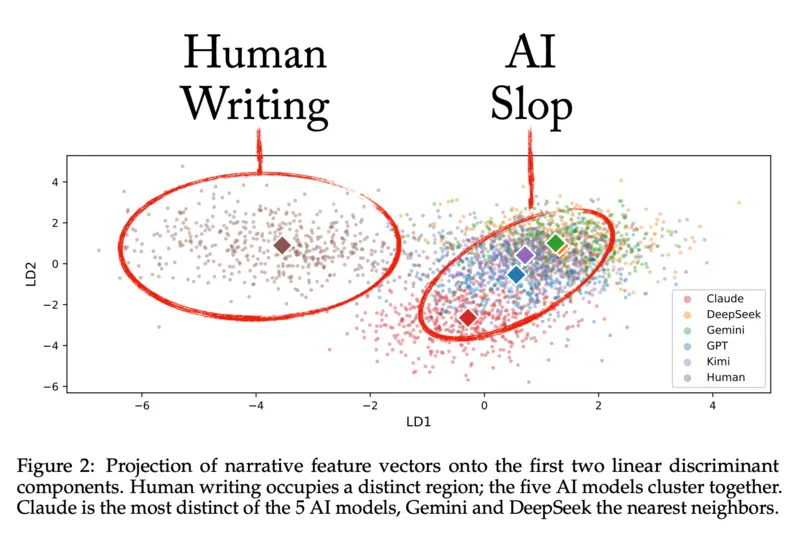
Graphic from The Digital Contrarian

What you’re seeing here in that image is the shape of AI Slop vs. Human Writing.

And there are five distinct ways that the shape of human writing is decidedly different from the so-called slop generated by today’s AI models:

  1. AI over-explains its themes. (instead of letting readers infer)
  2. Human writing is less linear. (more time-jumps and flashbacks.)
  3. AI relies on bodily metaphors to explain emotion. (81% vs. 38% human)
  4. Humans reference specific texts, brands, places. (nearly 2x the AI rate)
  5. AI narrative is less diverse. (fewer subplots and scenes, less dialogue)

[…]

The Beginning of the End of Social Media?

The clearest place to watch this shape materalize?

Social media.

This week, Farah Cormack mapped the predictable sequence, in a piece called “The Beginning of the End of Organic LinkedIn“.

Her argument is that every platform moves through the same five stages:

  1. Early adoption. A small group forms around something they love. It feels like a secret.
  2. Scaling. The crowds show up, and so does the money.
  3. Critical mass. Everyone’s here now. Organic and paid are both running hot.
  4. Enshittification. The business model takes over the product. The feed fills with ads, and the place starts to feel like every other place.
  5. Decline. The people who made it worth showing up for get fed up and leave.

Her read is that LinkedIn just crossed into stage four. The tell is its new Creator Marketplace, a feature that literally puts your reach openly up for sale.

(If your own posts have been reaching fewer people lately, you’re not imagining things … this has been engineered.)

The shape of Enshittification is a five-stage decline, and most of the social media platforms we use are somewhere at stage 4 or 5 right now.

Futurist Sinead Bovell goes further, and argues we’re watching the beginning of the end of the social media era itself.

The reality is that people don’t really post for friends/social circles like we used to even just a few short years ago.

Bovell argues that the entire reason we post is to be seen by other humans.

That’s the whole deal.

We post to signal that we’re employable, or interesting, or worth following, or because we want to sell something …

And we do that, because real people are on the other end, watching us.

Take those real people away, and the entire thing stops making sense …

But that’s exactly what’s happening.

Personally, I think LinkedIn hit stage four a lot sooner than this, almost certainly because it originated as a business-oriented platform. The owner of a company I worked for in the 2000s required that all managers have active LinkedIn accounts, so I was “active” there for a couple of years, but I felt it quickly lost any actual benefits and became a forum of boastfulness and sycophancy. There were serious people on the platform, providing useful and insightful posts, but the vast majority of content was self-promotion and empty flattery.

How to Steal a Country Without a European War – Death of Democracy 21 – Q1 1938

World War Two and Spartacus Olsson
Published 27 Jun 2026

In early 1938, Adolf Hitler turned a military scandal into personal control over the Wehrmacht — and within weeks used that power to pressure, invade, and annex Austria in the Anschluss. This episode follows the Blomberg-Fritsch crisis, Hitler’s February 4 command takeover, the Berchtesgaden ultimatum, Schuschnigg’s failed plebiscite gamble, the German invasion of March 12, and the terror that followed in Vienna.

This was not just a border crisis. It was the moment Nazi Germany moved from internal dictatorship to open territorial expansion. Britain and France did not intervene, Austria was erased as a sovereign state, and Hitler’s next target — Czechoslovakia — was already coming into view.

This historical documentary examines Nazi Germany, the Anschluss of Austria, the Wehrmacht, appeasement, antisemitic terror, propaganda, and the collapse of the post-1919 European order.

Educational documentary. Nazi symbols and imagery are shown only in a historical, critical, and anti-fascist context.

George R.R. Martin left “a smoking crater” where the epic fantasy market used to be

Filed under: Books, Business, USA — Tags: , , — Nicholas @ 03:00

Full disclosure, I’ve never read any of George R.R. Martin’s novels from which the Game of Thrones TV series began (I did read some of his earlier work). His failure to complete the book series has had serious negative consequences on the ability of other authors, as Larry Correia explains:

I’ve been telling people this for years.

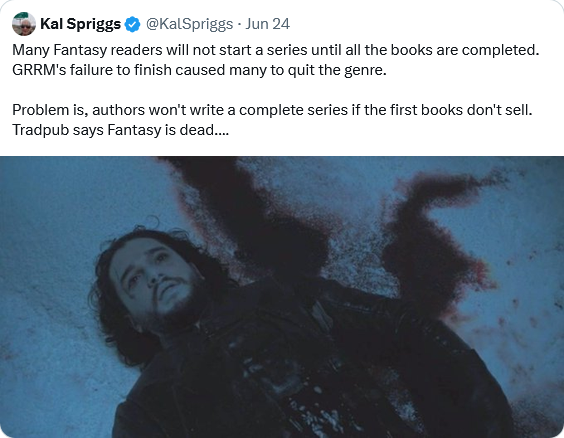
GRRM pissed off millions of customers but he don’t give a shit. He got his bag. But his legacy is being such an epic bum ass bum that he crippled an entire genre, ruined consumer sentiment, and killed off an entire generation of epic fantasy authors.

Romantasy and LitRPG grew as a direct result of filling the smoking crater George left in the industry. New writers could no longer get deals to write epic fantasy unless the entire series was in the bag, and nobody can afford to gamble that much time to write that many books they may never sell.

Publishers no longer took chances on new series because customers had got burned by lazy shirkers like George and Pat. Agents wouldn’t represent new epic fantasy unless the whole thing was done. It hurt Indy because dudes had to convince customers that they weren’t bums too. Except when book one makes $50 total, because customers said I’m not starting a new series until it’s done! they sure as shit ain’t writing book two. So it’s a self fulfilling prophesy of suck.

In the comments Dunning-Krugerands are saying this isn’t true. Look at guys like Brandon Sanderson. Wrong. Guys like him, or me, who already had established names, reputations, and fan bases were fine. We had enough customers who trusted us we could still do new things and people would come along to make it economically viable.

For example, the only reason my epic fantasy series got picked up is because I was already successful and could guarantee a viable level of sales off my existing fans. Newbs don’t have that. And over the ten years it took for me to write the six books to finish it, the entire time I heard from potential customers, nope, not gonna start a new series that might not finish because of George.

I am fine during this because I’m still gonna make a couple hundred grand off each of those just off my existing fans. Newbs make two bucks an hour, say to hell with being a writer I’m going back to my day job, and you all missed out on the next great author and his absolutely brilliant series, because you were too mad at billionaire George shoving twinkies in his mouth instead of writing.

Nope. Guys like me and Brandon are fine. George’s profound laziness screwed over the new guys. Customers and the industry quit taking chances on new guys. We will never know how many excellent fantasy series we missed out on, robbed by George’s laziness burning so many customers.

Some writers gave up, but others moved into different genres. Which is good. But it sure does suck if epic fantasy is your jam. LitRPG is close but different enough it blew up during this time frame because that’s where the talented went.

Being such a pretentious, bloviating bum that you damage an entire industry and strangle a generation of aspiring artists is quite the legacy.

Kal (who is a good writer btw, check out his books) asks what can we do about this? For me personally I’m just gonna continue mocking George’s work ethic in the hopes more normies realize what an outlier he is, and how they should expand their horizons to read other authors who aren’t stuck up, know it all, dickheads.

And before anybody starts barking at me that I’m such a hypocrite because I’ve not finished all my series, sorry I’ve only finished three of eight so far, and have only written THIRTY books since George’s last one, the next MHI comes out in December, and the last two books are next year, and I’m not planning on retiring anytime soon (if ever).

Bannerman, the Father of Gun Collecting: Tales from the Golden Age of Surplus

Filed under: History, USA, Weapons — Tags: , , — Nicholas @ 02:00

Forgotten Weapons
Published 11 Feb 2026

Francis Bannerman is really the father of the modern military surplus industry, and in many ways a father of gun collecting as we know it today. Before Bannerman, “gun collecting” was generally something for the wealthy and revolved around fancy and bespoke guns. It was not about have representative pieces of normal arms, it was about having the fancy and exclusive things. Bannerman changed that by offering all manner of ordinary surplus at affordable prices to anyone who was interested. In addition to complete guns and other equipment, Bannerman also dealt in huge numbers of bits and pieces, and sometimes assembled them into various odd hybrid guns for sale, which we still see occasionally today …

Sample Bannerman catalog (1903):
https://archive.org/details/francis-b…
(more…)

QotD: Getting cloth to market in the ancient and medieval world

Filed under: Economics, Europe, History, Quotations — Tags: , , , , , — Nicholas @ 01:00

Transport costs remain a significant factor in the organization of textile trade. Prior to the invention of the steam engine and thus the train, moving lower value goods in any kind of bulk overland any significant distance was prohibitively expensive. In contrast, seas and rivers represented blue roads and highways, allowing for far cheaper and faster transport of bulk goods. The typical estimate, derived from the Diocletian’s Price Edict (and thus dating to the Late [Western] Roman Empire, so this is with the system of Roman roads; take those away and things get even worse for land transport) is that the ratio of the cost of land, river and sea transport was roughly 20:4:1, with sea transport thus being four times cheaper than river transport and twenty times cheaper than road transport for bulk goods (like fabric).

It should thus be of little surprise that regions involved in major textile production for export were often concentrated either on coasts or on rivers that were navigable to the sea (one may map the regions Pliny lists as major wool and linen exporters to find that they are all accessible by sea). While the sheep themselves may be grazed part of the year up in the uplands far from the coast, one of the great advantages of transhumance is that the sheep may transport themselves under the care of their shepherds to villages and lower pastures not too far from coastal towns which may serve as centers of textile production and major points of sale.

Now those transport costs become less and less significant the more valuable the goods being transported are. For a bulk good like grain (or common wool), transport may represent a majority of the costs. But if one is shipping something extremely valuable (particularly valuable per unit weight), the cost of acquisition at the source (and the profits of final sale) are much larger relative to the transport costs and less efficient methods of transportation become useful, thus the viability of silk and other expensive luxury goods being transported overland across Eurasia on the famous Silk Road.

Very high value fabrics didn’t need to come from so far afield though. In the Roman world, the province of Asia (corresponding roughly to western Turkey today) had several notable centers of production for particularly high valued textiles (on this, see I. Benda-Weber, “Textile Production Centers, Products and Merchants in the Roman Province of Asia” in Gleba and Pásztókai-Szeöke, op. cit.). Thyateira’s guild of purple-dyers (the πορφυροβάφοι) seem to have had trade contacts for their wares – wool dyed Tyrian purple via the murex snail – all over the province as well as in Macedonia and Italy. Weavers in the region were also known for producing fabrics with complex woven patterns and Miletus, one of the major ports in the region, had as noted the reputation for producing the best dyed wool in the Mediterranean. Such fabrics were highly valued and we find evidence that such fabrics were bought not merely by the Roman elite, but also made overland as far as Persia where such wares were valued at the Achaemenid (550-330 BC) court.

Neverthless, not all fabrics moving through trade in antiquity or the middle ages were rare or high value fabrics. As Jinyu Liu notes in a study of inscriptions relating to the textile trade, “coarse wool and wool of medium quality, and products made of these non-luxury wools dominated the market” in the Roman Empire, often being “pulled” through trade towards both large population centers in the interior of the empire and towards the Roman armies in the frontier provinces, both of which must have outstripped local production in their demand for textiles (Liu, “Trade, Traders and Guilds (?) in Textiles” in Gleba and Pásztókai-Szeöke, op. cit.). This trade included not just fabrics but also ready-made products like garments or blankets which must have been aimed at fairly modest people, neither the very poor (who couldn’t afford them) nor the wealthy (who wouldn’t have been caught dead in “ready-made” one-size-fits-no-one clothing), but rather the middling urban workers and common soldiers (and perhaps small farmers, though we might assume their households would produce most of their own textiles in the countryside where wool and flax, being agricultural and pastoral products, might be more available).

In Medieval Europe, just as in the ancient world, the centers of textile trading tended to follow the water as it made transport easier. England was a major wool-producing center in the high and later Middle Ages (and into the Early Modern period), with J.S. Lee (op. cit., 9) estimating production per capita exploding from around 1.3 pounds per person in the early 1300s to 7 pounds by the 1550s as the textile production system in England reoriented towards export. Wool products, produced in towns mostly in towns that were nearly coastal or had river-access flowed down by coastal trade and up the Thames to London to either be sold and used there or to be further exported to the dyers and fabric markets of the Low Countries (where fabrics could use the Rhine to travel further into the continent) or to be bought by the merchants of the Hanseatic League and so head into the Baltic.

Bret Devereaux, “Collections: Clothing, How Did They Make It? Part IVb: Cloth Money”, A Collection of Unmitigated Pedantry, 2021-04-09.

Powered by WordPress