Quotulatiousness

June 25, 2026

Credit card fee cap: a great idea, with the best of intentions … what possibly could go wrong?

Nobody likes credit card fees — except the banks that issue credit cards — so politicians figure that they can please the voters at no cost and mandate limits to the fees that credit card companies can charge. But who is going to suffer for this “at no cost” bit of rule-making?

“Credit Cards” by Sean MacEntee is licensed under CC BY 2.0 .

Two years ago, Illinois passed crowd-pleasing restrictions on credit card interchange fees, which are better known as “swipe fees”. The ban on charging fees on processing payments for tips and taxes has now been delayed twice by skeptical federal judges and lawmakers worried that they’ve crafted a financial mess. These interventions may be saving the state from itself, as a new report points out that the law threatens to hurt consumers, small retailers, and local financial institutions.

Delayed Ban on Fees for Processing Taxes and Tips

Passed as part of a 2024 revenue bill, the Interchange Fee Prohibition Act (IFPA) defines “interchange fee” as “a fee established, charged, or received by a payment card network for the purpose of compensating the issuer for its involvement in an electronic payment transaction”. It adds: “An issuer, a payment card network, an acquirer bank, or a processor may not receive or charge a merchant any interchange fee on the tax amount or gratuity of an electronic payment transaction if the merchant informs the acquirer bank or its designee of the tax or gratuity amount as part of the authorization or settlement process for the electronic payment transaction”.

“Although merchants have long advocated for this change, banking and payment industry representatives argue that it imposes an undue hardship by forcing them to process certain components of transactions without compensation,” attorneys Thomas V. Panoff and Maxwell Earp-Thomas noted for the National Law Review at the time. They also commented that the law could force Illinois payments to be processed differently than those originating in the rest of the country and the world beyond.

The situation is now being fought in court and in public between advocates who argue the fees are hidden costs and opponents who say they’re an industry-standard means to cover the cost of business.

[…]

Overall, Illinois lawmakers’ attempt to please the crowd by mandating lower costs looks poised to create a mess that could leave the state’s consumers, small banks, and retailers with higher costs and fewer choices if financial institutions leave to avoid headaches.

“To protect the integrity of the checkout experience and avoid driving financial providers from the Illinois market, the IFPA must be either repealed or overturned”, concludes Swedberg.

Credit card fees are undoubtedly burdensome for consumers and retailers. Ultimately the best way to avoid them is the traditional way: Use cash.
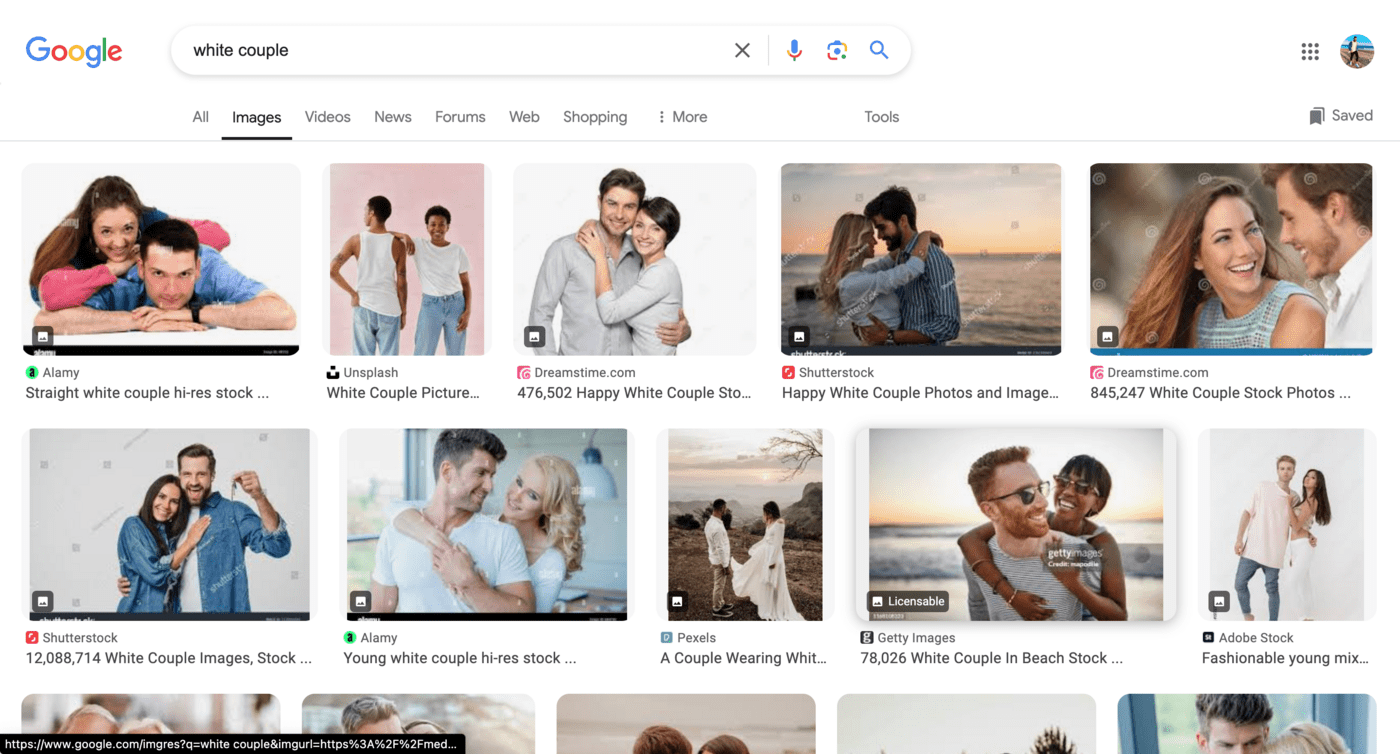
Passively shaping public opinion is one of big tech’s favourite techniques

Filed under: Media, Politics, Technology, USA — Tags: , , , , , , — Nicholas @ 05:00

In the portion of this post above the paywall, Celina shows a good example of how social engineering doesn’t have to be blatant to be effective:

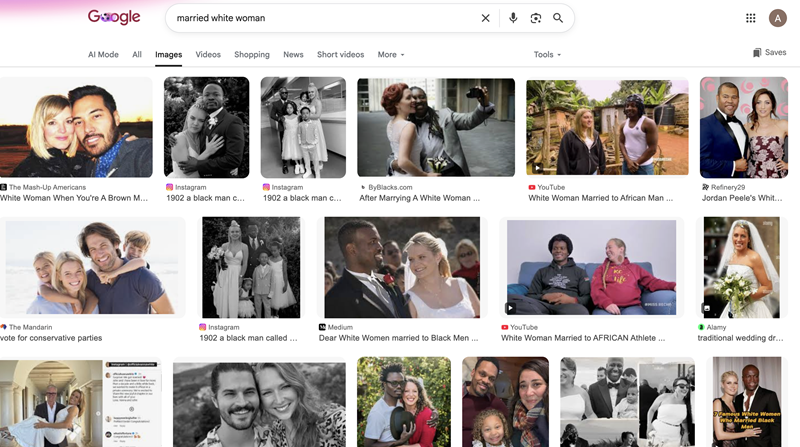
Before reading further, open a new browser tab and type the search term “married white woman” into Google Images. Scroll through the first several rows of results. What do you see?

The output which is consistently replicated across different devices and geographic locations is a deluge of mixed-race couples. The output is overwhelmingly dominated by images of white women intimately paired with black or non-white men. To the casual observer passively consuming this digital output, the presentation establishes an immediate baseline for normalcy. The volume and priority of these specific demographic pairings create the distinct impression that such relationships are the standard, ubiquitous, and foundational reality of modern Western society.

Yet, when we contrast this algorithmic simulation with reality, a massive discrepancy emerges. Statistically, interracial marriages remain a distinct minority of overall unions in the United States and across the broader Western world. According to comprehensive data from the Pew Research Center, in 2020, only 11% of all married couples in the United States were interracial or interethnic. When we drill down into the specific pairing that dominates the aforementioned image search, the numbers shrink even further. Marriages specifically between a white woman and a black man account for a mere 7% of that already small 11% sliver of intermarriages. In absolute terms, out of over 51 million married white women in the United States, less than 1% are married to black men.

Despite this statistical rarity, the digital simulation feels entirely “normal” to the modern consumer because media giants like Google, alongside massive stock photography conglomerates like Getty Images and Shutterstock, consciously and relentlessly curate it that way. This immense disparity between reality is the result of neutral, blind code cataloging human existence. It is an intentional act of social enforcement, by artificially elevating specific demographic pairings, media platforms execute a subtle but pervasive socio-cultural engineering project.

It can thus be argued that this engineered visual output serves a distinct ideological purpose: pushing European women toward demographic change and eroding the visual primacy of the homogeneous nuclear family that built and sustained Western nation-states for centuries. When digital representations are manipulated to consistently overwrite physical realities, a significant ontological shift occurs within the host population. The native majority is conditioned to view their own demographic decline as an organic, inevitable, and morally righteous progression. This forces us to confront the question: If images precede and dictate reality, who is engineering our extinction?

I’m long out of the habit of watching TV, so when the NFL season gets started and I’m presented with three-plus hours per week of commercial TV to watch my favourite team play, I can’t help but notice that most commercials that include representations of married couples are inter-racial or non-white. The advertisers are also presenting a small minority of marriages in North America as being the overwhelming majority in their TV ads. Why might they want to do that?

Formerly Peru’s First Lady, Keiko Fujimori is now President in her own right

The new President of Peru, Keiko Fujimori, faces a big economic challenge to her nation:

With just over 99% of ballots counted, Keiko Fujimori holds a lead of roughly 40,000 votes over Roberto Sánchez — less than half a percentage point, and the third consecutive Peruvian presidential contest decided by a margin that narrow. Sánchez led through the early days of counting, carried by rural and highland turnout; but the overseas votes, which broke for Fujimori above 63%, pulled the result the other way as the tally crossed 95%.

The outcome is no longer seriously in doubt. What remains in doubt is whether a victory this narrow constitutes a mandate to govern, or merely a turn to occupy the office in impotence.

Fujimori has never held executive power. What she inherits, however, is a name: her father, Alberto Fujimori, governed Peru from 1990 to 2000, stabilizing a hyperinflationary economy and crushing the Shining Path insurgency, albeit with darkly authoritarian techniques for which he was later convicted. Long known as Peru’s answer to Venezuela’s Hugo Chávez, Fujimori has cast a long shadow over Peruvian politics ever since.

Keiko served as his First Lady through the latter half of the 1990s, then built her own career: a congresswoman from 2006 to 2011, and the leader of Fuerza Popular (“Popular Force”) since. She spent 13 months in pretrial detention on corruption charges tied to Odebrecht financing; a court voided the case in January 2025. She has run for president four times, losing the previous three runoffs by margins under a single percentage point before, now, winning her fourth.

Her governing history is, as a result, tied deeply to her father’s. She has spent two decades defending it rather than living it, which is itself a kind of qualification in a country where economic memory often prevails over institutional memory. The model her father installed — trade liberalization, fiscal orthodoxy, an open door to foreign capital — has outlasted eight changes of president in ten years. The claims of Fujimorismo — the governing-economic doctrine named for Fujimori that has dominated ever since his time — is that it alone can be trusted to keep that model standing.

Keiko Fujimori’s flagship commitments are, consequently, the two pillars of Fujimorismo itself: a hard line on crime, and an unapologetic defense of the market economy.

The security platform proposes deploying the military against organized crime and prison disorder, taking inspiration both from Peru’s own recent past, and Nayib Bukele’s divisive tactics in El Salvador. Alongside this, the platform promises expanding video surveillance, and modernizing this apparatus through the use of artificial intelligence to detect corruption in public contracting. She insists that her father’s system’s abuses will not be repeated.

The economic platform is a much-needed deregulatory shock: cutting investment-approval timelines by 40%, reducing the fiscal deficit from 2.2% to 1% of GDP, and shrinking the state. As for exactly how that shrinking will be achieved besides the aforementioned measures, Keiko is not clear.

Nevertheless, both pillars of the plan were sold on a single word, repeated at her closing rally and in her final debate: order, against the chaos she says the left represents.

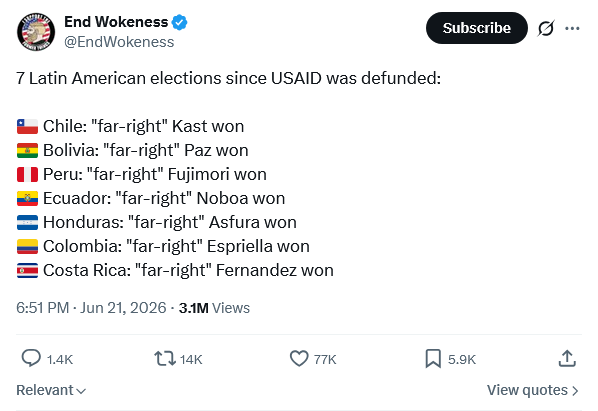
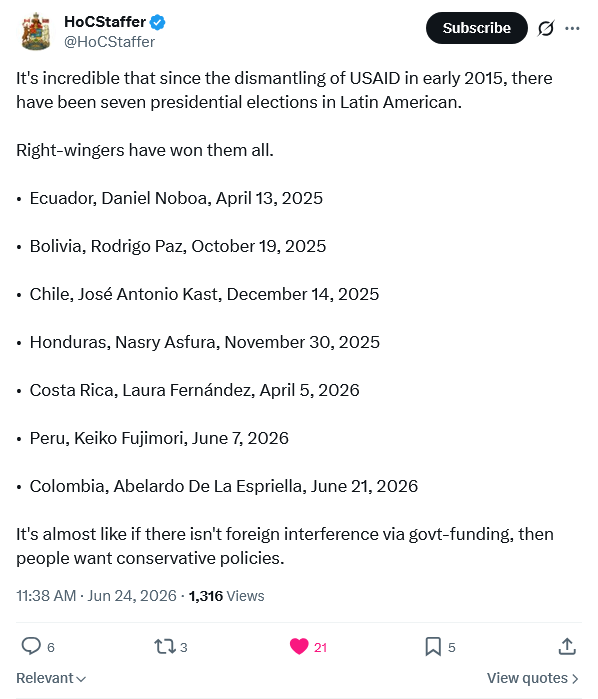
In counterpoint to recent claims that cutting USAID funding cost the lives of millions of children who depended on those funds, taking away USAID support in much of South America led to a number of electoral changes:

Why Britain voted for Brexit

Filed under: Britain, Bureaucracy, Europe, Government, Media, Politics — Tags: , , , — Nicholas @ 03:00

Pat Condell explains some of the reasons British voters chose Brexit over staying in the EU back in 2016:

Why did we vote for Brexit ten years ago? Because we understood that the core purpose of the European Union is to destroy the independent countries of Europe by opening the borders and transforming a diverse continent of sovereign nations into a single homogenous political bloc governed by a committee of unelected bureaucrats, as a model for the planned global dictatorship.

Obviously, you’re not going to get many votes for that if you just lay it out for people, so you start with something innocuous like trade.

You say “Let’s harmonise our trade arrangements and everything will run more smoothly.”

And people say “Yes, that sounds like a good idea.”

Then you say “While we’re at it, let’s give this small group of people the power to organise all this from one place, and everything will run more smoothly.”

“Well, I suppose that makes sense. We want things to run smoothly.”

Then it’s “Actually, let’s give these people the power to make our laws and override our parliament and justice system, and everything will run much more smoothly.”

“Hold on a second, I don’t know about that …”

“You fascist. You racist. You xenophobe. You bigot. You pig ignorant little Englander. You vermin. You scum.”

Although that attitude certainly helped to tip the balance, the most important reason we voted for Brexit is that politicians had no right to sign away the governance of the UK to a foreign entity, but that is what they did, while pretending it was about trade. They lied to us, and they tried to cheat us out of our country.

That is why we voted for Brexit, and it’s why we’re now being punished for our disobedience by traitors who refuse to secure the border and who are allowing our country to be flooded with millions of unwanted and incompatible immigrants and illegally invaded and occupied by an army of dangerous military age men in whose presence no woman or child is safe.

Forced mass immigration from hostile and barbarous cultures is punishment for Brexit. Our country is being purposely destroyed for not voting the way we were told.

Coenders’ Bolt-Less Last Ditch Bolt Action Rifle

Filed under: Germany, History, Military, Weapons, WW2 — Tags: , , , — Nicholas @ 02:00

Forgotten Weapons
Published 4 Feb 2026

When the German Army tested last-ditch Volkssturm rifles late in World War Two, one of the particularly obscure submissions was August Coenders’ Coenders-Rochling Volkssturmkarabiner. This was a bolt-action rifle chambered for 8mm Mauser with a 5-round magazine. However, instead of using a traditional bolt action system it had a fixed breechblock and the handle was attached to the barrel. Cycling the action meant unlocking the barrel and sliding it forward, while the breechblock held the fired case in place. When the barrel was fully forward, the next round in the magazine would kick out the empty case, and pull the barrel rearward seated the next cartridge, ready to fire. In testing, the rifle was, frankly, terrible.

Thanks to the Springfield Armory National Historic Site for giving me access to this unique specimen from their reference collection to film for you! Don’t miss the chance to visit the museum there if you have a day free in Springfield, Massachusetts: https://www.nps.gov/spar/index.htm
(more…)

QotD: Division of domestic work, 1970s onward

Filed under: Australia, Humour, Quotations, USA — Tags: , , , , — Nicholas @ 01:00

    The Women’s Liberation Movement wanted many things in 1970, but one of the most important was freedom from “unpaid domestic servitude at home”.

Again, this is Straight Outta Engels, from 1884. Even back in 1970, we could all yell “Read another book!” Someone ought to rewrite The Origin of the Family, Private Property and the State with a few quidditch matches in it; it’d be on the bestseller list until the sun’s a cinder.

    Half a century later, most women are still waiting for their freedom. Women still do far more domestic and care labour than men.

I find this extremely hard to believe. So I checked their source, which is a very scientific-sounding site called “The Conversation”. You’ll just have to click it for yourself, since I can’t figure out how to screenshot just the little graphic they have, but if you do, you’ll notice a couple things straight off:

First, this data is from Australia. Which is bullshit, because look, y’all, I’ve seen the Mad Max movies, and nobody’s doing any domestic labor in Australia. Their main settlement is ruled by Tina Turner, for fuck’s sake, and the Prime Minister runs around in a thong and a hockey mask. Sweet cars, though, I’ll give them that.

The other thing you’ll notice is that the “Australian Bureau of Statistics” — I’m pretty sure that’s the motorized hang glider guy — has obviously been having fun with the scalar functions in whatever post-apocalyptic version of Excel they’ve got down there. The bars for “did no unpaid domestic work” look dramatic … but they represent a mere seven point difference. (And do you see what I mean? Apparently 29% of Australian men, and 22% of Australian women, do no unpaid domestic labor whatsoever. By my math, that’s a quarter of the country stewing in its own filth. I know, I know … I’m amazed it’s that low).

The bars for “5-14 hours”, though, show a fractional difference: Women do a whopping 0.3% more. And again, this is Australia, but even if we assume that “unpaid domestic labor” is stuff like “wiping the blood from the somehow intact windshield of the last of the V-8 interceptors”, 5-14 hours is what you might call “the outer limits of normal for a working stiff”. Admittedly I live in a two-bedroom apartment, not a house, but I’m a bit of a neat freak, and “an hour a day” is about all I do. Vacuum the floors and scrub the toilets on Sunday, that’s two hours tops. I’ll be generous and say I spend another 3-4 doing the squeegee thing to my shower walls after I bathe, and loading the dishes in the washer, and giving the counters a quick wipedown once or twice a week, etc.

The real difference comes in the “15-29 hours” and “30 hours or more” categories, and you have to be very, very Smart indeed to find that “problematic”, since those are stay-at-home moms. In other words, they do that “unpaid domestic labor” by choice. Because “the care and feeding of the next generation”, not to mention “the deep, primal satisfaction one gets from seeing a little life grow that you helped create” don’t really count as pay.

    Since the 1960s, more and more women have taken up paid employment, but a problem remains: how would their unpaid domestic work be replaced?

Gosh, that IS a problem! And as the Australians have shown us, the answer seems to be “just stew in your own filth”. It’s a solution America’s single gals, at least, seem to have embraced with kamikaze-level enthusiasm. Back in the days, I’d always insist on taking a girl back to my place, because condoms don’t cover the entire body and her place was always, and I do mean always, a certifiable biohazard. I’d rather do a striptease in Chernobyl’s reactor core than do anything in an American woman’s bedroom, and their bathrooms are pits of unspeakable Lovecraftian horror.

Severian, “SJWs Always Project”, Founding Questions, 2022-08-08.

Powered by WordPress