Quotulatiousness

June 21, 2026

Jean Rapail’s The Camp of the Saints, translated by Robert Laffont

Filed under: Books, France, India — Tags: , , , , — Nicholas @ 06:00

Copernican reviews Jean Raspail’s The Camp of the Saints which was reprinted in an English translation by Robert Laffont earlier this year:

It is time that I throw my own hat into the ring regarding this particular piece of polemic fiction. It’s particularly topical given the recent events in the UK and the Western World. A look at toxic progressive empathy taken its natural conclusion.

Written by Jean Raspail and published in 1973, Camp of the Saints is a book infamous among those the media describes as “Far Right” and virtually unknown outside of that. Were history set upon an even keel, Camp of the Saints would sit on the bookshelf of every high school right next to the classic works of the same genre: notably 1984, Brave New World, and Fahrenheit 451.

This book was so dangerous that for decades, now, the English translation has been out of print, available only as an expensive antique, or through the Internet Archive, [as] a single shoddy .pdf. The corporate owners of the English translation rights have, despite considerable interest, refused to republish it. That was until September of 2025, when a new translation was created and distributed.1

As of now, what was once an antique book is now cheap and in-print. What’s more, it’s been converted to an audiobook available on Audible.2 It took the destruction of Western Culture for us to see published the one work of dystopian fiction that warned us of it.

Given its relevance, it makes sense that over ten percent of the run-time consists of various forwards from the author, translator, and the publisher, that describe the political and cultural push against its own publication. It’s worth it to read (or listen) through the numerous forwards to better understand the context and the author.

An Introduction to the Text

Among the dangerous books written in the late 20th century, Camp of the Saints takes the self-destructive anti-nativism of the neoliberal world order and draws it forward to its own natural conclusion. Like other works of fiction, it takes popular ideas and asks the question: “What if these beliefs are taken to their ultimate logical end?”

The book is written from the perspective of an omniscient historian who witnessed the events of the text; he knows that his work will be censored, silenced, or redacted. In the context of the book, the accurate recollection of the events described is inherently destructive to the (now) dominant anti-racist political regime. The force of political progressivism will destroy any such history on the basis that it may “incite racial hatred” or “create division”.

A fascinating bit of forethought in that those are the exact reasons why Camp of the Saints was itself banished from public view for the last half-century: Liberal cultural diversity transitioned smoothly to violent censure and virulent “anti-White” or “anti-Western” genocidal hatred.

The book is a dramatization of the Fall of the West. Not in pitched battle, but as it has lost its spiritual core to rampant idealism. The “other” is always to be given deference over our own people. The sympathy that is demanded for the “other” is also silenced and denied for our own. At what point do a people become so spiritually deracinated that they lose all legitimacy to exist? At what point do they become so deluded as to lack totally a theory-of-mind of the “other”, and at what point does sympathy for the foreigner overwhelm survival?

Camp of the Saints answers these questions in sometimes graphic detail. Some of the horrors written on those pages hadn’t happened to innocent Western children yet … but now, fifty years on, and they have happened. Many times over, in many places and nations, across the West.3 In comparison to the reality of the West in the 21st Century, Camp of the Saints is a tame warning.

The book begins with a great migrant fleet setting off from Calcutta, India. The poor, the starving, the diseased, and the malformed set out for the West- A land where milk and honey flow freely and where the rivers are rich with Fish. The people of India want a better life for themselves, even if they have to walk, unarmed, onto foreign lands to get it. They, like many peoples, believe that their land is simply poor and that Western nations are simply rich. Failing to understand that it is not some “magic dirt” that made France, England, Australia, and the United States rich, but rather it was the French, English, Australians, and Americans. The West doesn’t horde “magic dirt” but “magic people”, so to speak. Were the West to be flooded with Indians, it would become just like India, not magically make the invading Indians wealthy and intelligent.4

I doubt that it’s possible to explain that fact to third-world migrant retards.

To conclude a spoiler-free version of the review: You should read it. It should have been taught in high schools for the last 50 years. You should probably buy a copy before the beast of Progressivism finds a new way to censor it. If you buy the Audible copy, use a tool to convert it to an .mp3 file so that it can’t be deleted from your personal library after the fact.5 There’s a reason it’s been censored for the last 30 years or so. It’s dangerous, subversive, and intelligent in a way that modern dystopian authors wish they could be.


  1. Here is a direct link [https://www.amazon.com/Camp-Saints-Jean-Raspail/dp/B0FG4MJS8K] to where you can purchase the book on Amazon. A shoutout to Vauban Books for doing the work that every other publisher has been unable, or too scared, to do.
  2. I kind of enjoy audiobooks. Though Camp of the Saints can be particularly tricky to listen to over reading directly due to its complex cast and jumping around in the timeline.
  3. The Rape Gang Inquiry Report by Rupert Lowe is particularly poignant and well-timed here.
  4. A fact that is in stark relief as of 2026, with over 10% of their population (official sources say it’s close to 7%, but I don’t believe them) now being Skaven imports from India … and the wealth, safety, culture, and prosperity of Canada now vanishing at an alarming rate.
  5. The “Open Audible” tool is works for this, but it isn’t free.
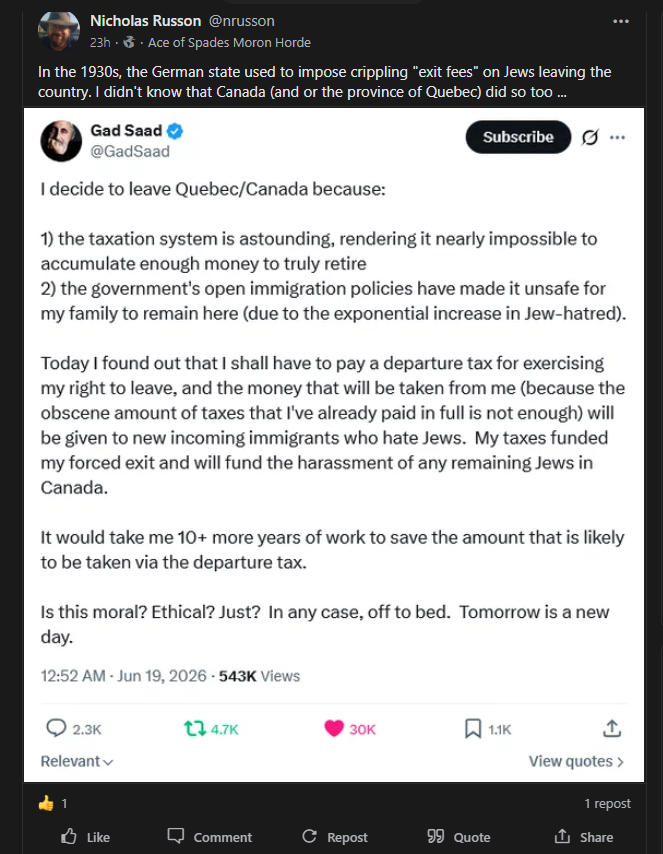
Gad Saad discovers that Canada has an “exit tax” … and it’s insane

Filed under: Bureaucracy, Cancon, Government — Tags: , — Nicholas @ 05:00

The other day, I shared a post from Gad Saad that alerted me to something I’d never heard of before: a steep tax the federal and provincial governments levy when a Canadian emigrates to another country:

On the social media site formerly known as Twitter, Vesper provides more information:

The Great Scam

After what @GadSaad posted yesterday, something I had no idea existed … an “Exit Tax” I did some digging. This is what I found.

Canada’s departure tax is one of the biggest scam taxes on the books. Apparently when you leave the country, the government treats you as if you sold every investment you own, even if you sold nothing.

You get hit with a tax bill on money you never touched, never withdrew, never spent. They literally invented a fake sale to justify taking your money.

Here’s what makes it even worse. The stocks they’re taxing? Those are foreign companies. Apple, Samsung, whatever you hold, those grew because of what those businesses did in their own countries, their own markets, with their own workers.

Canada had absolutely nothing to do with it. Zero. But they still want a cut just because you happened to live here while you owned them. They did nothing and still want to be paid like they did.

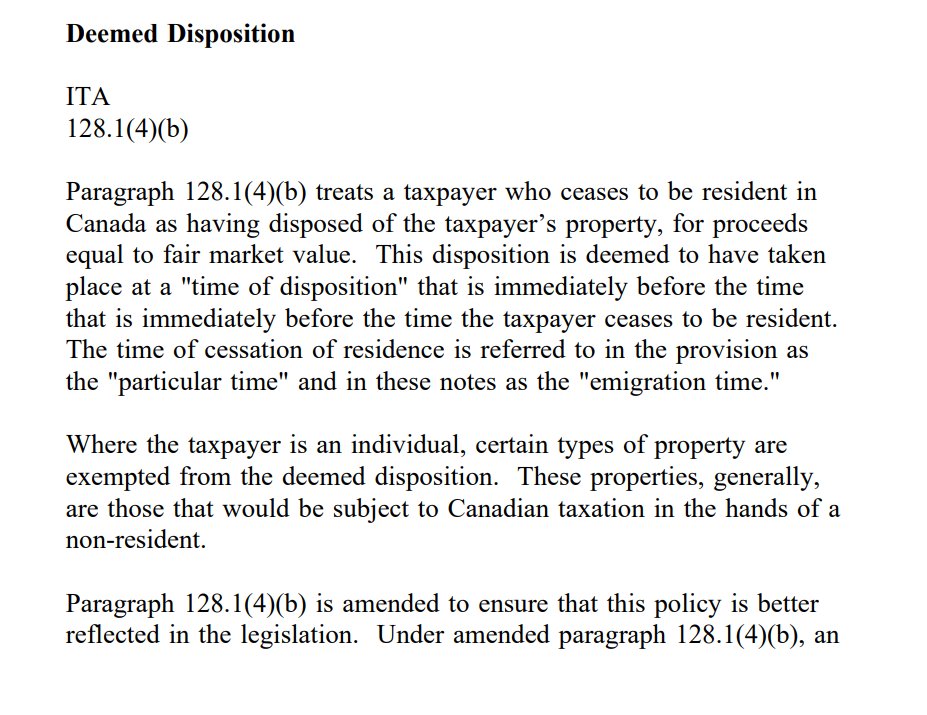
And before 1996 this didn’t even exist the way it does now. Chrétien’s government expanded it that year and buried it in section 128.1(4)(b) of the Income Tax Act like they hoped nobody would notice. Italy doesn’t do this. Portugal doesn’t. Belgium, Switzerland, the UK, none of them pull this shit.

You paid income tax every year. You paid sales tax. Property tax. You held up your end of the deal the whole damn time. And when you decide to go live somewhere else, they hit you with a bill for money that was never real to begin with.

Canada under any Liberal is a Scam!

And followed up with:

FYI- Just to make clear why I posted that image instead of Clause 17 it was meant to make an additional point, that I’m not sure Gad was informed about. The system is one-directional and rigged.

That image explains that The exit tax locks in your gains the day you leave at whatever the market says that day. You have no choice, no timing, no flexibility.

If your portfolio drops 30% the week after you leave, too bad. Canada already took their cut on the higher number. The gain was real to them the moment you packed your bags. The loss that came after is entirely your problem.

If you want to see the stocks section it’s this

You can read it for yourself:

https://publications.gc.ca/collections/Co

Update: After some online mockery, Gad Saad explains that he’s not just upset on his own behalf.

People are astoundingly stupid. My comments about the departure tax is not that I should be treated differently from anyone else. I am making a point about the extent to which taxes are confiscatory. As I have previously explained, there was a time when ZERO cents of income tax were levied in Canada and the US. Then bit by bit, that “temporary” measure, to be applied to only a few, and at a very low percentage rate of your income, becomes a mammoth monster that takes more than 50% of your earnings. It can occur because there are no repercussions if governments do not balance their budgets (other than voting them out). Hence, what starts off as a small temporary tax on a few becomes an existential theft that is orders of magnitude larger than the so-called illegal extortion tax of the Mafia. It can exist only because the great majority of people BENEFIT from this form of parasitic taxation. But someone has to pay for everyone else, and when you are that someone, you are not necessarily pleased to be funding the ultimate Ponzi scheme. I’m making a moral, philosophical, and ethical argument. It’s not just about me.

How To Make War Inevitable – Death of Democracy 20 – Q4 1937

World War Two and Spartacus Olsson
Published 20 Jun 2026

By late 1937, Nazi Germany’s rearmament economy had trapped itself. Autarky was failing. Hjalmar Schacht was pushed aside. Göring’s Four-Year Plan dominated economic policy. And at the secret Hossbach meeting of November 5, Hitler turned economic impossibility into an argument for territorial conquest.

This episode covers Q4 1937: the Hossbach Memorandum, Schacht’s resignation, the Anti-Comintern alignment, Lord Halifax’s visit, Himmler’s police-state consolidation, the December “Preventive Crime Fighting” decree, and the antisemitic propaganda exhibition Der Ewige Jude.

The argument is not that war was metaphysically inevitable. It is that the Nazi regime built an ideological, economic, and police-state machine that made war look increasingly necessary to its own leadership. This is a historical analysis of Nazi dictatorship, antisemitic propaganda, and war planning. It condemns Nazism and uses extremist material only for educational and documentary context.

Chapters:
0:00 Q4 1937 Intro
0:53 The world at the end of 1937
1:36 Germany’s quarter of acceleration
3:30 Himmler Tightens Police Power
6:26 Der Ewige Jude and dehumanization
8:30 Hossbach: autarky fails
11:16 Halifax and diplomatic confidence
13:03 Mood inside Germany
15:09 Mein Kampf has become policy
17:16 Conclusion: the politics of beasts

Explaining our failure to expand beyond Earth to an alien

Filed under: Economics, Government, Humour, Space, USA — Tags: , — Nicholas @ 03:00

Devon Eriksen pens an ultra-short story in response to Senator Elizabeth Warren’s claim that “we” need to take a lot more money from Elon Musk to benefit “everyone”:

This-individual has an outstanding query for you-individual.

Yes, Dee-six-twenty-four-prime? Ask your question.

When we-collective initialized language-idea-exchange with you-collective, you-collective had no settlements on the surface of other planets in your-collective own star system.

Yet you-collective possessed advanced chemical propulsion technology sufficient to leave your-collective native gravity well. For over a hundred cycles around your-collective star, you-collective possessed this.

Why did you not use it?

Well, all that technology was worth a lot of money.

Value-consideration-tokens, yes. Continue.

So we decided to take it away from the really talented geniuses who built, break it up for parts, sell the parts, and throw a big free stuff party.

A … free stuff party?

Yeah, for like, average dudes. The kind of guys who don’t know calculus or anything. The ones you’d want to have a beer with. We thought we’d buy them some stuff.

Instead of leaving your home planet?

Yeah.

This-individual understands, now. Conclusions have been submitted to collective-thought-matrix. Please line you-collective up in an orderly fashion for processing, classification, and reassignment and/or biomass reclamation.

How Britain Made the L1A1 SLR: archive film with intro by Jonathan Ferguson

Filed under: Britain, History, Military, Weapons — Tags: , , , , , , — Nicholas @ 02:00

Royal Armouries
Published 21 Jan 2026

Following last week’s look at the very first L1A1 SLR ever produced (1957), we’re sharing a remarkable Royal Small Arms Factory (RSAF) Enfield archive film, shot in the 1960s, showing the key stages of L1A1 manufacture and a rare glimpse of the original Enfield pattern room.

Then we step back and let the film speak for itself, nearly an hour of pure production and engineering process.

0:00 Intro
3:05 Enfield + Pattern Room
3:57 Planning & Tooling
4:37 Rifle body: Heat treat → Machining → Inspection
18:16 Barrels: Drilling, Rifling, Plating & Production line
34:28 Housing/Trigger, Furniture & Magazines
50:16 Assembly → Proofing/Testing → Packing & Dispatch
(more…)

QotD: Wishful thinking

Filed under: Health, Quotations — Tags: , , , — Nicholas @ 01:00

The wish is often father to the belief, never more so when our interests are in play. But even without material interests, we are often so attached to our ideas or theories that wishful thinking easily overcomes evidence that casts, or at any rate ought to cast, doubt on them. No one is immune from wishful thinking, and therefore from special pleading. Not surprisingly, the latter is easier to spot in others than in oneself.

There is a déformation professionelle that is very common among practitioners of the human sciences, namely the tendency to treat the human beings who are the objects of their study as if they were no different in principle from sticks or stones or stars. A striking example of this tendency was published in the New England Journal of Medicine in April this year, in an article titled “Stigma and the Toll of Addiction” by Dr. Nora Volkow, Director of the National Institute on Drug Abuse.

The first thing one might have looked for in an article by the director of the Institute was a certain modesty. After all, the Institute has been witness to a vast increase in the abuse of drugs, leading to hundreds of thousands of deaths, without having been able — notwithstanding claims to advance in the scientific understanding of addiction — to effect improvement in any significant way whatever. No mea culpa is required, but a tone of hectoring evangelism is not very seemly in the circumstances.

Theodore Dalrymple, “Stigma and Sympathy”, The Iconoclast, 2020-09-23.

Powered by WordPress