
Copernican reviews Jean Raspail’s The Camp of the Saints which was reprinted in an English translation by Robert Laffont earlier this year:
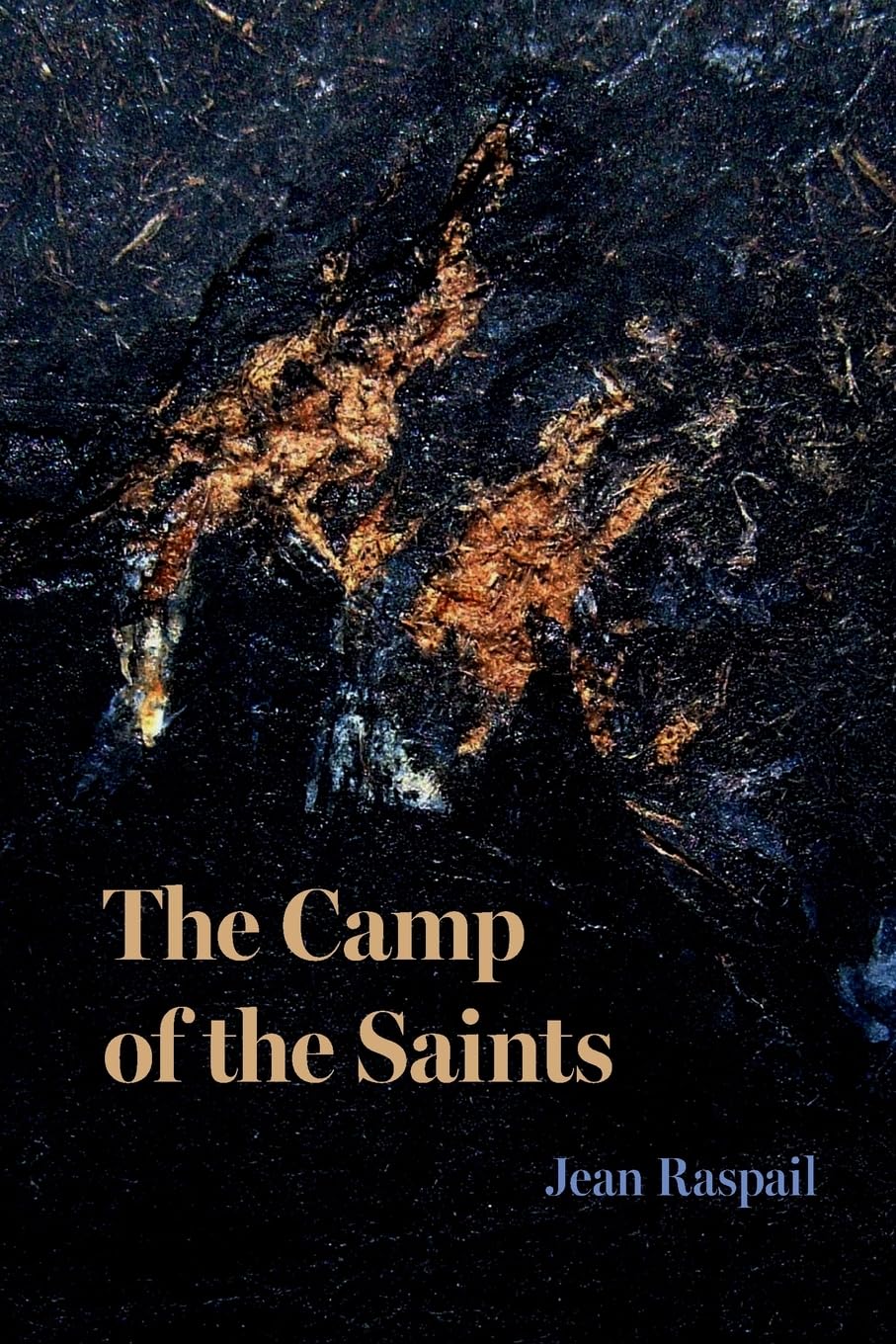
It is time that I throw my own hat into the ring regarding this particular piece of polemic fiction. It’s particularly topical given the recent events in the UK and the Western World. A look at toxic progressive empathy taken its natural conclusion.
Written by Jean Raspail and published in 1973, Camp of the Saints is a book infamous among those the media describes as “Far Right” and virtually unknown outside of that. Were history set upon an even keel, Camp of the Saints would sit on the bookshelf of every high school right next to the classic works of the same genre: notably 1984, Brave New World, and Fahrenheit 451.
This book was so dangerous that for decades, now, the English translation has been out of print, available only as an expensive antique, or through the Internet Archive, [as] a single shoddy .pdf. The corporate owners of the English translation rights have, despite considerable interest, refused to republish it. That was until September of 2025, when a new translation was created and distributed.1
As of now, what was once an antique book is now cheap and in-print. What’s more, it’s been converted to an audiobook available on Audible.2 It took the destruction of Western Culture for us to see published the one work of dystopian fiction that warned us of it.
Given its relevance, it makes sense that over ten percent of the run-time consists of various forwards from the author, translator, and the publisher, that describe the political and cultural push against its own publication. It’s worth it to read (or listen) through the numerous forwards to better understand the context and the author.
An Introduction to the Text
Among the dangerous books written in the late 20th century, Camp of the Saints takes the self-destructive anti-nativism of the neoliberal world order and draws it forward to its own natural conclusion. Like other works of fiction, it takes popular ideas and asks the question: “What if these beliefs are taken to their ultimate logical end?”
The book is written from the perspective of an omniscient historian who witnessed the events of the text; he knows that his work will be censored, silenced, or redacted. In the context of the book, the accurate recollection of the events described is inherently destructive to the (now) dominant anti-racist political regime. The force of political progressivism will destroy any such history on the basis that it may “incite racial hatred” or “create division”.
A fascinating bit of forethought in that those are the exact reasons why Camp of the Saints was itself banished from public view for the last half-century: Liberal cultural diversity transitioned smoothly to violent censure and virulent “anti-White” or “anti-Western” genocidal hatred.
The book is a dramatization of the Fall of the West. Not in pitched battle, but as it has lost its spiritual core to rampant idealism. The “other” is always to be given deference over our own people. The sympathy that is demanded for the “other” is also silenced and denied for our own. At what point do a people become so spiritually deracinated that they lose all legitimacy to exist? At what point do they become so deluded as to lack totally a theory-of-mind of the “other”, and at what point does sympathy for the foreigner overwhelm survival?
Camp of the Saints answers these questions in sometimes graphic detail. Some of the horrors written on those pages hadn’t happened to innocent Western children yet … but now, fifty years on, and they have happened. Many times over, in many places and nations, across the West.3 In comparison to the reality of the West in the 21st Century, Camp of the Saints is a tame warning.
The book begins with a great migrant fleet setting off from Calcutta, India. The poor, the starving, the diseased, and the malformed set out for the West- A land where milk and honey flow freely and where the rivers are rich with Fish. The people of India want a better life for themselves, even if they have to walk, unarmed, onto foreign lands to get it. They, like many peoples, believe that their land is simply poor and that Western nations are simply rich. Failing to understand that it is not some “magic dirt” that made France, England, Australia, and the United States rich, but rather it was the French, English, Australians, and Americans. The West doesn’t horde “magic dirt” but “magic people”, so to speak. Were the West to be flooded with Indians, it would become just like India, not magically make the invading Indians wealthy and intelligent.4
I doubt that it’s possible to explain that fact to third-world migrant retards.
To conclude a spoiler-free version of the review: You should read it. It should have been taught in high schools for the last 50 years. You should probably buy a copy before the beast of Progressivism finds a new way to censor it. If you buy the Audible copy, use a tool to convert it to an .mp3 file so that it can’t be deleted from your personal library after the fact.5 There’s a reason it’s been censored for the last 30 years or so. It’s dangerous, subversive, and intelligent in a way that modern dystopian authors wish they could be.
- Here is a direct link [https://www.amazon.com/Camp-Saints-Jean-Raspail/dp/B0FG4MJS8K] to where you can purchase the book on Amazon. A shoutout to Vauban Books for doing the work that every other publisher has been unable, or too scared, to do.
- I kind of enjoy audiobooks. Though Camp of the Saints can be particularly tricky to listen to over reading directly due to its complex cast and jumping around in the timeline.
- The Rape Gang Inquiry Report by Rupert Lowe is particularly poignant and well-timed here.
- A fact that is in stark relief as of 2026, with over 10% of their population (official sources say it’s close to 7%, but I don’t believe them) now being Skaven imports from India … and the wealth, safety, culture, and prosperity of Canada now vanishing at an alarming rate.
- The “Open Audible” tool is works for this, but it isn’t free.



I have an old copy, did not realize it was hard to get. John Derbyshire wrote about it often so I had to get it. Not the best written, but he was French, so, there you go. The pathological empathy we see was all there on his pages.
Comment by Pat McCracken — June 21, 2026 @ 20:06