Quotulatiousness

June 10, 2026

To protect under-16s from harmful content, everyone will now need to show their ID online

Australia’s attempt to ban under-16s from accessing social media and other online sites blew up rather quickly. Britain and Canada, seeing what happened down under, chorused “Hold our beers!“:

“Automotive Social Media Marketing” by socialautomotive is licensed under CC BY 2.0

The government is expected to table the Digital Safety Act on Wednesday with reports that it will include a ban on social media for those under 16, framed as a “temporary” measure that platforms can exit once a new digital regulator certifies their safety standards. I have been writing about these issues, from the original Online Harms Act to mandated age verification and website blocking and now the kids’ ban, for several years. This FAQ gathers the analysis in one place, with links throughout to the longer pieces for anyone who wants to go deeper. The key takeaway is that a kids’ social media ban is an ineffective and harmful policy that raises privacy concerns for tens of millions of Canadians through mandated age verification requirements. The policy fails to address the underlying concerns with social media and the prospect of a “temporary” ban makes little sense since the requirement might be reversible, but the data collection and regulatory infrastructure are permanent.

What is the government reportedly about to introduce?

According to the Globe and Mail, the forthcoming bill would bar anyone under 16 from social media. The government will indicate that this is a temporary safeguard with an opt-back-in once a regulator certifies safety standards. The government will frame this as “temporary” measure, but I argue that once established, there is no putting the toothpaste back in the tube given that the policy will require a regulator and proof of age from everyone.

Didn’t this start with Bill C-63, the Online Harms Act? What happened to it?

Bill C-63 was the government’s 2024 online harms bill, and from my first-day take I described it as effectively three bills in one: a defensible set of provisions focused on platforms that featured a duty to act responsibly, more contentious Criminal Code and Canada Human Rights Act provisions, and a powerful new Digital Safety Commission modelled on the CRTC to be funded by the tech companies. My view was that the Criminal Code and Human Rights Act provisions should have been dropped or incorporated into a separate piece of legislation. Bill C-63 itself died on the order paper when Parliament was prorogued ahead of the 2025 election, but the duty-to-act-responsibly model is likely to survive as part of the forthcoming bill.

Why is a kids’ social media ban bad policy?

I set out at least six reasons in this post on the issue. The most important is the first: the harms people associate with social media, such as algorithmic manipulation, addictive engagement design, weak content moderation, inconsistent enforcement, inadequate transparency, and privacy risks, affect users of every age. Treating them as a children’s problem misidentifies both the source of the harm and the right target of regulation. By focusing legislative attention on who is permitted to use social media rather than on how the platforms operate, an age-based ban lets legislators and the companies off the hook from more effective broad-based regulation. The other reasons identified in the post include the absence of evidence that bans work, the privacy harms they create, and the constitutional rights of the children they claim to protect.

Does the ban actually work?

The evidence to date says no. Australia’s under-16 ban took effect in December 2025, and the eSafety Commissioner’s first compliance report found that roughly 70 per cent of children who had accounts before the ban retained access to at least one platform three months later, with no discernible reduction in cyberbullying or image-based abuse complaints from under-16 users. Children route around age gates through VPNs, borrowed accounts, and false birthdates, and the most at-risk users are the most likely to circumvent them. Professor Lisa Given laid out much of this on a Law Bytes episode before most of the data was even in. Canadian politicians now citing the Australian approach with approval are pointing to a model whose own regulator’s data suggests has thus far proven ineffective. At a recent Canada 2020 event in Ottawa, Australian professor Amanda Third confirmed that kids are actively circumventing the ban and indicated that parents are concerned that their children are now less safe.

Doesn’t polling show overwhelming public support for a ban?

The headline number is real but misleading. The March 2026 Angus Reid Institute survey found that three-quarters of respondents support a full ban on social media for those under 16, and politicians have cited it repeatedly. But as McGill’s Sara Grimes documented on this Law Bytes podcast episode, the less-quoted numbers in the same survey complicate the picture: 72 per cent said parents, not governments, should be primarily responsible for regulating teens’ social media use, only 32 per cent picked 16 as the right threshold, and the survey did not ask respondents anything about the mechanism any ban would actually require. Simply put, public support for “protect kids from harm” is not the same as public support for “every Canadian must submit ID to a third-party provider in order to use the internet”.

Hasn’t social media been proven harmful to kids?

The data on social media harms to kids is far more mixed than is often portrayed in the media and in Jonathan Haidt’s Anxious Generation book that has fuelled much of the legislative panic. Grimes has produced a very accessible explainer on the issue that walks through the science. As she notes in Panic First, Evidence Later, “there is a serious problem. Researchers who have spent their entire careers studying adolescent mental health, children’s digital media, developmental science, and media psychology – the people who actually built the evidence base Haidt draws on – have raised sustained, substantive objections to his core claims.”

Read all of Michael Geist’s FAQ here.
The Korean War Week 103 – The Outpost War – June 9, 1952

Filed under: China, History, Military, USA — Tags: , , , , — Nicholas @ 04:00

The Korean War by Indy Neidell
Published 9 Jun 2026

The US 45th Division launches Operation Counter in the field this week, to take some enemy outposts, Bull Boatner finishes his plans for his operation to take total control at Koje-Do POW Camp, and in the US, the Presidential primary season finishes, though it’s still anybody’s guess who the actual Democratic and Republican candidates will be.

00:00 Intro
01:21 Recap
01:52 Primary Season
05:18 Operation Counter
09:20 Communist Artillery
12:09 Boatner
20:10 Summary
20:20 Conclusion

“Don’t talk to the police”

Filed under: Cancon, Law, USA — Tags: , , , — Nicholas @ 03:00

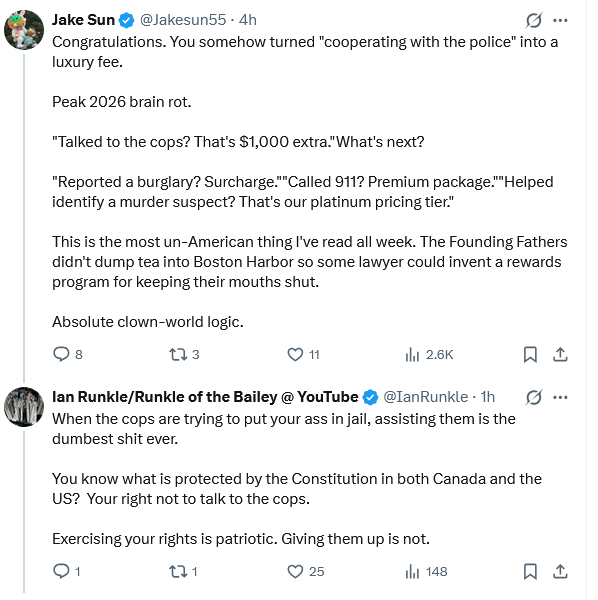
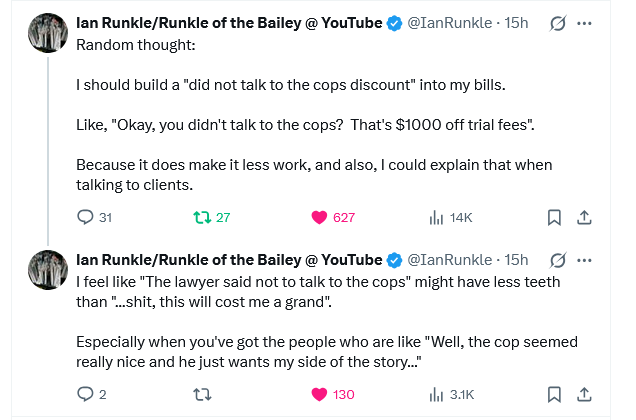
On the social media site formerly known as Twitter, Canadian lawyer Ian Runkle (aka “Runkle of the Bailey”) jokingly suggested that he needed to make a change to his normal billing practice:

This rustled the jimmies of Jake Sun:

Which led to a more extended discussion from Ian:

Okay, ignoring the whole Canadian vs. American thing, let’s talk about this notion that it is somehow un-American to advise people not to speak to the cops.

Cause holy shit that’s funny.

First, when the cops want to put you in jail, cooperating with them and making that easier for them is a real dumb move. If you’re sitting in the interrogation room it’s not because the cops are looking to help you find a burglar or because you’re calling 911. It’s because they want to put you in jail, potentially for years. Wanting to help them at that point is as dumb as it gets.

Second, your right not to talk to the cops is enshrined in the Constitution in both Canada and the U.S. In other countries, likely not as much, which means that being able to tell the cops “Fuck you, no” is absolutely American, both because it is a thing in America and because exercising your Constitutional rights is an American and patriotic thing to do.

Third, if we’re talking about the United States specifically, we’re not talking about a country founded on respect for and obeisance to authority. The slogan was never “Give me Liberty, if the government allows it”. No one asked for a permit to throw tea in the harbour. The U.S. was not founded on the principles of obedience and deference to authority, but instead the rights of the individual against authorities are fundamental to the American experience.

America is not and never was about “Yes, sir.” It’s far more about “Fuck you, I won’t do what you tell me.”

World War 2 Mincemeat Pie for the Battle of the Bulge

Filed under: Food, History, Military, USA, WW2 — Tags: , , , , — Nicholas @ 02:00

Tasting History with Max Miller
Published 16 Dec 2025

Raisin-forward army mincemeat pie made in a quarter sheet pan

City/Region: United States of America
Time Period: 1945

During World War II, and really any war, soldiers far from home longed for a taste of home, especially during the holidays. Field kitchens would go to great lengths to break the monotonous menus and bring a little holiday cheer to the troops with things like turkey, stuffing, and pies.

This mincemeat pie is not bad, but it does lack the spices and citrus that really say “Christmas” to me. The corned beef and bouillon cubes add more of a savory note than a real meaty flavor, and raisins are the star of this pie.

    No. 822. MINCEMEAT FORMULA NO. 1
    Yield: 100 servings, 2 sheet pans, 16 1/2″ x 24″ x 1 1/2″.
    Bouillon cubes……36 cubes
    Water, boiling……9 quarts (9 No. 56 dippers)
    Corned beef, canned……4 pounds
    Fat……2 pounds (1 No. 56 dipper)
    Apple nuggets, dehydrated……2 1/2 pounds (3 1/4 No. 56 dippers)
    Sugar, granulated……3 pounds (1 1/2 No. 56 dippers)
    Raisins……7 pounds (5 1/3 No. 56 dippers)
    Cinnamon…… 3/4 ounce (3 mess kit spoons)
    Pepper……(1/3 mess kit spoon)
    Nutmeg……1/4 ounce (1 mess kit spoon)
    Salt……(1/3 mess kit spoon)
    Dissolve bouillon cubes in boiling water.
    Add remaining ingredients. Simmer on a slow fire for approximately 45 minutes or until apples and raisins are tender. The addition of gravy coloring or caramelized sugar will improve the appearance. Remove from fire and cool. Pour into pastry-lined sheet pans.
    Cover with a top crust and make in hot oven 40 to 45 minutes or until crust is golden brown.
    Note. This mix should be prepared just prior to using.
    TM 10-412 US Army Technical Manual. Army Recipes by the U.S. War Department, 1945

(more…)

QotD: Tiberius Gracchus, Tribune of the Plebs

Tiberius Gracchus’ proposal to fix this problem [the perceived loss of free farmers from whom the Roman army was raised] was the lex Sempronia Agraria. The law proposed to enforce a legal but long ignored limit on the holding of ager publicus,1 restricting individuals to holding just 500 iugera (c. 311 acres), with the state revoking the leases on the remainder and using the reclaimed land to then provide small plots for free to the Roman poor, with a rider that these plots could not be sold (to avoid them being reconsolidated into elite estates).

And here it is worth noting that kind of government the Romans had to understand the response. The Roman Republic had written laws but no written constitution – instead, the rules for office holding, for conducting the business of the Senate, for running the assemblies and so on were all customary: the Romans governed themselves in accordance with what they called the mos maiorum, “the custom of the ancestors”. In a sense then, certain practices, if practiced long enough, became a sort of law-of-tradition to themselves and of course one of those customs – practiced at this point for, at minimum around 150 years – was the continual leasing of large amounts of ager publicus to the point that the leases were treated as a form of ownership: people used that land as security for loans, they built houses on it, they buried their parents on it and so on. Because the leases were presumptively renewable and had been for decades if not centuries, under the mos maiorum, the holders of ager publicus had long considered the land theirs. And of course the upset parties are rich and powerful, so their opposition was significant and meaningful, politically.

In brief, the way this plays out is that while Tiberius Gracchus does have significant popular support for his motion (Plut. Ti. Gracch. 9.1), much of the elite are opposed. He draws up a quite conciliatory version of the law, which proposes to compensate the holders of large amounts of ager publicus for their lost leasing rights and to then give them the remainder of their leased land (so they needn’t fear a second lex agraria and a third and a fourth and so on), but according to Plutarch in the face of continued elite opposition, shifts back to a less conciliatory version of the law (Plut. Ti. Gracch. 10.3). The resistance to his law centers on another tribune, Marcus Octavius, himself a large holder of public lands, who plans to veto the law and uses his own powers as a tribune to disrupt the process (along with some fairly clear shenanigans by some of the wealthy, like trying to hide the voting urns to prevent a vote on the law and so on).

Now there are a few things to note at this juncture in the story. First, there being ten tribunes, it must never have been very hard to find a tribute willing to gum up the passage of a given law, but that, traditionally, this was a tactic of delay, rather than a hard-stop the way Octavius is using it. At the same time, with real public momentum to make this law happen, one could easily imagine simply waiting Octavius out – he only has one year in office. Except. Except that, remember, Tiberius Gracchus needs a big victory in his tribunate to get his political career [back] on track, a consideration that was clearly significant (thus the reason we’re informed of his quaestorship; we usually don’t know much about even very significant figures’ time in junior offices!). That consideration, I think, serves as important context for Tiberius’ decision to escalate every time he encounters resistance: he cannot afford to simply be the prelude to someone else passing this law: he needs to pass it himself.

The normal method for “deconflicting” two magistrates with opposing vetoes like this was to go to the Senate, which Tiberius Gracchus, hoping his influential supporters would carry the day, did. Instead, according to Plutarch (Ti. Gracch. 11.2) the Senate was merely no help, whereas Appian (BCiv 1.12) describes the Senate as openly upbraiding Tiberius, a strong negative response. Now under the mos maiorum, that would be the end of it: the authority of the Senate (the auctoritas senatus) ought to be so intense that when the Senate speaks in one voice and says, “not right now” then you desist. Remember that in the Roman conception, the Republic is a partnership of sorts between the Senate and the People (the S and the P in SPQR), rather than a situation in which the Senate is purely subordinate to the popular will: if the Senate is strongly opposed, that is supposed to be a veto point that is respected.

But remember: Tiberius Gracchus cannot, politically, desist. He must push through because his political career requires a victory this year. Note that the cause does not require a victory in 133; there is nothing to stop another tribune in 132 from trying to advance the same bill or a more limited or different version of it. But Tiberius Gracchus’ career absolutely requires success in 133. So instead of desisting, he escalates.

He now breaks clearly with the mos maiorum and plans to take his law directly to the people against the advice of the Senate. Octavius is obviously a problem – he’ll veto anything Tiberius Gracchus tries to do – so Tiberius Gracchus introduces a law to depose Octavius from office. The Roman Republic doesn’t have anything like impeachment, there is no framework to remove someone from office. Instead, the way the Republic works is that all of the offices are held for short duration (one year) and while tribunes and office holders with imperium are immune from prosecution while in office, they can be prosecuted the moment they leave office for any crimes they committed. There is no framework for booting out a tribune like this; the remedy in the customary Roman system is to make sure the next year you elect tribunes who support the idea and try to pass it then. But that remedy doesn’t work for Tiberius Gracchus.

So Tiberius Gracchus passes the law deposing Octavius and then has him dragged from the speaker’s platform (the rostra) and now we have a problem. Because of course Octavius’ supporters are going to view this law itself as illegal and invalid: tribunes are, you will recall sacrosanct, so it’s not clear they can be deposed and it is very clear they cannot be assaulted or dragged. Violating the sacrosanctity of a tribune is, at least notionally, a capital offense and a severe violation of religion and if you think that Tiberius Gracchus’ legal basis for all of this is rubbish, you think he just did it twice. Of course, Tiberius is also a tribune, so you can’t attack him now, but once his year is done, you are probably planning to haul him in to court and let a jury decide if what he did was legal or not.2

In any case, with Octavius removed, Tiberius passes his land reform bill. The law provided for a three-man commission to handle the assessment of what public land was held in excess and then to hand it out. Tiberius Gracchus names as those commissioners himself, his brother and his father-in-law (Appius Claudius Pulcher (cos. 143)). Needless to say, that is a set of commissioners which does not inspire a lot of confidence that the commission will be uncorrupted by politics, a point we’ll get back to in just a moment.

In the meantime, the Senate looked to exert its traditional prerogative over state funds (as it advised the quaestors who superintended the treasury) to hamstring the new commission, but Tiberius Gracchus took advantage of the recent death of Attalus III, King of Pergamum. Attalus had notionally willed his kingdom “to the Roman people” – he had no clear heirs and so perhaps thought by this act to get the Romans to pick one of his relatives to run the kingdom, thus avoiding a damaging civil war – but instead Tiberius, getting the news early, rushed to pass a law annexing the kingdom and using the windfall to fund his commission. The law passes, but this is a breach both of the Senate’s traditional power over state finances, but also its very important role managing Roman foreign policy.

What I want to note in this sequence which is important for understanding what comes next is that Tiberius Gracchus has just demonstrated that, so long as he remained popular, he could use the powers of the tribunate to essentially run the Roman state from the tribune’s chair. Tiberius has now forced not merely a domestic land issue, but also a finance issue and a foreign policy issue over the objection of the Senate and another elected tribune, essentially running roughshod over all of the customary limits intended to keep any one Roman politician from coming to dominate the Roman political system.

Of course if you were an opponent of Tiberius Gracchus, you could at least tell yourself that this is all bad, but at the very least, Tiberius Gracchus will be out of office next year, as it was contrary to custom to run for any office immediately after holding it. Indeed, it was unusual to hold basically any office more than once, save for the consulship (and even then, only for very successful consuls and never multiple years in a row). Those limits are customary but everything about the Roman Republic is customary; if you discounted the mos maiorum, there wouldn’t be any republic left. You’d instead expect that Tiberius would go back to being a senator for a few years while planning his shot at the praetorship – during which he’ll have to survive a series of court battles over the legality of his actions.

So even if he is doing potentially outrageous, dangerous things, at least he’ll be gone in a year, right?

Bret Devereaux, “Collections: On the Gracchi, Part I: Tiberius Gracchus”, A Collection of Unmitigated Pedantry, 2025-01-17.


  1. Which, again, noting the complications above, probably means applying that limit for the first time to at least some classifications of land it had not applied to before and also applying it against the socii.
  2. The Roman court system leaves questions of law – which in most modern courts would be decided by a judge – to the jury itself.

Powered by WordPress