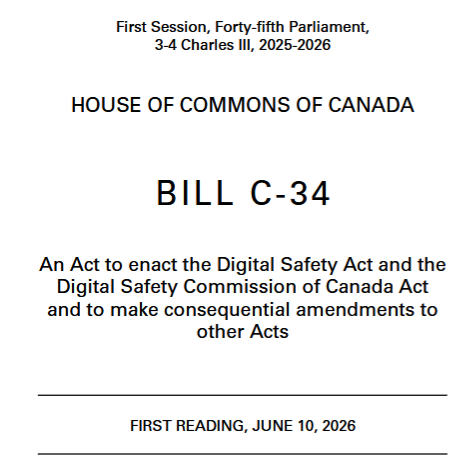
As promised/threatened, the Liberal government introduced a new bill to address ongoing concerns about “online harms”: Bill C-34, the Safe Social Media Act. The ever-informative Michael Geist provides an overview:
The government tabled Bill C-34, the Safe Social Media Act, earlier today, marking its third attempt at online harms legislation after the failed 2021 consultation and Bill C-63, the Online Harms Act that died on the order paper when Parliament was prorogued ahead of the 2025 election. As I wrote on the day Bill C-63 was introduced, that bill was effectively three bills in one: a defensible set of platform regulation provisions built around a duty to act responsibly and a clear list of identifiable harms, contentious Criminal Code and Canada Human Rights Act reforms, and a powerful new Digital Safety Commission with considerable regulatory discretion. My view at the time was that the contentious provisions should be removed and addressed separately, since they were certain to dominate the debate at the expense of what really mattered, namely the platform regulation piece. That is precisely how it played out as the speech provisions undermined the bill for months, and by the time the government conceded and agreed to split the bill, time ran out.
Bill C-34 suggests the government absorbed only part of the lesson. The Criminal Code and Human Rights Act provisions are gone, but in their place the government has thrown in everything else: the original Online Harms Act platform duties, an under-16 social media ban backed by mandated age verification, Bill S-209’s pornography age verification requirements, a new AI chatbot regulatory regime, and sweeping powers for a Digital Safety Commission that will write the rules, enforce them, and decide which platforms escape the ban restriction. It is an everything-all-at-once approach in which nearly every key component, including which services face the restriction, how age gets verified, which AI systems are covered, and what standards govern exemptions, is left to regulations that do not yet exist.
I’ve been working on this piece since before the bill was introduced with the expectation that many provisions from the prior proposal would resurface. This post is long, but seeks to provide a very initial review of key elements in the bill. For those looking for the key takeaways, there are five. First, the platform regulation elements with a duty to act responsibly once again offers a good starting point for working through regulation. Second, the inclusion of a social media ban for those under 16 is bad policy that will take considerable time to implement and raises serious privacy concerns that will affect tens of millions of Canadians. Third, the AI chatbot regulations are consistent with emerging standards, but the uncertainty of who it covers is not. Fourth, the government is creating a bureaucracy comparable to the CRTC in the Digital Safety Commission as it will wield serious power and be tasked with fleshing out much of the detail of how the law will work. Fifth, the uncertainty of this bill has the hallmarks of a government wanting to do something quickly, but the “trust us” approach likely means years of implementation work and potential court challenges.
The Foundation: A Duty to Act Responsibly
The aspect that attracted the broadest support in Bill C-63, namely the platform regulation rules, survived largely intact. The bill features the same seven categories of harmful content (intimate content communicated without consent, content that sexually victimizes a child or revictimizes a survivor, content that induces a child to harm themselves, content used to bully a child, content that foments hatred, content that incites violence, and terrorism or violent extremism content) and revives the duty to act responsibly that requires platforms to assess and mitigate the risk of exposure to that content. There is also a duty to make certain categories of content inaccessible within 24 hours backed by a complaint path to the new Digital Safety Commission, and a duty to be transparent through public digital safety plans, record-keeping, and researcher access to data. These measures target how platforms actually operate and provide a credible starting point.
[…]
The Social Media Ban for Under 16’s
The headline measure, widely reported as a “temporary” ban on social media for those under 16, leaves many questions unanswered since the application of the ban, age verification methods, and exemption rules are all left to future regulation. The word “temporary” appears nowhere in the bill. […]
The AI Chatbot Regime: Mainstream Duties, Unbounded Definition
The government wisely took the duty path rather than the ban path on AI chatbots, an approach I argued last month would be even worse than the social media ban. There is no chatbot ban and no under-16 account restriction for chatbot services. Instead, the bill creates duties that track the emerging international mainstream found in California’s SB 243 and New York’s AI companion law. […]
The Commission: More Power, Fewer Limits, Smaller Penalties
The third concern is the one the government never resolved the first time. My day-one assessment of Bill C-63 flagged the Digital Safety Commission’s regulatory power as a serious concern. The answer two years later is an even more powerful Commission with more undefined limits. Bill C-63’s three-pronged approach of the Commission, a Digital Safety Office, and a Digital Safety Ombudsperson has been consolidated into a single Digital Safety Commission of Canada that develops the regulations and guidance, assesses compliance, manages complaints, conducts audits, issues compliance orders, levies administrative monetary penalties, and decides the exemption applications that determine which platforms escape the under-16 restriction. Once again, the amount of uncertainty is the real story since the design features at the heart of the duty to protect children are simply those “set out in the regulations”, and the user thresholds that determine which services are covered at all are to be determined.