The flare-up of anti-immigrant/anti-government violence in Belfast has drifted out of the headlines lately, as state-oriented media try to get their audiences back onto safer topics like footy and hissing at the Bad Orange Man. But the situation in Northern Ireland has not resolved itself in the preferred way — preferred, that is, by the British government. John Carter responds to some American social media users who loudly wonder why British men generally are not “doing something” now:
In response to the migroid atrocity du jour, one often hears Americans ask “why haven’t British men done anything?”, to which Americans will flatteringly reply to themselves, “It’s because those BRITCUCKS have gone SOFT, they gave up their GUNS like little BITCHES, but you won’t see anyone trying THAT in a SMALL TOWN”. Which conveniently elides the awkward detail that American men, armed to the teeth as no other people on Earth, have allowed themselves to be pushed around this way and that since the sleep of the good Reverend Doctor Martin Luther King, Junior (PBUH) was disturbed by his little dream. “Just you wait”, Americans will promise when this is pointed out, “The electric boogaloo will come any day now, you’ll see!” Sure we will. In the meantime, all those guns have done precisely nothing to prevent the relentless incursions of Section 8 housing, disparate impact, affirmative action, DEI, anti-discrimination training, Title IX, human resources, and all the rest of the soft tyrannies that flew out of the Pandora’s box of America’s ersatz race communist constitution. There was no resistance to any of this. Heavily armed red state Americans abandoned the cities for the suburbs rather than standing and fighting for them, and then stolidly watched as their kids were sidelined in education and employment while being terrorized by black criminals.
American speech is protected by the first amendment and backstopped by the second, yet nevertheless you will not find many Americans daring to even so much as mutter the forbidden word of power. This is not because white Americans don’t understand the problems. They have developed an elaborate vocabulary of “bad neighbourhoods” and “good schools” and “urban crime” and “troubled youth” and so on and so forth with which to discuss, in whispers, after glancing twice over their shoulders, the realities of life in the USSA. There is no law against parrhesia [Wiki], technically an American citizen may say whatever he pleases without consequence, but of course frank speech in this Greek sense requires courage by definition, and there has been a great shortage of that. You can say whatever you please, yes, of course, fill your boots, but you will find yourself ostracized, divorced, unemployed, and homeless if you speak too directly, so you know, shut up. The unspoken strictures of the longhouse are a more effective prison than iron bars for those whose spirits have been cowed.
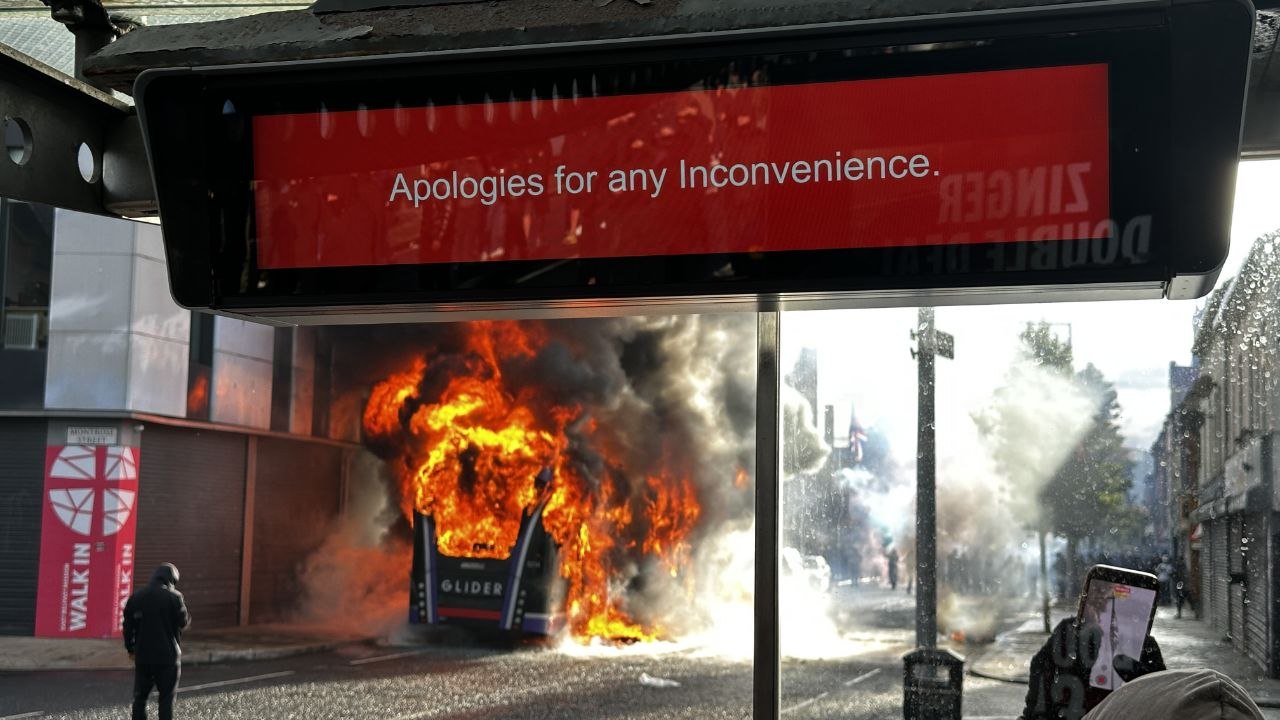
Meanwhile, last week there was a minor uprising in Belfast. Hadi Alodid, a gentlemen of Sudanese extraction, enriched the face of Stephen Ogilvie, a local bloke with special needs, providing him with extensive tribal scarring in a generous act of cross-cultural exchange, and only claiming two of his eyes in payment. The entire incident was caught on video. Ogilvie’s life, though not his sight (and he was already hard of hearing) was saved by three Irish men who rushed in to beat the innocent Sudanese rocket surgeon off with their hurling sticks. In the aftermath, it emerged that Ogilvie had helped Alodid move in to his new accommodations just a few days before. No good deed, etc.
[…]
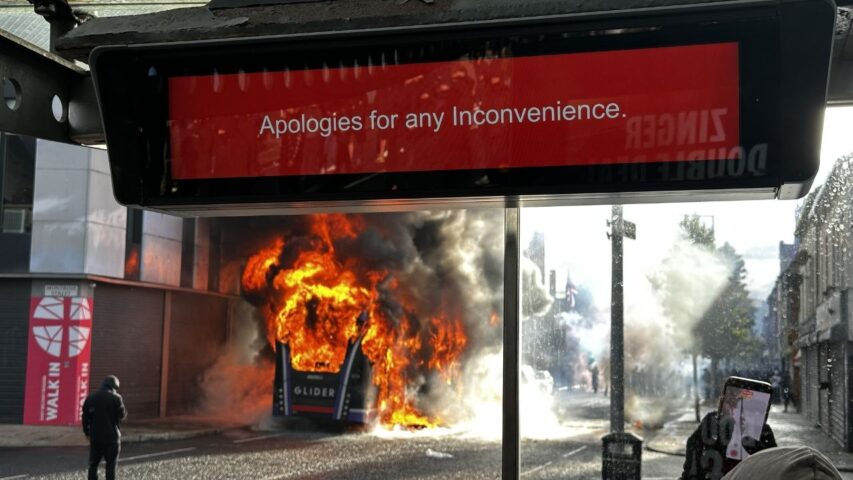
The uprising was variously described as a protest and as a riot, but it was neither of these. A protest is when an angry crowd gathers to chant some slogans and wave around some signs, pretending that their numbers are a display of power, and deluding themselves that Power will redress their grievances because a noisy lump of quivering biomass is somehow intimidating to Power. A riot is an explosive release of emotional energy that results in some property destruction and futile confrontations with armoured riot police, typically ending with the rioters being rounded up and jailed. In some cases, it’s true, protests and riots appear to produce political change, but this is almost invariably because Power has orchestrated these little carnivals in order to sanctify the policies it’s already decided upon under the guise of “bowing” to “pressure” from the “public”. The Canadian government, by the way, has long since mastered a non-violent variant of this dark art: practically every “public policy research group” in the country is funded by the government to pressure the government to do what the government already wants to do. Show me what Our Democracy looks like; this is what Our Democracy looks like.
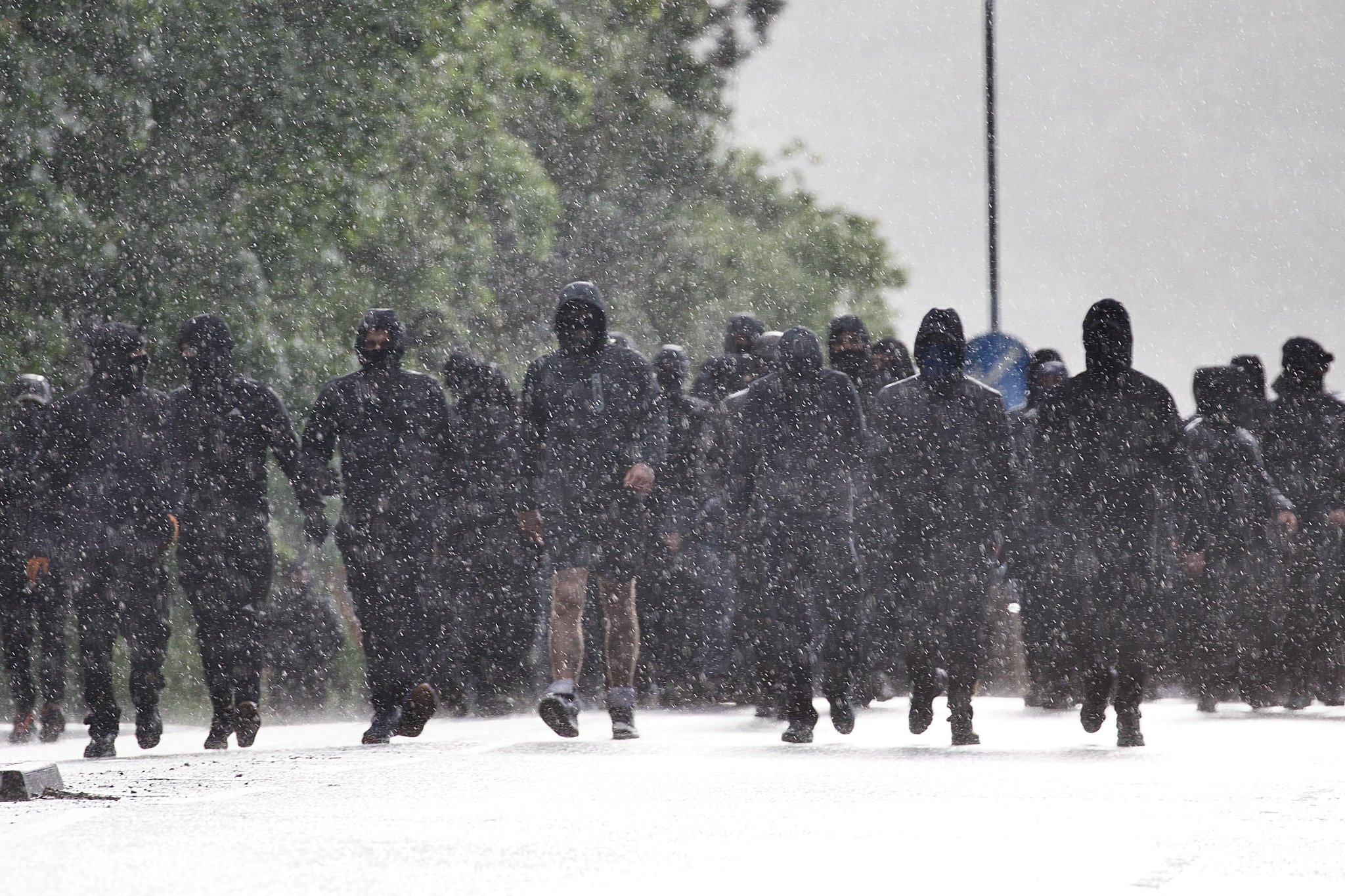
There were no signs being waved around in Belfast, no chanting of slogans. While there was a great deal of violence, it was not random and senseless, but methodical and carefully targeted. It unfolded with the tight discipline of a coordinated military operation.
The day before the uprising started, a communique was sent out to local businesses, instructing them to close before the fun started. At the appointed hour loose formations of young men, indistinguishable in black hoodies, fanned out across the city.
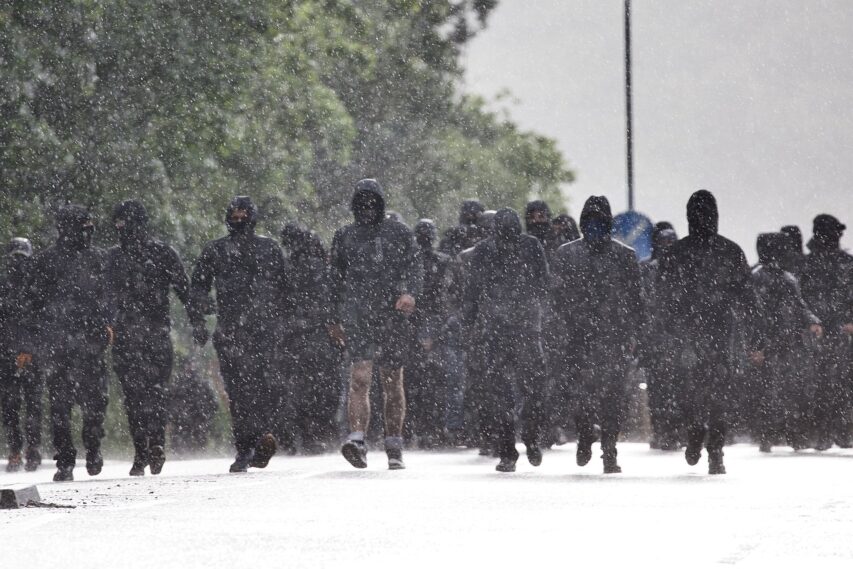
[…]
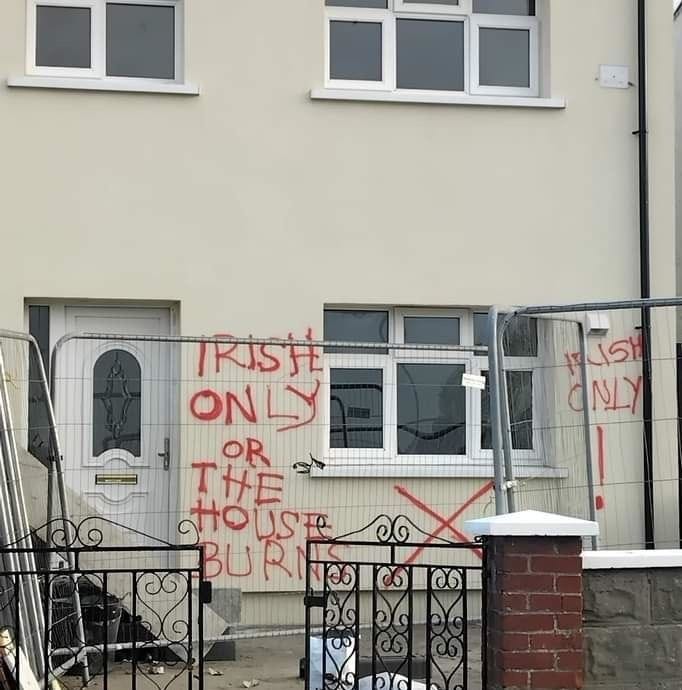
The uprising in Belfast was not nihilistic violence for the sake of violence, though I’ve no doubt the lads were enjoying the opportunity for mayhem. It was violence towards a specific political objective: driving the foreigners out. Migrants whose domiciles were destroyed were directly deprived of housing. Migrants who managed to avoid this were made to worry that they will be next. Landlords taking government money to house migrants, or even thinking about doing so, now need to worry about the immediate cost of repairs and the ongoing expense of higher insurance premiums, making the Home Office’s lucre a lot less attractive. Landlords also need to worry about escalation: reportedly, letters were circulated which heavily implied that bricks and petrol bombs were just the first step on the violence ladder, and that the paramilitaries would be quite happy to take more decisive measures against the landlords themselves should the message not be received.
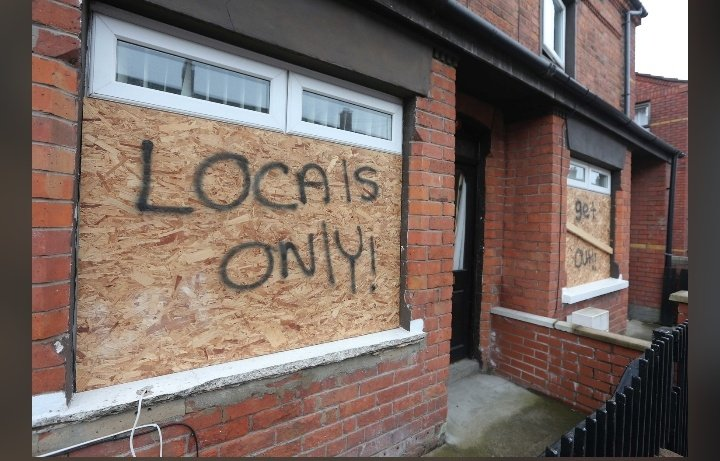
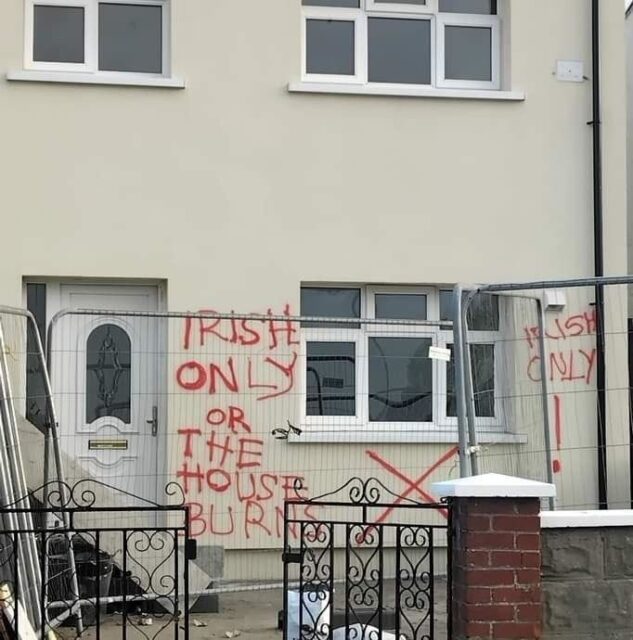
All of this is very sad, and I don’t want to seem heartless. The immigrants whose houses were destroyed were probably innocent; there was one particularly touching video of a nurse from Ghana or somewhere. Unfortunately, that is the nature of these things. They were brought in by the government en masse as a form of biological warfare against the native population. The government wants them there, the people want them gone, and the government refuses to listen, so, this is what happens.
Only 27 migrants were actually made homeless by the arson, but reportedly, quite a few are already clearing out on their own. The British government quite naturally condemned the violence, organizing a rally against racism in the aftermath, but it also responded by instructing the media to emphasize that it would be cracking down on illegal immigration into Northern Ireland. Underneath the condemnation, there is a clear message to all of this: in this case, violence worked.
That message has been sent before in Northern Ireland. Exactly one year to the day before the uprising in Belfast, there were riots in the small town of Ballymena after the courts let two gypsy boys off with delicate wrist taps for raping an Irish girl. The rioting went on for two weeks, and resulted in two thirds of the gypsy population clearing out. Again: violence worked.
Contrast Ballymena with the other major British protest movement last summer: the anti-migrant hotel protest in Epping, a London exurb populated largely by Londoners driven out of their city by diversity, which started when one of the migrants diversified a teenage girl. In contrast to the eruption in Ballymena, the protest in Epping was explicitly non-violent: the only violence came at the hands of the cops arresting people for flying Union Jacks. The mothers of Epping spent months gathering outside the migrant hotel, holding signs and raising awareness. The council also fought the migrant hotel in the courts, and enjoyed early success when a judge found that the location was zoned as a hotel but not as a migrant dormitory, essentially telling the Home Office that they didn’t have a loicense for that. This legal victory was short-lived. The decision was overturned almost immediately by a higher court judge, who explicitly found that whatever the concerns of the people of Epping as to their children’s safety, these were outweighed by the human rights of the mystery meat that had washed up on Britain’s shores, and by the government’s interest in housing them. As a result, parallel lawsuits that had been launched by councils across the country were dropped. The migrant hotel in Epping was eventually shut down, but this likely had more to do with the government’s switch to “Operation Scatter” in which migrants were garrisoned in smaller houses all over the country, rather than concentrated in a few large centres, than it did with the government responding to the concerns of British subjects.
In Ballymena and Belfast, violence worked; in Epping, peaceful protest did not.