At The Bugscuffle Gazette, Ian expresses his disgust and contempt at the British government which has categorically failed to protect a quarter of a million girls and young women from sexual predators imported by that government, which then actively covered up the crimes. It’s impossible to put into words just how cowardly every politician, every police officer, and every “social worker” has been for decades in allowing these crimes to flourish:
Click the image to open the report PDF
I was not expecting to learn that the grooming gangs have been operating since 1955. Seventy-one years. At least two generations of British children have been savagely sacrificed on the altar of multiculturalism, willingly helped and encouraged by not only the State, but by our “Journalistic Betters”.
I was not expecting to learn that the victims number a quarter of a million. At minimum.
The least job of a society — the very minimal function expected — is the protection of the innocent and the defence of those who cannot protect themselves.
The Government of Great Britain — from the least to the highest — not only failed in this most minor of duties, but actively aided and abetted the destruction of the innocent and the depredation of the defenceless — with the enthusiastic assistance of “professional” “journalists”.
Seventy-one (71) years. Two-hundred and fifty-thousand (250,000) children raped. Trafficked. Tortured.
I don’t ever bloody well want to hear any English person tell me I don’t need guns again. “The police will protect you” you say, with that supercilious smirk. Read that report again — especially the part about the police failing to protect children, CHILDREN for God’s sake — and then get sodding bent.
I am furious. I don’t want apologies — I want officers executed. I want politicians hung in the public square, their possessions seized. I want journalistic edifices chained shut and set on fire.
I want the bloodshed and retribution visited upon those responsible, those who enabled, and those who willingly ignored to be of a level that will snarl softly to British people for ages to come:
“Do. Not. Fail. Again.”
Bastards.
On the social media site formerly known as Twitter, X Freeze summarizes some of the findings from the report:
Perpetrators:
~87% of convicted group-based CSE offenders had Muslim names. Estimates put the real figure at ~95% Muslim. Networks were almost entirely Muslim men — overwhelmingly Pakistani. Massively disproportionate to population share.
Enabled by honour-shame clan culture and Islamic doctrines that treat non-Muslim girls as available property: Muslim superiority over kuffar, al-walā‘ wa-l-barā‘ enmity to non-Muslims, no fixed age of consent, and rules allowing sexual use of captives.
How the grooming worked:
Girls as young as 11 were befriended by young Muslim men who treated them like adults, supplied alcohol, drugs and cigarettes. They were collected in taxis from school gates, care homes and streets, taken to houses, flats, restaurants and hotels, then raped repeatedly by groups of men, passed between perpetrators, tortured, filmed, and told they were “white trash” or “kuffar” who deserved punishment. Many became pregnant while still children. Some were trafficked to the Middle East for Islamic marriage.
failure & cover-up
Every pillar of the state failed catastrophically for decades:
- Police ignored reports, criminalised victims instead of perpetrators, destroyed evidence and bailed known rapists.
- Social services placed children in trafficking hubs inside children’s homes, closed cases despite clear signs, and retaliated against whistleblowers.
- NHS recorded genital injuries, multiple STIs in children as young as 13, and rape pregnancies — then discharged victims back to their abusers.
- Schools saw older men collecting girls at the gates and heard disclosures, yet often excluded the victims rather than protecting them.
- Politicians (especially Labour-controlled councils and the party nationally) denied knowledge, blocked or watered down inquiries, suppressed ethnicity data, and prioritised electoral support from Muslim voting blocs and “community cohesion” over child protection. Fear of being called “racist” paralysed action. Sadiq Khan repeatedly insisted there were no grooming gangs in London, despite the Metropolitan Police holding reports of girls being raped by groups of men in hotels and other locations across the capital.
On her Substack, Celina identifies the specific state failures that perpetuated what started as isolated, local crimes:
The central thesis of the Rape Gang Inquiry Report is unequivocal: the estimated 250,000 victims were the victims of a deliberate collapse of the British state’s safeguarding architecture. Across every crucial sector, the state chose institutional convenience over the lives of children.
The Police: Criminalisation and Complicity
The Inquiry documents how officers frequently arrived hours late to missing persons reports, actively discouraged parents from filing complaints, and routinely closed cases without conducting basic forensic or digital examinations.
The most pervasive failure was the ideological decision to view the victims as willing participants in their own destruction. Children like Chloe, found highly intoxicated in the cars of adult men, were labelled “prostitutes” making “lifestyle choices”. By framing the organised rape of children as consensual sex work, the police absolved themselves of the legal requirement to launch resource-heavy investigations into organised crime syndicates.
When victims or their families did provide actionable evidence, it was routinely mishandled, ignored, or actively destroyed. Ross, the father of a survivor named Phoebe, testified that vital digital evidence handed over to the police was inexplicably deleted from the device while in police custody. When Grace’s abusers repeatedly breached their bail conditions and stalked her family, the police took no action, rendering protective non-molestation orders entirely meaningless.
The bureaucratic responses were often farcical. In some instances, the only formal action taken by police was issuing “harbouring notices” to the men, pieces of paper warning them not to associate with the child. When the men inevitably ignored these notices, no further enforcement followed. Furthermore, the Inquiry uncovered a deeply entrenched “two-tier” policing system. While forces surrendered to the fear of disorder from certain communities, they aggressively targeted the victims and their families. Chloe was arrested in her pyjamas after her mother called the police for help, kept in a cell until 2:00 AM, and released onto the streets without transportation, leading directly to her being picked up by a gang member and trafficked nationwide.
Most disturbingly, the report highlights allegations of direct police complicity, referencing whistleblower accounts of “cop nights” where officers were allegedly active participants in the trafficking and abuse of girls using police vehicles. The revelation that an abuser could be legally accepted as an “appropriate adult” for Michelle during police questioning underscores a force either dangerously incompetent or wilfully blind to the dynamics of coercive control.
Social Services: Abandonment and Retaliation
If the police failed to enforce the law, social services failed to enforce basic humanity. Across multiple districts, social care systems identified the precise markers of severe exploitation, truancy, self-harm, sudden wealth, STIs, missing episodes and consistently chose to look away.
The Inquiry demonstrates that social workers frequently undermined protective parents, isolating children from their families and placing them in residential care homes and semi-independent units that functioned as drive-through delivery systems for the gangs. Children were centralised, making them easier targets.
Jane, a victim placed in semi-independent living at 16, was trafficked directly from her state-provided accommodation. When she disclosed the abuse and the exchange of money to the staff, she was told it did not constitute trafficking because she was over 16. The staff then blackmailed her, threatening to blame her for the exploitation if she complained further. Following a psychiatric hospitalisation, Jane discovered that all statutory care records from her placement had been mysteriously “lost or destroyed,” legally obstructing any path to future accountability.
When internal whistleblowers attempted to expose the ongoing grooming, trafficking, and financial abuse of children in these units, they were met with severe retaliation. An unnamed social worker who acted as an Interim Co-Manager testified that after raising concerns about untreated exploitation risks and unlawful housing practices, she faced sudden suspensions, the removal of payments, fabricated allegations, and career-ending professional isolation orchestrated by senior leadership to protect the council’s reputation. Social services actively punished those who tried to protect children.
Schools:
Teachers and school administrators observed older men waiting at the school gates to collect young girls in taxis. They noted sudden drops in attendance, drastic changes in behaviour, and physical exhaustion.
Instead of recognising these as textbook indicators of exploitation, schools responded with punitive measures that pushed the children further to the margins. When Chloe’s trauma manifested as truancy, the school repeatedly placed her in isolation, compounding her emotional distress and alienation. When Jen was bullied to the point of wetting herself because a teacher refused her access to the toilet, the school ignored her subsequent self-harm and suicidal ideation, failing to initiate any safeguarding response.
In the most tragic instances, schools actively protected the abusers to avoid scandal. When Rachel’s autistic daughter disclosed that she had been orally raped by a peer, the school failed to effectively safeguard her, allowing the alleged perpetrator to remain on the premises. She was subjected to relentless physical and online bullying by students linked to the abuser, which was filmed and shared online. The intimidation escalated until the twelve-year-old took a fatal overdose of colchicine, stating she “just wanted everything to stop”.
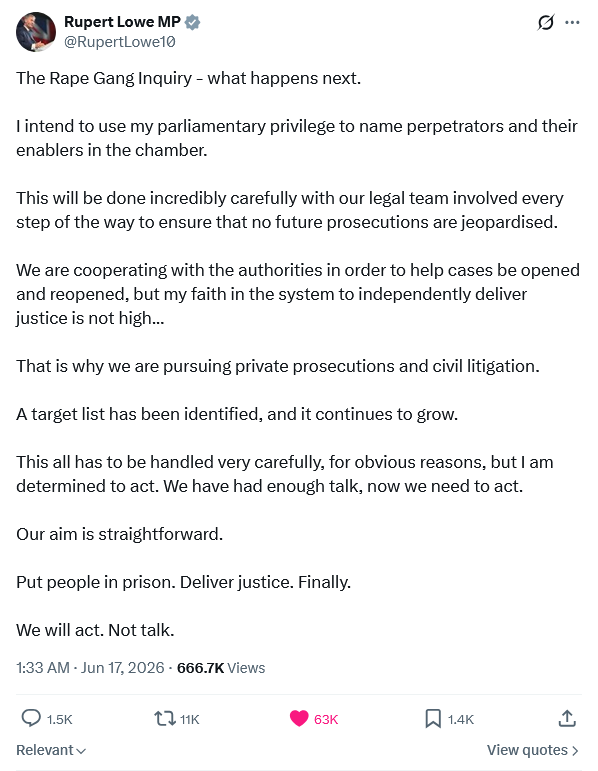
Rupert Lowe explains his next steps after the publication of the inquiry report: