I’m not an economist, so my personal opinion on Thomas Piketty’s work is based purely on the reports of others … you could say I’m not a fan. In the National Post, J.D. Tuccille discusses Piketty’s latest push to impoverish the rich nations for the noble cause of “global justice”:
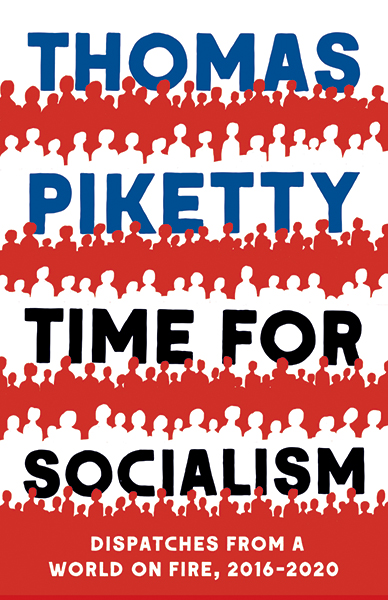
Piketty’s 2021 paean to socialism and central panning.
Celebrity economist Thomas Piketty won fame with a claim that, in market economies, capital accumulates in the hands of the already wealthy, leading to increased inequality. The message found a receptive audience among people eager to believe economic success isn’t earned. Canada’s Prime Minister Mark Carney cited Piketty in his own 2021 book-length argument that economic activity should be managed by people like Carney.
And now Piketty is back seeking new fans with a scheme for top-down central planning of the world’s economy. He is the co-director of the new Global Justice Report from the World Inequality Lab.
Introducing the project, Piketty posted on X, “The world today is characterized by large-scale inequalities. And a climate crisis is looming over us. We urgently need a new vision for global progress in the 21st Century. One that grounds human development and equality in planetary habitability.”
Piketty shoehorns an impressive number of buzz phrases into a few lines. He includes concerns about equality and inequality, climate change and progress that should send thrills through college campuses. But Piketty has a talent for tapping into the moment. In this case, at a time when Freedom House’s annual report finds that “Global freedom declined for the 20th consecutive year in 2025,” the economist and his colleagues propose authoritarian policies for shaping the entire planet to their liking.
In his post, Piketty asks, “What would it take to achieve high prosperity and equality while remaining within planetary boundaries?” He answers that “energy transition” (meaning moving away from power sources that produce carbon) is necessary, as well as “labour hour reductions, growth caps in rich countries, less material consumption, and changes in food habits.”
The report itself asserts, “The compression of global inequality is not only compatible with deep decarbonization; it is a necessary condition for shared prosperity on a finite planet.”
To fight climate change and battle inequality, Piketty and company want “full income convergence across countries by 2100.” This requires, in part, limiting growth to “around 0-0.5% in today’s richest regions (North America/Oceania, Europe).” They argue that near-zero growth in rich countries “does not mean that their living standards stagnate” because people will benefit from flattened incomes.
On his Substack, Tim Worstall says that the latest Piketty emission disproves the “we need a global wealth tax” case of fellow French economist Gabriel Zucman:
So Tommy Piketty has released his big report self-pleasuring over how a few Frogs are going to run the global economy forever. The Guardian, of course, thinks there’s merit in it:
One of the report’s key aims is to bring every country to today’s rich-country level of €5,000 per person per month in purchasing-power terms. The figure for sub-Saharan Africa is €290. The report proposes a new global fiscal and monetary architecture: taxes on the very rich would build the public realm, while a Keynesian “clearing union” and new international currency would ease the external constraints that limit poorer countries’ state spending.
Super, eh?
But the plan doesn’t just try to get the poor up to our standard of living — an excellent goal in and of itself, obviously. It also insists that we don’t increase our standard of living. For a century. Which is, you know, going to be a little more difficult.
So, how is this to be achieved? Well, this is Piketty — Frogs, eh? — so it’s going to be truly swingeing taxation of anyone who puts their head up above the parapet. The global 1% in fact.
And, well, this isn’t wholly true but it’s a useful rule of thumb, the top 1% globally is about the top 10% of the UK. -Ish, you know? Somewhere just above £50k a year for an individual in the UK. £150k for a two adult w/children household perhaps. That’s the level at which the 90% income tax swinges into action.
Oh, and, lovely wealth taxes on top too.
The effect of this is to kill economic growth. That’s what it’s designed to do too. You’ve enough, you rich bourgeois bastard, you, so that’s all you’re going to get and we’re going to use punitive taxation to make sure that’s true.
Well, OK, it’s a plan, right?