Quotulatiousness

June 7, 2026

Are “Dad books” in trouble?

Filed under: Books, Business, History, Military — Tags: , , — Nicholas @ 06:00

In the latest SHuSH newsletter, Ken Whyte views with (mild) alarm a recent Wall Street Journal article claiming that “Dad books” — the kind of books thoughtful kids give their fathers as gifts — are in steep decline:

The Wall Street Journal ran a piece last month on the death of Dad books, the Father’s Day specials — books about “some little-known chapter of World War II, the sweeping narrative of a shipwreck, perhaps the latest presidential biography”.

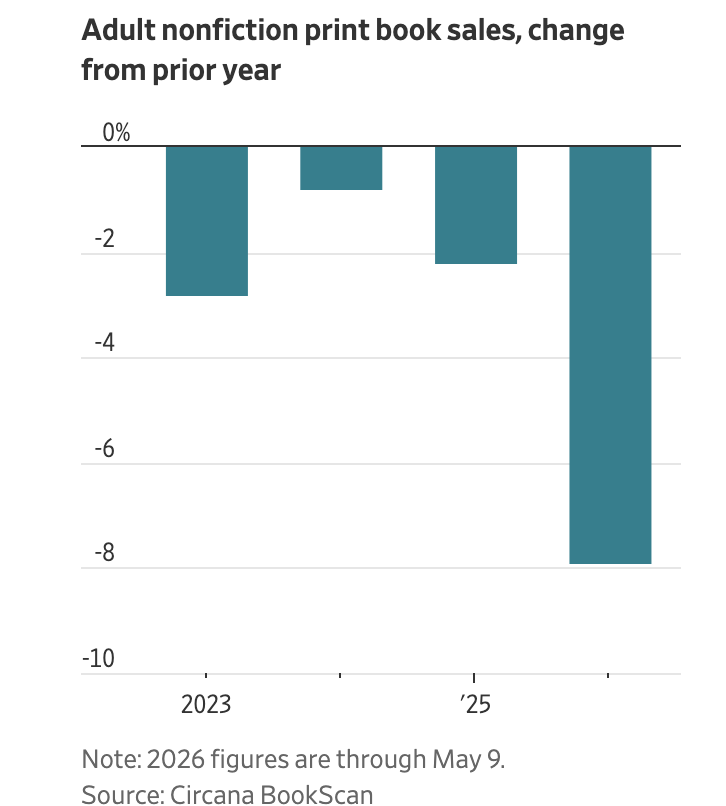
Here’s what it gave for evidence. Nonfiction book sales have declined for four years, including an 8 percent drop this year up to May 9.

Sales of Books about politics and current affairs are down 19 percent in those same four months and nine days in 2026. The article quotes, among others, former Simon & Schuster publisher Jonathan Karp saying that “this is a sea change and people should wake up and realize we’re living in a new world”.

The new world is one with “an endless supply of Substack newsletters, Netflix documentaries, YouTube videos and podcasts that offer the kind of fresh reporting, sharp analysis and historical perspective once limited doorstop-size books”.

Jonathan Burnham of Harper Group adds that all these alternatives to books make “the idea of sitting down with a 700-page Ron Chernow book less appealing. You’ve scratched that itch.”

The WSJ noted that Chernow’s recent biography of Mark Twain, published last spring, is underperforming his 2017 biography of Ulysses S. Grant.

There was an obligatory quote from Barnes & Noble CEO James Daunt, who attributed the decline in serious nonfiction sales to the fact that everyday events are all-consuming: “The world is exceptionally interesting right now and when that happens the nonfiction reader is reading the news instead.”

As someone who publishes a lot of Dad books, i.e., serious researched nonfiction, histories and biographies, that sort of thing, I read the article with concern. In fact, I read it twice.

I felt much better after the second reading.

Let’s start with the chart. The first four months and 9 days of 2026 are doing all the work here. A decline of 1 to 2 percent in the years 2023 to 2025 is statistical noise. Circana BookScan numbers don’t include audiobooks, which have been rising steadily in popularity. The very slight decline in sales for the first three years might be entirely attributable to format shifting, hardcopy to digital audio. The 8 percent decline in the first four months of 2026 looks more ominous, but book sales figures are always lumpy, never a straight line. A four-month sample tells you nothing.

The greater problem with the chart is that it is counting adult nonfiction book sales, not Dad books. There are any number of ways to cut Circana BookScan data, but the broad adult nonfiction category contains a vast array of books. Books for men, books for women, books for everybody. Not only serious researched nonfiction, but self-help, how-to, study guides, business and personal finance, psychology and religion books, health and fitness books, parenting books, food and travel books, true crime, sports, military, essays, crafts and hobbies, memoirs, etc. There is no data cut for Dad books. So the story is backing its thesis for the death of apples with stats about oranges.

The report of a 19 percent drop in the narrower category of politics and current affairs also looks ominous, but this is one of the most notoriously cyclical genres in existence. And, again, we’re discussing a short period of four months and nine days. The new Trump era was less than a year old at the start of that period. It generally takes longer than a year to get new books from commission to sale. Ten days after the end of the period under discussion, Andrew Weissmann released Liar’s Kingdom: How to Stop Trump’s Deceit and Save America. It was an instant number-one New York Times bestseller. In so specialized a category as this, Liar’s Kingdom alone might have been sufficient to right the ship.

The only other evidence presented to support the decline in Dad books is poor Ron Chernow’s journey. His Mark Twain, with 119,259 hardcover sales, is underperforming his Ulysses S. Grant, with 381,604 sales.

I don’t know where to start. The Grant book has been out for almost a decade, Twain for a year. Not surprising that it has sold less. Also, you can’t compare major political biographies to major cultural biographies. David McCullough’s biographies of Truman and Adams far outsold his book about American artists and writers in Paris. And while I’m a fan of Chernow, his Twain book isn’t his best work. He received polite and generally positive reviews, but they noted that the book is overly long — the word “exhaustive” surfaces repeatedly — and that he doesn’t entirely succeed in bringing Twain to life. Grant is a superior book, and the more enjoyable read, too, if customer reviews are anything to go by. The Twain sales prove nothing.

So we don’t really have any evidence at all that Dad books are in trouble, that they’re getting swamped by podcasts or current events, and certainly not that there’s been “a sea change” and that we’re living “in a new world”.

Amusingly, the literary world was flooded with hot new Dad books coincident with the WSJ‘s declaration of their death.
Those “decorations” or “doodles” on medieval manuscripts

Filed under: Books, Education, Europe, History, Religion — Tags: , , , , — Nicholas @ 05:00

In this week’s Substack Post of links they included this gem from weird medieval guys providing lots of illuminated explanations of the visual additions to pages of handwritten text generated in monasteries all over Europe during the Middle Ages:

After perhaps my 9,000th time seeing someone describe medieval marginalia as “doodles” or the product of “boredom”, I thought it might be nice to put together a brief guide to some of the themes and ideas that recur in the margins of manuscripts, hopefully helping to showcase the fact that these drawings were usually anything but “random”! In fact, far more interestingly, these little characters and scenes were part of a complex and visually dense world rooted in religion, pop culture, humour, and folklore. This is just a whistle-stop tour, but I’d love to add a second part soon.

Context matters

Illuminated manuscripts were essentially always written first and illustrated second in the late Middle Ages. The scribes would add their writing to unbound, empty pages, working carefully around blank fields where painted miniatures and initials would later be added by a separate artist or artists. We do not know exactly what sort of education these artists would have obtained. However, they almost certainly would have had a degree of literacy in their native tongue and a familiarity with the scriptures they were illustrating, even if this did not extend to a firm grasp of written Latin.

Understanding this is crucial for pushing back on the idea of medieval marginalia as “random”, since it opens up the possibility of considering marginal drawings in relation to the rest of the page and manuscript as a whole — crucial context that is often neglected when we encounter marginalia as isolated snippets online. Artists were not simply filling in blank voids but adding adornment to a canvas already rich with meaning imparted by the scribe. Thus, the first step to understanding a piece of marginalia should always be to trace it back to its source, if possible. Have a look through the entire work and see what themes and images recur.

Works like the 13th century English prayerbook known as the Rutland Psalter show extensive evidence of the marginal artists playing on specific words and lines from the scriptures featured on the same page. I highly recommend Betsy Chunko Dominguez’ fantastic paper “Playing on Timbrels: The Margins of the Rutland Psalter” for a more complete exposition, but I will go over a couple examples here.

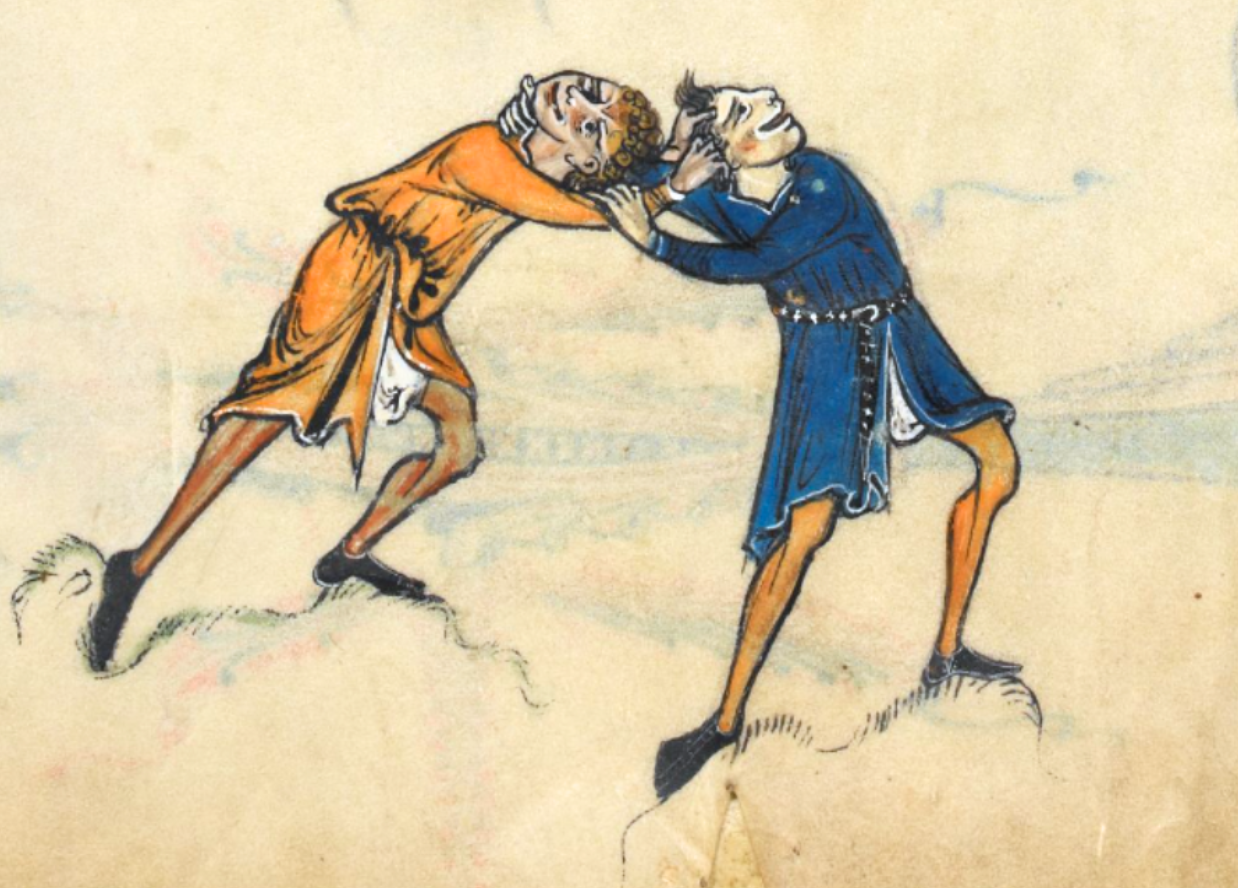
In the lower margin of folio 11r of the Psalter, two men seem to be engaged in a fierce struggle, with one of them apparently trying to rip off the other’s ear. Moving their eyes back up to the start of the opposite page, a reader would have been greeted by the following line from Psalm 5:

    Verba mea auribus percipe Domine intellege clamorem meum.

    Give ear, O Lord, to my words, understand my cry.

Thus, our marginal brawl becomes a clever pun on the notion of “giving ear” — perhaps a way of making the text more engaging and memorable for its reader.

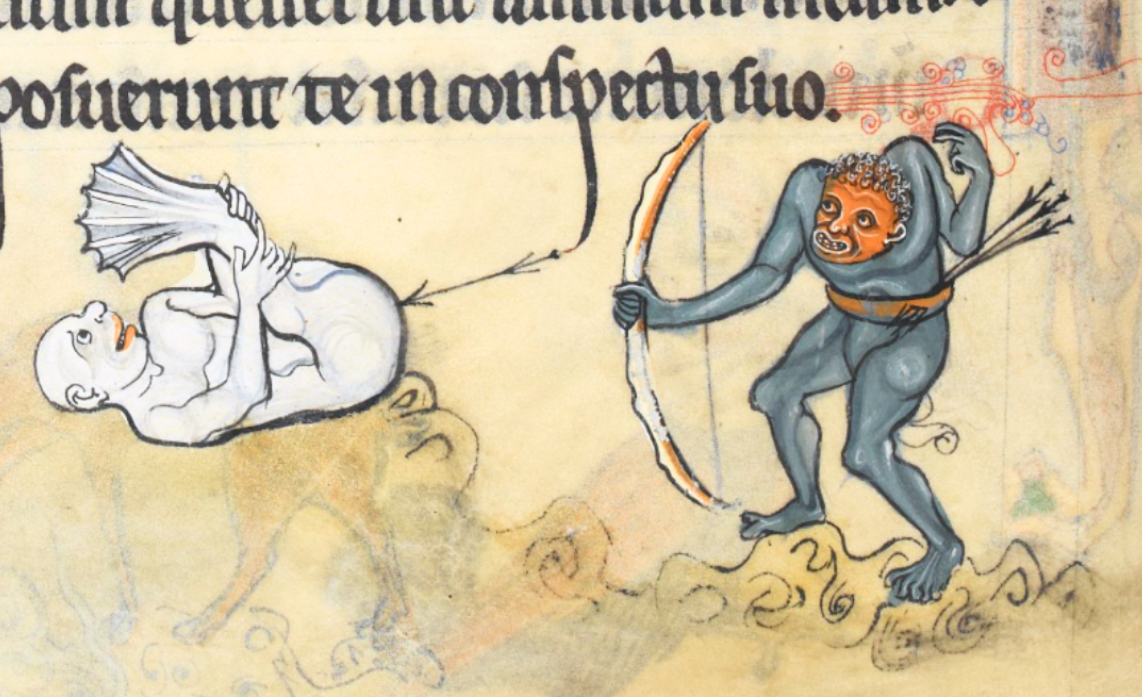
On folio 87v, the artist has extended the letter p from the word conspectu in Psalm 86 (85 in the Vulgate) into an arrow fired from the bow of one monster into the rear end of another.

Conspectu means “to behold” or “to consider”, and the famous medieval scholar Michael Camille connected the arrow’s placement to the notion of gaze as a type of visual penetration. One might also consider the entire verse from the Psalm, which reads:

    Deus, iniqui insurrexerunt super me, et synagoga potentium quaesierunt animam meam: et non proposuerunt te in conspectu suo.

    Arrogant men are rising up against me, O God; a violent mob seeks my life; they do not keep you before their eyes.

In redirecting the word for “gaze” into the supine creature’s rear end, the artist has perhaps emphasised the evils of turning one’s eyes away from God, connecting the two monsters with the violent mob evoked in the text above.

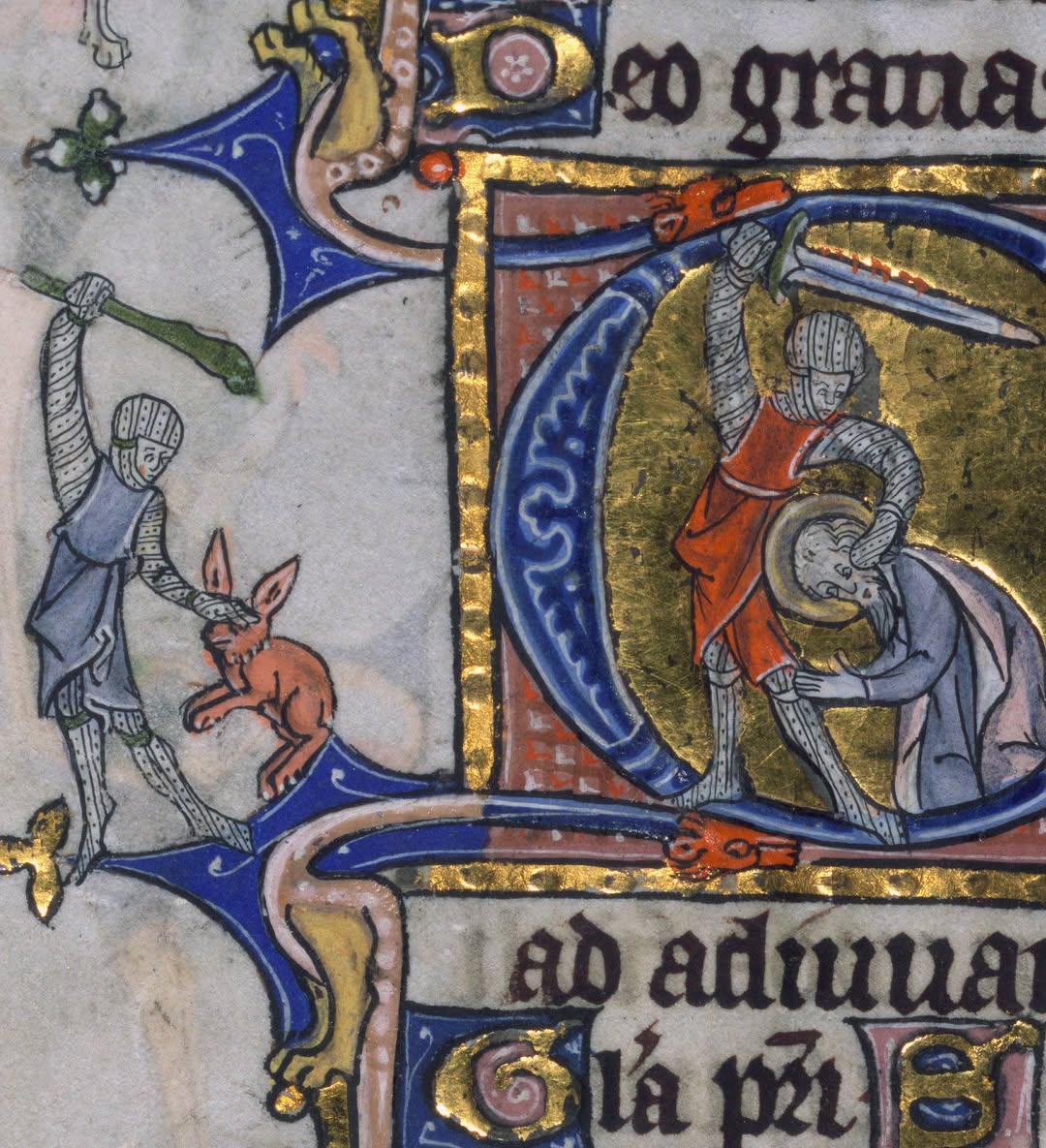
For those who lack an education in Latin, this type of wordplay can be tricky to identify. What may be easier to find are visual parallels between different drawings in a manuscript: the margins could function as a sort of antithesis to the “orthodox” miniatures and initials in the centre of the page. In one 14th century French book of hours, the martyrdom of St Paul in an initial D is reenacted directly to the left by a soldier about to club a rabbit — a humorous elevation of lapine suffering that perhaps emphasises Paul’s innocence.

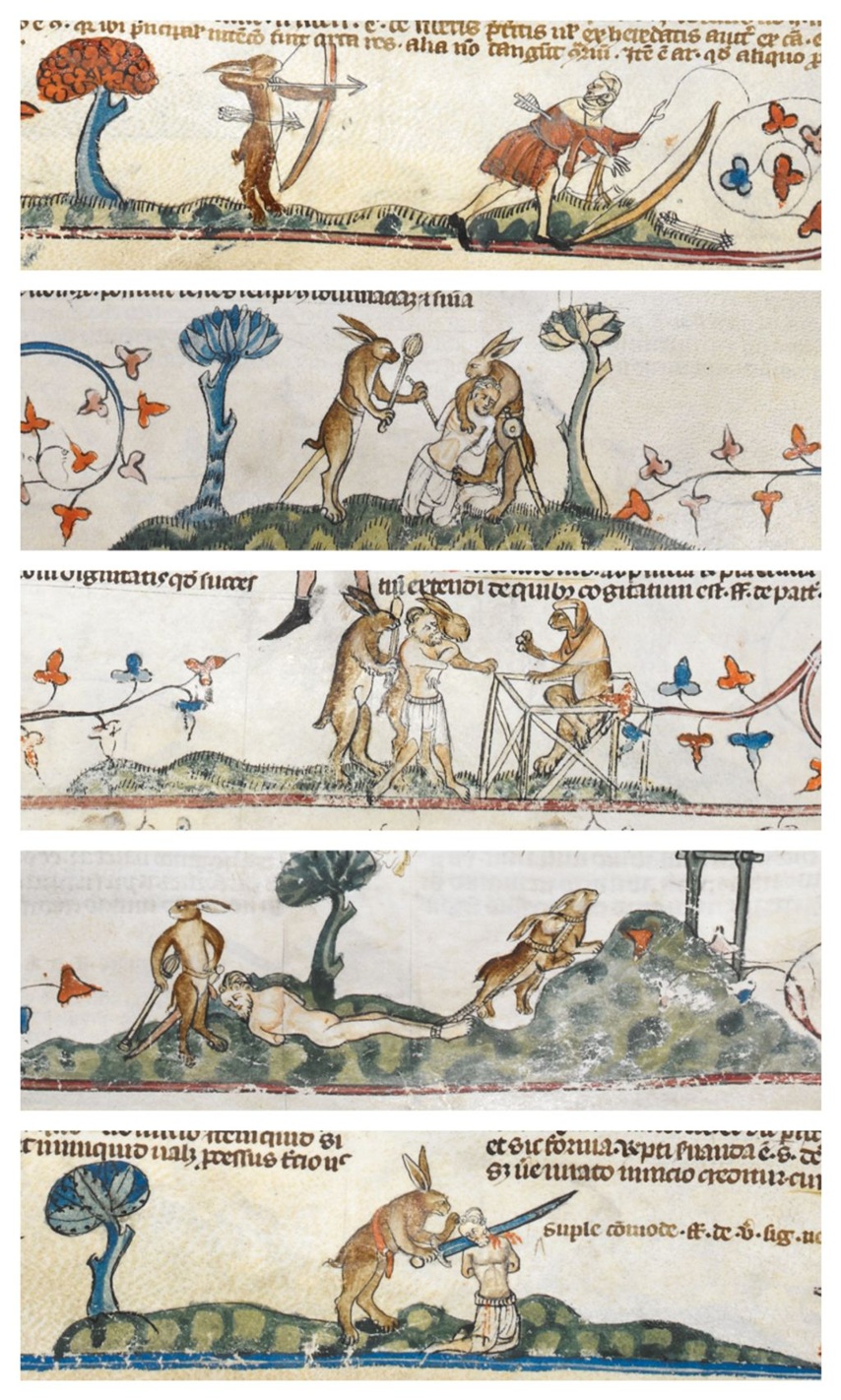
Other manuscripts show narratives playing out in the margins across multiple pages in a comic-book fashion. The 14th century Smithfield Decretals contains more than a dozen multi-page stories, including those of several saints, naughty priests, henpecked husbands, and a group of rabbits who capture, try, convict, and execute a hunter for his crimes against their kind.

British Library, Royal MS 10 E IV

How Hitler Tested His Next War in Spain – Death of Democracy 18 – Q2 1937

Filed under: Germany, History, Military — Tags: , , , , , , — Nicholas @ 04:00

World War Two and Spartacus Olsson
Published 6 Jun 2026

Berlin, June 30, 1937. Hitler has not staged a major diplomatic shock this quarter — but beneath the surface, Nazi Germany is preparing for war.

In Spain, the Condor Legion helps Franco’s Nationalists and the bombing of Guernica gives the world a terrifying preview of modern aerial terror. At home, the regime escalates its assault on the Catholic Church, begins the purge of “degenerate art”, tightens the link between courts and concentration camps, and hides rearmament behind spectacles of economic success.

This episode of Death of Democracy looks at Q2 1937: the quarter when Nazi Germany normalized aggression abroad while deepening tyranny at home.

00:00 Berlin, June 30, 1937
00:05 No Hitler Surprise — But War Preparations Continue
00:51 The Hindenburg and the Shadow of Modern War
01:50 The “Give Me Four Years” Exhibition
02:25 Guernica and the Condor Legion
02:55 The Bombardment of Almería
03:11 Case Green and Case Otto
03:54 Degenerate Art and Cultural Cleansing
04:22 The Judiciary and the Concentration Camps
05:13 The Nazi Assault on the Catholic Church
06:07 Goebbels, Propaganda, and the Morality Trials
07:45 Autarky, Rearmament, and Hidden Austerity
08:52 Mood Inside the Nazi Leadership
09:48 Ordinary Germans and Apathy
12:15 Analysis: War Abroad, Tyranny at Home
14:19 Conclusion: Nazi Double-Talk

Morality and humour

Filed under: Health, Humour — Tags: , , — Nicholas @ 03:00

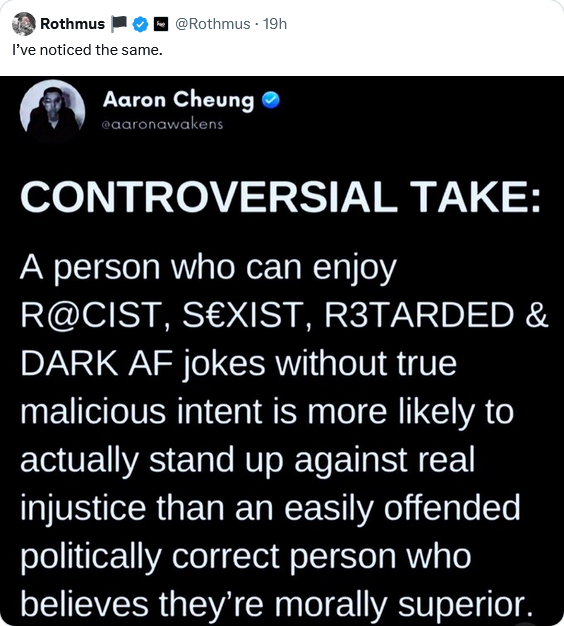
Devon Eriksen suggests that there’s a correlation between a person’s morality and their sense of humour (or lack thereof):

There is probably a correlation between morality and sense of humor.

Larry Niven once theorized that humor is associated with an interrupted defense mechanism.

The idea is that you have a situation presented to you which would normally trigger a defensive response, but when you realize it is actually harmless, the response that you experience as laughter or amusement is your brain’s way of derailing that inappropriate defense mechanism.

Because it isn’t appropriate to fight or run away from harmless things.

This mechanism become easy to see when you look at very simple or developing senses of humor. To a baby, unexpected + safe = comedy gold.

And my cat Dante’s favorite joke is “I BITE your toes! … but actually, I don’t bite them! I just lick them by surprise, watch you jump, then run away mewing and looking pleased with myself!”

Humor can become quite sophisticated, but I’ve never yet seen anything funny that couldn’t be understood this way.

But there’s a certain type of evil person who is evil precisely because they don’t interrupt defense mechanisms.

They fight harmless things. Even beneficial ones. And they give you long lectures about how the harmless or even the wonderful thing is ackshually super-problematic.

This is the visible symptom of a form of neurotic hypervigilance which can, and often does, progress to the point of simply lashing out, figuratively or even literally, at random parts of the environment, because the brain has constructed some narrative whereby it’s a threat.

The humor response is our natural way of not doing this.

The Ancient Greeks: 01 – What Made Them Special? (e) Science, Art, and the Limits of Greek Freedom

Filed under: Europe, History, Science — Tags: , , , , , — Nicholas @ 02:00

seangabb
Published 31 Jan 2026

Greece: A Brief History, c.700 BC – 500 AD

This final section examines what the Greeks achieved with the intellectual tools they developed — and where those tools fell short.

It discusses Greek science through figures such as Archimedes and the Antikythera Mechanism, highlighting both technical brilliance and flawed cosmology. It then turns to Greek art, explaining why Greek sculpture represents a decisive shift towards realism, embodiment, and the truthful representation of the human body.

The section concludes with an assessment of Greek democracy: its radical nature, its severe limits, and its enduring influence.

The lecture ends by drawing together the central argument: the Greeks were not morally exemplary, but they were intellectually revolutionary.

QotD: Undergrad writing

Filed under: Education, Quotations, USA — Tags: , , , , — Nicholas @ 01:00

The other problem undergrads typically have is a concern with “style”. That’s almost harder to break than any other habit, because the fix sounds so robotic: Subject-verb-object; five sentences per paragraph; five paragraphs per paper. Back when I first started teaching, I had a lot of students just back from the Sandbox, giving college a try on the GI Bill. I enjoyed having them in class for lots of reasons, but a big one was that the military at that time still taught the basic five-paragraph essay (maybe they still do). Your basic After Action Report ain’t great literature, but it does exactly what it’s supposed to do, efficiently.

I would always tell students who genuinely wanted to improve that nobody is ever going to fail your term paper for style. Unless you really want to be a novelist — and you don’t; we wouldn’t be having this conversation if you did — pretty much all the writing you’re ever going to do is about efficient communication. Fuck literature, fuck all the tropes of rhetoric. Just lay it out there. Who cares if it’s not a page-turner?

But the few things students are taught about writing in grade school are not just useless, they’re counterproductive, because they focus – for some unfathomable reason — on style. So you end up with crap like this:

    This article was very thought provoking and caused me to thoroughly evaluate the idea of gender and the role it plays in our society.

Duuuuuuude … far out!!! It’s not quite as “cosmic” as some of the intro sentences I’ve gotten over the years (one kid said something like “Throughout history, there have been many historic events”), but it’s just filler, very obvious filler, and that’s the very first thing your reader sees. Give me Militarese any day: “At 0500 hours, patrolling near Checkpoint Bravo, 1st platoon encountered an enemy force of approximately platoon strength …” But back in sophomore English, Teacher said that all papers must have a Thesis Statement, and since xzhey never bothered to define “Thesis Statement” I keep getting stuff like this.

Same way with the other crap they teach. There’s the one about never using the same word twice, so I’d get papers with half the thesaurus cut-and-pasted. There’s stuff about alliteration and parallelism and metaphors and passive voice, oh God, the passive voice. I swear, I’ve seen things you people wouldn’t believe. Passive voice on fire off the shoulder of Orion. Botched alliteration glittering in the dark near the Tannhäuser Gate. All these moments will be lost in time, like tears in the rain, after I’ve had enough beers to endure grading another batch of midterms …

Yeah, you see what I did there. It’s all so, so unnecessary. The point of writing is communication, and in this instance what you are trying to communicate, above all else, is that you have read and understood the assignment. Every sentence I have to read about how deeply thought provoking you found the article is another moment of my life gone, like tears in the rain. The funny thing is, except for the far-out intro, this girl mostly doesn’t have the “style” problem. Her sentences are short and to the point, and most of them are in that nice subject-verb-object pattern that makes me suspect AI, especially coming from a Current Year undergrad.

In my experience, the Kids These Days either give you tweets — often literal bullet points, to the point where some colleagues actually had to specify complete sentences in their essay prompts — or these long, byzantine things that look like really bad parodies of Alexander Pope. If she really does write like that, good! I can work with that. Outline your response next time, making sure that each paragraph contains at least one direct citation from the assignment, and you’ll be fine.

Severian, “Friday Mailbag”, Founding Questions, 2025-12-05.

Powered by WordPress