Quotulatiousness

June 23, 2026

Modern children as human hothouse plants, needing constant care and protection

Filed under: Health — Tags: , , , — Nicholas @ 05:00

At Becoming Noble, Johann Kurtz discusses how parents today treat their children in ways they largely never experienced, failing to provide them with enough freedom to allow them to develop personal autonomy as most western children have done for generations:

Giving children the freedom they need to develop agency is now a luxury good. The number of neighborhoods in which it is normal for children to leave the house and roam all day has collapsed. This collapse has come for a variety of reasons relating to security, trust, law, norms, and infrastructure.

Allowing children the privilege of freedom depends on conditions that most families no longer have access to: safe streets — yes — but also neighbors who are known and trusted, and a settled local agreement about what children are and what they are for. These conditions have not vanished, but they have concentrated, and are now a guarded secret, found only in private, privileged, and intentional communities.

This is a curious inversion of an older pattern. For most of history the peasant’s son had the run of the village while the noble’s son was kept under tutors. Now it is the wealthy child who is sent out to enjoy the freedom and adventure of camps and screenless schools, while working and underclass children are kept indoors and screened up.

Photo from Becoming Noble

It is worth being clear about the factors which underlie this transition. Otherwise, parents seeking the nostalgic “free roaming” experience are directed to explanations which are emphasized because they are unproblematic and suggest that a broad solution is available if we just move policy in a sensible direction. This includes discussions of “walkable development” and a rejection of “helicopter parenting”.

This polite framing avoids the reality that the prudent decisions available to parents are mostly made for them by the place they can afford to live, the people they live among, and how radical they are willing to be.

Children develop “agency” — the self-belief that they can independently and effectively manipulate and shape the world in creative ways — through constant experimentation and positive reinforcement.

The “independent” aspect of this formula involves developing internal psychological permission to break from prosaic norms and routines. Developing this is helped by play outside the control of authorities and interacting with the real world in settings unmediated by parents.

The closed systems that now fill children’s hours provide some feeling of agency (open world games, sprawling social media platforms, private chat rooms) without its substance. A child scrolling or playing through the programmatic logic of games is making choices, but they are only the choices that limited systems can accommodate.

Closed-system childhoods teach that there are inviolable hidden structures underneath reality and that the smoothest and most rewarding experiences are to be found when you conform with them. Experiences from boxes teach you to think within boxes. And the vice available online can be as controlling as any parent.

A few years ago, I linked to an article that graphically illustrated how the generations of an English family near Sheffield had experienced continuously diminished “range” for the children to explore:
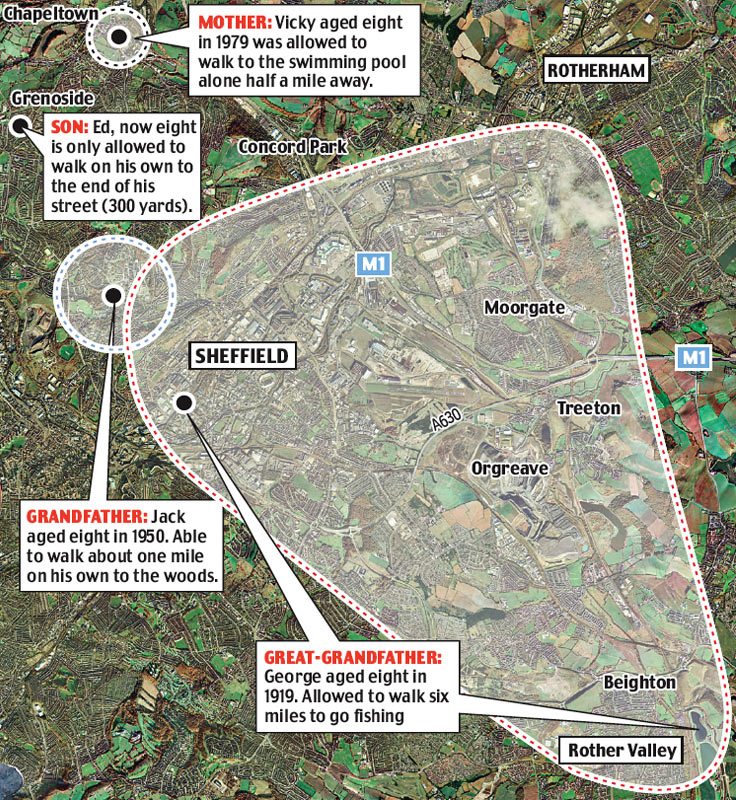
Graphic showing the diminishing “free ranges” of each generation of an English family.


They don’t do “democracy” in Europe for any important issue: the voters might get it wrong

It used to be a joke that voting never matters because the voters can’t be trusted with that kind of power. Over time, the joke stopped being at all funny, because that’s exactly what has happened in most western countries at the national level, but most blatantly in the European Union, where voters can express their will in a clear majority, yet see exactly the opposite policies implemented by Brussels:

EU delenda est

2005: the day they decided your “no” didn’t count

May 29, 2005. The French vote. Referendum on the European Constitutional Treaty.

Result: 54.68% NO.

Turnout: 69%.

Not a vote of abstainers, not a misunderstanding.

A people speaking out, massively, with full awareness.

Three years later, the same text — or nearly so — came into force. Without asking their opinion again.

Here’s how.

The context.

The Constitutional Treaty was the great federal leap: a text that gave the EU the attributes of a state. A flag, an anthem, a “constitution”, a foreign minister, supremacy written in black and white. Chirac, full of confidence, calls the French to the polls. The “yes” campaign mobilizes everything: the state, the major parties, the media, big business, the institutional unions.

And the French say no. For reasons the elite refused to hear: fear of social dumping (the infamous “Polish plumber”, the Bolkestein directive), a sense of a machine slipping out of their control, rejection of a project decided from on high and ratified by acclamation. Five days later, the Dutch say no in turn. 61%.

The treaty is dead. Officially, it’s called a “period of reflection”. In reality, it’s time to find a workaround.

The workaround has a name: Nicolas Sarkozy.

2007 campaign. Sarkozy proposes a “simplified treaty”. And above all, he lays out the adoption method: it will be the parliamentary route. No referendum. Parliament will vote in place of the people.

That’s his promise. He is elected.

And he keeps it against the people who had already decided.

The sleight of hand: the Lisbon Treaty.

Signed in December 2007.

They remove the symbols that scared people: no more “constitution”, no flag in the text, no “minister”.

They keep the essentials: permanent presidency of the Council, extension of qualified majority voting, retreat from unanimity, the Union’s legal personality, European diplomatic service. The institutional substance of the rejected text, repackaged.

The most cynical part is that they admitted it. Valéry Giscard d’Estaing, the architect of the Constitution, wrote it himself: the tools are the same, we’ve simply changed their order in the box. The stated goal: make the text unreadable so no government would be forced to submit it to a referendum. Technique replacing the popular verdict.

February 2008. Versailles.

Congress convenes to amend the French Constitution and allow ratification. Then Parliament ratifies Lisbon. The government left, which had campaigned for “no”, abstains and lets it pass. The French, they are never consulted again.

The “no” of 2005 has just been converted to “yes” by procedure.

And for those who might doubt the method: Ireland, for its part, was constitutionally required to vote. It says no in June 2008. They make it revote in 2009 until they get the right result. Vote until you get it right.

And that’s where it all connects.

This isn’t a procedural anecdote. It’s the founding act of a legitimacy problem that France has never settled.

Because the question of 2005 is exactly the one today. When Brussels signs 96 billion in development aid, when the NDICI directs billions to foreign “civil societies”, when the Global Gateway promises 300 billion the real question is never “should we do it?”.

It’s: who decided, and with what legitimacy?

The answer, we’ve known it since 2005: an administration that believes the people, when they answer wrong, must be circumvented, not heard. Hayek called it the fatal conceit.

The idea that a center knows better than the peoples what is good for them including against their explicit vote.

The French never accepted Lisbon. They were never asked.

And a structure built by going over the head of a lost referendum doesn’t carry a democratic deficit: it carries a birth defect.

The American Constitution starts with “We the People”.

Ours, the European version, started with a people who said no and an apparatus that decided it didn’t count.

Auto-translated by X from Brivael Le Pogam’s original French post.

The Metric and Imperial systems of measurement

Filed under: History, Science — Tags: , , , — Nicholas @ 03:00

Devon Eriksen explains the different purposes of the metric and Imperial systems:

Okay, time to explain the Imperial system, the metric system, and why attempts to replace either with the other are all retarded.

They have two different purposes.

The metric system is designed around precise measurement of objects. Its goal is to make engineering and scientific calculations simple.

The Imperial system is designed around humans. Its goal is to make calculation unnecessary.

100 degrees is really hot. 0 degrees is really cold. Anything that starts with a 5 is cool, anything that starts with an 8 is warm. No computation.

6 feet is tall, 5 feet is short.

100 pounds is light, 200 pounds is substantial, 300 pounds is heavy.

A 1000 square foot house is small, a 2000 square foot house is medium, a 3000 square foot house is large.

1 mile is a short walk, 2 miles is a medium walk, after that it takes a while.

1 acre of land is a homestead, 10 acres is an estate, 100 acres and up is a ranch or a farm.

Do you see now why it is so strange and awkward to convert from miles to feet?

It’s because converting from miles to feet is not something you’re supposed to do in the first place. Yes, they are both measures of length, so they are technically convertible, and yes, on rare occasions, you might need to do that.

But feet are for measuring humans, and things built around humans, like doorways, and mattresses. Miles are for measuring travel distance.

You wouldn’t measure the distance between Seattle and Portland in feet for the same reason you wouldn’t measure the distance between Tokyo and Osaka in mattress-lengths.

It would be silly.

This is why Americans so fiercely resistant to any notion of “conversion” to the metric system. Because it makes no sense. We already use the metric system for what it’s good for, which is doing physics and chemistry and whatnot.

But converting everyday measurements to the metric system would be less useful, generally inconvenient, and serve no purpose other than to make petty government bureaucrats happy that everything is now tidy, orderly, and worse, three qualities that bureaucrats love.

I thought about this carefully when I wrote my first science fiction novel. In the world of the 22nd century, extraterrestrial settlers (“Orbitals”) use three systems of measurement.

They measure themselves in feet, inches, and pounds.

They measure the spacecraft and habitats they build in meters and centimeters, grams and kilograms.

And they measure space travel distances in light-seconds and light-minutes.

Each system has its own natural scale.

The sole exception to this is when Marcus doses himself with drugs for high-g resistance, Miranda objects that he has taken too much, and Marcus responds by stating his mass … in kilograms.

Why?

Because they’re talking about drug doses, a engineering measurement. Drugs are dosed in milligrams per kilogram.

So, yes, the Imperial system makes perfect sense when you understand what it’s for, and no, we ain’t changing.

And, as a general rule, when an entire civilization of smart people does something for centuries, and it makes no sense to you, they’re probably not being silly.

It’s more likely there’s something you don’t know.

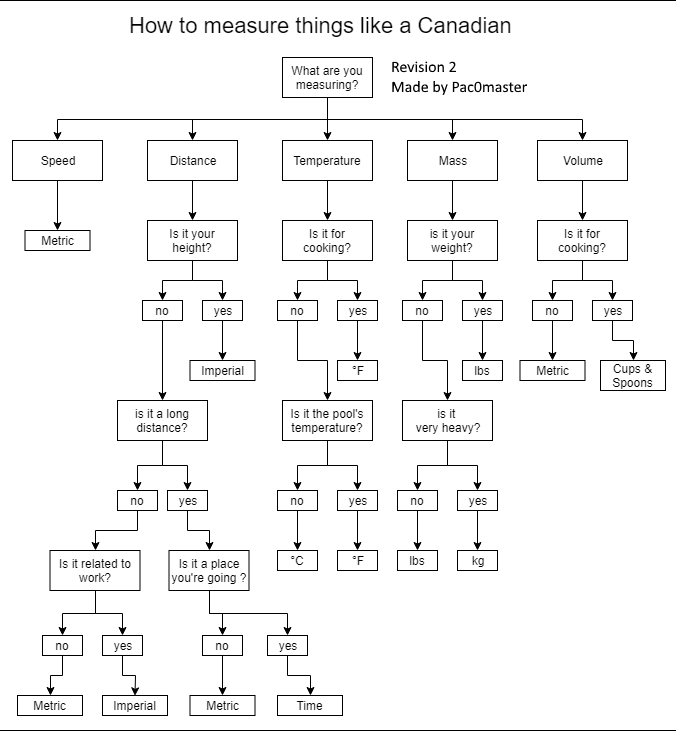
Most of the world switched over to the metric system, but some, like Britain and Canada still use both in a confusing-to-an-outsider idiosyncratic way:

American Gods: Land and Egregores

Filed under: Books, USA — Tags: , , , — Nicholas @ 02:00

Feral Historian
Published 20 Feb 2026

American Gods (Neil Gaiman, 2001) is, among other things, a layered examination of the role of mythologies, religion, national identities, and some underlying “American-ness” that bends them all into something new. By necessity this meanders a bit (I’m not going to get into Gaiman’s failings as a human being much) but it gives us a lot to think about.

I mention a couple outside references in here, links below if you want to dig into it.

Lilly Wachowski on the role of the Red Pill in The Matrix: https://screenrant.com/the-matrix-mov…

George Lucas on the Rebellion, and Viet Cong (people often quote the line but miss the context) : • JAMES CAMERON’S STORY OF SCIENCE FICTION |…

00:00 Intro
01:56 The Setup
04:48 Spirit of America
07:57 White and Red
10:50 New Gods and the State
12:51 Author, Intent, and Meaning
(more…)

QotD: Addiction

Filed under: Health, Quotations — Tags: , , , , — Nicholas @ 01:00

Why is stigmatization in the case of drug addicts so wrong, according to Dr. Volkow? Because addiction is a disease, and nothing else. According to Dr. Volkow people resist this idea, and falsely believe “that willpower should be sufficient to stop drug abuse”. After all, if you give drugs to rats until they are addicted, they will pursue them to the exclusion of all else, to their own detriment and even to the point of death. Moreover, you can show that there are changes in their brains by comparison with non-addicted rats.

Thus an addict has roughly the same metaphysical status as an addicted rat. He does what he does because, like Luther, he cannot do otherwise. He is a slave of his biochemistry, he is a Zombie whose master is his habit. To blame him for his behaviour is like blaming a leper for his leprosy.

This is all the most lamentable bilge, of course. When you consider what heroin addicts actually have to do to become heroin addicts it is clear that, at least to begin with, they want to be heroin addicts, it is not something that just happens to them or creeps up on them unawares. For example, they have to learn where to get their heroin, how to prepare it, and how to inject it (most people have an aversion to sticking needles into themselves and have to overcome it). They have to learn to disregard or overcome such side-effects as nausea, which is normally extremely aversive. Most of us would go a long way to avoid nausea. As a matter of fact, most addicts take heroin intermittently for some time before taking it regularly. The expression “hooked” is implicitly a lie; the addict has hooked heroin, not the other way round.

Still, it might be argued that, having become addicted, the addict loses all powers of control, but this too is not so. The experience (among many others) of American soldiers returning from Vietnam, who addicted themselves to heroin while there, proves it. They swiftly ceased to be addicts on their return to the US, notwithstanding all of Dr. Volkow’s neurocircuitous and neurochemical blather.

Theodore Dalrymple, “Stigma and Sympathy”, The Iconoclast, 2020-09-23.

Powered by WordPress