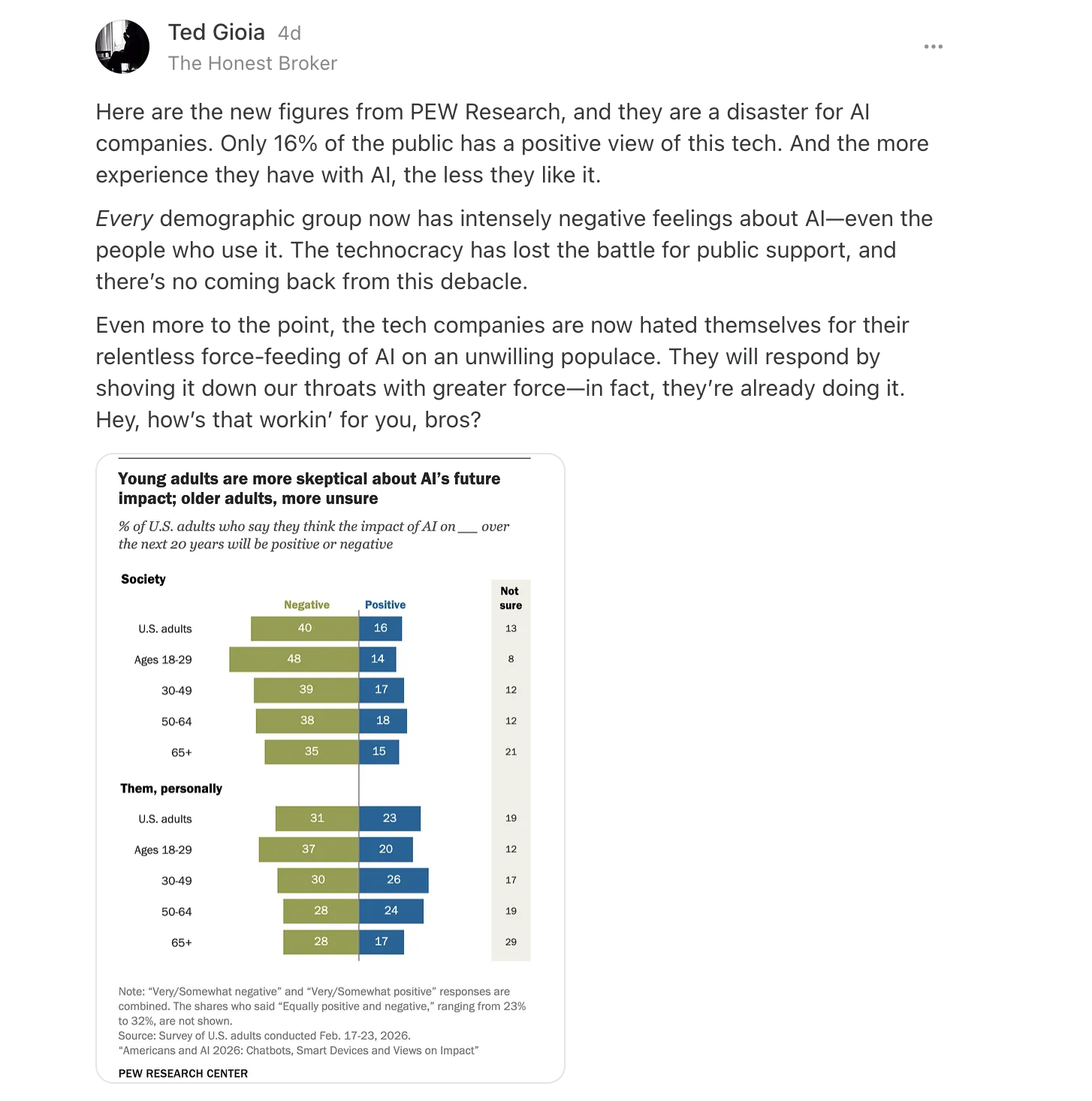
Ted Gioia posted this a couple of days back, but if you haven’t read it it’ll still be new to you:
Last November I suggested that 2026 would witness a tech backlash of unprecedented intensity. And it’s now happening with a vengeance. Silicon Valley is getting skewered everywhere, and to a degree inconceivable just a short while ago.
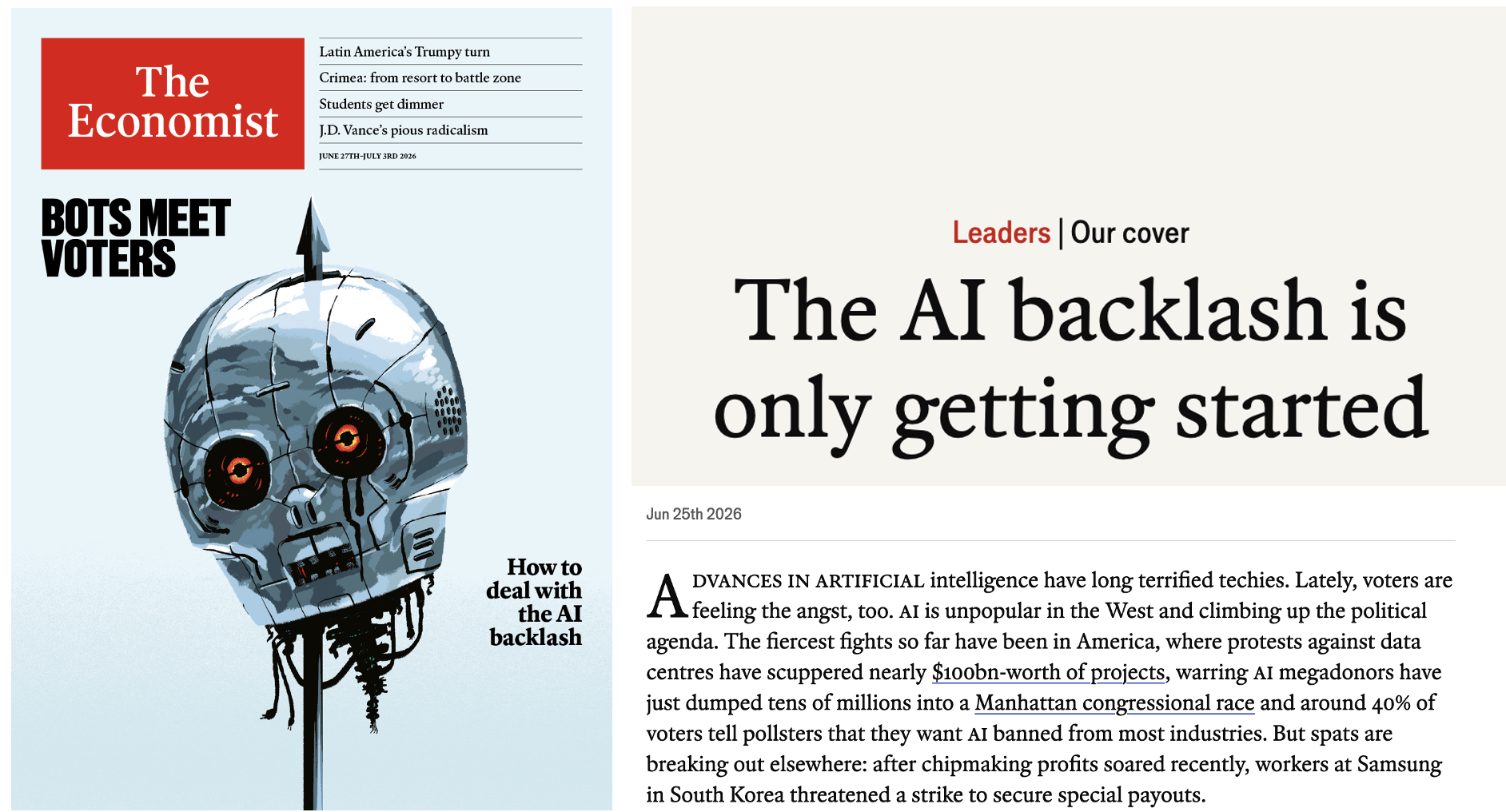
Just yesterday, The Economist finally grasped how rapidly tech antipathy is mounting — and made AI backlash its cover story.
The latest survey numbers are devastating. Every demographic group is now opposed to AI—especially young people, previously the most enthusiastic supporters of new tech.
[…]
Not every pushback to encroaching tech is quite so gentle.
Consider the case of “Mr. Daniels,” a 25-year-old man from England. He knows that AI will rob every music file on the web for training — so he decided to poison the data.
How did he do it? According to Tuned Into Tech, it happens like this:
He took his entire music library of 2,000 records, stripped out the original vocals, and replaced every single one of them with the voice of Homer Simpson. Then he uploaded all of them to Soulseek. He didn’t change the metadata, the file names, the artist tags, the album information. They all stayed exactly the same.
A listener might not notice at first. Some of these songs have long intros, and those are unchanged. But as soon as the singing begins, Homer Simpson takes over. When AI tries to steal this for training, it gets fooled—and contaminates its own data set.
So somewhere deep in a training algorithm’s data set is the audio of Homer Simpson which the AI will assume sounds like [for example] Madonna, Rihanna, or maybe even Sean Paul. The model doesn’t know the difference. It just ingests the data and treats that like the truth.
And that is exactly what Mr. Daniels is hoping for.
He wants “to introduce noise, chaos” into the bots that are putting human musicians out of work.
“Mr. Daniels” is not an isolated example. Musician Benn Jordan has also been “poison-pilling” music files in hopes of disrupting AI.
In recent months, he has watched in horror as “tech companies started raising millions of venture capital dollars and scraping my music without my consent”. They now use his own work to generate “shittier music with it that is inadvertently associated with my name — and then attempting to resell that in the same economy in which I make money from my music”.
As a result, he has stopped releasing music. But he hasn’t walked away from the battle — instead Jordan has developed “a type of encoding that not only makes a music file more or less untrainable by generative AI companies, but actually has the ability to decrease the quality and efficiency of their entire data set”.
“Unethical generative AI companies have made artists feel incredibly powerless for quite some time now”, he adds, “but all of that is about to change”.