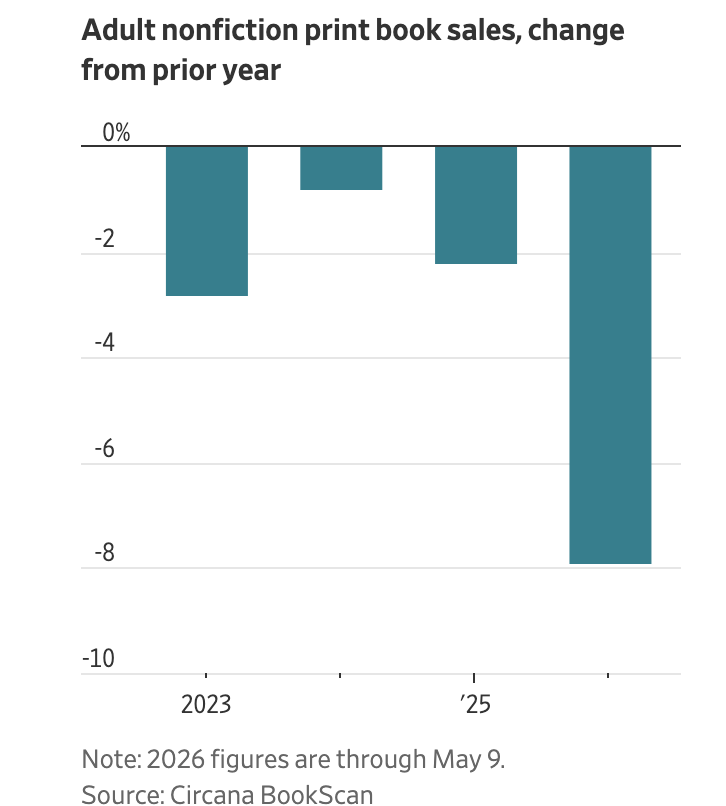
In the latest SHuSH newsletter, Ken Whyte views with (mild) alarm a recent Wall Street Journal article claiming that “Dad books” — the kind of books thoughtful kids give their fathers as gifts — are in steep decline:
The Wall Street Journal ran a piece last month on the death of Dad books, the Father’s Day specials — books about “some little-known chapter of World War II, the sweeping narrative of a shipwreck, perhaps the latest presidential biography”.
Here’s what it gave for evidence. Nonfiction book sales have declined for four years, including an 8 percent drop this year up to May 9.
Sales of Books about politics and current affairs are down 19 percent in those same four months and nine days in 2026. The article quotes, among others, former Simon & Schuster publisher Jonathan Karp saying that “this is a sea change and people should wake up and realize we’re living in a new world”.
The new world is one with “an endless supply of Substack newsletters, Netflix documentaries, YouTube videos and podcasts that offer the kind of fresh reporting, sharp analysis and historical perspective once limited doorstop-size books”.
Jonathan Burnham of Harper Group adds that all these alternatives to books make “the idea of sitting down with a 700-page Ron Chernow book less appealing. You’ve scratched that itch.”
The WSJ noted that Chernow’s recent biography of Mark Twain, published last spring, is underperforming his 2017 biography of Ulysses S. Grant.
There was an obligatory quote from Barnes & Noble CEO James Daunt, who attributed the decline in serious nonfiction sales to the fact that everyday events are all-consuming: “The world is exceptionally interesting right now and when that happens the nonfiction reader is reading the news instead.”
As someone who publishes a lot of Dad books, i.e., serious researched nonfiction, histories and biographies, that sort of thing, I read the article with concern. In fact, I read it twice.
I felt much better after the second reading.
Let’s start with the chart. The first four months and 9 days of 2026 are doing all the work here. A decline of 1 to 2 percent in the years 2023 to 2025 is statistical noise. Circana BookScan numbers don’t include audiobooks, which have been rising steadily in popularity. The very slight decline in sales for the first three years might be entirely attributable to format shifting, hardcopy to digital audio. The 8 percent decline in the first four months of 2026 looks more ominous, but book sales figures are always lumpy, never a straight line. A four-month sample tells you nothing.
The greater problem with the chart is that it is counting adult nonfiction book sales, not Dad books. There are any number of ways to cut Circana BookScan data, but the broad adult nonfiction category contains a vast array of books. Books for men, books for women, books for everybody. Not only serious researched nonfiction, but self-help, how-to, study guides, business and personal finance, psychology and religion books, health and fitness books, parenting books, food and travel books, true crime, sports, military, essays, crafts and hobbies, memoirs, etc. There is no data cut for Dad books. So the story is backing its thesis for the death of apples with stats about oranges.
The report of a 19 percent drop in the narrower category of politics and current affairs also looks ominous, but this is one of the most notoriously cyclical genres in existence. And, again, we’re discussing a short period of four months and nine days. The new Trump era was less than a year old at the start of that period. It generally takes longer than a year to get new books from commission to sale. Ten days after the end of the period under discussion, Andrew Weissmann released Liar’s Kingdom: How to Stop Trump’s Deceit and Save America. It was an instant number-one New York Times bestseller. In so specialized a category as this, Liar’s Kingdom alone might have been sufficient to right the ship.
The only other evidence presented to support the decline in Dad books is poor Ron Chernow’s journey. His Mark Twain, with 119,259 hardcover sales, is underperforming his Ulysses S. Grant, with 381,604 sales.
I don’t know where to start. The Grant book has been out for almost a decade, Twain for a year. Not surprising that it has sold less. Also, you can’t compare major political biographies to major cultural biographies. David McCullough’s biographies of Truman and Adams far outsold his book about American artists and writers in Paris. And while I’m a fan of Chernow, his Twain book isn’t his best work. He received polite and generally positive reviews, but they noted that the book is overly long — the word “exhaustive” surfaces repeatedly — and that he doesn’t entirely succeed in bringing Twain to life. Grant is a superior book, and the more enjoyable read, too, if customer reviews are anything to go by. The Twain sales prove nothing.
So we don’t really have any evidence at all that Dad books are in trouble, that they’re getting swamped by podcasts or current events, and certainly not that there’s been “a sea change” and that we’re living “in a new world”.
Amusingly, the literary world was flooded with hot new Dad books coincident with the WSJ‘s declaration of their death.