Quotulatiousness

June 25, 2026

Formerly Peru’s First Lady, Keiko Fujimori is now President in her own right

The new President of Peru, Keiko Fujimori, faces a big economic challenge to her nation:

With just over 99% of ballots counted, Keiko Fujimori holds a lead of roughly 40,000 votes over Roberto Sánchez — less than half a percentage point, and the third consecutive Peruvian presidential contest decided by a margin that narrow. Sánchez led through the early days of counting, carried by rural and highland turnout; but the overseas votes, which broke for Fujimori above 63%, pulled the result the other way as the tally crossed 95%.

The outcome is no longer seriously in doubt. What remains in doubt is whether a victory this narrow constitutes a mandate to govern, or merely a turn to occupy the office in impotence.

Fujimori has never held executive power. What she inherits, however, is a name: her father, Alberto Fujimori, governed Peru from 1990 to 2000, stabilizing a hyperinflationary economy and crushing the Shining Path insurgency, albeit with darkly authoritarian techniques for which he was later convicted. Long known as Peru’s answer to Venezuela’s Hugo Chávez, Fujimori has cast a long shadow over Peruvian politics ever since.

Keiko served as his First Lady through the latter half of the 1990s, then built her own career: a congresswoman from 2006 to 2011, and the leader of Fuerza Popular (“Popular Force”) since. She spent 13 months in pretrial detention on corruption charges tied to Odebrecht financing; a court voided the case in January 2025. She has run for president four times, losing the previous three runoffs by margins under a single percentage point before, now, winning her fourth.

Her governing history is, as a result, tied deeply to her father’s. She has spent two decades defending it rather than living it, which is itself a kind of qualification in a country where economic memory often prevails over institutional memory. The model her father installed — trade liberalization, fiscal orthodoxy, an open door to foreign capital — has outlasted eight changes of president in ten years. The claims of Fujimorismo — the governing-economic doctrine named for Fujimori that has dominated ever since his time — is that it alone can be trusted to keep that model standing.

Keiko Fujimori’s flagship commitments are, consequently, the two pillars of Fujimorismo itself: a hard line on crime, and an unapologetic defense of the market economy.

The security platform proposes deploying the military against organized crime and prison disorder, taking inspiration both from Peru’s own recent past, and Nayib Bukele’s divisive tactics in El Salvador. Alongside this, the platform promises expanding video surveillance, and modernizing this apparatus through the use of artificial intelligence to detect corruption in public contracting. She insists that her father’s system’s abuses will not be repeated.

The economic platform is a much-needed deregulatory shock: cutting investment-approval timelines by 40%, reducing the fiscal deficit from 2.2% to 1% of GDP, and shrinking the state. As for exactly how that shrinking will be achieved besides the aforementioned measures, Keiko is not clear.

Nevertheless, both pillars of the plan were sold on a single word, repeated at her closing rally and in her final debate: order, against the chaos she says the left represents.

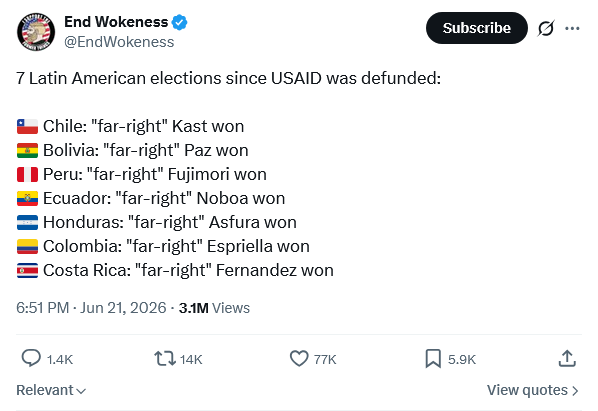
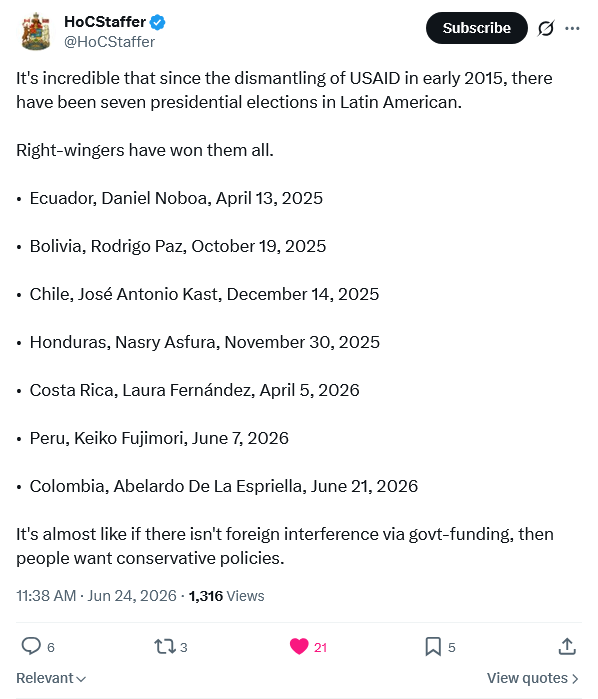
In counterpoint to recent claims that cutting USAID funding cost the lives of millions of children who depended on those funds, taking away USAID support in much of South America led to a number of electoral changes:
October 16, 2021

City Minutes: Indigenous America

Overly Sarcastic Productions
Published 15 Oct 2021

As we look at four pre-Columbian American cities, I don’t know whether to be more impressed with the the architecture or the landscaping. Probably both.

More Indigenous Myths & History:
The Five Suns (https://youtu.be/dfupAlon_8k)
Quetzalcoatl (https://youtu.be/451jzIesWoU)
Huitzilopotchli (https://youtu.be/Zj-jDOjBets)
El-Dorado (https://youtu.be/UHzkGueRz3g)
Pele (https://youtu.be/q1z19p48lZU)
Hawaii (https://youtu.be/xYouQESFE2A)

Teotihuacan shirt: https://www.redbubble.com/shop/ap/903…

Timestamps:
0:00 – 1:03 — Teotihuacan
1:03 – 2:04 — Tikal
2:04 – 3:00 — Tenochtitlan
3:00 – 4:08 — Cusco
4:08 – 5:20 — Conclusion

SOURCES & Further Reading: The Great Cities in History by John Julius Norwich, The Great Courses lectures “The Great City of Teotihuacan” and “Tikal – Aspiring Capital of the Maya World” and “The Aztec Capital of Tenochtitlan” from lecture series Maya to Aztec: Ancient Mesoamerica Revealed by Edwin Barnhart, and “Machu Picchu and the Sacred Valley” and “The Inca – From Raiders to Empire” from lecture series The Lost Worlds of South America by Edwin Barnhart.

Our content is intended for teenage audiences and up.

PATREON: https://www.Patreon.com/OSP

PODCAST: https://overlysarcasticpodcast.transi…

DISCORD: https://discord.gg/osp

MERCH LINKS: http://rdbl.co/osp

OUR WEBSITE: https://www.OverlySarcasticProductions.com
Find us on Twitter https://www.Twitter.com/OSPYouTube
Find us on Reddit https://www.Reddit.com/r/OSP/

September 11, 2020

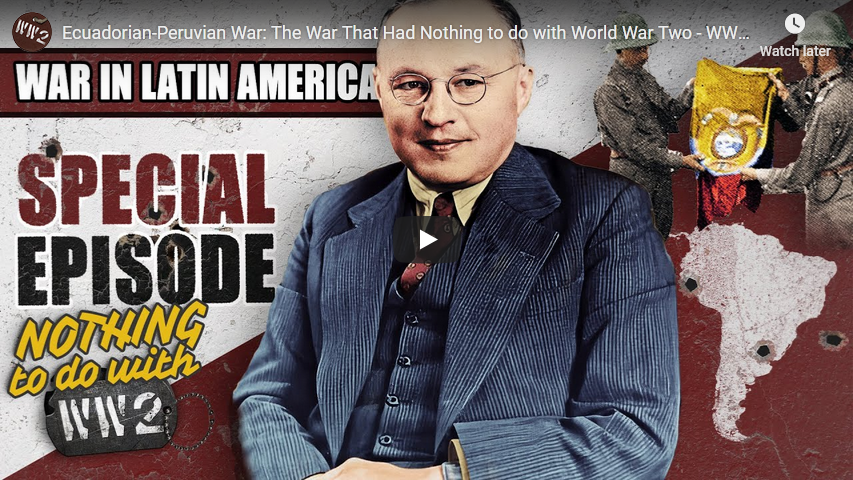
Ecuadorian-Peruvian War: The War That Had Nothing to do with World War Two – WW2 Special

Filed under: Americas, History, Military — Tags: , , , , — Nicholas @ 06:00

World War Two
Published 10 Sep 2020

While the Second World War grows ever more destructive, some nations take advantage of the global chaos to settle old disputes. In Peru and Ecuador, long standing territorial disputes turn violent.

Join us on Patreon: https://www.patreon.com/TimeGhostHistory
Or join The TimeGhost Army directly at: https://timeghost.tv

Follow WW2 day by day on Instagram @ww2_day_by_day – https://www.instagram.com/ww2_day_by_day
Between 2 Wars: https://www.youtube.com/playlist?list…
Source list: http://bit.ly/WW2sources

Hosted by: Indy Neidell
Written by: Francis van Berkel
Director: Astrid Deinhard
Producers: Astrid Deinhard and Spartacus Olsson
Executive Producers: Astrid Deinhard, Indy Neidell, Spartacus Olsson, Bodo Rittenauer
Creative Producer: Joram Appel
Post-Production Director: Wieke Kapteijns
Research by: Marlon William Londono and Lewis Braithwaite
Edited by: Mikołaj Cackowski
Sound design: Marek Kamiński
Map animations: Eastory (https://www.youtube.com/c/eastory)

Colorizations by:
Carlos Ortega Pereira, BlauColorizations, https://www.instagram.com/blaucolorizations
Mikolaj Uchman

Sources:
David Rumsey Map Collection, David Rumsey Map Center, Stanford Libraries
ecured.cu
From the Noun Project: Artillery by Creative Mania, engineer by Eucalyp, company soldiers by Andrei Yushchenko, Horse by RIZCA

Soundtracks from the Epidemic Sound:
Rannar Sillard – “March Of The Brave 4”
Johannes Bornlof – “The Inspector 4”
Fabien Tell – “Last Point of Safe Return”
Reynard Seidel – “Deflection”
Philip Ayers – “Trapped in a Maze”
Johannes Bornlof – “Deviation In Time”

Archive by Screenocean/Reuters https://www.screenocean.com.

A TimeGhost chronological documentary produced by OnLion Entertainment GmbH.

October 5, 2019

Legends Summarized: El Dorado

Overly Sarcastic Productions
Published 4 Oct 2019

El Dorado! A shining golden city packed with promises of wealth, power and everlasting glory. An unspoiled paradise deep in the jungle, the PERFECT destination for treasure-hunters and anthropologists alike. Something that perfect is something EVERYONE wants to be real.

Aaaaand that’s the trick, isn’t it? Wanting something that badly isn’t healthy. Just ask the conquistadors!
(Oh wait, we can’t – because so many of them died on fruitless quests for El Dorado. And also it’s been five hundred years and they’d all be dead anyway)

PATREON: https://www.Patreon.com/OSP

MERCH LINKS: https://www.redbubble.com/people/OSPY…

OUR WEBSITE: https://www.OverlySarcasticProductions.com
Find us on Twitter https://www.Twitter.com/OSPYouTube
Find us on Reddit https://www.Reddit.com/r/OSP/

September 22, 2019

The Inca Empire – A God Taken Hostage – Extra History – #5

Filed under: Americas, Europe, History, Military, Religion — Tags: , , , , , — Nicholas @ 06:00

Extra Credits
Published on 21 Sep 2019

Join us on Patreon! http://bit.ly/EHPatreon

Atahualpa vs. Francisco Pizarro. The Incas had never seen horses before, and it wasn’t long before the Spanish had captured Atahualpa as a hostage for gold and silver. But Atahualpa had a plan. He found a way to use this situation to his own political advantage — and Pizarro eventually destroyed himself through his greed and violent carelessness that appalled the Spanish government, eventually allowing the Incas to thrive again.

Follow us on Instagram: http://bit.ly/ECisonInstagram

September 16, 2019

The Inca Empire – Andean Apocalypse – Extra History – #4

Filed under: Americas, History, Military — Tags: , , , , , , — Nicholas @ 06:00

Extra Credits
Published on 14 Sep 2019

Join us on Patreon! http://bit.ly/EHPatreon

Disease — likely, smallpox or measles — had arrived in the Inca empire, and it was ruthless. Two of the (now dead) Emperor Huayna Capac’s sons, Atahualpa and Huáscar, decided that a civil war over who should be Sapa Inca was perfect to do right now — nevermind the fact that Francisco Pizarro and his conquistadores had just showed up.

September 9, 2019

The Inca Empire – Life of a Dead Emperor – Extra History – #3

Filed under: Americas, History, Religion — Tags: , , , , — Nicholas @ 04:00

Extra Credits
Published on 7 Sep 2019

Join us on Patreon! http://bit.ly/EHPatreon

To understand daily life in the Inca Empire, we travel from Cusco to Quito (located in modern-day Ecuador), where Thupa Inca wanted to establish a second capital city. From efficiently designed work assignments, to elaborate death rituals, life was neatly organized, masking rising tensions.

September 2, 2019

The Inca Empire – Earth-Shaker – Extra History – #2

Filed under: Americas, History, Military — Tags: , , , — Nicholas @ 04:00

Extra Credits
Published on 31 Aug 2019

Join us on Patreon! http://bit.ly/EHPatreon

Pachacuti, the Earth-Shaker, was the ninth leader of the Inca and the one who took the ambitions of the city of Cusco into an all-out military campaign to expand the empire — alongside bribing and engineering and negotiating their way to expansion.

Pachacuti turned out to be a good name for this ninth ruler of the Inca, because while the name did mean “earth-shaker” it was also a philosophical concept. In Quechua, the Inca’s primary language, a pachacuti was a historic event, a cataclysm that overturns space and time, remaking the world. It was a good title for the man who would forge the Kingdom of Cusco into an empire.

August 26, 2019

The Inca Empire – Out of Thin Air – Extra History – #1

Filed under: Americas, History, Religion — Tags: , , , , — Nicholas @ 04:00

Extra Credits
Published on 24 Aug 2019

Join us on Patreon! http://bit.ly/EHPatreon

There’s a lot that we don’t know for sure about the Inca Empire, because we have conflicting accounts among Spanish colonizers, as well as the fact that Inca history itself is told non-linearly. But we do know that they used Andean accomplishments, from architecture to knotted quipu, to create a city that ruled the largest indigenous empire in the Americas, starting with Manco Capac and the successive Sapa Inca rulers.

August 20, 2018

Causes of Inflation

Filed under: Economics — Tags: , , , , , — Nicholas @ 02:00

Marginal Revolution University
Published on 24 Jan 2017

In the last video, we learned the quantity theory of money and its corresponding identity equation: M x V = P x Y

For a quick refresher:

‌•M is the money supply.

‌•V is the velocity of money.

‌•P is the price level.

‌•And Y is the real GDP.

In this video, we’re rewriting the equation slightly to divide both sides by Y and explore the causes behind inflation. What we discover is that a change in P has three possible causes – changes in M, V, or Y.

You probably know that prices can change a lot, even over a short period of time.

Y, or real GDP, tends to change rather slowly. Even a seemingly small jump or fall in Y, such as 10% in a year, would signal astonishing economic growth or a great depression. Y probably isn’t our usual culprit for inflation.

V, or the velocity of money, also tends to be rather stable for an economy. The average dollar in the United States has a velocity of about 7. That may fall or rise slightly, but not enough to influence prices.

That leaves us with M. Changes in the money supply are the driving factor behind inflation. Put simply, when more money chases the same amount of goods and services, prices must rise.

Can we put this theory to the test? Let’s look at some real-world examples and see if the quantity theory of money holds up.

In Peru in 1990, hyperinflation came into full swing. If we track the growth rate of the money supply to the growth rate of prices, we can see that they align almost perfectly on a graph with both clocking in around 6,000% that year.

If we plot the growth rates of the money supply along with the growth rates of prices for a many countries over a long stretch of time, we can see the same relationship.

We’ll wrap-up the causes of inflation with three principles to keep in mind as we continue exploring this topic: ‌

•Money is neutral in the long run: a doubling of the money supply will eventually mean a doubling of the price level.
‌•“Inflation is always and everywhere a monetary phenomena.” – Milton Friedman ‌
•Central banks have significant control over a nation’s money supply and inflation rate.

July 14, 2018

Hernando de Soto Knows How To Make the Third World Richer than the First

Filed under: Americas, Economics, Law, Liberty — Tags: , , , — Nicholas @ 04:00

ReasonTV
Published on 13 Jul 2018

The Peruvian economist says blockchain technologies and social media will transform the planet by securing property rights.
—————-

In the spring of 1989, Chinese students occupied Tiananmen Square, erected a replica of the Statue of Liberty, and called for democracy and individual rights. By the fall, people living in East Germany took hammers and chisels to the Berlin Wall, unleashing a wave of revolutions that ultimately led to the collapse of the Soviet Union. It was an auspicious year for human freedom.

Nineteen eighty-nine was also the year that Peruvian economist Hernando de Soto published The Other Path: The Invisible Revolution in The Third World, which radically challenged conventional wisdom about the underlying cause of persistent poverty in the post-colonial landscape. Drawing on his extensive field work with the Peruvian-based think tank the Institute for Liberty and Democracy, de Soto argued that people were pushed into the black market and wider informal economy because governments refused to recognize, document, and promote legal ownership of land and other assets.

Without clear title and the right to transfer property, common farmers understandably refused to invest much in the land they tilled, and they couldn’t use it as collateral. This created what de Soto later called “citadels of dead capital” with value that could never be fully accessed.

No one, he argued, would plan for the future if everything they accumulated could just be taken away. As much an activist as an intellectual, De Soto has been called “the world’s most important living economist” by former President Bill Clinton. He is credited with changing policy in Peru and elsewhere by pushing governments to create property regimes that are public, transferable, and secure. His latest endeavor is a partnership with Overstock.com founder Patrick Byrne and others to use blockchain technology and social media to create totally public and perfectly transparent records of ownership.

Reason‘s Nick Gillespie caught up with de Soto in Washington, D.C. in June, where he received the Competitive Enterprise Institute’s Julian L. Simon Memorial Award, named for the late free-market economist who believed that “mankind is the ultimate resource.”

May 3, 2017

“Poverty, to be scenic, should be rural”

Filed under: Americas, Economics, Liberty — Tags: , , , , — Nicholas @ 05:00

Daniel Hannan on the contrast between rural and urban poverty, and the attitudes of Westerners:

When I was growing up in Lima in the 1970s, Western visitors were astonished by the shantytowns, the barriadas, as they were known, that ringed that grimy city. Why, they asked, did people leave the countryside to live in these squalid slums? Why swap the pure air of the Andes for traffic fumes and sewage?

It was a very First World question. No Peruvian ever asked why people were quitting villages that lacked electricity and clean water. The barriadas may have been ugly, but they were humming with enterprise. They offered work, access to schools and clinics, a power supply. They were, for most of their denizens, transitional, a staging post between mountain squalor and something better.

In time, I came to realize that Western nose-wrinkling at developed countries was more esthetic than sympathetic. As the Victorian novelist Anthony Trollope put it, “Poverty, to be scenic, should be rural.”

Western attitudes haven’t advanced much since then. My kids’ geography homework is full of stories about evil Western corporations exploiting poor women in Vietnam or wherever. Now, you and I would not want to work in a Vietnamese sweatshop. But we have not spent our lives bending our backs in rice paddies.

Employees of foreign-owned companies in Vietnam earn 210 percent of the average wage. The readiness of that country to open itself to trade and investment has brought huge benefits to the Vietnamese, including those on the lowest incomes. Over 19 years, the West struggled to defeat totalitarian socialism in Vietnam, and failed. Three decades of trade have achieved what 60,000 American lives and over a trillion dollars in today’s prices in military spending failed to achieve: the end of Communism.

Developing countries which open their markets eliminate poverty more quickly than those which don’t. Compare Vietnam to Myanmar, or Colombia to Venezuela, or Bangladesh to Pakistan. A study of developing states since 1980 showed that those which had joined the global trading system enjoyed annual growth at an average of 5 percent, as against 1.5 percent for those which hadn’t.

February 4, 2017

Simón Bolívar – VI: All Good Things – Extra History

Filed under: Americas — Tags: , , , , — Nicholas @ 04:00

Published on Dec 24, 2016

Simón Bolívar hoped to bring the nations of South America together in one great federation, but he feared that people would think he meant to make himself a king. He tried to step back, but revolution threatened from within his ranks and his body had grown weak with illness.

January 30, 2017

Simón Bolívar – V: Heavy is the Head – Extra History

Filed under: Americas, History — Tags: , , , — Nicholas @ 03:00

Published on Dec 17, 2016

After so many failures, Simón Bolívar finally began to find success: Gran Colombia, Peru, and Bolivia all stood free from Spanish rule. He raced to found new governments and consolidate the liberty he’d earned, but resources had been stretched too thin.

January 25, 2017

Simón Bolívar – IV: Defeat is Not Surrender – Extra History

Filed under: Americas, History — Tags: , , , , — Nicholas @ 04:00

Published on Dec 10, 2016

Failure had taught Simón Bolívar one important lesson: no single state in Spanish South America could win independence alone. To succeed, he needed to form one great state, united and able to stand up to the might of Spain.

Older Posts »

Powered by WordPress