Quotulatiousness

March 9, 2026

A lot of real problems could be fixed with $16 trillion

Filed under: Economics, Environment, Government — Tags: , , — Nicholas @ 04:00

On his Substack, John Robson observes that there are huge numbers of problems — real, measurable problems — that could be ameliorated or completely solved by the application of $16 trillion dollars. But instead, the governments of the western world have pissed that up against the wall on unsuccessful efforts to address climate change:

In the Epoch Times Stephen Moore of the Heritage Foundation writes “Environmental scholar Bjorn Lomborg recently calculated that across the globe, governments have spent at least $16 trillion feeding the climate change industrial complex. And for what?” A splendid question. Of course some people would say “Well, to keep the sky from catching fire, duh”. But since the reduction in emissions has been trivial, it wasn’t a great bargain. Plus, Moore being an actual economist, he drills in on the key point: “But it’s much worse than that. In economics, there is a concept called opportunity cost: What could we have done with $16 trillion to make the world better off?” So, after carving “Opportunity cost” over the entrance to our academy, we ask anyone who enters to suppose that you are a do-gooder, and a green one at that. And suppose that someone had offered you sixteen trillion bucks back in 1995 to do good with. Whatever you wanted. Malnutrition in Africa. Plastic in the oceans. Loss of habitat. Safe drinking water for people in South Asia or even on Canadian aboriginal reserves. Literally anything. What could you have accomplished, or at least attempted? This question was long ago posed by Lomborg, albeit only with $75 billion imaginary dollars, to a panel of experts who concluded climate change was far down the list of spending targets. And yet governments said no thanks and spend all $16 trillion fighting “carbon pollution”. And for what?

In their defence those same governments might be tempted to point to the lack of warming and say something like “See, it worked! Sure, $16 trillion is a lot but we saved Earth from runaway heating so be grateful.” However they are also the ones who lament that the planet continues to warm, heat, bake and boil. So even if they’re right, they’re wrong. And either way, the money really was all wasted.

Of course they might say no, see, it would have been way worse without that spending. And as we’ve noted before, one of the many slippery things about climate alarmism is just how fast they think changes in CO2 produces changes in temperature and via changes in temperature, changes in weather. It’s very difficult to pin them down on just when the really troubling impacts began to be palpable, not least because they generally say we’re already in a climate crisis that’s about to hit. But even the models, and here we include hysterical ones like RCP8.5, do not generally suggest that the temperature today would be a whole lot higher if we’d stayed on the emissions track from 1995 instead of, well, staying on it, with Western nations declining due to increasing energy efficiency not political grandstanding and China, India and others more than taking up the slack.

To be fair, it would not be illogical for such persons to say, or shriek, that it proves $16 trillion was just peanuts, we should have spent $160 trillion or $48 quadrillion or 4 Triganic Pus or something of that sort. And they did.

For instance, just over two years ago Bloomberg actually ran a column saying “$266 Trillion in Climate Spending is a No-Brainer”. And we agreed, sardonically, since the whole world GDP seems to be around $96 trillion as nearly as anyone can estimate it. (We are not convinced most alarmists who toss such numbers around, like former Canadian Environment Minister Catherine McKenna who wanted “trillions in infrastructure investments from both governments and the private sector”, can tell you off the cuff to within an order of magnitude what, say, the current US or Canadian GDP is.)

December 4, 2025

Don’t put a lot of trust in the “surging Canadian GDP stories” they’re pushing

Filed under: Cancon, Economics, Government, Media — Tags: , — Nicholas @ 03:00

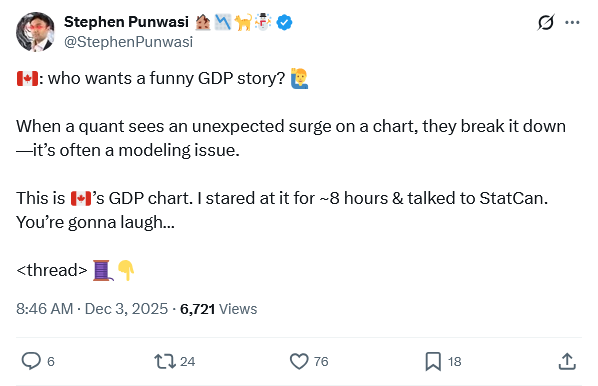
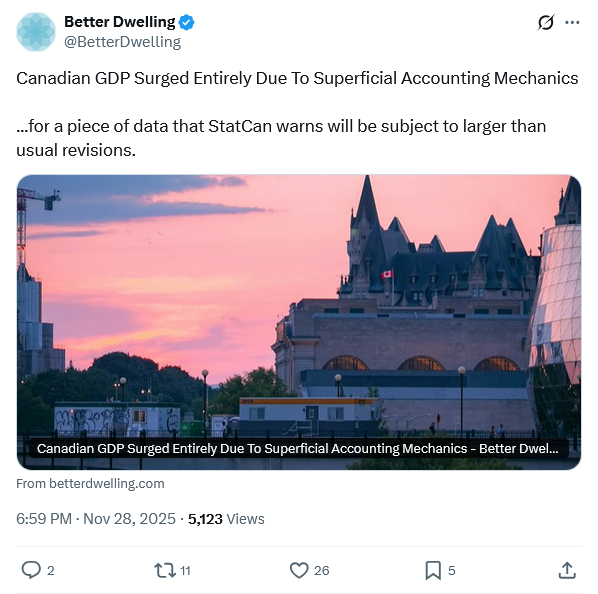
On the social media site formerly known as Twitter, Stephen Punwasi put together an interesting thread on the latest “rosy scenario” GDP numbers the state media have been making such a big deal about:

2/ What do we see? Imports contributed 0.7 points out of 0.6 points of Q3 GDP growth. The rest of the economy was a net drag.

Imports contribute to GDP as a part of net exports: exports minus imports.

Smaller imports boost net exports. Imports made the biggest drop since 2022.


3/ What we’re seeing is a phenomenon called import compression: the balance was boosted by falling imports.

It’s a superficial improvement due accounting mechanics. The only growth is actually weakness.

We figured it out. But wait β€” how do they get import/export data? 😬


4/ Let’s start with imports. I recalled reading about the CBSA’s new customs & revenue management (CARM) platform.

Totally normal bedtime reading for weirdos, I know.

CARM delayed data to StatCan, who had to estimate on trend & revise. I can’t recall the issue being resolved.


4/ I contact StatCan. Delays have improved but recent data is heavily impacted.

They warn to expect larger than usual revisions to September β€” a third of Q3. πŸ˜…

It gets funnier: πŸ‡ΊπŸ‡Έ’s gov shutdown means πŸ‡¨πŸ‡¦ can’t get data for ~75% of its exports. Trend estimate again.


5/ so all GDP growth was imports, which fell faster than exports.

Imports & exports are estimates based on trend.

But wait β€” what exactly is a trend? It’s based on seasonal adjustments β€” smoothing predictable variation.

In πŸ‡¨πŸ‡¦, that means suppressing summer & boosting winter.


6/ non-predictable variations to consumption like recession & trade wars can’t be filtered out.

The adjustment over/understates. e.g. πŸ‡ΊπŸ‡Έ Fed research shows this overstated recovery & lengthened the financial crisis. Ditto with COVID.

It can’t be fixed until years later.


7/ let’s put this together:

– πŸ‡¨πŸ‡¦’s GDP grew exclusively due to the trade balance.

– import compression β€” a weakness that overstates growth

– trade had to be inferred via trend

– trend overstated by irregular shock

Yup.


8/ just to clarify β€” none of this is StatCan’s fault.

They’re tasked w/a deadline over the past year & πŸ‡¨πŸ‡¦ decided to overhaul its trade data during a trade war.

They told me Dec 11th will be when revisions for imports come in & we’ll get an update on CARM.


9/ Bonus fun facts for the pros:

– by pushing it back to the 11th, this overstatement helps suppress yields for the GoC cash management program

– the 11th is after the last auction data is provided to dealers

Fascinating combo while πŸ‡¨πŸ‡¦ is asset cycling for short-term optics.


10/ anyway, full write up, direct quotes from StatCan, & a fun bonus GDP fact for the kiddos.

Also, follow @BetterDwelling if you found this interesting.

We take research & insights reserved for deep-pocketed investors & give it away to normies w/plain english explanations.

December 2, 2025

The elites will continue pushing high immigration despite the obvious social costs it imposes

One of the very tip-top luxury beliefs is that massive immigration is always and under all circumstances a good thing. A great thing, even. One of the things about the holders of luxury beliefs is that they are almost always completely insulated from any of the consequences of their beliefs, and this is especially true in this case. As Lorenzo Warby points out, the elites’ devotion to this cause contributes to collapsing levels of trust in the society absorbing all those immigrants and deeply undermines confidence that the leadership have anyone else’s but their own best interests at heart:

There is a straightforward, respectable view on immigration to Western countries. More people means more transactions, means more gains from trade, so immigration is a good thing. Immigration grows the economy, it increases GDP, so sensible folk support immigration.

There are extra bells and whistles, such as providing needed skills; compensating for falling fertility; willingness to do jobs locals are not. All the extra bells and whistles have responses. Why not train locals (i.e., citizens)? Won’t the immigrants’ fertility also fall? (Yes, though possibly more slowly.) The real willingness is to do jobs at lower wages and conditions than the locals would accept. For instance, potentially using US H1B visas to bring in entry-level employees who will work for less, and in worse conditions, than the locals.

Moreover, increasing total GDP is not the same as increasing per capita GDP. Even with per capita GDP, there are always questions about the distribution of those gains to GDP.

Nevertheless, the basic intuition is: immigration means more transactions, more gains from trade. Those who believe in markets β€” in positive-sum interactions β€” should support immigration.

This is not the trumping response it appears to be. Immigration does not only import workersβ€”nor even just increase mutual-gain transactions β€” it imports people, so potentially affects all aspects of the receiving society. This means, of course, that there are a much wider range of possible concerns about immigration that “yes, but more gains from trade” is not an adequate response to.

Efficiency and number of transactions are not the only issues for a social order, particularly not a flourishing social order. There are also issues of social cohesion; social resilience; connections and social capital; the distribution of GDP gains; effects on relative prices; congestion costs; how well institutions are managing the influx; effects on local communities; cultural differences; social coordination issues and the ability to manage collective action problems; increased competition for positional goods β€” goods that cannot, or are blocked from, responding to increased demand.

These are all legitimate grounds for concern that are not answered by “yes, but more gains from trade“. How many of those “yes, but more gains from trade” folk have grappled with mass rape and sexual exploitation of young women and girls as a cost of culturally divergent immigration (and its systematic mismanagement)? How many of those “yes, but more gains from trade” folk have grappled with violent disturbance, even civil war, as a potential cost of immigration, even though we have historical examples of precisely that?

If, on one hand, the respectable people insist “yes, but more gains from trade” is an adequate response, and that other concerns are not legitimate, this will almost certainly be taken as the contemptuous dismissal it is. Not only will it not be persuasive, it will (and does) generate anger and resentment.

If people have concerns that the “reasonable”, “liberal-minded” folk will not deal with β€” or, worse, are dismissive of such concerns even being raised β€” then people will turn to unreasonable and illiberal folk, if they are the only people who will respond to their concerns. Significant gaps in political markets will be filled by political entrepreneurs.

If folk are told that “if you believe in markets, you have to support (high levels of) immigration” then many folk will respond with “OK, I reject markets“. Moreover, it is simply false that market economics entails that mass immigration is a good thing.

The idea that there is some economic phenomena such that marginal costs exceeds marginal benefits for all people over all ranges in all forms is not Economic thinking, it is magical thinking. (More precisely, it is class-signalling parading as Economics.)

It is magical thinking that falls foul of economist Thomas Sowell‘s dictum that there are no solutions, only trade-offs. Immigrants may be engaging in lots of positive-sum, gains from trade transactions, yet still be imposing more costs than benefits on a society, and on resident citizens, precisely because societies are not just efficiency arenas for free-floating transactions and no one is just an economic transactor.

Update, 3 December: Welcome, Instapundit readers! Please do have a look around at some of my other posts you may find of interest. I send out a daily summary of posts here through my Substack – https://substack.com/@nicholasrusson that you can subscribe to if you’d like to be informed of new posts in the future.

August 30, 2025

Canada’s economy is going the wrong way

Filed under: Cancon, Economics, Government, Media, Politics, USA — Tags: , , , — Nicholas @ 03:00

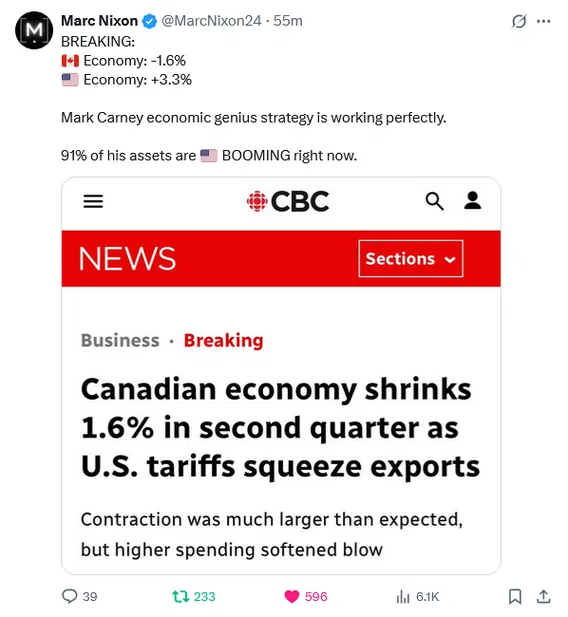
The latest figures show the US economy growing by 3.3% while Canada’s shrank by 1.6% in the same period. It’s bad news for Canadians, except those like Prime Minister Mark Carney who have the bulk of their investments in the United States (91% for Carney, according to various sources). On X, Dan Knight explains what is happening:

Canada’s economy just shrank. That’s the headline. In the second quarter of 2025, real GDP fell 0.4%. On a per-person basis, it was the same. Canadians are poorer than they were three months ago. That’s not speculation. That’s Statistics Canada’s official number.

So, here’s what happened. The government and its media allies spent the spring bragging that the Canadian economy “grew” in the first quarter of 2025. Real GDP was up half a percent. Sounds good, right? But if you read the fine print, if you look at the numbers it wasn’t real growth at all. It was panic.

Exporters rushed to push product into the United States before tariffs came down. Automakers. Machinery producers. Parts suppliers. They all jammed as much across the border as they could, knowing the window was closing. That sugar high showed up in the Q1 GDP number. It made the economy look like it was humming along.

Then the tariffs hit. And in the second quarter, the bottom fell out. Exports collapsed down 7.5% overall. Passenger cars and light trucks? Down nearly 25%. Machinery and equipment? Down 18.5%. Travel services? Down 11%. The result: GDP fell 0.4%. On a per-capita basis, it was exactly the same. Canadians are literally poorer than they were three months ago.

This is the story you’re not hearing: Q1 wasn’t proof of a healthy economy. It was proof of a desperate one. Businesses scrambling to get ahead of trade barriers, because they knew Ottawa wasn’t going to stop them. Q1 was fake growth, and Q2 was the crash.

Meanwhile, households are spending more, saving less, and wages are barely moving up just 0.2%, the slowest since 2016 outside of COVID. Corporate profits are falling. Government revenues are down since the carbon tax was lifted. And Ottawa’s answer? Spend more. Borrow more. Pretend it’s all fine.

So the question is simple: if this is what “growth” looks like under Mark Carney’s Liberal government front-loaded exports, collapsing investment, rising debt what does the next quarter look like?

On her Substack, Melissa Lantsman says that the economic situation in Canada is discouraging investors from putting money into Canadian companies:

You don’t need to be a foreign investor to see that putting your money into Canada is not a winning move.

Recently, Statistics Canada reported “strong foreign divestment in Canadian shares” across many sectors, including energy, mining, and manufacturing. At the same time, Canadian buyers also moved their money stateside, purchasing $13.4 billion of foreign securities in just one month.

If this were a small, short-term blip, it would be easy to dismiss it as market noise or an aberration. But that’s not the case: Statistics Canada found four consecutive months of net divestment from the Canadian economy, adding up to $62 billion in lost capital.

And that’s not to mention that every year since 2015 has seen more Canadian investment going abroad than foreign investment coming here. For those keeping track, this is the fastest rate of divestment in Canada since the Great Recession.

What does this all mean?

From an investor’s point of view, there’s no sugar-coating it. Canada is, simply put, an unattractive place to invest hard-earned cash. People making financial decisions for the future don’t have confidence in the Canadian economy to make them money.

From a government’s point of view, it should mean alarm bells ringing left, right, and centre. Lower investment in Canada translates into lower productivity, fewer employment opportunities, less government revenue, and a weaker Canadian dollar, leaving us all worse off.

But why is this happening in the first place?

According to the C.D. Howe Institute, the culprits are familiar: high taxes, regulatory barriers, policy uncertainty, and anti-growth mindsets that penalize success and demonize the private sector.

Anyone who has been paying attention for the last ten years knows that’s exactly what’s been happening. Nothing says “Welcome to Canada” to investors quite like a hike in the capital gains tax at the last minute, chaos at the CRA, multi-year project approval processes, and the highest deficits on record.

And anyone serious about fixing the problem would do the exact opposite of what the last government did. But when your new government is the same as the old one, it’s hard to believe Canadians will get the bold economic transformation this country desperately needs.

April 25, 2025

Canada’s lost decade, 2015-2025

Filed under: Cancon, Economics, Government, Media, Politics — Tags: , , , — Nicholas @ 03:00

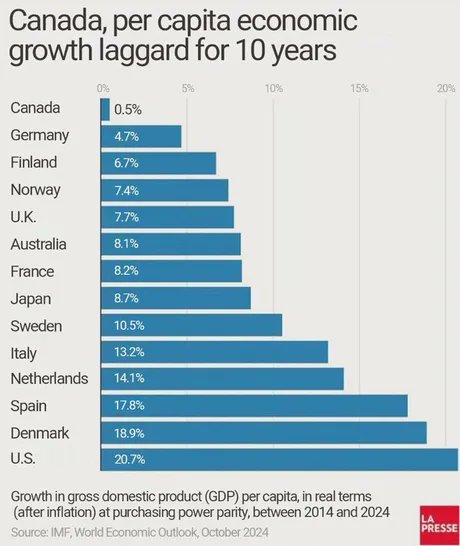
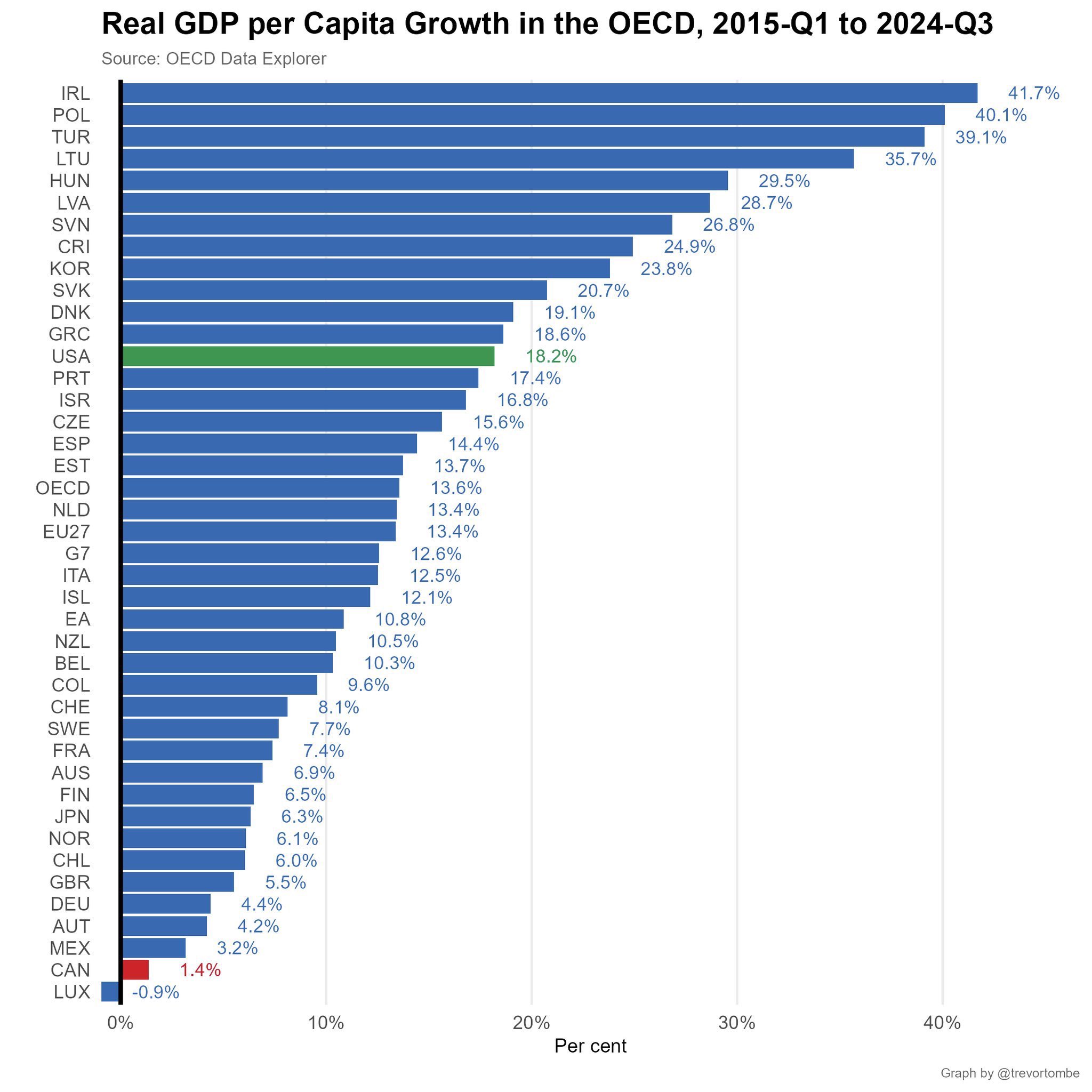
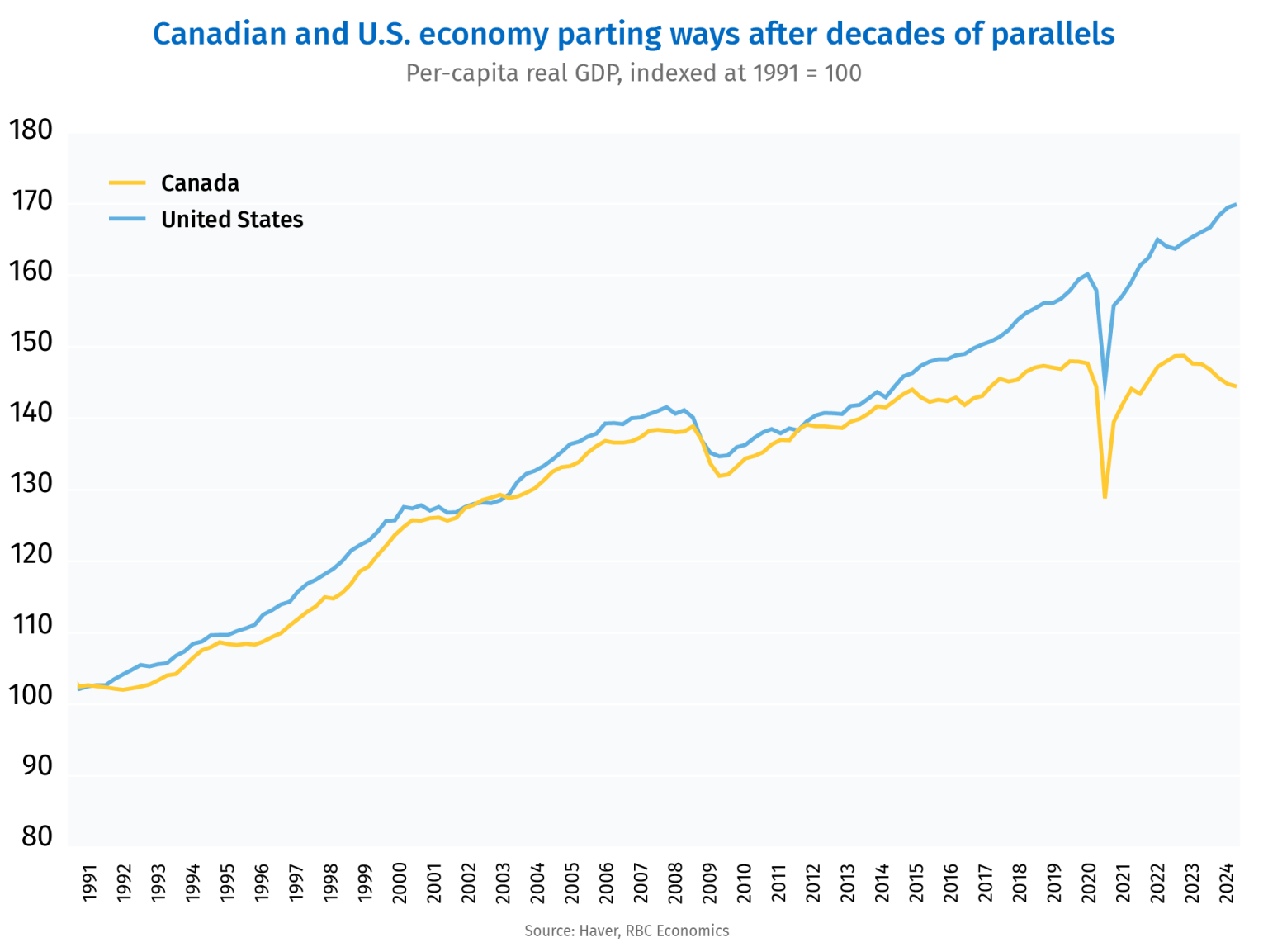
It’s quite remarkable how many economic charts show the US and Canadian economies tracking along similar paths up until “something” happened in 2015 that knocked the Canadian economy well below the US trend line. I wonder what happened in 2015 that could account for this quite visible change in fortune?

GDP growth in Canada fell off a cliff over the period from 2015 onwards. This kinda matters.

Throughout the 2025 campaign, the Conservatives have frequently referred to what they call the “Lost Liberal Decade”, a reference to the fact that Canada has lagged dramatically on virtually every available indicator since the Liberals first came to power in 2015.

In sum, the economy is worse, crime is worse, public services are worse, affordability is worse β€” and there’s a whole galaxy of niche indicators, such as firearms incidents, refugee backlogs, even life expectancy, that are worse than they’ve ever been.

Below, a quick guide to the fact that, whatever you think of the Liberals, the last decade has really not been great for Canada.

In the year the Liberals took office, 604 people were murdered across Canada. This was already a slight uptick from the year before, when murder rates hit a low not seen since the mid-1960s.

Just seven years later, in 2022, homicides would hit a high of 874. In raw numbers, that’s 270 more murdered Canadians.

But even when accounting for population growth, there are way more murders happening now than in 2015. The homicide rate in that year was 1.71 murders per 100,000 people. As of 2023, the most recent year for which Statistics Canada has released data, it was 1.94.

Put another way, if Canada had stuck to the homicide rates of 2015, we’d have had 94 fewer murders in 2023, 216 fewer murders in 2022, and about 150 fewer murders in 2021.

And it’s a similar story when it comes to virtually every other category of crime. Statistics Canada maintains a “crime severity index” that attempts to aggregate the raw amount of criminality each year in Canada. The index bottoms out just before the Liberals came to power in 2015, and has been on the upswing ever since.

Unfortunately, this is particularly true when it comes to violent crime. For one thing, the number of guns being turned on people each year in Canada has never been higher.

In 2015, for every 100,000 Canadians, there were 28.6 incidents of firearm-related violent crime. By 2022, the last full year for which data is available, this had surged to 36.7 incidents β€” nearly a 30-per-cent increase in just seven years.

The Correctional Service of Canada publishes annual statistics on incarceration rates, and a noticeable trend begins to emerge starting in 2015: The prison population begins to plummet.

February 5, 2025

QotD: Economies and disasters

Filed under: Economics, Quotations — Tags: , , , , — Nicholas @ 01:00

Here’s a question: Are natural or manmade disasters good for the economy? Dr. Larry Summers, top economic adviser to President Obama, said about the Kobe, Japan, earthquake: “(The disaster) may lead to some temporary increments ironically to GDP as a process of rebuilding takes place. In the wake of the earlier Kobe earthquake Japan actually gained some economic strength.” After devastating Floridian hurricanes, it’s not uncommon to read newspaper headlines such as “Storms create lucrative times”, or “Economic growth from hurricanes could outweigh costs”, or “It’s a perverse thing … there’s real pain, but from an economic point of view, it is a plus”. Then there’s Nobel Laureate Paul Krugman who wrote in his New York Times column “After the Horror”, after the 9/11 attack, “Ghastly as it may seem to say this, the terror attack — like the original day of infamy, which brought an end to the Great Depression — could do some economic good”. He went on to explain that rebuilding the destruction would stimulate the economy through business investment and job creation.

One would never hear my colleagues in George Mason University’s economics department spouting such insanities. Just ask yourself whether the Japanese economy would have faced even greater opportunities for economic growth had the earthquake also struck Tokyo, Hiroshima, Yokohama and other major cities? Would the 9/11 terrorists have made a greater contribution to our economy had they also destroyed lives and buildings in Chicago, St. Louis, Los Angeles and Atlanta? The belief that a society benefits from destruction is sheer lunacy.

French economist Frederic Bastiat (1801-1850) explained it in his pamphlet “What is Seen and What is Not Seen”. He said, “There is only one difference between a bad economist and a good one: the bad economist confines himself to the visible effect; the good economist takes into account both the effect that can be seen and those effects that must be foreseen”. That’s why my George Mason University colleagues are good economists.

Walter E. Williams, “Economics Reality”, Townhall.com, 2020-02-04.

August 9, 2024

Rare signs of growth in the Argentine economy

Filed under: Americas, Economics, Government — Tags: , , , — Nicholas @ 05:00

It looks as if Argentina is managing a trick that Justin Trudeau can’t manage — growing the national economy while keeping inflation down:

Javier Milei, 8 October 2022.
Photo attributed to Vox EspaΓ±a via Wikimedia Commons.

During his first year as president, Javier Milei has been waging a bitter but largely successful campaign against inflation.

Now, Argentines received more welcome news: their economy is growing again.

“Economic activity rose 1.3 percent from April, above the 0.1 percent median estimate from analysts in a Bloomberg survey and the first month of growth since Milei’s term began in December,” Bloomberg reported on July 18. “From a year ago, the proxy for gross domestic product grew 2.3 percent.”

The positive economic report, based on data from the Argentine government, is a surprise to many.

The 2.3 percent year-over-year increase defied expectations of a decline of similar magnitude, Bloomberg reported. As Semafor notes, the Argentine economy was projected to have the least economic growth of any country in the world in 2024, according to the International Monetary Fund.

A “Wrecking Ball”?

Argentine economists I spoke to said that the numbers are encouraging, but the country’s economy is far from being out of the woods.

As most people know, Milei inherited an economic mess decades in the making. When the self-described anarcho-capitalist assumed office in December, Argentina was suffering from the third highest inflation rate in the world β€” 211 percent year over year. The poverty rate was north of 40 percent, and Argentina’s economy was declining.

With his country’s economy in a full tailspin from decades of Peronism, Milei proposed a series of economic reforms dubbed “shock therapy” that consisted primarily of three components: slashing government spending, cutting bureaucracy, and devaluing the peso.

Critics warned that these measures would be disastrous, and many took it for granted that the remedies would deepen Argentina’s recession.

The former head of the International Monetary Fund’s Western Hemisphere Department, Alejandro Werner, said Milei’s strategy could tame inflation, but at great cost.

“A deep recession will also take place,” Werner wrote, “as the fiscal consolidation kicks in and as the decline in household income depresses consumption and uncertainty weighs on investment.”

Felix Salmon, the chief financial correspondent at Axios, concurred, comparing Milei’s policies to “a wrecking ball”.

“Milei’s budget cuts will cause a plunge in household income, as well as a deep recession,” wrote Salmon.

Despite these warnings, Milei delivered his “shock therapy” plan in the first few months of his presidency. Tens of thousands of state workers were cut as were more than half of government ministries, including the Ministry of Culture, as well as the Ministries of Labor, Social Development, Health, and Education (which Milei dubbed “the Ministry of Indoctrination“). Numerous government subsidies were eliminated, and the value of the peso was cut in half.

Even before Milei’s policies were given a chance to succeed, many continued to attack them.

“Shock therapy is pushing more people into poverty,” journalist Lautaro Grinspan wrote in Foreign Policy in early March. “Food prices have risen by roughly 50 percent, according to official government data.”

Yet the official government data Grinspan cited was a report from December 2023, before Milei had even assumed the presidency.

Contrary to the dire predictions, the results of Milei’s policies have been better than even many of his supporters had dared hope.

During the first half of 2024, inflation cooled for five straight months in Argentina, the Associated Press reported in July. Though consumer prices were up 4.6 percent in June from the previous month, that’s down from a 25 percent month-over-month increase in December, when monthly inflation peaked in Argentina. Meanwhile, in February the government saw its first budget surplus in more than a decade. And just days ago, an economic report was published showing a massive decline in poverty in Argentina.

Many doubted that these successes were possible, and the conventional wisdom said that wringing inflation out of the economy and slashing government spending could only be achieved at great cost: a deepening recession.

June 7, 2024

Since 2015, the Trudeau Liberals have done a fantastic job of suppressing the Canadian economy

If Canadians elected Justin Trudeau and the Liberal Party to make major changes from what had gone on under Stephen Harper’s Conservatives, then they got their wish in so many different ways, but especially economically:

Reports of Canada’s dismal economic outcomes seem never to end. Why should they? For years Canadians have had the same federal government delivering the same deleterious economic policies and the same expansion in regulatory initiatives and spending that have invariably depressed economies and reduced standards of living whenever and wherever they are imposed. Therefore, until the federal government or its policies change, we should not expect the miserable results to materially improve.

The latest negative report is the release of Canada’s 2024-Q1 GDP numbers on Friday, which again showed sluggish growth relative to population, resulting in yet another quarterly decline in real GDP per capita. Relative to 2015-Q3, the last full quarter before the Trudeau government took office, cumulative real GDP per capita is up only about 0.7 per cent. A recent RBC Economics analysis showed from around 1991 to 2015, cumulative real GDP per capita growth in Canada approximately tracked with the U.S., but not since Justin Trudeau took office. Compared to 0.7 per cent growth in Canada from 2015-Q3 to 2024-Q1, real GDP per capita is up 15.7 per cent in the U.S. in the same time period.

Where the 0.7 per cent comes from matters, too. In real per capita terms, some components of GDP β€” mainly government β€” expanded while others contracted. Alarmingly, business investment, which drives productivity and standards of living, is down 13.9 per cent. This includes real per capita reductions of 15.2 per cent in residential structures, 18.4 per cent in machinery and equipment, and 19.3 per cent in non-residential structures, with an increase in intellectual property investment not nearly enough to offset the reductions in other categories.

To understand why business investment and economic performance in Canada are so poor under the Trudeau government, let us consider the following representative example of its economic strategy.

The government believes many families struggle with the cost of caring for young children, which is a legitimate concern. A reasonable solution, which the Harper government implemented in 2006, is to send money to families with young children and let parents buy for their children what they need. After the Liberals expanded that program, they could have left it at that, but what have they done instead? The government initiated a national takeover of child care, effectively expropriating child care entrepreneurs’ businesses by flooding their sector with public money and then controlling private companies’ revenues and operations. The result is child care entrepreneurs’ investments have been wiped out or severely reduced, control of their business operations have been wrestled away by government, and they are unable to properly serve their customers (the families), as evidenced by the drastic reduction in parental options and widespread shortages.

May 22, 2024

If you re-define it carefully, you can make any statistical measure look hopeful

Filed under: Economics, Government, Media, Politics, USA — Tags: , , , , , — Nicholas @ 04:00

In his Substack, Tim Worstall jokingly called this piece “Larry Summers Explains Why Americans Hate Joe Biden”:

As a good Democrat of course Larry Summers would never put things in quite that headline way. But the implication of this latest paper with others is to explain why Americans really aren’t as happy as they should be given the economic numbers. The answer being that the economic numbers we all look at to explain how happy folk are aren’t the right economic numbers to explain how happy people are.

We can also make — possibly rightly, possibly wrongly, this might be me projecting more than is merited — a further claim. That Americans simply aren’t as rich as those standard economic numbers suggest either. Which would also neatly explain the general down in the dumps attitude toward the economy.

So, the new paper:

    Unemployment is low and inflation is falling, but consumer sentiment remains depressed. This has confounded economists, who historically rely on these two variables to gauge how consumers feel about the economy. We propose that borrowing costs, which have grown at rates they had not reached in decades, do much to explain this gap. The cost of money is not currently included in traditional price indexes, indicating a disconnect between the measures favored by economists and the effective costs borne by consumers. We show that the lows in US consumer sentiment that cannot be explained by unemployment and official inflation are strongly correlated with borrowing costs and consumer credit supply. Concerns over borrowing costs, which have historically tracked the cost of money, are at their highest levels since the Volcker-era. We then develop alternative measures of inflation that include borrowing costs and can account for almost three quarters of the gap in US consumer sentiment in 2023. Global evidence shows that consumer sentiment gaps across countries are also strongly correlated with changes in interest rates. Proposed U.S.-specific factors do not find much supportive evidence abroad.

OK, or as explained by the Telegraph:

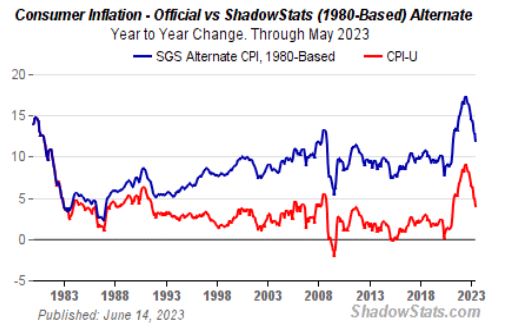
    In it, the authors made a shocking claim: if inflation was measured in the same way that it was measured during the last bout of price rises in the 1970s, data showed that it peaked at 18pc in November 2022. This is far higher than the 9.1pc peak inflation shown by the official data.

    The reason for this discrepancy is that, since the 1970s, economists have removed the cost of borrowing from the Consumer Price Index (CPI). The motivations here were not nefarious. The reasoning of the statisticians had something to it.

And, OK, if inflation peaked at 18%, not 9%, then that would explain why folk are pissed. Sure it would.

[…]

OK. But that means that if inflation was higher than we’ve been using then the deflation of nominal to real GDP is also wrong. Just that one year of 9% recorded but 18% by this new measure is damn near a 10% difference. That’s how much we’re over-estimating real GDP by right now. Add in a couple of years of lower levels of that and being 20% out wouldn’t surprise.

Which would mean that — if this were true and I might be overegging it — Americans are in fact 20% poorer than the Biden Admin keeps saying they are. And yes, that would piss the voters off, wouldn’t it?

Gaslighting has been a staple of the legacy media for quite some time now, going into high gear during the 2016 US Presidential elections and then into overdrive during the pandemic. They probably don’t even realize they’re doing it any more, because it feels “normal” to them. Yet they wonder why their popularity and public trust in their pronouncements continues to drop.

January 1, 2023

QotD: The amazing economic impact of mobile phones in the developing world

Filed under: Africa, Asia, Economics, Quotations, Technology — Tags: , , — Nicholas @ 01:00

One of the interesting findings about mobile phones is that they grow the economy. In a country without a general landline network – ie, all the poor ones – 10% of the population gaining a mobile increases GDP by 0.5%. No, not the growth rate goes up from 2% to 2.01%. But an additional 0.5% of GDP each year. Which is, by the standards of these things, pretty big.

We also know why too. Being able to contact people means that markets complete, contracts and transactions are possible. It’s no longer necessary to near randomly meet someone physically in order to be able to organise a transaction. Thus more transactions happen – the value added in voluntary transactions being that GDP which is increasing.

Tim Worstall, “Mobile Phones Cut The Murder Rate – For the Same Reason They Grow The Economy”, Continental Telegraph, 2019-05-30.

October 15, 2020

QotD: What the GDP is failing to show (even though it’s there)

Filed under: Economics, Quotations, Technology — Tags: , , , , , — Nicholas @ 01:00

There simply isn’t a technology that has come anywhere close to arriving in the hands of actual users as fast as the smartphone and mobile internet. The next closest competitor is the mobile phone itself. All others running distant third and behind.

Our problem is that we know technological revolutions produce growth. Yet economic growth is limp at best, meagre perhaps a better description. So, there’s something wrong here. Either our basic understandings about how growth occurs are wrong and we [are] loathe to agree to that. Not because too much is bound up in that understanding but because too much of it makes sense. The other explanation is that we’re counting wrong.

[…]

We know that we’ve not quite got new products and their falling prices in our estimates of inflation quite correctly. They tend to enter the inflation indices after their first major price falls, meaning that inflation is always overstated. Given that the number we really look at is real growth – nominal growth minus inflation – this means we are consistently underestimating real growth.

[…]

The more we dig into this the more convinced I am that our only real economic problem at present is counting. Everything makes sense if we are counting output and inflation incorrectly, under-estimating the first, over- the second. If we are doing that – and we know that we are, only not quite to what extent – then all other economic numbers make sense. We’re in the midst of a large technological change, we’ve full employment by any reasonable measure, wages and productivity should be rising strongly. If we’re mismeasuring as above then those two are rising strongly, we’re just not capturing it. Oh, and if that’s also true then inequality is lower than currently estimated too.

The thing is, the more we study the details of these questions the more it becomes clear that we are mismeasuring, and mismeasuring enough that all of the claimed problems, the low growth, low productivity rises, low wage growth, simply aren’t there in the first place. And if they ain’t then nothing needs to be done about them, does it? Except, perhaps, count properly.

Tim Worstall, “Where’s All The Economic Growth? Goldman Sachs Blames Apple’s iPhone”, Continental Telegraph, 2018-07-03.

August 16, 2020

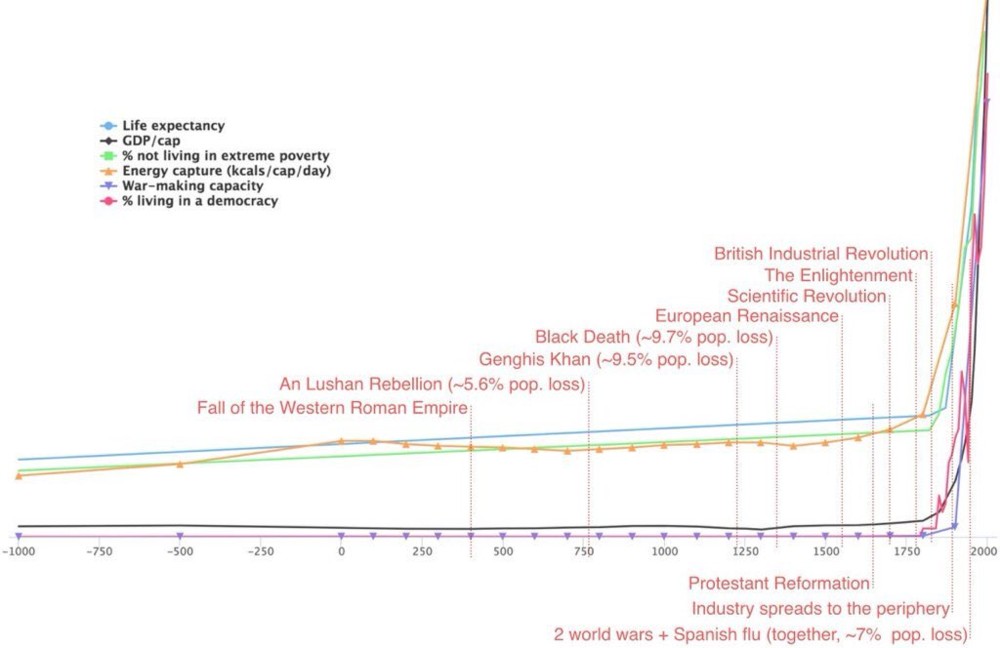
This is a “hockey stick” graph you can believe

Filed under: Economics, Health, History — Tags: , , , , , — Nicholas @ 03:00

Brian Micklethwait says this graph, unlike the more famous (debunked) “hockey stick”, shows one of the most important moments in human history:

If that graph, or another like it, is not entirely familiar to you, then it damn well should be. It pinpoints the moment when our own species started seriously looking after its own creature comforts. This was, you might say, the moment when most of us stopped being treated no better than farm animals, and we began turning ourselves into each others’ pets.

Patrick Crozier and I will be speaking about this amazing moment in the history of the human animal in our next recorded conversation. That will, if the conversation happens as we hope and the recording works as we hope, find its way to here.

I’m not usually one for podcasts, in the same way that I’m not an audiobook user: I find I’m unable to do other things while listening to the spoken word, and it’s always far faster to read a text than to have it read to you. In this particular case, I might try to make an exception, and give up hope of doing anything else productive while I listen.

April 15, 2020

When the Fed Does Too Much

Filed under: Economics, Government, History, USA — Tags: , , , , , — Nicholas @ 02:00

Marginal Revolution University
Published 22 Aug 2017

In the 2000s, the Fed kept interest rates low to stimulate aggregate demand. But the cheap credit also helped fuel the housing market bubbles. We’ll look at the case of the Great Recession as an example of where the Fed did too much in one area, and perhaps not enough in others.

October 17, 2019

England in 1550 was a remarkably unpromising location for the later industrial revolution

Filed under: Britain, Economics, Europe, History — Tags: , , , , , , — Nicholas @ 03:00

Anton Howes, in his investigations on the Industrial Revolution looks back in time to see where or even if England deviated from the rest of Europe in ways that made the revolution possible, thinks he’s located the crucial time:

If a peaceful extraterrestrial visited the world in 1550, I often wonder where it would see as being the most likely site of the Industrial Revolution – an acceleration in the pace of innovation, resulting in sustained and continuous economic growth. So many theories about why it happened in Britain seem to have a sense of inevitability about them, but our extraterrestrial visitor would have found very few signs that it would soon occur there. There were many better candidates, on a multitude of metrics.

[…]

But England in 1550 was by global standards quite poor. Historical GDP per capita measures are notoriously difficult to obtain, even for some countries in the twentieth century let alone the sixteenth. The historical GDP per capita of England – by far the most studied region – is still hotly debated among economic historians. Nonetheless, according to the most recent collection of estimates – the Maddison project’s database of 2018 – in 1550 our extraterrestrial visitor would have been much more interested in Belgium. England at that stage lagged behind almost all of the areas for which we have estimates: Holland, Spain, Italy, Sweden, and France. In 1600, it was behind Portugal and India. Here are the figures in 2011 dollars; the colours are by row:

Such estimates should of course be taken with a hefty boulder of salt. (Note, also, that these particular figures, called “CGDPpc”, are something of an innovation by the team compiling the Maddison Project Database – they use multiple benchmarks to improve how we compare countries’ relative incomes in any particular year, which comes at the cost of not being able to compare their growth rates, for which there are separate figures. In other words, you should read the figures by row, not by column.) But it is worth noting that the more recent research on historical GDP per capita, finally filling in some details for regions other than England and Holland, often results in those other countries seeming richer in the sixteenth and seventeenth centuries. The more we know, the more the traces of an early English divergence seem to disappear.

Even without access to such statistics, however, our visitor would have noticed that in the mid-1550s England suffered severe food shortages. Indeed, the threat of famine would be present right up until the beginning of the eighteenth century: there was a major famine in the north of England in 1649, and even a famine in the 1690s that killed between five and fifteen percent of Scotland’s population. Britain would one day become perhaps the first famine-free region, but that did not occur until much later, when innovation had already begun to accelerate. It may even have been its result.

And England in 1550 was not just poor; it was also weak. If our visitor thought, as some historians do, that conquest and exploitation were essential for future growth, then it was Spain that had the major overseas empire, followed by Portugal. England in 1550 had no colonies in the New World, and its attempts to found them all failed until the seventeenth century, by which stage the Dutch and French had also begun to extend their own empires too. It was not until the eighteenth century that Britain began to exceed them.

March 16, 2019

MMT – Magic Money Theory

Filed under: Economics, Government, Politics — Tags: , , , , , , , — Nicholas @ 05:00

Antony Davies and James R. Harrigan explain just why so many progressives are so excited about MMT:

Modern Monetary Theory, or MMT, is all the rage in the halls of Congress lately.

To hear the Progressive left tell it, MMT is not unlike a goose that keeps laying golden eggs. All we have to do is pick up all the free money. This is music to politicians’ ears, but Fed Chairman Jerome Powell is singing a decidedly different tune. Said Powell recently on MMT, β€œThe idea that deficits don’t matter for countries that can borrow in their own currency … is just wrong.”

MMT advocates see this as outdated thinking. We can, they claim, spend as much as we want on whatever we want, unencumbered by trivialities like how much we have. But MMT is a bait-and-switch wrapped in a sleight-of-hand. It focuses on debt and dollars rather than resources and products. Debt and dollars are merely tools we use to transfer ownership of resources and products. It’s the resources and products that matter. Shuffling debt and dollars merely changes the ownership of resources and products. It doesn’t create more.

[…]

So here’s the sleight of hand. MMT advocates say that we won’t experience inflation because the U.S. dollar is a reserve currency β€” foreigners hold lots of U.S. dollars. First, increasing the money supply, other things constant, does create inflation. But when a reserve currency inflates, the pain gets spread around the world instead of being concentrated within one country. In short, MMT advocates believe our government should print money and let foreigners bear some of the inflation pain. Second, there’s no law that says that the U.S. dollar must be a reserve currency. The British Pound was one, but as its value declined, foreigners stopped holding it. Foreigners will stop holding U.S. dollars too as their value declines.

And here’s the bait-and-switch. MMTers say that if inflation does become a problem, the government can simply raise tax rates to soak up excess dollars. In short, the government would print money with one hand, buying whatever it wants and causing inflation. It would then tax with the other, thereby removing dollars from the economy and counteracting the inflation. In the end, all that’s happened is that the government has replaced goods and services that people want with goods and services politicians want.

After a bout of MMT, we might have the same GDP and zero inflation, but what constitutes that GDP would have changed dramatically. Instead of having more cars and houses, we might have more tanks and border walls.

Older Posts »

Powered by WordPress