
Of all the potential military conflicts facing the west, a US invasion of Canada has to be among the least likely — not just because it’s been attempted more than once in the past. For one thing, I don’t think even the best social media posting is going to bring ordinary Americans around to getting boots on the ground across the 49th parallel … there’s remarkably little passion about seizing our maple syrup and confiscating our strategic reserves of poutine among voters. Unlike places that Americans have strong feelings about, Canada just doesn’t move the needle.
The Operational Art of War has the first of a promised three-part series on Operation Maple Stomp, the biggest and best invasion of Canada — everyone says so:
In the latest round of “let’s do everything the dumbest way possible” the two nations in the world sharing the most in common keep taking to social media to fantasize going to war with each other.
It is deeply annoying, brings out the worst tendencies on both sides, and (to my mind worst of all) illustrates no one understands the Operational Art of War!
Americans take to social media and claim Canada doesn’t have a military, the military wouldn’t fight and be so outnumbered that resistance would collapse within hours.
Canadians usually agree the conventional war would be over in an afternoon, but then America would face a long and bloody insurgency (just wait till Uncle Sam meets the Maple Mujahedeen!).
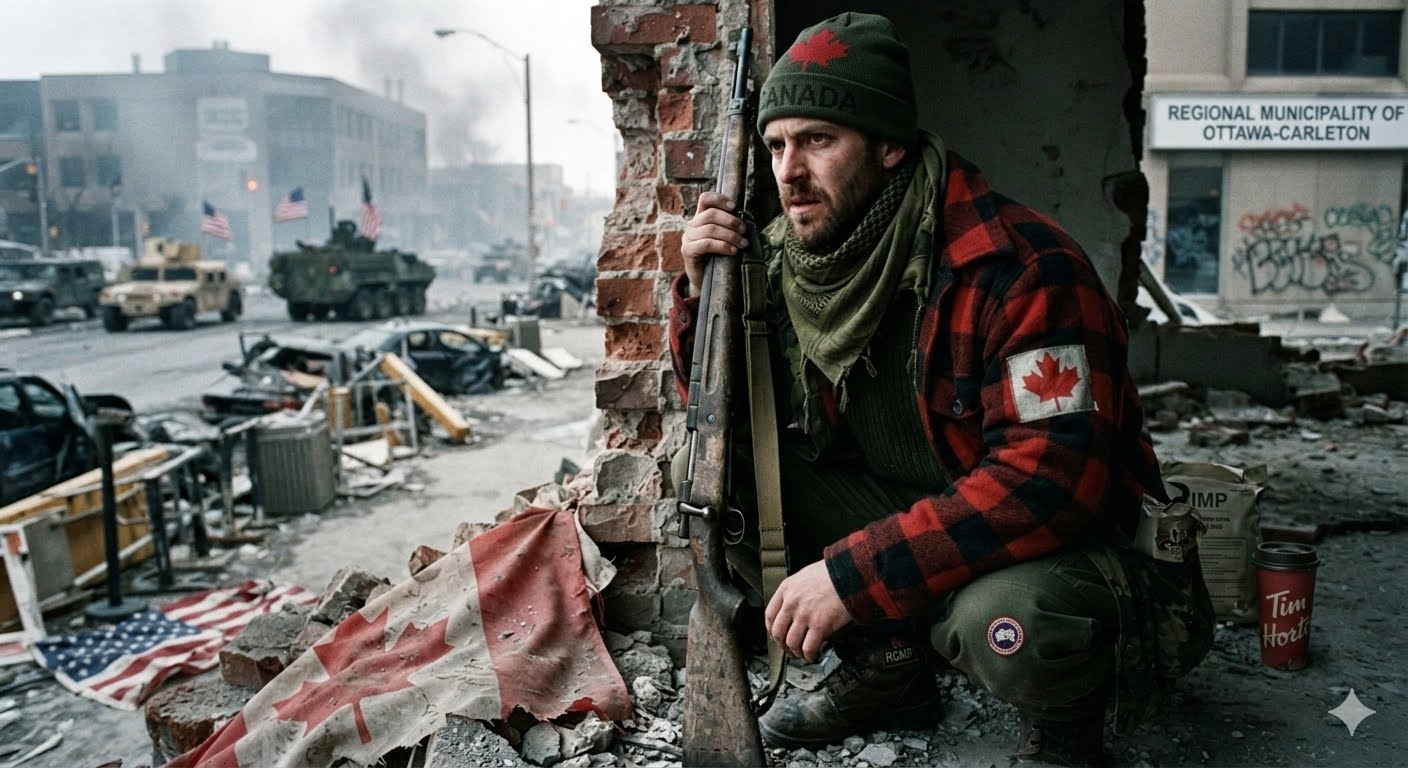
Google AI’s idea of what a Canadian Insurgent looks like.
You can definitely count me as a member of Team Mere-matter-of-marching, at least as far as the tactical operations necessary to occupy the most populous parts of Soviet Canuckistan. Here’s a sketch map that Big Serge updated for the 2020s, based on the mid-1930s details for an attack on southern Ontario from War Plan Red:
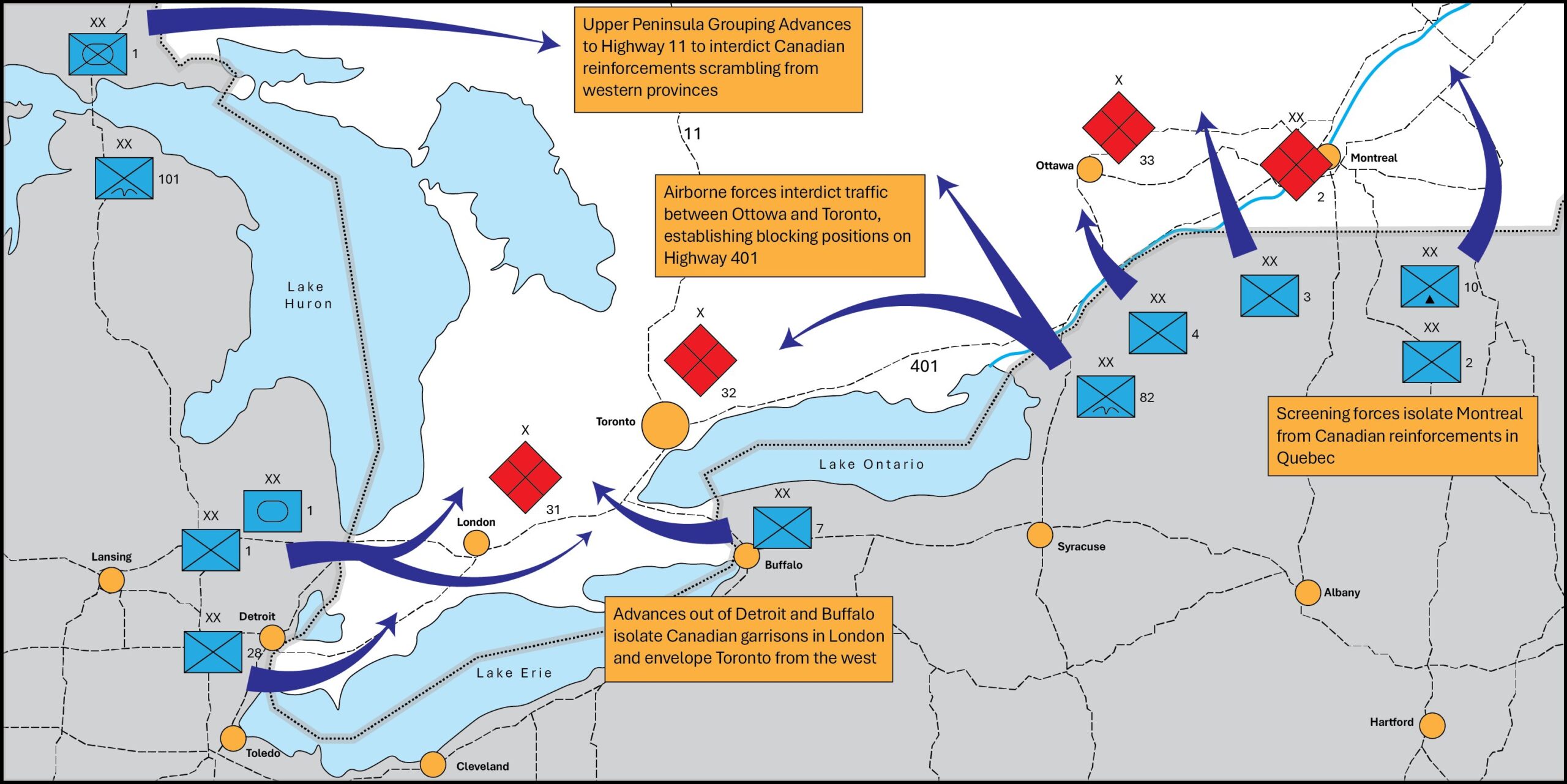
Manifest Destiny, 2025? Big Serge’s updated map for the old US War Plan Red for a military invasion of Canada.
The distances are short enough and the chances of significant military resistance low enough, that US Army vehicles would probably not need to refuel before reaching the initial stop-lines for their advance. Canadian infrastructure is not pre-wired for destruction, so unless local hotheads manage to temporarily block road bridges, volume of traffic will be a bigger friction factor than actual defensive fire.
Trump’s legions would reap the benefit of more than a century of demilitarized populations and the (small, but real) Canadian military being oriented to expeditionary operations rather than home defence. But taking the territory is only the first step. There are Canadians scattered throughout the continental United States, looking and sounding pretty much like any other American, and it wouldn’t take too many of them to decide that Trump’s fight was also their fight. Canada isn’t the only one enjoying the benefits of decades of lack-of-worry about homeland defence. Look how exposed the US has been to Islamic terrorists who, for the most part, don’t look or sound like Americans and still managed to pull off one of the greatest terror attacks of the modern age.
I mean, don’t misread what I’m saying here: the US would win. That’s not even remotely in doubt. There are at least ten of you for every one of us, and more of you have military training and access to personal weapons. (One wonders if the Canadian government’s fanatic devotion to civil disarmament is a kind of pre-surrender to this imagined US invasion we’re discussing …)
But the cost of winning might be more than even the most government-worshipping progressive might be willing to pay. We look like you. With a few exceptions (French-speaking Quebecers and Newfoundland-speaking Newfoundlanders, mostly), we fit in very well with you. We come from very, very similar cultures (some like Vancouver vlogger J.J. McCulloch argue it’s the same culture). Rather than a war of conquest, this would be much more like that “Second Civil War” that’s been so much a topic of conversation on far left and far right social media. The kind of civil war that takes far too long to settle back into peaceful co-existence.
You don’t like government surveillance? Too bad, bucky, because every level of government is going to be eager to ensure that you’re a good, loyal American … at all hours of the day and in everything you do. Cut down a Flock camera? That’s not going to be a mere vandalism issue … that’s tantamount to treason. What if that Flock camera was watching one of those undercover Canucki guerilla fighters?
Don’t like the feds watching every financial transaction? Too bad, bucky, ’cause you giving $5 to that sketchy Canuck for some bootleg maple syrup might be funding a terror attack on your nearest USAF base.
To fight the threat of Canuck infiltration, your every car trip will need to be logged, and your patterns of travel will need to be recorded and analyzed. Who you talk to will also need to be observed, in case one of your buddies is a covert maple-slurping spy!
Oh, wait, there’s more from the Operational Art of War:
There Won’t Be a Maple Mujahadeen
If the United States annexes Canada, there will not be a long-standing violent insurrection by a nation of hunters. The Maple Mujahadeen isn’t going to happen.
A successful insurgency has several requirements:
- A pre-existing structure to organize around;
- The structure having access to weapons;
- The insurgent group not having a future in the new regime; and
- The broader population being willing to shelter the insurgency.
Canada does have factions that meet all four of these factors, but spread across different factions. Like any complex modern society, Canada does have pre-existing structures of voluntary organizations. Virtually none of them are organized around any kind of collective defense or skills that easily translate to an insurgency.
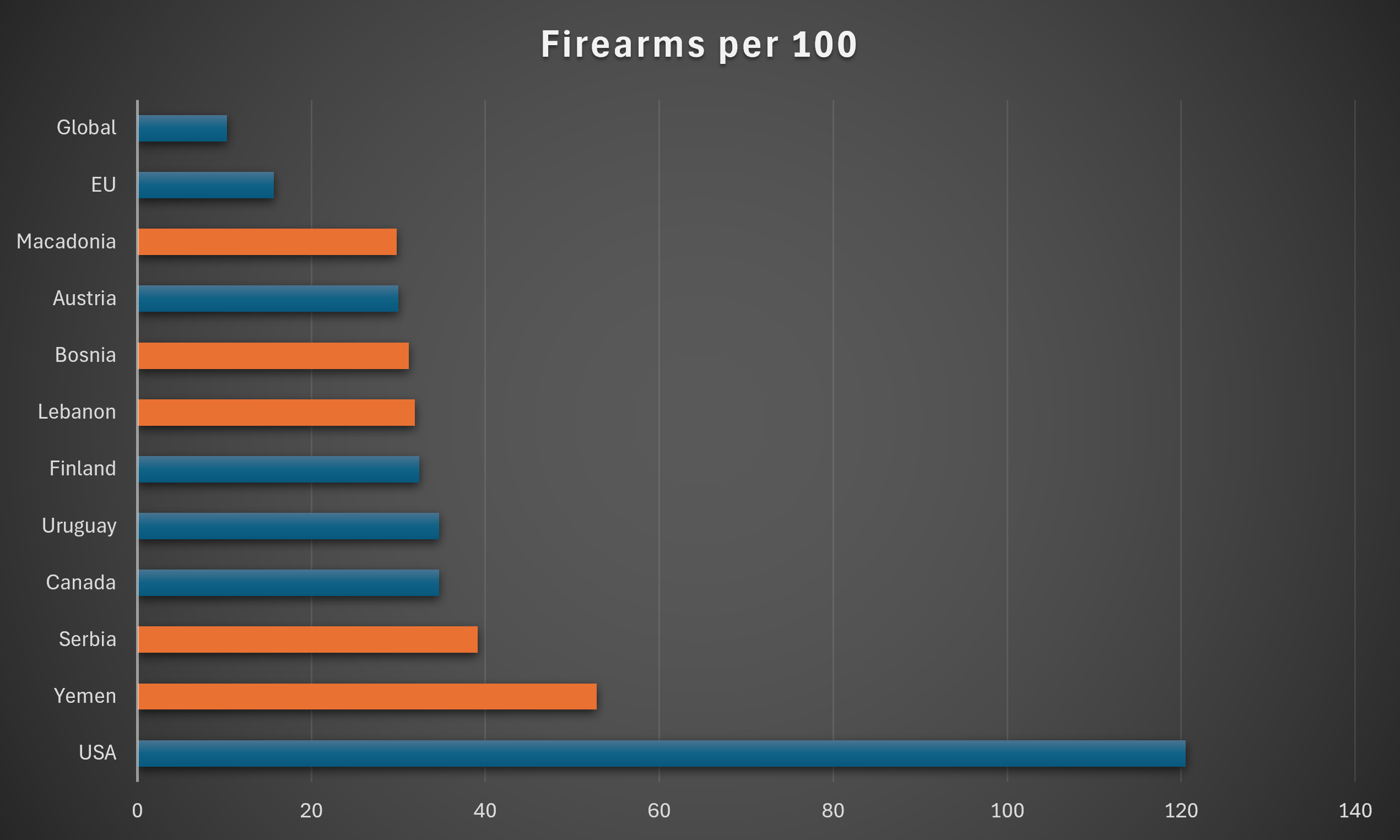
For #2 (access to weapons) you either need armed citizens, government weapons cashes or weapons brought in by a rival power supporting the insurgency. In Canada’s case, the only viable supply of weapons for an insurgency is its armed citizens. As with most statistics, Canada only looks like a gun free country because it’s beside America.
The graph below shows the top 10 countries for estimated firearms per 100 people, plus the EU and global average for comparison (excluding countries with a population under one million). Countries that were recently warzones are in orange, as their rate of firearm ownership is something of a special case.
The number for Canada is likely too low. This is based on a 2017 data set, and firearm ownership is growing faster than the population. It also assumes there are five unregistered firearms to every registered firearm in Canada. The last time Canada had hard data on unregistered firearms (2003 to 2012) the ratio was 10:1. Assuming a similar ratio today, firearms per 100 jumps to 1/2 that of America and nearly 4x the European average.



That vehicle in the street next to the two Hummers looks an awful lot like an LAV6. (Oh, noooes, AI is going to put us all out of work!)
Comment by Jim Whyte — August 29, 2026 @ 17:13
I think the US Army has some Strykers, which are derived from the same hull as the LAV.
Comment by Nicholas — August 29, 2026 @ 17:35
Quite right, but does Grok/GagGPT/Gemignani know that? It’s probably scraped a generic APC from somewhere, fair enough. But the pic is still at the unbelievable fringe. It’s kinda like the AI-drawn open pits that put a crusher right in the middle.
Comment by Jim Whyte — August 29, 2026 @ 22:03