
On Substack, Ryan Levesque explains the major differences between human writing and AI-trained-on-human-writing:
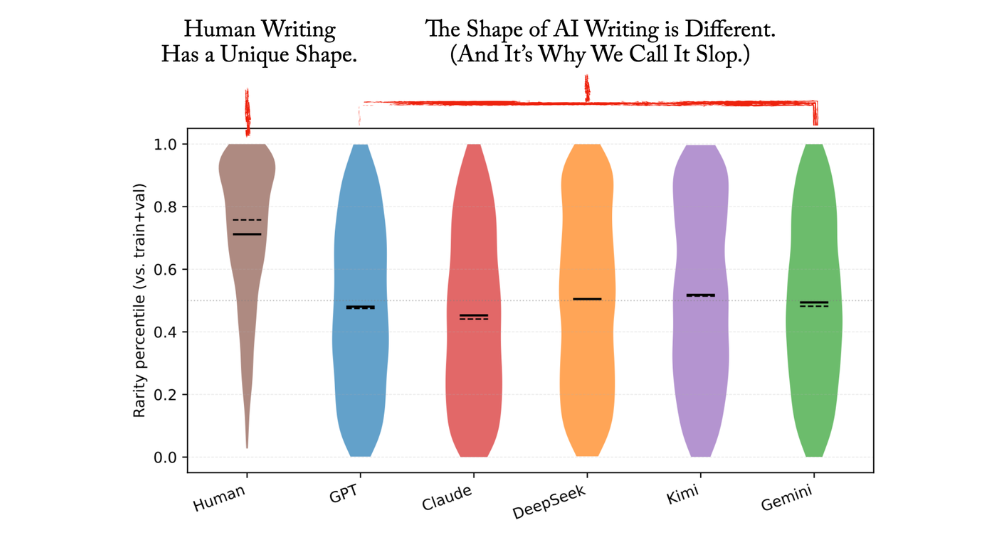
Graphic from The Digital Contrarian
It turns out, slop has a shape.
And it’s the reason why AI generated writing sounds the way it does.
In a new study, a team of researchers at the University of Maryland and Google DeepMind ran an experiment.
They took 10,272 writing prompts and gave each one to a human author and to five AI models: Claude, GPT, Gemini, DeepSeek, and Kimi.
They generated 61,608 stories, at around 5,000 words each.
Then, they looked at the underlying structure of each story: how the plot progresses, where the tension and conflict is placed, etc. etc.
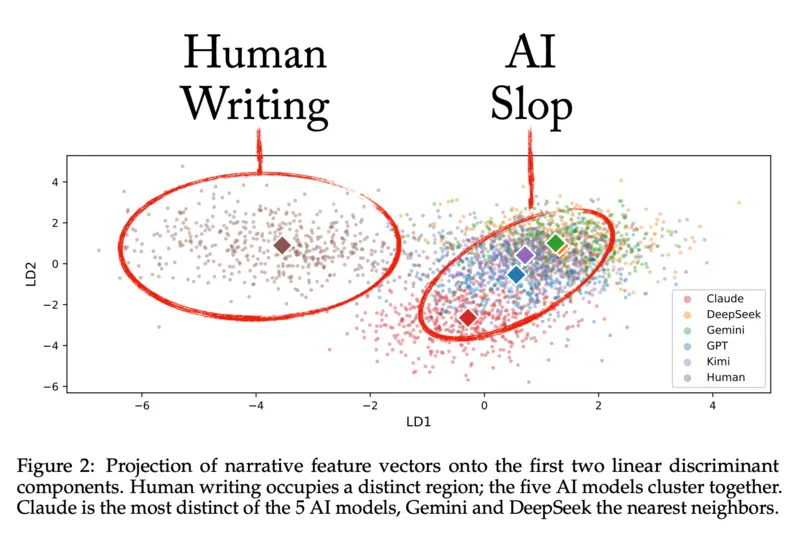
And from that structure, they could identify a human-written story from AI-generated slop nearly 93% of the time.
Graphic from The Digital Contrarian
What you’re seeing here in that image is the shape of AI Slop vs. Human Writing.
And there are five distinct ways that the shape of human writing is decidedly different from the so-called slop generated by today’s AI models:
- AI over-explains its themes. (instead of letting readers infer)
- Human writing is less linear. (more time-jumps and flashbacks.)
- AI relies on bodily metaphors to explain emotion. (81% vs. 38% human)
- Humans reference specific texts, brands, places. (nearly 2x the AI rate)
- AI narrative is less diverse. (fewer subplots and scenes, less dialogue)
[…]
The Beginning of the End of Social Media?
The clearest place to watch this shape materalize?
Social media.
This week, Farah Cormack mapped the predictable sequence, in a piece called “The Beginning of the End of Organic LinkedIn“.
Her argument is that every platform moves through the same five stages:
- Early adoption. A small group forms around something they love. It feels like a secret.
- Scaling. The crowds show up, and so does the money.
- Critical mass. Everyone’s here now. Organic and paid are both running hot.
- Enshittification. The business model takes over the product. The feed fills with ads, and the place starts to feel like every other place.
- Decline. The people who made it worth showing up for get fed up and leave.
Her read is that LinkedIn just crossed into stage four. The tell is its new Creator Marketplace, a feature that literally puts your reach openly up for sale.
(If your own posts have been reaching fewer people lately, you’re not imagining things … this has been engineered.)
The shape of Enshittification is a five-stage decline, and most of the social media platforms we use are somewhere at stage 4 or 5 right now.
Futurist Sinead Bovell goes further, and argues we’re watching the beginning of the end of the social media era itself.
The reality is that people don’t really post for friends/social circles like we used to even just a few short years ago.
Bovell argues that the entire reason we post is to be seen by other humans.
That’s the whole deal.
We post to signal that we’re employable, or interesting, or worth following, or because we want to sell something …
And we do that, because real people are on the other end, watching us.
Take those real people away, and the entire thing stops making sense …
But that’s exactly what’s happening.
Personally, I think LinkedIn hit stage four a lot sooner than this, almost certainly because it originated as a business-oriented platform. The owner of a company I worked for in the 2000s required that all managers have active LinkedIn accounts, so I was “active” there for a couple of years, but I felt it quickly lost any actual benefits and became a forum of boastfulness and sycophancy. There were serious people on the platform, providing useful and insightful posts, but the vast majority of content was self-promotion and empty flattery.



And here I thought discriminant analysis was a well-kept secret (or at least a minority taste).
Comment by Jim Whyte — June 29, 2026 @ 21:20