Quotulatiousness

July 22, 2026

Why progressives are always so eager for more gun control

Filed under: Law, USA, Weapons — Tags: , , , , , — Nicholas @ 03:00

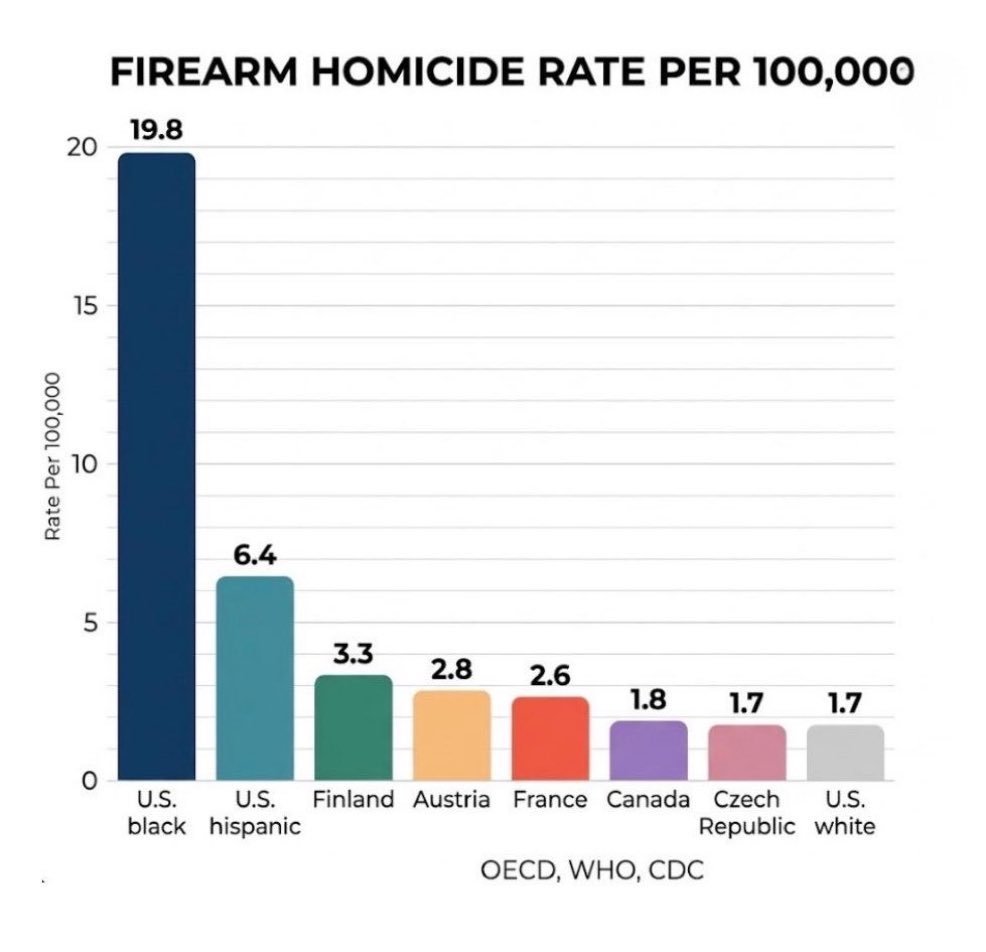
ESR discusses a recently posted chart about firearm homicide rates:

I’m not certain this chart is true, but looking at it shook something loose in my head. I think it explains why ordinary liberals are so obsessive about gun control despite the fact that it’s both bad policy and a persistent election-time loser.

This isn’t a trivial question. I understand why Communists are obsessive about gun control; the last thing they want is a population capable of armed resistance to tyranny. What I have never figured out is why Communists have been so successful at selling gun control to their dupes as an urgent moral necessity.

This chart could be exaggerated, but the figures are at least possible. In the United States, murder and other forms of criminal violence are heavily, heavily concentrated among Blacks. Usually with other Blacks as their victims.

And that’s a problem for your typical normie liberal, because not being “racist” against Blacks is the core of their moral and political identity.

What I now understand — forgive me because I probably should have noticed this sooner — is that gun-control advocacy is a sort of reaction formation. When you’re not an evil Communist, it’s something you do frantically to avert your eyes from unbearable reality.

The truth: outside of a relatively small cohort at the right-hand end of the Black IQ distribution, the people liberals want to treat as sacred victims deserving of infinite indulgence are savages that even intelligent Blacks fear and despise.

That’s the message in the left hand column, there.

IQ denialism, blank-slatism, “poverty causes crime” — these are all defensive formations. They cluster with gun-control advocacy as ways of avoiding the horrible, intolerable truth.

Which makes me wonder: what happens when the strain becomes too great and the protective illusion snaps?

The Ancient Greeks 03 – Enter the Persians 4 – The Ionian Revolt and the Fatal Intervention

Filed under: Greece, History, Middle East — Tags: , , , , , , , — Nicholas @ 02:00

seangabb
Published 16 Feb 2026

The Persian Wars begin not in Athens, but in Miletus. In this lecture we explore the failed Naxos expedition, Aristagoras’ desperate gamble, and the outbreak of the Ionian Revolt in 499 BC. We examine Aristagoras’ appeals to Sparta and Athens, Herodotus’ famous scene before Cleomenes, and the fateful decision of Athens to send twenty ships.

We also analyse the burning of Sardis, Darius’ calculated response, and the suppression of Ionia. This is not yet a world war — but it is the moment when Athens introduces itself to empire.

QotD: Burnside’s Army of the Potomac

Filed under: History, Military, Quotations, USA — Tags: , , — Nicholas @ 01:00

It was not a genteel, restrained, orderly country that was feeling this changed emotional current. It was a nation with the infinite raw strength of graceless youth, moving with gigantic careless energy into a future that was not known to have any bounds whatever. It was feeling its oats and it was flexing muscles bigger than anybody else ever had, and if people got hurt along the way it was not even going to notice. It had been like that from the beginning and it had not yet grown mellow and thoughtful, and it was not for nothing that its national air was a little tune called “Yankee Doodle”, which has no words to speak of and expresses no sentiment on earth but sheer perky impudence.

This was the country of the boisterous forty-niner, the hell-roaring lumberjack, and the riverman who was half horse and half alligator. Without rancor (and also without the slightest hesitation) it annihilated Indian tribes so that it could people a wilderness, asserting that the only good Indian was a dead Indian and remarking casually of its own pioneers that the cowards never started and the weak died along the road. As it faced the cathedral aisles of endless virgin forests it shouted for immediate daylight in the swamp, even if whole generations must be brutalized for it. It was the country that invented the bucko mate and the Shanghai passage, and if the skysails of its incredible clippers gleamed on the farthest magic horizon they were taken there by men under the daily rule of clubs and brass knuckles. This nation accepted boiler explosions as the price of steamboat travel and it would boast presently of a dead gandy-dancer for every cross-tie on the transcontinental railroad. It wore seven-league boots and scorned to look where it planted them, and each of its immense strides was made at immense human cost. And the army of this country, buckling down to it at last in a fight which had to go to a finish, was going to be very rough on enemy civilians, not because it had anything against them but simply because they were there.

Of genuine hatred this army had practically none. The wild young men who ruined ancestral portraits and pranced in the smoky streets wearing the embroidered undergarments of gentlewomen were expressing nothing but plain hooliganism, which somehow was the obverse side of the medal that had laid nine hundred corpses in front of the stone wall west of town. Both sides of the medal bespoke raw youth which cheered and guffawed by turns, whose noble best forever went arm in arm with its ugly worst.

Bruce Catton, Army of the Potomac: Glory Road, 1952.

Powered by WordPress