
Why, it appears that we appointed all of our worst generals to command the armies and we appointed all of our best generals to edit the newspapers. I mean, I found by reading a newspaper that these editor generals saw all of the defects plainly from the start but didn’t tell me until it was too late. I’m willing to yield my place to these best generals and I’ll do my best for the cause by editing a newspaper.
Robert E. Lee, quoted at American Digest, 2005-08.
July 11, 2024
QotD: Armchair generals
Comments Off on QotD: Armchair generals
April 9, 2023
Uncancelled History | EP. 01 Robert E. Lee
Nebulous Media
Published 21 Nov 2022Jonathan Horn joins Douglas Murray on this episode to discuss Robert E. Lee’s infamous legacy. The two dissect his childhood, military career and life after the war. Should Robert E. Lee stay cancelled?
(more…)
Comments Off on Uncancelled History | EP. 01 Robert E. Lee
July 5, 2021
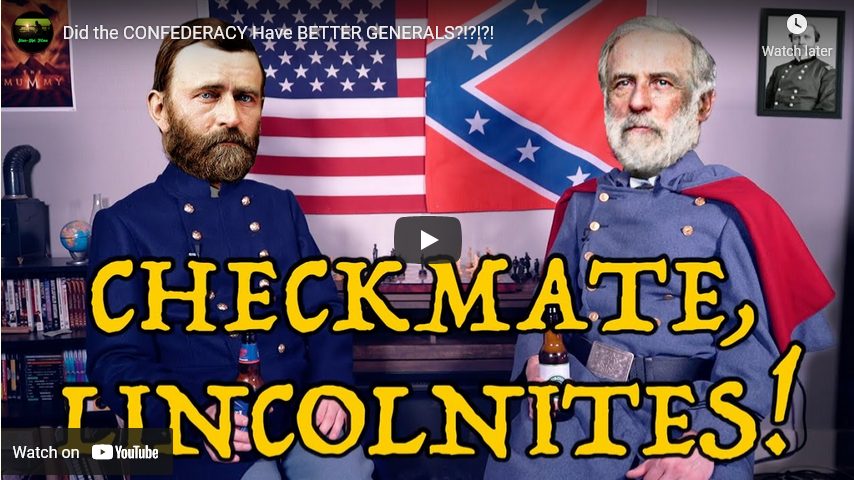
Did the CONFEDERACY Have BETTER GENERALS?!?!?!
Atun-Shei Films
Published 4 Jul 2021Checkmate, Lincolnites! Debunking Lost Cause myths – as well as more benign common misconceptions – about the military leadership of the Civil War. Did the South really have all the best battlefield talent? Was the key to Union victory a simple strategy of overwhelming the Confederate army with numbers and resources? Who was better at their job, Ulysses S. Grant or Robert E. Lee?
I’d say watch and find out, but the answer is obviously Grant.
Support Atun-Shei Films on Patreon ► https://www.patreon.com/atunsheifilms
Leave a Tip via Paypal ► https://www.paypal.me/atunsheifilms
Buy Merch ► teespring.com/stores/atun-shei-films
#CheckmateLincolnites #CivilWar #MilitaryHistory
Original Music by Dillon DeRosa ► http://dillonderosa.com/
Reddit ► https://www.reddit.com/r/atunsheifilms
Twitter ► https://twitter.com/atun_shei~REFERENCES~
[1] Andy Hall. “With One Hand Tied Behind its Back” (2013). Dead Confederates Blog https://deadconfederates.com/2013/11/…
[2] G.S. Boritt. Why the Confederacy Lost (1992). Oxford University Press, Page 39-40
[3] Richard E. Beringer. Why the South Lost the Civil War (1986). University of Georgia Press, Page 8-24
[4] Borritt, Page 24-30
[5] Charles Royster. The Destructive War: William Tecumseh Sherman, Stonewall Jackson, and the Americans (1991). Vintage Civil War Library, Page 76
[6] “Lincoln’s Unsent Letter to General Meade”. American Battlefield Trust https://www.battlefields.org/learn/pr…
[7] Eric J. Wittenberg. “A Civil War Witch Hunt: George Gordon Meade, The Retreat from Gettysburg, and the Joint Committee on the Conduct of the War” (2015). Emerging Civil War Blog http://emergingcivilwar.com/2015/07/0…
[8] Report of the Joint Select Committee Appointed to Inquire into the Condition of Affairs in the Late Insurrectionary States, so Far as Regards the Execution of Laws, and the Safety of the Lives and Property of the Citizens of the United States and Testimony Taken (1872). https://quod.lib.umich.edu/m/moa/ACA4…
[9] Andy Hall. “Nathan Bedford Forrest Joins the Kl@n” (2011). Dead Confederates Blog https://deadconfederates.com/2011/12/…
[10] Andy Hall. “Confederate Veterans on Forrest: ‘Unworthy of a Southern Gentleman'” (2013). Dead Confederates Blog https://deadconfederates.com/2013/08/…
[11] Edward Bonekemper. Ulysses S. Grant: A Victor, Not a Butcher (2004). Regnery History, Page 89-92
[12] Mary Boykin Chestnut. A Diary of Dixie (1905). D. Appleton and Company, Page 350
[13] Ernest B. Ferguson. “Catching Up With ‘Old Slow Trot'” (2007). Smithsonian Magazine https://www.smithsonianmag.com/histor…
[14] Bonekemper, Page xii
[15] Bonekemper, Page 308-309
[16] Bonekemper, Page 192-193
[17] Bonekemper, Page 201-203
[18] Justin D. Murphy. American Civil War: Interpreting Conflict Through Primary Documents, Vol. II (2019). ABC-CLIO, Page 331
[19] Bonekemper, Page 121 & 243-245
[20] Elizabeth Brown Pryor. Reading the Man: A Portrait of Robert E. Lee Through his Private Letters (2008) Penguin Books, Page 335
[21] Sean Kane. “Myths and Misunderstandings: Grant as a Slaveholder” (2017). The American Civil War Museum https://acwm.org/blog/myths-misunders…
[22] “Letter from Robert E. Lee to Mary Randolph Custis Lee (December 27, 1856).” Encylopedia Virginia https://encyclopediavirginia.org/entr…
[23] Pryor, Page 144-150
[24] “Ulysses S. Grant and General Orders No. 11”, National Park Service https://www.nps.gov/articles/000/ulys…
Comments Off on Did the CONFEDERACY Have BETTER GENERALS?!?!?!
August 24, 2017
Teaching history in the South – the “Lost Cause” school of historiography
Warren Meyer gives some background on how most people in the Southern US were taught the history of the “War Between the States”:
The Lost Cause School: I want to provide some help for those not from the South to understand the southern side of the statue thing. In particular, how can good people who believe themselves not to be racist support these statues? You have to recognize that most folks of my generation in the South were raised on the lost cause school of Civil War historiography. I went to one of the great private high schools in the South and realized later I had been steeped in Lost Cause. All the public schools taught it. Here is the Wikipedia summary:
The Lost Cause of the Confederacy, or simply Lost Cause, is a set of revisionist beliefs that describes the Confederate cause as a heroic one against great odds despite its defeat. The beliefs endorse the virtues of the antebellum South, viewing the American Civil War as an honorable struggle for the Southern way of life, while minimizing or denying the central role of slavery. While it was not taught in the North, aspects of it did win acceptance there and helped the process of reunifying American whites.
The Lost Cause belief system synthesized numerous ideas into a coherent package. Lost Cause supporters argue that slavery was not the main cause of the Civil War, and claim that few scholars saw it as such before the 1950s. In order to reach this conclusion, they often deny or minimize the writings and speeches of Confederate leaders of the time in favor of later-written revisionist documents. Supporters often stressed the idea of secession as a defense against a Northern threat to their way of life and say that threat violated the states’ rights guaranteed by the Union. They believed any state had the right to secede, a point strongly denied by the North. The Lost Cause portrayed the South as more profoundly Christian than the greedy North. It portrayed the slavery system as more benevolent than cruel, emphasizing that it taught Christianity and civilization. In explaining Confederate defeat, the Lost Cause said the main factor was not qualitative inferiority in leadership or fighting ability but the massive quantitative superiority of the Yankee industrial machine.
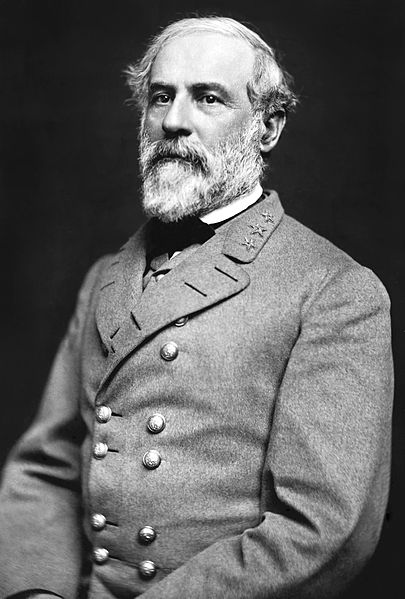
Confederate General Robert E. Lee, commander of the Army of Northern Virginia (via Wikimedia)
Obviously this was promoted by the white supremacists after the war, but in the 20th century many well-meaning people in the South who are not racist and by no means want to see a return of slavery or Jim Crow still retain elements of this story, particularly the vision of the Confederacy as a scrappy underdog. But everything in these two paragraphs including the downplaying of slavery in the causes of the Civil War was being taught when I grew up. It wasn’t until a civil war course in college (from James McPherson no less, boy was I a lucky dog there) that I read source material from the time and was deprogrammed.
The comparisons of the current statue removal to Protestant reformation iconoclasm seem particularly apt to me. You see, growing up in the South, Confederate generals were our saints. And the word “generals” is important. No one I knew growing up would think to revere, say, Jefferson Davis. Only the hard-core white supremacists revered Jefferson Davis. Real lost cause non-racist southerners revered Robert E. Lee. He was our Jesus (see: Dukes of Hazard). Every town in the south still has a Robert E Lee High School. Had I not gone to private school, I would have gone to Houston’s Lee High (I had a friend who went to college at Lehigh in New Jersey. Whenever he told folks in the South he went there, they would inevitably answer “yes, but where did you go to college.”) So Lee was by far and away at the top of the pantheon. Then you had folks like Stonewall Jackson and J.E.B. Stuart who were probably our Peter and Paul. Then all the rest of the generals trailing off through the equivalents of St. Bartholomew or whoever. We even had a Judas, General James Longstreet, who for a variety of reasons was reviled by the Lost Cause school and was blamed for many of Lee’s, and the South’s, losses.
If you want to see the Southern generals the way much of the South sees them, watch the movie Gettysburg, which I like quite a bit (based on the book Killer Angels, I believe, also a good read). The Southern Generals are good, talented men trying to make the best of a losing cause. Slavery is, in this movie, irrelevant to them. They are fighting for their beloved homes in the South, not for slavery. The movie even has Longstreet saying something like “we should have freed the slaves and then fired on Fort Sumter”.
The movie Gettysburg is excellent, but if you don’t know much about the actual battle, you might end up thinking the entire conflict revolved around the 20th Maine …
Comments Off on Teaching history in the South – the “Lost Cause” school of historiography
April 11, 2015
Robert E. Lee
In City Journal, Ryan L. Cole reviews a recent book on one of America’s most famous generals:
America’s Civil War presents a set of forever ponderable “what ifs.” What if a Union soldier hadn’t discovered plans for the Confederate invasion of Maryland in 1862? What if Stonewall Jackson hadn’t been hit by friendly fire after the Battle of Chancellorsville? What if George Meade had pursued the wounded Army of Northern Virginia in the wake of Gettysburg? The list goes on.
But perhaps the most vexing hypothetical has always been: What if Robert E. Lee had accepted Abraham Lincoln’s offer to command Union forces at the outset of the conflict? This would have likely robbed the Confederacy of its greatest military mind. It may have also robbed the South of its fleeting glories, dramatically shortened the war, and made Lee — not Ulysses S. Grant or even Abraham Lincoln — the savior of the Union. It could even have made Lee a second George Washington.
This decision and its ramifications are the basis of The Man Who Would Not Be Washington, Jonathan Horn’s thoughtful new life of the Confederate general. It would be wrong to call this a biography. Though Horn, a former speechwriter for President George W. Bush, assays Lee’s life from birth to death, the book is built around the premise that Lee was practically destined to become the second coming of Washington. Yet he declined, and the consequences of his refusal altered the course of the nation.
Lee had familial and professional connections to Washington. His father, Henry Lee III, better known as “Light-Horse” Harry Lee, was a dashing cavalry officer in the Continental Army. General Washington was impressed by Lee’s bravery and invited the young Virginian to join his personal staff. When Lee begged off, Washington asked Congress to give him an independent command. Like some other young officers, Lee found a mentor in Washington, who had no biological children of his own. He did, however, adopt and raise Martha Washington’s grandson, George Washington Parke Custis, as his own son. Custis’s daughter, Mary, wed Robert E. Lee. Their children, by birth and marriage, were direct descendants of America’s original first lady.
The Lees lived in Arlington House, a Potomac mansion overlooking Washington, built by Custis as a shrine to his adoptive father and a repository for his relics. Through marriage, Lee was heir to the tactile remains of Washington’s legacy; even the slaves he inherited from his father-in-law were descendants of those who had toiled at Mount Vernon. In his opening chapters, Horn carefully draws the connections between the two titular subjects and plots Lee’s rise to military distinction in the years leading up to the Civil War. The history is simply fascinating. Horn is a graceful writer, and when the occasion warrants, has a suitable flair for the dramatic. The pages blaze by.
Comments Off on Robert E. Lee


