The CBC recently published a highly misleading article based on a recent report on firearm use in intimate partner violence, omitting two key facts and massaging the rest to support their preferred narrative:
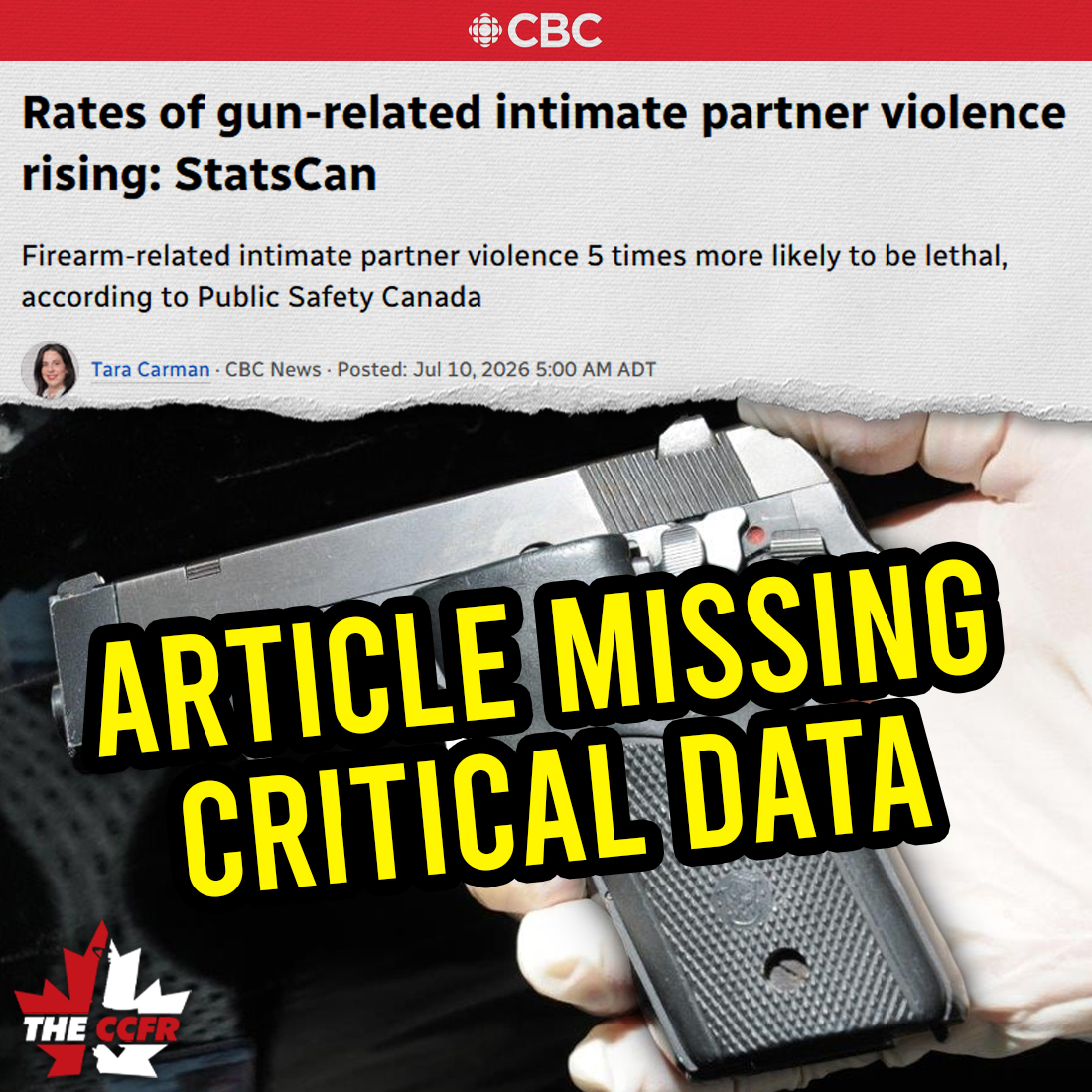
Tara Carman [@tarajcarman] is directly responsible for producing this deceptive piece of journalism that deliberately misleads the Canadian public on a critical public safety issue. As the sole author of the article published by CBC, she made the conscious decision to omit the most important data from the Statistics Canada report she herself references, leaving readers with a completely distorted picture of firearm-related intimate partner violence. Specifically, she buried or ignored the fact that, in solved firearm-related intimate partner homicides, only 25% involved an accused person who had a valid firearms licence and was in legal possession of the gun used, while a massive 58% involved individuals who had no valid licence, were not in legal possession, or both. For non-intimate partner cases, the figure for legal possession drops to a pathetic 9%. These numbers come straight from the official report, yet Carman chose not to include them, choosing instead to hype up rising rates, female victims, and lethality while pushing narratives around red flag laws and confiscating guns from legal owners.
This is shitty journalism at its worst because Carman actively shaped the story to imply that legally owned firearms, held by licensed, responsible citizens, are a primary driver of these tragedies, when the data she had access to proves the opposite is true in the majority of solved cases. By leaving out these crucial possession statistics, she misleads the public into believing that broader restrictions on law-abiding gun owners are the solution when, in reality, the problem is overwhelmingly tied to illegal guns, criminals, and repeat offenders who already slip through the system. Her selective framing ignores how small a slice of firearm-related incidents overall intimate partner violence represents and instead amplifies fear to fit a predetermined anti-gun narrative that CBC routinely peddles. Carman has failed in her basic duty as a reporter to present the full truth, choosing omission and emphasis that distort reality and erode public trust. This kind of dishonest reporting from Tara Carman harms informed debate on serious issues and deserves strong public condemnation for prioritizing agenda over accuracy.
Rod Giltaca has more on the omissions of the original CBC story:
IMPORTANT POST🚨
Additional point to the story below: less than 1% of intimate partner violence has a firearm present. It’s been this way for decades. Statcan tracks this.
This is how CBC describes this: “Most intimate partner violence crimes don’t involve firearms”.
“Most”? How about 99% doesn’t?
This is the type of manipulation you can expect from the CBC. It’s unconscionable.
Domestic violence is absolutely unacceptable. We should be looking for the people and situations involved in it and deal with it directly. We should be using the billions the gov’t has wasted on gun bans on services to support women escaping these situations. Stories like this merely serve as an opportunity to vilify people who legally and responsibly own firearms, full stop.
We need to start asking real questions about where these situations occur, who’s involved, and that includes demographic information of every kind; racial, cultural, economic, geographical, real information that demonstrates the will to (actually) solve these problems.
If you want to reduce this type of violence then you have to ask these questions whether they’re uncomfortable or not.
Do you really care, or is this just another opportunity to play politics or virtue signal? Clear thinking people are sick of this.