Quotulatiousness

January 18, 2026

Mark Carney’s actual jobs before becoming Prime Minister

On the social media site formerly known as Twitter, Ezra Levant explains the various jobs Mark Carney has held compared to what many Canadians think he’s done:

    Laura Stone @l_stone
    Unifor President Lana Payne calls China EV deal “a self-inflicted wound to an already injured Canadian auto industry”. Says providing a foothold to cheap Chinese EVs “puts Canadian auto jobs at risk while rewarding, labour violations and unfair trade practices”. #onpoli

I think there’s a misconception amongst Canada’s chattering classes that Mark Carney is an experienced and successful businessman and executive.

He wasn’t. He wasn’t CEO of Brookfield. He was its chairman, overseeing quarterly board meetings and spending the rest of his time flying around to different globalist conferences at the UN or WEF.

He was more of a mascot, a symbol, an ambassador of Brookfield. He didn’t negotiate deals or turn around companies. He did photo-ops.

Before that, he worked at the Bank of England, and before that, the Bank of Canada.

No Googling: can you name a single actual duty of that job? Can you tell me what Carney actually achieved?

He wafted up from fake job to fake job — like Justin Trudeau did, but instead of being a surf instructor and a substitute teacher, he had meaningless executive jobs.

And now when it’s time to shine … he doesn’t know what to do.

It’s been a year, and he has no deal with Trump, despite saying that was his chief focus.

What exactly did he achieve in Beijing? The tariffs against Saskatchewan were lifted — so that merely brings us back to the status quo ten months ago. Nothing else. No investments in Canada, which was the pretext of the trip. Just a capitulations, to allow the dumping of 49,000 Chinese EV cars, with their spyware and malware.

But he looks good in a suit and says ponderous words like “catalyze” and “transformative”. And that’s enough to impress the Parliamentary Press Gallery. Not that they needed much impressing — they’re all on his payroll already, through his massive journalism subsidies. They’re too busy holding the opposition to account to take notice of this latest disaster.

But the regime media shouldn’t feel too bad about being conned. Carney tricked Doug Ford pretty good, didn’t he?

January 9, 2026

Mark Carney’s play-acting on the international stage

There is no way that Canada can make itself economically independent of the United States, no matter how much wishcasting power is exerted to persuade anti-American boomers who habitually vote Liberal. Our entire economy is oriented to serve the vast market to our south, and we’ve been freeloading on our own military because the Americans have been willing to take up the slack and — until recently — not castigate our leaders for their fecklessness. It was bad under Justin Trudeau, but it’s actually gotten worse under Mark Carney’s leadership. Trudeau was performative and loved to play to the world media, but Carney seems to actually believe that he can reverse the entire direction of the Canadian economy by jetting around the world and bad-talking Donald Trump. The Canadian economy has been stalled for ten years now, and if Trump finally loses patience with our idiotic elites, it’ll go into free-fall.

On the social media site formerly known as Twitter, James E. Thorne points out just how few cards Carney actually has in his hand:

Mark Carney’s and Canada’s Dangerous Refusal to Face Reality.

Mark Carney and most Canadians are behaving as if Canada is an independent pole in a multipolar order, when the world he actually inhabits is a hierarchy being brutally clarified by Washington. Trump’s revamped National Security Strategy and the “Trump Corollary” — asserted through the seizure of Nicolás Maduro and open threats toward Cuba and Colombia, make plain that the United States now treats the Western Hemisphere as an American security estate, not a debating society among equals.

In that framework, Canada is not a co-author of the rules. It is a dependency inside the U.S. sphere, structurally lashed to American markets, finance and supply chains. AND after decades without a serious sovereign industrial or energy strategy, Canada is at best a weak Middle Power, that has for decades squandered its competitive advantage through proformative politics and virtue signalling.

In this era, the Western Hemisphere is now a “secure production platform” for American industry and technology, defined not by territorial control but by ownership, access and compliance. The Trump doctrine logic is clear and blunt yet internally coherent: if the Western Hemispheres natural resources and supply chains are secured, the economic and geopolitical dividends will follow.

Carney’s answer to the Trump Doctrine, however, remains the same “City-of-London” orthodoxy that produced him: more proformative political grandstanding, more process, more declarations, more meetings, and more boondoggles.

The Greenland consulate, rhetorical red lines over annexation, the flying around the world, and ritual protests against U.S. action in Venezuela all presume that we still live in the post WWII rules based order. We do not! Will live in the era of the Trump Doctrine, and no we can’t wait it out. And in this era, Greenland will not be allowed to be under the influence of Russia or China.

Thucydides warned that “the strong do what they can and the weak suffer what they must”. Carney’s tragedy is that he quotes the rules-based order while presiding over a country whose economic structure is colonial and whose security ultimately depends on the very power he is theatrically chastising. Posturing without power is not prudence. It is provocation without a plan. And yes it’s dangerous.

The irony is that Carney understands all of this perfectly well, which only sharpens the question: what, exactly, is he doing by posturing as a rules-based equal in a hierarchy where he knows Canada lacks the hard power to back his stance?

December 30, 2025

“This is where Canada is now”

Filed under: Cancon, Economics, Government, Media, Politics — Tags: , , , , — Nicholas @ 03:00

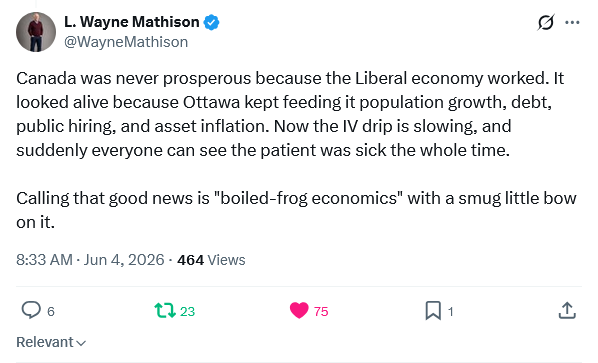
On the social media site formerly known as Twitter, L. Wayne Mathison handily sums up the state of the nation:

I’ve reached the point most people hit right before systems fail.

The point where facts stop working.

Charts don’t matter. Reports don’t matter. Evidence doesn’t matter. You can post receipts until your fingers cramp and political partisans will still clap, chant, and rationalize while the house fills with smoke. They are not misinformed. They are committed. And commitment beats reality every time.

That’s where Canada is now.

The Liberals and the NDP no longer govern with outcomes in mind. They govern with narratives. If the story sounds compassionate, the damage underneath is waved away as acceptable collateral. Housing explodes. Healthcare buckles. Food banks flood. Productivity sinks. And if you point to any of it, you’re told to be kinder, quieter, or more patient.

Patience is a luxury people without power can’t afford.

What scares me isn’t just the policies. It’s the psychology. We are watching a ruling class that confuses control with competence and optics with success. Every failure is met with more management, more spending, more moral language, and less accountability. When reality resists, they don’t change course. They tighten.

That’s where Mark Carney enters the picture, and why he should worry anyone paying attention.

Carney doesn’t speak like a democratic leader. He speaks like a risk officer explaining why losses are necessary. “Sacrifice.” “Stability.” “Confidence.” These are not solutions. They are words used when the model is failing but the managers refuse to admit it. In his world, the problem is never the plan. It’s public resistance to the plan.

That mindset is poison in a democracy.

The Liberals broke affordability and papered it over with subsidies. The NDP cheered and demanded more of the same. Now Carney offers to professionalize the decline. Smoother language. Tighter controls. Bigger levers. Less dissent. He doesn’t promise prosperity. He promises management.

Here’s the part people don’t want to hear.

You can’t fix a country by overruling its citizens.
You can’t tax, regulate, borrow, and moralize your way out of shortages.
You can’t feed kids, house families, or staff hospitals with press releases.

And when governments start treating criticism as a threat rather than a warning, history tells us what comes next. Not reform. Hardening. Surveillance language. Emergency logic. Ever broader definitions of “harm”. Ever fewer off ramps.

This is how civilizations don’t collapse in a bang. They collapse in meetings.

I don’t expect to convince partisans anymore. That window is gone. This is a warning, not an argument.

If you are still cheering while food banks replace paycheques, while hospitals ration care, while housing becomes a privilege, while leaders talk about sacrifice without ever naming their own, understand this: they are not fiddling while Rome burns. They are insisting the fire is necessary.

And once that belief sets in, facts won’t save us. Only consequences will.

By then, our children are already in the smoke.

December 29, 2025

Will 2026 finally be the year Canada abandons food cartels?

For reasons unknown, Canadian politicians both left and right have been willing to sacrifice almost anything in trade negotiations except the cosy protectionist scheme we call “supply management”, which enriches a tiny number of farmers in Ontario and Quebec by keeping grocery prices significantly higher than the free market price. On his Substack, The Food Professor predicts that Prime Minister Carney will be forced to give up this market-rigging, anti-consumer scheme in the coming year:

Image from Agri-Food Analytics Lab, Dalhousie University

As we enter 2026, several forces are converging to reshape Canada’s food economy. Consumer empowerment — amplified by social media — continues to accelerate, while geopolitics, particularly tensions with our southern neighbour, are becoming increasingly disruptive. Together, these dynamics will push food policy issues that once lived in technical silos into the public spotlight.

At the top of that list sits CUSMA and supply management. Prime Minister Carney has signaled firmness on market access, backed by legislation that shields supply management from parliamentary debate. That protection, however, is unlikely to endure. Even if the United States has little genuine interest in exporting more dairy to Canada — and even if Canadian consumers show limited appetite for it — President Trump now understands, far better than during his first term, that supply management is a potent political wedge. The system protects roughly 9,400 dairy farmers who exert disproportionate influence over agricultural policy, while compensation payments continue to flow without any meaningful reduction in production or market share. For a growing number of Canadians, this arrangement increasingly resembles a closed loop rather than a public good. The irony is that global demand for dairy is rising and Canadian milk should be part of that growth story. Instead, the system prioritizes insulation over ambition — a missed opportunity at a time when competitiveness should matter most.

January 1 also marks the formal implementation of new front-of-package nutrition labels. Although these symbols have been appearing on shelves for some time, many consumers either overlook them or misunderstand their purpose. Their real impact has been largely invisible to the public: they have already reshaped how food companies formulate products, invest in research, and redesign portfolios. Whether the labels meaningfully change consumer behaviour remains debatable, but their influence on product development is no longer.

[…]

Finally, 2026 coincides with the United Nations’ International Year of Rangelands and Pastoralists — a timely moment to reset the debate around meat consumption and livestock production. Rangelands underpin global meat systems by converting grasslands — often unsuitable for crops — into high-quality protein. In a world where demand for animal protein continues to grow, portraying livestock as inherently incompatible with sustainability ignores nutritional, economic, and ecological realities. Well-managed grazing supports rural livelihoods, strengthens export economies, and can enhance biodiversity and soil health rather than undermine them. If policymakers are serious about food security, climate resilience, and affordability, 2026 should mark a shift away from apologizing for meat production and toward recognizing livestock as a strategic pillar of resilient food systems — not a sector to be regulated out of existence

December 6, 2025

Canada – a subsidiary of the Brookfield Corporation

Filed under: Cancon, Government — Tags: , , , , — Nicholas @ 03:00

Melanie in Saskatchewan reminds us that Prime Minister Mark Carney’s interests seem to align far more with those of the Brookfield Corporation than with those of ordinary Canadians:

Canadians are tired of being treated like an afterthought. Eight months ago, Mark Carney parachuted into the safe Liberal seat of Nepean, shoved aside a long-serving MP, and promised voters he would be their voice in Ottawa. Today, there is still no constituency office open in the riding. Residents who need help with immigration files, CRA problems, or passports are told to send an email and wait, sometimes for several weeks. That betrayal starts at home, and Nepean is living proof that Carney’s priorities lie somewhere else entirely.

That “somewhere else” has a name: Brookfield Asset Management.

A $500-million federal “green steel” subsidy was rushed through cabinet for Algoma Steel in Sault Ste. Marie. Nothing wrong with helping steelworkers, except the electricity for the project comes almost exclusively from wind farms owned by Brookfield Renewable Partners. Mark Carney still holds roughly $6 million in unexercised Brookfield stock options that vest based on the company’s renewable-energy profits. In other words, every tax dollar sent to Algoma flows through to the bottom-line gains that Carney himself pockets.

The Parliamentary Budget Officer has already flagged the transaction as one of several in Carney’s $78-billion deficit budget that rely on “creative accounting” to hide the true cost.

This isn’t a conspiracy theory; it’s on the public record in Carney’s own ethics disclosure filed with the Conflict of Interest Commissioner Konrad von Finckenstein. The same disclosure that conveniently claims his former advisory role was “exempt” from stricter rules, rules that apply to every other cabinet minister.

While Canadians wait 33 hours in emergency rooms, watch their real wages shrink, and see layoff notices pile up at Stellantis, CAMI, and Algoma itself, the Prime Minister’s old firm is doing just fine. Brookfield’s stock is up 18 per cent since the subsidy was announced. Coincidence?

Hardly.

The hypocrisy runs deeper than one subsidy. Carney spent years on the world stage lecturing banks and governments about “climate risk and the urgent need to phase out fossil fuels”. Yet the same Alberta energy memorandum that triggered Steven Guilbeault’s resignation quietly allows new pipelines and extends oil recovery through carbon-capture tax credits, credits that, once again, flow disproportionately to companies in which Brookfield has major stakes.

Green Party Leader Elizabeth May says Carney personally assured her those provisions would never see the light of day. Nine Liberal MPs are now telling reporters, off the record, that they feel betrayed by the same broken promise.

November 27, 2025

Carney – “Who cares?”

Filed under: Business, Cancon, Economics, Government, Media, Politics, USA — Tags: , , — Nicholas @ 03:00

On the social media site formerly known as Twitter, Melanie in Saskatchewan reacts to Prime Minister Mark Carney’s shrugging-off the economic concerns of ordinary Canadians with a casual “Who cares?”

Dear @MarkJCarney

“Who cares?”

That’s what you actually said when asked when you last bothered talking to Trump about the tariffs that are currently body-slamming Canadian jobs.

“Who cares? … It’s a detail.”

Really Mark? Let’s meet some of those “details”, Prime Minister.

The single mom juggling three gig jobs because the factory that used to pay her mortgage “paused investment” and then paused her entire livelihood: she’s just a detail.

The Windsor autoworker whose night shift got cancelled forever while you were busy perfecting your thoughtful squint for the cameras: tiny detail.

The steelworker in Hamilton burning through EI while the mill runs skeleton crews and you call the carnage a “temporary adjustment”: just a little detail.

The small-shop owner deciding which of her three employees to fire this month because 25% tariffs turned her cross-border contracts into suicide notes: who cares, right? Detail.

The rail worker staring at empty tracks where trains full of Canadian auto parts and steel used to roll: super minor detail.

The Saskatchewan electrician watching Nutrien build its next billion-dollar terminal in Washington State instead of BC because at least the Americans aren’t at war with their own economy: I guess that’s barely worth mentioning.

The welders and millwrights being told the next big plants are going up in Ohio and Texas, not Ontario or Alberta, because Canada’s too busy arguing about jurisdiction to actually fight for work: pfft, details.

The family parked on gurneys in an ER hallway at 3 a.m. because we never trained enough doctors and now the ones we have are bolting: honestly, who has time for that detail?

All those kids with degrees doing DoorDash because private-sector job growth is wheezing and every company is frozen waiting for the next Trump tweet or Trudeau shrug: whatever, details.

You flew around the world taking heroic photos, sold us “Team Canada”, bragged you were the adult who could handle Trump, and the second a reporter asks when you last actually picked up the damn phone to fight for Canadian jobs, you smirk and say “Who cares?”

Message received, loud and clear.

Those people I mentioned above? They care.

Every single one of them cares when the shift vanishes, the mortgage renews, the mill goes quiet, the doctor quits, the plant gets built south of the border, and their kids ask why Mom’s crying at the kitchen table again.

But you don’t care.

And the worst part? You didn’t even bother to lie about it.

You lied to every single Canadian to get elected, yet you don’t care.

Well Mark … we sure as hell do care.

And you WILL care.

When your greasy grifting ass is voted to the curb and we undo all the harm you’ve caused Canadians to fatten your coffers. You cant stand living in Canada and can’t wait to move back to the UK … remember?

We sure will.

Just watch us.

Sincerely,
One of the millions of Canadians tired of being your rounding error.

Melanie in Saskatchewan

Also published on her Substack.

Apparently even the most detached of politicians can occasionally be persuaded to acknowledge an unforced error:

November 26, 2025

The RCAF needs either F-35s or Gripens … not both

Filed under: Cancon, Europe, Government, Military, USA, Weapons — Tags: , , , , , , — Nicholas @ 05:00

Although the Trump provocations are a unique situation for the Royal Canadian Air Force to find itself dealing with, the long-delayed decision on what the replacement for our current CF-18 fleet can’t be realistically put off for much longer. The government has committed to paying for the first 16 aircraft of an 88-plane order, but many pundits are crying out for the government to cancel the remaining portion of the order and instead purchase different aircraft … the leading contender being the Swedish Gripen. This might be the worst of all worlds for the RCAF, in needing to support two different airframes with zero parts compatibility. This two-fleet “solution” would make life much more difficult for RCAF training and logistics, but it’d be a performative eLbOwS uP to Trump, so there’s a strong chance it’ll happen despite military and economic reality. Bryan Moir makes the argument for the Gripen on his Substack:

Mark Carney loves the big phrases. “Build Canada strong.” “Rewire the economy.” “Generational investments.”

It’s good branding. But slogans don’t build nations — decisions do. And right now, one decision matters more than the rest:

Will Canada assemble the Saab Gripen fighter on Canadian soil — or will we lock ourselves into permanent military dependence through the F-35?

Let’s start with the truth no one in Ottawa wants to say out loud.

The F-35 is a 56% aircraft in a 100% environment.

The F-35 fleet’s mission-capable rate sits at 55–56%. That means a country buying 16 aircraft can expect maybe eight airborne on a good day. Eight jets to defend the Northwest Passage, the Arctic archipelago, and a coastline longer than Russia’s.

This isn’t speculation; it’s physics, logistics, and accounting.

Meanwhile, the United States fields 54 F-35s at Eielson AFB in Alaska — backed by billions in supporting infrastructure: software hubs, spares depots, rapid part cycling, and multiple layers of maintenance and training.

They can sustain the F-35 in the Arctic.

Canada cannot.

And pretending that we can — or worse, pretending that it doesn’t matter — is not national defence. It’s denial.

Gripen was designed for the world Canada actually lives in.

Gripen’s core design features are the ones Canada pretends the F-35 also has:

  • Cold-weather resilience
  • Short runway and road-base operations
  • Minimal crew requirements
  • Quick turnarounds
  • Low maintenance footprint
  • Sovereign sustainment

Gripen isn’t just compatible with Canada.

It was built for countries whose geography forces them to be independent.

The importance of “a bicycle shop in Bermuda” to Mark Carney’s financial affairs

Filed under: Cancon, Government, Law, Media, Politics — Tags: , , , , , , — Nicholas @ 03:00

It’s no secret that Prime Minister Mark Carney is a rich man. When he entered politics, he put his financial holdings into a blind trust to satisfy the federal government’s ethical and conflict of interest rules. But through this arrangement, he still owns significant positions in companies whose fortunes can (and are) affected by the actions of his government. On Monday, this was discussed at some length by a Parliamentary committee in Ottawa, as reported on his Substack by Dan Knight:

On November 24, in a basement room of West Block, MPs spent two hours asking a very simple question that everyone in Ottawa is suddenly pretending is complicated:

If Mark Carney gets richer when Brookfield does better, and Brookfield is running big climate and infrastructure funds out of what one MP described as a bicycle shop in Bermuda, how on earth is that not a problem for the Prime Minister of Canada?

The man in the hot seat was Justin Beber, Chief Operating Officer of Brookfield Corporation. His job was to calm everyone down. Instead, under oath, he calmly confirmed just about everything the government would rather you didn’t think about too hard.

He started with the corporate biography. Brookfield, he reminded the committee, is a massive global investor headquartered in Toronto. It has more than 600 direct employees in Canada, more than 15,000 workers in its operating businesses, and it paid over $750 million in federal tax last year, not counting provincial and local taxes. All of that is true. None of it changes the basic conflict: the sitting Prime Minister still has long-term compensation that rises when Brookfield, and certain Brookfield funds, succeed.

Conservative MP Michael Barrett went straight there. He asked Beber whether, when Brookfield’s value increases, the value of stock options and deferred share units also increases. Beber said yes. Then Barrett asked whether that changes if those options and units are placed in a blind trust. Beber said no. It does not. The economic reality is exactly the same: if Brookfield’s share price goes up, those instruments are worth more, whether they are in Mark Carney’s brokerage account or parked with a trustee behind frosted glass.

[…]

Cooper spelled out why it matters. Carney, he said, knows what kind of public policy could improve the success of the fund. The fund’s success determines his future bonus pay. Without knowing who the investors are or all of the fund’s positions, Canadians have no way to see where those incentives may line up — or collide — with the national interest. These are not theoretical conflicts. They are simply invisible ones.

Eventually, after some confusion over terminology, Beber did confirm that Transition Fund I has invested in 20 companies and that their names are listed in the ethics annex. Only one of those firms, Entropy, is in Canada. The rest of the portfolio, and the roster of big-money investors behind it, sits offshore, beyond any serious public scrutiny, while the Prime Minister’s upside rides on how well those bets pay off.

The tax side of the story is just as revealing. Bloc MP Luc Thériault put it bluntly: tax avoidance is not a conspiracy theory, it is a business model so widespread that the OECD and G20 built an entire 15 percent global minimum tax regime to deal with it. He cited Canada Revenue Agency estimates of tens of billions of dollars in lost federal revenue each year, including billions attributable specifically to tax avoidance. He asked Beber whether Brookfield engages in tax avoidance. Beber refused to use the term. “We practice tax planning”, he said, like “any other company”. He repeated that Brookfield pays all taxes that are “due and payable” in the jurisdictions where it operates.

That phrase sounds reassuring until you remember who writes the rules that decide what is “due and payable”, and who benefits when the system can be routed through Bermuda via something that, on paper, looks like a bicycle shop.

[…]

At some point, the pattern becomes impossible to ignore. The Prime Minister of Canada left a giant global investor with standard executive incentives, kept his vested long-term instruments, retained a carried interest in a $15 billion Bermuda-run climate fund that will operate into the 2030s, and knows exactly which sectors that firm is betting on. His government is now pouring public money and regulatory support into many of those same sectors. The firm uses structures justified as “tax transparent” that just happen to run through low-tax jurisdictions, including one address a Conservative MP described as a bicycle shop in Bermuda. The man running the firm’s operations will not say the Prime Minister’s potential upside is small. He will not say the global minimum tax is being met in practice. He will not disclose who the fund’s other investors are.

You do not need to be an expert in securities law to see the conflict. You do not need to be an expert in global taxation to see why a bicycle-shop registration in Bermuda is not about cycling. You just need to watch what they are desperate not to talk about directly: the hard link between public power in Ottawa and private profit offshore, wrapped in legal jargon, buried in annexes, and shielded from sunlight by a blind trust and a lot of very careful answers.

November 18, 2025

Canada’s divide isn’t left versus right, it’s old versus young

Older Canadians seem to be taking joy in sticking up their elbows and robbing younger Canadians of opportunities, jobs, and hope. It’s quite literally un-Canadian, but the Boomers have always been a generation apart and this is merely the latest manifestation of their self-centred worldview. Alexander Brown wonders if this divide can be fixed before the country itself is ruined:

“eLbOwS uP!”

“Talk to your parents,” the host of an event for Pierre Poilievre joked on Saturday in Vancouver — an event I happened to attend. “But be patient. Be kind.” And he’s right.

The cross-talk, the rock’em sock’em robots, the continued slap-fight between warring consultant tribes, it isn’t getting us anywhere, clearly. When the present iteration of the party of the status quo wedges a nation against itself, and denies a reform election after a decade of haphazard redistribution, non-growth, and abject decline, you get a traditional voter-demographic breakdown flipped entirely on its head.

The party of seemingly endless opposition dominated with youth, held strong with the 35-54s, but found itself walloped 52% to 34% among those aged 55+. Since then, those 55+ numbers have only widened, as the “safe” choice, that more stately actor (when he’s not radicalizing those who don’t know any better with claims of false invasion) can do little wrong, even coming out of “middling” budget heading to a vote Monday, and with a nation remaining pessimistic about its future prospects.

If the Liberals are voted down Monday, they would likely relish that opportunity to seize on a majority. The spin is already built in.

    The Conservatives don’t want to stand up against Trump!

    At a time like this, when we should be coming together, it’s un-Canadian …

    We’re supposed to be one Team Canada right now (offer void in British Columbia, Ontario, and Quebec), we can’t afford Pierre Poilievre’s divisive Trumpiness.

On and on. Yada and yada.

Nowhere in that comms exercise, drummed up by those who spend more time in America or the Arab Emirates, or meeting with Chinese proxies than they’d publicly care to admit, would there be a defence of younger Canadians, of those still on the launch pad, worried about, say, supposed ‘fixes’ to immigration riddled with creative accounting and more of the same.

Nowhere would they address housing, set to get much, much worse, under both the federal Liberals and targets they’re admitting they won’t come close to hitting, and Ontario’s ‘Conservative’ premier who leads the galaxy in not getting off his ass to get out of the way on starts and lowering punitive development costs.

Nowhere would one find a stout defence against “deconstruction“, or the daily humiliation ritual of flags flying that aren’t our own, or imagined and inflated woke excess meant to sully the memory of our war dead and marginalize normal people.

Following recent debates sparked by Without Diminishment, where we’ve argued a version of “it’s not just the economy, stupid,” when it comes to what’s animating young people and young conservatives — actually talk to them, and half of them are trending towards fascism with how alienated they feel by a lack of upward social mobility, or a society without rules or those willing to enforce them — it’s been easier for some serving in established camps to mischaracterize these conversations as focusing too much on culture, or, ridiculously, “blood and soil nationalism”. But we’re not. If one is dealing in good faith, it’s plain to see we’re trying to talk about both.

Of course, the Liberals survived Monday’s budget vote … for now:

When I saw Elizabeth May stand up and ask Mark Carney what looks like a completely planted question, I assumed the budget would pass and I was correct. Planted questions normally come from government MPs and are a soft way for the government to push their agenda.

This time, it wasn’t a Liberal MP, well at least not a Liberal MP in name and fact. Instead it was Green leader, or deputy leader, or let’s be honest the lonely lady in the corner who is the only Green MP asking the question.

That statement put the Liberals one vote closer to passing their budget and of course May later confirmed ahead of the vote that she would back the budget. This was after saying couldn’t back the budget, might back the budget, would probably back the budget, definitely wouldn’t back the budget and finally would back the budget.

How anyone can take Elizabeth May seriously is beyond me.

How the other votes went…

Ahead of the vote there were lots of questions about how things would go. Would all MPs show up or be able to vote online? Would people abstain? Would MPs vote for the budget without crossing the floor?

In the end, the budget passed 170 to 168 with two NDPers abstaining. That leaves five votes not accounted for and we will figure out.

Here is how the vote went.

Now, some members who were not in their seats did vote electronically. I didn’t see Matt Jeneroux vote electronically and I’m told that he is in British Columbia with is family. Also not voting, Conservative MP Shannon Stubbs.

Conservatives Andrew Scheer and Scott Reid both voted no but only in the time that is allowed for MPs voted electronically to claim tech problems. They were both in the House, so why were didn’t they vote in person?

Regardless, the NDP rushed out to say they voted against the budget but also made sure that it passed with their two abstensions.

As for all this talk of a Christmas election, had the government lost this vote and the PM gone to see the Governor General tomorrow, the earliest election date would have been December 25.

A Christmas election.

Canada’s major projects announcements are an economic “hostage release” program

On the social media site formerly known as Twitter, David Knight Legg vents about Dear Leader Carney’s penchant for even-more-Trudeauesque-than-Justin performative governing. Far more emphasis is put on the PR value of an announcement than on the common sense practicality of the thing being announced. And Carney is also starting to re-announce already announced “projects” as if speaking it aloud will magically manifest it into reality:

Canada’s major projects announcements are a national embarrassment — an economic “hostage release” program — that tells the world just how uninvestible Canada has become under the Liberal party.

1970s central planning Liberal govt arrogance is at an all time GDP destroying high.

Try naming another OECD nation (we’re at the bottom now) where the press waits with bated breath for a “dear leader” politician who has never built anything in his life to fly in to grant a bureaucratic benediction on a few projects his bureaucrats will allow past the gate of the caps, taxes, green rules and red tape his govt imposes on everything.

Idea: set up the Major Dumb Redtape office in Calgary instead and get rid of the 10 anti-business rules written into law by the Montreal green alarmist fringe that’s holding Canadian energy, ag, forestry, and manufacturing back while other nations grow …

But PM Carney seems to like his bureaucratic power over what used to be a leading free market economy. Even while our GDP grinds down to the worst in the OECD.

The arrogance is breathtaking.

So is the ineptitude. This same central planning genius just punched a record new $78billiom hole through our public finances because he can’t manage basic public service delivery without more crushing debt.

The budget is a train wreck solidifying the final year of a Liberal decade steeply eroding purchasing power, national wealth, personal security and living standards and public services.

The irony is that this has driven Canada to ever-greater 51st state economic dependency. Donald Trump didn’t do that. They did.

But he’s been a too-convenient way to con the elderly with “elbows up” PR.

But should the next generation really be forced to lend this govt another $78bn in addition to the 1 trillion they’ve already taken to fund their failed decade of central planning, green slush funds and EV mandates while real infrastructure projects wait years for the Liberal party to bless them?

It’s not going to last.

Fitch just questioned the sustainability of all this. Unlike our lacklustre press they aren’t buying “net debt” or “operating/investment” Liberal financial illiteracy.

I had high hopes PM Carney would return fiscal sanity to Canada after openly borrowing Conservative policies to get elected by cutting the carbon and cap gains taxes.

But this budget, this major projects farce and his inability to kill a dozen economy killing rules of his own govt is showing the work how uninvestible Canada has become — and it’s accelerating national economic decline.

2026 is the end of the Liberal lost decade. First recession. Then debt downgrade. Then an election. And Carney can go back offshore to his assets and all the other global investors who like him don’t invest in Canada under Liberal mismanagement.

@SteveSaretsky thx for the brilliant line chart as usual.

A day later, after his post got significant attention on the social media site formerly known as Twitter, he posted this follow-up:

This angry post I wrote a day ago got 300,000 views.

Canadians are tired of the fake “major projects” PR by the same people who prevented those projects for a decade with their green taxes and prohibitions.

Announcing the release of 7 hostage projects is a joke. Some of these projects aren’t major and most aren’t new. None needed the govt to do anything but get out of the way from the beginning.

All the several hundred major projects still in purgatory need is for this govt to reverse their anti-job and anti-infrastructure tanker ban, industrial carbon tax, emissions cap, and electricity regs.

Oh — and also clarify by law that in Canada property rights are not overridden by leftist judges and UN wishful thinking.

Then get out of the way so a couple trillion dollars can flow in, major projects can get built and the govt revenue will flow to better public services — and to pay down that debt they just added $78bn to.

November 17, 2025

Yet another example of the Liberal focus on symptoms rather than underlying problems

Filed under: Cancon, Government, Media, Politics — Tags: , , , , , , — Nicholas @ 03:00

The Liberals under both Justin Trudeau and Mark Carney have amply demonstrated that they care far more about appearances than achievements. The immigration crisis is merely the latest example of the government reaching for something that will look good on TV and in the newspapers rather than addressing the root cause of the problem:

Perhaps the most intractable policy disaster handed to Prime Minister Carney by the Trudeau government is the immigration file. The ugliest detail in that file is undoubtedly the astronomic increase in temporary residents (largely foreign workers, international students, and asylum seekers) – a population that expanded from 3.3% in 2018 to 7.5% in 2024. The Carney government’s solution is to limit the inflow of new temporary residents significantly, while at the same time giving permanent residency to many of the ones already on Canadian soil.

The base problem is far too many people entering the country, driving up demand for housing, overloading healthcare facilities, absorbing more and more government assistance at a time the government is running record deficits, and undercutting young Canadians for entry level jobs while youth unemployment is skyrocketing. But this “solution” will look like firm action as it will be presented by the tame media, so from the point of view of the government, it’s “mission accomplished”.

The Carney government’s first annual Immigration Levels Plan commits to “reducing Canada’s temporary population to less than 5% of the total population by the end of 2027”. To this end, Canada’s annual intake of new temporary residents will be cut from 673,650 in 2025 to 385,000 in 2026, and 370,000 in 2027 and 2028. This cut will hit international students the hardest, with annual new study permits cut in half from over 300,000 to 155,000 in 2026, and 150,000 in 2027 and 2028.

This major cut will ease the strain on Canada’s housing, healthcare, food banks, roads, and social services – a strain that is no longer denied by politicians, and is freely acknowledged across the political aisle. But, as is the case with many policies, the devil is the details. It turns out that one of the ways which the federal government intends to shrink the size of the temporary resident population is by making a large number of them permanent residents.

In the recently released 2025 Annual Report to Parliament on Immigration, Immigration Minister Lena Diab says the Carney government intends to “give priority for permanent residence to temporary residents already living and settled in Canada, further reducing the number of new arrivals”.

How many temporary residents will get permanent residency under this plan is unclear, but we can extrapolate from the data we have.

The Carney government’s Immigration Levels Plan sets the annual permanent resident rate at 380,000 for the next three years – or, a total of 1,140,000. The very last Immigration Levels Plan of the doomed Trudeau government – which committed to transitioning many temporary residents to permanent residency – predicted that temporary residents would account for “more than 40% of overall permanent resident admissions in 2025”.

If the Carney government is heralding the idea of transitioning more temporary residents as a way to slow down the catastrophic population growth Canada has experienced in recent years, we can safely assume that this proportion will be at least a little bit higher than the Trudeau government’s rate. A rate of 50%, say, would mean that 570,000 temporary residents will receive permanent residency over the next three years.

See, Canadians are telling the government that there are too many temporary immigrants, so by waving a magic wand and transforming the bulk of the temporary immigrants into permanent residents, the government can pretend they’ve solved the problem. And the sycophants, fluffers, and cheerleaders in the media will laud them to the skies for their brilliant solution.

November 14, 2025

“Conscription if necessary, but not necessarily conscription” 2 – Electric Boogaloo

Filed under: Cancon, Government, Media, Military, Politics — Tags: , , — Nicholas @ 05:00

Canada has only had two brushes with military conscription — after voluntary enlistments couldn’t keep up with casualties in both the First and Second World Wars — and both caused severe resentment in Quebec. Canadian politicians have generally avoided any hint of anything that could be framed as “conscription” for fear of triggering yet another existential crisis between Quebec and the rest of the country. Prime Minister Mark Carney isn’t a typical Canadian politician, and does not seem to have any of the built-up scar tissue that most others do. This might make him prone to saying and doing things that seem quite ordinary to him, but trigger civil unrest … like forcing civil servants to become soldiers against their will.

I floated the notion that this might be Carney’s five-dimensional chess strategy to reduce the civil service without having to fire everyone, but it’s far more likely that he genuinely doesn’t understand Canadians and our shared history.

John Carter is … skeptical about the Laurentian Elite being capable of rebuilding the depleted Canadian Armed Forces, as it’s hard to conceal sixty years of open contempt long enough to fake some sincerity:

The Canadian Armed Forces – which refer to themselves as the CAF, pronounced exactly as it’s spelled – recently leaked its intention expand its reserves from the current, anemic 22,000 to 400,000 soldiers. At first I wondered if an extra 0 was added to that number as a typo, but the plan is to grow the Army reserve to 100,000 and the supplementary reserve (which I hadn’t even known existed, and is currently composed of retirees) from a few thousand to 300,000. Further leaked details are that the 300,000-strong supplementary reserve will be created by essentially drafting civilian Federal employees, training them in driving trucks, marksmanship, and drone flying, which really just sounds like the makings of an absolute clown show.

At the same time, Canada’s prime minister Mark Carney has committed to a considerable increase in the CAF’s budget – over $80 billion spread over the next five years, with 2025-26 spending rising to around $62B from the previous average of around $35B – with the goal of reaching the 2% of GDP level that NATO members are expected to (but in practice usually don’t) maintain. As part of this build-up, the CAF is hoping to reach its authorized strength of 71,500 uniformed personnel.

[…]

A recent Angus Reid poll indicates that there is very little enthusiasm for military service amongst Canada’s population. Only one in five Canadians would volunteer no matter the reason if their country called them, while 40% would refuse service under any circumstances.

Young men are even less likely to be potentially willing to unconditionally volunteer than old men, while being far more likely to refuse to volunteer under any circumstances (of course, women are almost universally aghast at the idea of serving). Contrast this to World War 2, when about 1/3 of fighting-aged men volunteered.

Governments that find it impossible to motivate their young men to volunteer for military service, but need their warm bodies in uniform anyhow, have historically resorted to conscription. Since they are manifestly not interested at the moment, the political class has begun floating trial balloons about mandatory military service in its media.

[…]

Just because conscription would be unpopular doesn’t mean that the government won’t reach for it, of course. More or less by definition, conscription has never been popular. It is, however, very far from ideal. Conscripts don’t tend to make the most enthusiastic troops. Their morale tends to be low, their enthusiasm non-existent, and their propensities to shirk their duties, avoid danger, surrender, and mutiny are all much higher than those of the committed volunteer.

[…]

The Canadian government has worked hard to systemically alienated the native population. Official state ideology is that Canada is a post-national multicultural state with no core identity built on stolen native land by genocidal settler-colonialists. As such, there’s nothing to defend. There’s no there, there: no identity to identify with, no boundaries of culture to justify the borders of political geography, no in-group to defend against an outgroup. No nationalism without a nation; no patriotism without patria.

Reinvigorating Canadians’ willingness to serve their country and rebuilding Canada’s military into a force that can win wars would both require the Canadian political class to repudiate the ideological territory of globalism, feminism, multiculturalism, mass immigration, and gender-bothering that they have made themselves synonymous with. However, they can’t reverse course without discrediting themselves, and so, they won’t. Fixing the recruitment crisis is therefore a coup-complete problem: it cannot be accomplished absent wholesale replacement of Ottawa’s political class. We only need to look south of the border for demonstration of this. Until 2025, the American military was suffering from precisely the same recruiting woes as afflict Canada and Great Britain, due entirely to a collapse in interest amongst America’s traditional warrior class: white rural Southern men.

The ascendant Trump replaced the shapeless blob Lloyd Austin as the Secretary of Defense with the young, energetic, crusader-tattooed Pete Hegseth as the Secretary of War (and that difference in terminology matters). Recruitment rebounded immediately, with the US Army alone exceeding its 2025 goals by 61,000, four months ahead of schedule. Including reserves, the US military as whole recruited about 325,000 new personnel in 2025, with each branch either hitting or exceeding its recruitment targets (which were also 10-20% higher than in 2024). Adjusting for population ratios, this would be the equivalent of the CAF recruiting 32,500 personnel in one year.

Of course, as we’ve noted here before, the CAF doesn’t have the same kind of recruiting problem that the American services faced (please pardon the self-quote here):

We’ve had surprising numbers of media folks paying attention to the crippling recruiting crisis, as even on current funding, the CAF is short thousand and thousands of soldiers, sailors, and aircrew. Sadly, but predictably, most of that media attention looks at the shortfall of new recruits being trained for those jobs, which is true but incomplete. The biggest problem on the intake side of the CAF is the bureaucratic inability to bring in new recruits in anything remotely like a timely fashion. The last time I saw annual numbers, the CAF had huge numbers of volunteers coming in the door at recruiting centres, but getting the paperwork done and getting those volunteers into uniform and on to job training was an ongoing disaster area. More than seventy thousand would-be recruits applied to join the CAF and the system managed to process less than five thousand of those applicants and get them started on their military careers.

At a time that we’re losing highly trained technicians in all branches to overwork, underpay, and vocational burn-out, we somehow lack the competence to take in more than one in twenty applicants? That is insane.

November 6, 2025

Reactions to Tuesday’s budget announcement

Mark Carney’s government finally got around to releasing their 2025 budget and lots of folks have thoughts and concerns about what is in it and what isn’t in it. After all, it could be the best possible budget, but it would still not satisfy all concerns … and nobody is pretending that this is anything close to “best possible” territory. Sylvain Charlebois says that the budget ignores the food insecurity issues and grocery prices for ordinary Canadians:

Graphic stolen from Small Dead Animals.

For a government that often talks about food affordability and insecurity, Budget 2025 offers surprisingly little that directly addresses either. There’s no bold food strategy, no affordability roadmap, and no new incentives for domestic food production. Yet, in between the lines, Ottawa has quietly set the stage for some indirect relief — not through grocery subsidies or consumer-facing policies, but through infrastructure, trade, and administrative reforms that could make the food system work a little more efficiently.

The largest signal comes from the government’s $115 billion infrastructure plan, one of its so-called “generational investments”. The new Trade Diversification Corridors Fund aims to modernize ports, railways, and airports — all chronic weak points in Canada’s food supply chain. When bottlenecks ease, goods move faster, and perishable products arrive fresher and cheaper. While no one in Ottawa framed this as a food-price measure, logistics efficiency has long been one of the most effective — and least visible — forms of price control.

[…]

Still, the absence of a broader vision for food affordability stands out. After years of grocery price volatility and public debate about “greedflation”, Canadians might have expected a more direct focus on food resilience — investments in innovation, local processing, or retail transparency. Instead, the government seems to have opted for a quieter, systemic approach: strengthen the arteries of trade and logistics, and trust that efficiency will trickle down to the dinner table.

The budget forecasts a $78.3 billion deficit for the 2025-26 fiscal year, which is significantly higher than notorious spendthrift Justin Trudeau’s last budget number. This adds to an already staggering $1.27 trillion debt load, which is nearly double what it was just before the pandemic. In the lead-up to the budget release Mark Carney had hinted at major sacrifices to be made, and while there wasn’t a lot in the document directly corresponding to sacrifice, the need to service that long-term debt will do the job quite adequately.

In the National Post, John Robson says that the budget is “elbows up, IQs down”:

Since I was last propelled years ago into the purgatory known as “the lockup”, where journalists spend budget day, have either process or contents improved? No. Instead they now insert a false stolen-land “acknowledgement” before even getting to the same old same old labeled bold and new. Which is especially troubling at this supposedly critical juncture.

The document is the familiar brick, 406 paper pages and 493 digitally with no explanation for the discrepancy and no excuse for the length. (Or for being called “Canada Strong” with an inexplicable picture of a ship.) Especially as the Finance Minister gabbled “This is a budget that talks to everyday Canadians,” and its purpose is to state plainly how much the government intends to spend, where it hopes to get the money and how far short it already knows it will fall, you shouldn’t have to wade through 248 pages of sludge to find out.

As P.J. O’Rourke said, “beyond a certain point, complexity is fraud”. Though we “privileged” insiders search “Summary Statement of Transactions” and voila, submerged on p. 249 (all references digital) is a $78.3 billion deficit next year if all goes well, and the national debt increasing $80.5 billion so it already didn’t.

Much commentary, and special-interest attention, focuses on trivial fiddles. But what matters is that Leviathan is in hock up to its horns, with interest payments projected at $55.6 billion next year, soaring to $76.1 billion by 2029-30. If the Lord is willing and the creek don’t rise, both forlorn hopes. NDP MP Leah Gazan, who would jail you for “downplaying” residential schools, snarled about not supporting an “austerity budget” but she won’t get the chance.

Some may bleat that times are tough. Indeed the finance minister’s campaign-speech “Foreword, Budget” gasses “The world is changing, profoundly and in real time; we are no longer living in an era of calm, but of significant change”.

The projected deficits are clearly hallucinatory, as the Liberals never seem to get deficit spending to go down, running deficits every year since 2015:

However, on the ludicrous side, the feds want to spend money to “investigate” Canada taking part in the freaking Eurovision contest:

On the slightly less ludicrous side, Noah considers the military aspects of the budget:

Budget 2025 outlines the government’s generational investment to quote, “defend Canada’s people and values, secure its sovereignty, and position the nation as a strong, reliable partner to its allies“. This starts by initiating a process of rebuilding, rearming, and reinvesting in the DND, CCG, and CAF to provide everyone with the necessary tools and equipment to protect sovereignty and bolster security.

Budget 2025 starts by outlining the government’s previous commitment to accelerate investments to meet NATO’s 2 per cent defence-spending target this year, which is five years ahead of schedule.

Budget 2025 goes a step further by setting Canada on a path to meet NATO’s 5 per cent Defence Investment Pledge by 2035. This will be broken down into two categories, 3.5 per cent of GDP by 2035 in core military needs, including supporting the CAF, modernising equipment and technology, and building up defence industries, and 1.5 per cent on security-related infrastructure and investments.

This reinvestment in defence and security is the largest in decades, totaling $30 billion over a five-year horizon on an accrual basis. This funding is allocated across three main pillars: $20 billion for capabilities, $5 billion for infrastructure and equipment, and $5 billion for industrial support.

On a cash basis, Budget 2025 proposes to provide $81.8 billion over five years, starting in 2025-26, to rebuild, rearm, and reinvest in the CAF. This figure includes over $9 billion in 2025-26 that was previously announced in June 2025. This is the funding previously set out for Canada to reach the 2 per cent NATO target.

Key investments from this $81.8 billion fund include $20.4 billion over five years to recruit and retain a strong fighting force, which incorporates the previously announced updates to pay and support for CAF health care.

An additional $19.0 billion over five years is allocated to repair and sustain CAF capabilities and invest in defence infrastructure, including the expansion of ammunition and training infrastructure. Upgrades to digital infrastructure for the Department of National Defence, CAF, and the Communications Security Establishment, particularly for cyber defence, are funded with $10.5 billion over five years.

Finally, $17.9 billion over five years is designated to expand Canada’s military capabilities, with investments in logistics, utility, and armoured vehicles, as well as counter-drone, long-range precision strike capabilities, and domestic ammunition production.

This is a serious chunk of change, although sadly, and as you will see, we don’t get a major breakdown of what this looks like. What we are left with are general piles of money, which isn’t always a bad thing. It’s also expected. The budget is set for a timeline before many critical capabilities will be delivered, so they won’t be included. Almost everything comes after 2030.

October 27, 2025

Trump versus Carney (and Ford, his court jester)

Another week, another set of bleak headlines about the trade relationship (or lack thereof) between Canada and the United States. For some, this is the story of how Trump Derangement Syndrome has consumed all levels of Canadian leadership, while for others it’s proof that you can’t deal with Trump as a rational adult and instead need to consider him an overgrown toddler with a nuclear arsenal at his disposal. Or perhaps it’s a little from column A and a bit from column B:

At the risk of overstating my own influence, it’s like the President of the United States read my piece saying he was acting like a toddler and decided, “oh yeah? I’ll show what ‘acting like a toddler’ means!” and did this, presumably once Bluey was over:

    U.S. President Donald Trump says he is raising tariffs on Canadian goods by 10 per cent, after accusing Canada of airing what he called a “fraudulent” advertisement that misrepresented former president Ronald Reagan’s stance on tariffs.

    In a post published on Truth Social at 4:30 p.m. Saturday, Trump wrote, “I am increasing the Tariff on Canada by 10% over and above what they are paying now.”

    Trump’s post cited his frustration over an advertisement produced by the Ontario government that used clips of Reagan warning about the dangers of protectionism and praising free trade.

    “Canada was caught, red handed, putting up a fraudulent advertisement on Ronald Reagan’s Speech on Tariffs,” he wrote.

    Earlier this week, Trump had cut off trade negotiations with Ottawa, explaining it was due to the “hostile” nature of the ad campaign.

    “Their Advertisement was to be taken down, IMMEDIATELY, but they let it run last night during the World Series, knowing that it was a FRAUD,” Trump further said in the Truth social post.

The good news is, at least Trump is coming right out and admitting that his “national security” tariffs are really about nothing more than his fragile ego, just in time for the Supreme Court to hear arguments about this very issue.

The bad news is, I think it’s exceptionally naive to think SCOTUS is going to save us from this madness.

Not because I think they’ll rule that what he’s doing is legal. That might be a bridge too far for even Justices Thomas and Alito.

But because this proposition rests on the assumption that Trump considers himself bound by Supreme Court rulings and that anyone else is going to exercise their power to ensure these rulings are followed.

Or, if you think Canadian leaders are deep in a TDS binge:

How The New Republic saw Donald Trump during the 2024 election campaign.

Trump Derangement Syndrome (TDS) is a widespread and serious issue. When one is afflicted by it, their capacity to sense-make becomes compromised. Emotions are a difficult thing for humans to control, and TDS-sufferers seem for the most part unaware of how much their negative, emotional feelings concerning Trump have hijacked their reason.

TDS types reveal themselves in so many ways. One specifically, which often goes unnoticed, is a general uncharitableness when it comes to interpreting the words and actions of Trump, or a general unwillingness to look beyond words – either Trump’s words or anyone else’s which have been inserted into Trump discourse. A prime example of this is the anti-tariff ad campaign involving a 1987 speech by former president Ronald Reagan which the Ford government paid $75 million to have broadcast to American audiences – key Republican areas – for the purpose of undermining President Trump’s economic policy.

Firstly, the uncharitable analysis does not allow that Trump has any right, or any good argument, or reason to be upset about Canada’s trade practices, such as supply management. The uncharitable analysis sees Canada as an innocent victim and Trump as a bully who is trying to destroy us and/or take us over.

[…]

Returning to reason and reality. Trump has justification for being upset with Canada over both our trade practices and in the under-handed and unfriendly tactics of Doug Ford and other Canadian leaders. The ad was an insult to Trump. His reaction or over-reaction to the ad, does not change the fact that what Ford did was antagonistic and not in the best interests of productive trade negotiations. The charitable analysis understands this, and does not lose sight of it, no matter how outlandish the things Trump does may be.

On the other side of the uncharitable Trump analysis concerning Ford’s Reagan ad blunder, is circulating the idea that Reagan was anti-tariff. Why is this idea believed? Because of Reagan’s rhetoric. You can find hundreds of clips of Reagan speaking about the dangers of high tariffs, or advocating for free trade. But the uncharitable analysis refuses to go beyond words. They ignore words that don’t support their argument, and act as if the words that do support their argument were the only ones spoken. Further, they act like words are the be all and end all, by not bothering to investigate the actions of those who speak the words, they pretend that word-speakers always do and intend exactly what they say. Reagan’s oratory contained lots of anti-tariff rhetoric, but his actions included lots of pro-tariff policy in an effort to deal with unfair trading partners.

None of this is difficult once you mea culpa from TDS. If you remain under the spell of TDS, you will not be rational or reasonable, and I for one, will not take you seriously. You will look increasingly foolish as time goes on and Trump’s policies turn out not to be the disasters you hysterical twits dreamed they would be. And the group of people like me, who shake their heads and roll their eyes at you, will grow and grow, under the weight of inevitable mass mea culpa. But you will remain shrouded from truth as you descend further into darkness and gloom and hate. It doesn’t have to be this way … just mea culpa FFS!

When announcing something is a substitute for doing something

Filed under: Cancon, Media, Politics — Tags: , , , , — Nicholas @ 03:00

The headline seems to be the most accurate way to describe the habits of the federal Liberals from the start of Justin Trudeau’s first government to Mark Carney’s most recent national media appearance. Peter Menzies describes the bought-and-paid-for national media’s coverage of the big non-event:

It has never been easier, thanks to the internet, for journalists to check if they are being played for fools. But due either to sloth, neglect, habit or servility — pick one — way too many lack the motivation to use a search engine.

Instead, they frequently accept the role of featherheads manipulated by politicians staging one of the oldest scams in the Machiavellian playbook, the recycled “news” announcement. I say “featherheads” (patsies was another option) because, for instance, Prime Minister Mark Carney can book news network time for a full half hour speech that is nothing more than a rehash of everything he’s been saying for the past 10 months and still lead newscasts and make the front pages.

Here, I must pause to credit the Toronto Star. It, like other news organizations, received an embargoed copy of Wednesday’s speech in advance. It read it, saw that it contained no news and did not put a report on its front page. Others such as National Post and the Globe and Mail tried desperately to find a fresh angle within the speech but put it on their front pages anyway. CBC threw everything it had into it and CTV also led with it and tried its best to make it sound like news had happened.

Now, I am a reasonable and fair-minded person, so I would not be reacting were it just this incident that captured my attention. The PM is speaking, everyone gets excited, you review and lock in your story lineup and, ya, I get it. Been there, done that. But this was part of a troubling pattern that has emerged.

For instance, the government’s “plan” to hire 1,000 more Canadian Border Services guards was first announced in the Liberal election platform last spring. It was then, according to Blacklock’s Reporter, re-announced “April 10, April 28, June 3 and August 12”.

That Blacklock’s report was published Oct. 14 and focused on Public Safety Minister Gary Anandasangaree’s insistence he was “not responsible” for the promised hiring that hadn’t happened yet. Two days later, Carney announced that the previously announced and re-announced plan would be announced again in the Nov. 4 budget. And the day after that — Oct. 17 — Anandasangaree announced his ministry would be doing what he said a few days previously wasn’t his responsibility and hiring 1,000 new border guards — over the next five years. A similar pattern of announcement and reannouncements took place regarding the government’s plan to hire 1,000 more RCMP officers, also not immediately but eventually. Then, last week, Finance Minister Francois-Philippe Champagne announced a financial crimes agency would be up and running by next June. This, too, was reported as a new initiative even though the government first committed to that agency in 2021.

While not all news organizations rise to the bait, this widely carried Canadian Press story is an example of how easily the public can be misinformed by reporting that lacks proper context. Re-announcements are presented as “news” despite there being no news other than “politicians repeat what they said before to keep their names in the news”. Media that go along with this pattern of manipulation allow themselves to be accused of defining news as anything the government wishes to present as news, something about which — now that media are subsidized by politicians — they should be more cautious.

The nation needs journalists to tell the whole story or, as Robert Maynard, founder of the Maynard Institute for Journalism Education, put it:

    The first thing about journalism is about accuracy and fairness, but that’s not enough. It has to be about context, it has to be about depth.

« Newer PostsOlder Posts »

Powered by WordPress