
The Roman Senate had been created very early in Rome’s history, served under the kings, ruled under the Republic, served again under the emperors, only to fade away after the fall of the western empire, be briefly revived, then to disappear again by the early seventh century, this time for good:
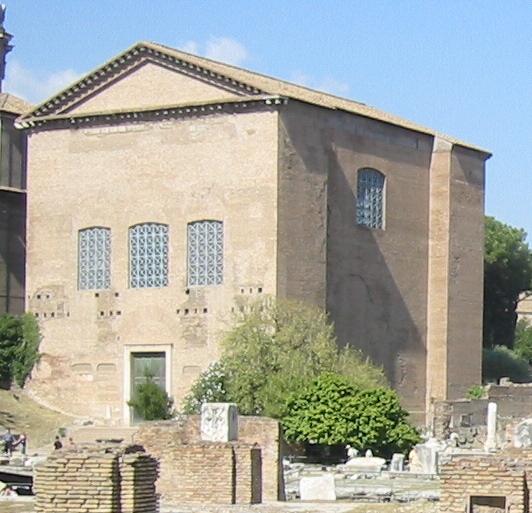
The Curia Iulia at Forum Romanum in Rome, one of the traditional meeting places for the Roman Senate. The building was reconstructed under the Fascists between 1930 and 1936, based on an earlier reconstruction in the reign of Diocletian.
Wikimedia Commons.
It was members of this very assembly — which was soon to become the Senate of the future Republic — who staged a coup and expelled the last of Rome’s kings, the Etruscan Tarquinius Superbus. From that point on, the Senate became the undisputed center of power in Rome until the end of the 2nd century BC, when the socio-demographic crisis facing Italy led to a search for change and reform through other institutions, such as the tribunes of the plebs. The failure to resolve the conflict led to the rise of warlords such as Sulla and Julius Caesar, each waging their own civil wars. These wars deeply divided the Senate, solidifying two diametrically opposed factions: the Optimates and Populares.
The future split between the Republic of the Senate and the Empire of the prince or emperor is, in part, an artificial one that has given rise to a narrative in which the Senate is seen as increasingly diminished in the face of the emperor’s authority, to the point of becoming practically irrelevant and invisible. It is still there, but merely as another monument to Republican Rome. The truth is that Rome began to be an empire long before Augustus was proclaimed emperor, just as it did not cease to be a republic during the imperial era, with a Senate that remained a political actor, wielding more informal power than formal power.
I understand the periodization that divides the history of ancient Rome into the Monarchy, the Republic, and the Empire, but I believe that, above all, it serves pedagogical purposes rather than the actual objectives of historiography. The Romans themselves, even though they were ruled by an emperor, understood that theirs was a republic, and they never ceased to describe it as such.
The issue of the figure and concept of the emperor is one that may have a great deal to do with the marginalization suffered by the Senate during the so-called Imperial era. The Romans’ concept of an emperor is quite different from our modern one. To begin with, the title imperator, from which the modern word emperor derives, was not used by the Romans when addressing their emperors. Imperator was a title bestowed by the legions upon their commanders as a form of recognition, granting them imperium — that is, the authority to command and lead — over their soldiers. The Roman emperor was called princeps (the first citizen), and this recognition meant that he was the first among the senators, holding primacy over the rest. Logically, this implies that for there to be a princeps or prince, there must be a senate; and in that sense, the Roman Senate was an integral part of the political structure of what we classify as the Imperial era until the fall of the Western Empire in 476 AD.
The Roman Senate survived the deposition of its emperor, Romulus Augustulus, the total disintegration of the Empire’s western provinces, and the imposition of two barbarian kings: first Odoacer of the Heruli, and then Theodoric the Great, king of the Ostrogoths. Throughout that entire period, the Roman Senate continued to function. It had already gained some independence in dealing with local affairs following the permanent establishment of the emperor’s court in Ravenna, in northern Italy, and under the new barbarian rulers — who sought to maintain the imperial structure and institutions for the purpose of governing — the Roman Senate experienced a modest political resurgence.
Links added to my Roman glossary.


