
Quotulatiousness

May 12, 2026

Something something hoist, something something petard

Filed under: Cancon, Media, Politics — Tags: , , , , , — Nicholas @ 04:00

The Liberal party, both federally and provincially, have been massive fans of immigration for decades. Any kind of restriction on foreigners being allowed into the country was seen as tantamount to treason, in Liberal eyes. This resulted in a lot of votes for Liberal candidates in election after election, as most immigrants associated their welcome in Canada with the party most associated with pro-immigration policies. On the weekend, this happy little virtuous circle suddenly broke in the Toronto-area provincial riding of Scarborough Southwest, and the party is left wondering what is going on:
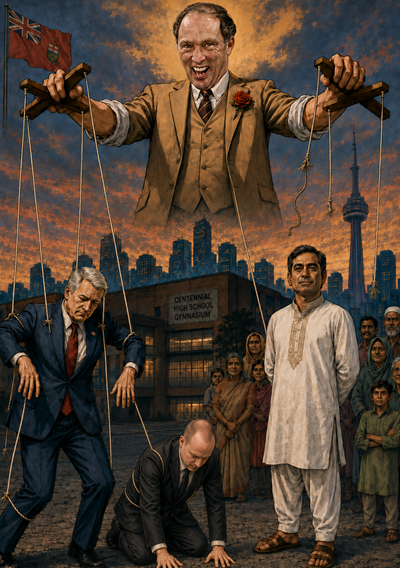
AI-generated image from Upper Canadian Cavalier

There is a particular flavour of humiliation reserved for the courtier who discovers, too late, that the rules he wrote for everyone else now apply to him. On Saturday afternoon in Scarborough Southwest, Nathaniel Erskine-Smith tasted it. The former federal Minister of Housing, the man Mark Carney himself had blessed to retain his Beaches–East York seat while parachuting into a provincial nomination as a launchpad for the Ontario Liberal leadership, lost. He lost to a man named Ahsanul Hafiz, a Bangladeshi immigrant who had arrived as an international student two decades ago, who had been forced during the campaign to answer for old social media posts of himself posing with firearms and calling for the death penalty of a Bangladeshi politician. Hafiz won not because he was a more accomplished man, not because he had a deeper grasp of public policy, not because he carried the gravitas of a former Crown minister of the Dominion. He won because he could deliver more bodies to a high school gymnasium on a Saturday afternoon than the Oxford-trained lawyer with the cabinet pedigree could.

This is the open secret of Liberal politics in Canada in the year 2026. The white Liberal cannot win his own nomination battles anymore. Not on the merits. Not on the organisation. Not on the strength of his name or the depth of his rolodex. He can only win when the party machinery he himself built bends the rules in his favour, locks the gate behind him, and quietly disqualifies the rivals who would otherwise eat him alive. When the machinery fails, as it failed in Scarborough Southwest, the result is what we saw on the weekend: the dauphin of the Carney court, the heir presumptive, sent home with a participation ribbon and a press release about how concerned he is of the democratic process.

The democratic process. We shall return to that phrase, because it has done a great deal of work for the Liberal Party of Canada these past sixty years, and it deserves the close inspection of an honest mind.

The Scarborough Lesson

Consider the bare arithmetic of what happened. Erskine-Smith is, by every measure the Laurentian establishment recognises, the kind of man the Liberal Party manufactures for leadership. Queen’s University, then Oxford for the BCL. A successful federal MP since 2015. A cabinet minister under both Trudeau and Carney. The blessing of the Prime Minister himself to remain a sitting federal MP while contesting a provincial nomination, an arrangement of breathtaking entitlement that would have been denied to anyone of lesser standing. He had every advantage the system can confer on a chosen son.

And yet the Bangladeshi grocer down the street had more votes.

Three thousand five hundred members were on the final voting list. The Bangladeshi community of Scarborough Southwest, organised through its mosques, its community associations, its weekly newspaper the Weekly Bangla Mail, its television station NRB TV, had decided some time ago that this riding belonged to them. Doly Begum, the former NDP MPP turned federal Liberal, had won the by-election three weeks earlier as the first Bangladeshi-Canadian elected to Parliament. The provincial nomination was the next obvious prize. Three of the four candidates running were of Bangladeshi origin. The fourth was Erskine-Smith.

You can imagine the scene at the high school. The folding tables, the volunteer scrutineers, families arriving in groups of six and eight, elderly grandmothers helped to their seats by grandsons. And against this, the dispersed and atomised liberal professionals of the riding, the kind of people who attend brunches in the Beaches and write earnest letters to the Toronto Star about housing policy. There was no contest. The grandmothers won. They will always win. They were always going to win. Anyone who has spent five minutes thinking honestly about what mass non-European immigration into a Westminster system actually means could have told you so.

This is not a scandal, it is not foreign interference. It is not even when properly understood, a failure of the Liberal Party. It is what democracy looks like when you transplant a foreign communal politics into a parliamentary system that was built for atomised individuals voting their conscience as Englishmen. The system the Liberals constructed across two generations, the system of mass importation without integration, of multiculturalism as official ideology, of the ethnic vote as the quiet hydraulic engine of every Liberal majority, has finally arrived at its terminal stage. The body has now grown larger than the head, and the head has noticed.

At Without Diminishment, Dakota Jeffery-Petts, who once worked as a volunteer on Erskine-Smith’s 2015 campaign, writes:
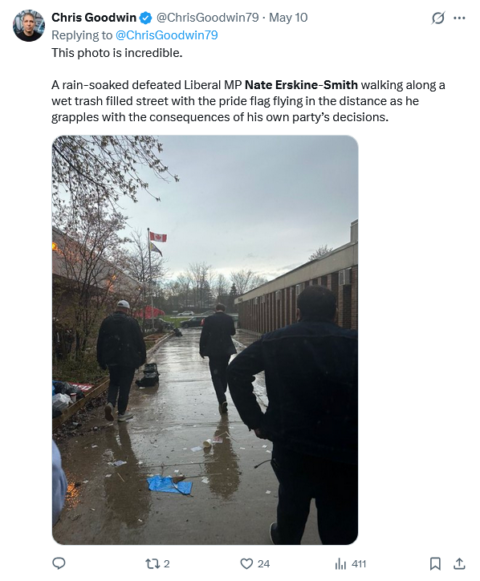
In Canada, the nomination process remains a glaring national security loophole. These contests are treated as private club matters rather than public democratic exercises. They lack the oversight of a neutral authority. This creates a low-cost, and at times entirely cost-free, environment providing a high-reward entry point for foreign interference.

All you need to do is speak sweet lies to members and constituents. In doing so, you create a motivated interest group that can effectively hand-pick a representative in a safe seat, bypassing the general electorate entirely.

When 3,580 memberships appear overnight in a single riding, we must ask: whose interests are being served? Are they Canadian interests, or diaspora interests?

The primary duty of an elected official, after all, is to the national and public interest. But when a candidate’s mandate is derived from a narrow, diaspora-specific recruitment drive, often centred on grievances or political movements from the old country, that candidate becomes a delegate for a foreign interest rather than a representative of Ontario and the Ontarians in that riding.

The result illustrates the danger of fragmented national and local loyalties.

Multiculturalism, when left without a strong framework of national identity, allows for the importation of foreign conflicts into our legislative halls. We are seeing the rise of a political class that views a seat in a Canadian legislature as a platform for foreign advocacy, rather than a tool for national or provincial governance.

This capture of our nomination process by diaspora activism is the ultimate sign of a hollowed-out democracy. If the gates to our legislatures are guarded by whoever can mobilise the largest bloc of unintegrated interests, then the concept of a Canadian mandate becomes meaningless.

We are effectively outsourcing our leadership selection to the highest bidder, or to the most aggressive foreign-aligned organiser. The decision by the Ontario Liberal Party to allow this surge, and the subsequent defeat of one of the more prominent politicians in the province, shows a party that has lost its way.

By prioritising raw numbers over the quality and loyalty of its candidates, the Ontario Liberals have signalled that they are comfortable being a vessel for proxies acting on behalf of foreign interests, despite the hardships facing so many Ontarians.


June 18, 2023

QotD: Good intentions do not automatically mean good results

The United Nations Children’s Fund is probably the greatest mass-poisoner in human history — not deliberately, of course, but inadvertently. It encouraged and paid for the drilling of tube wells in Bangladesh without realizing that the groundwater was dangerously high in arsenic content. It promoted the wells to reduce the infant mortality rate from infectious gastroenteritis and in this it succeeded. Indeed, it trumpeted its success to such an extent that it found it hard to recognize that, in the process, it had exposed tens of millions of people to arsenic poisoning, and was very late in recognizing its responsibility in the matter.

Another United Nations agency, its peacekeeping force in Haiti, was responsible for the most serious epidemic of cholera of the twenty-first century so far. Before 2010, cholera had been unknown in Haiti despite the country’s poverty and lack of hygiene. Then, from 2010 to 2018, it suffered outbreaks of cholera that have affected perhaps a tenth of the population and caused between 10,000 and 80,000 deaths (the exact figure will never be known).

The evidence suggests that cholera was brought to Haiti by United Nations peace-keeping troops from Nepal. Whether Haiti needed peacekeeping troops at all may be doubted: at the time it suffered from civil unrest rather than from war. One suspects that the peacekeeping force was employed more to keep the Haitians from leaving Haiti than to keep the peace.

Be that as it may, some Nepali troops arrived fresh from a cholera epidemic in Nepal, established a camp next to the Artibonite River from which many Haitians drew their water. The Nepalis emptied their sewage directly into the river, and some of them were infected with the cholera germ. There was soon an outbreak of cholera among the local population of extraordinary violence. The Haitians guessed at once that the Nepali troops had brought the cholera, but this was strongly denied.

Theodore Dalrymple, “Negligence and Unaccountability at the United Nations”, New English Review, 2019-07-09.

April 17, 2021

QotD: Erasing the Maldives from the atlas

Filed under: Asia, Books, Britain, Environment, Humour, Quotations — Tags: , , , — Nicholas @ 01:00

Maldivian media outlets this morning published as fact a satirical Telegraph news blog citing “unconfirmed rumours” that the 14th edition of the Times Comprehensive Atlas of the World will omit the Maldives, Tuvalu, “and major parts of Bangladesh” as a statement on global warming.

The blog post, written by climate change skeptic James Delingpole who describes himself as “a writer, journalist and broadcaster who is right about everything”, features comments by a “Times Atlas spokesman” David Rose.

In a UK press scandal this year, “David Rose” was found to be a psuedonym used by left-wing Independent journalist and climate change writer Johaan Hari to edit his own Wikipedia entry, advocate his own position and attack his critics.

Rose, who in Delingpole’s article holds “a doctorate in Cambridge in Climate Change and Sinking Islands Studies so I know what I’m talking about, and if you don’t believe me, ask my friend Johaan Hari who taught me everything I know”, acknowledges that it “may not be strictly geographically accurate to say the Maldives and Tuvalu will definitely have disappeared in about ten years time when our next edition appears.”

“But did you see that picture of the Maldives cabinet holding a meeting underwater? If the Maldives government says the Maldives are drowning, they must be drowning. And frankly I think it’s despicable, all those deniers who are saying it was just a publicity stunt, cooked up by green activist Mark Lynas, to blackmail the international community into giving the Maldives more aid money while simultaneously trying to lure green Trustafarians to come and spend £1500 a night in houses on stilts with gold-plated organic recyclable eco-toilets made of rare earth minerals from China. Why would a government lie about something as serious as climate change?”

Rose goes on to state that “I’m pleased to say that this is a view of the world shared by my colleagues at Times Comprehensive Atlas Of The World. They understand that maps based on accurately recorded geographical features belong in the Victorian age of child chimney sweeps. What we need now is maps that change the world, transforming into something which it isn’t actually yet but might be one day if we don’t act NOW!”

“Delingpole Satire Dupes Maldives Media”, The Global Warming Policy Forum (GWPF), 2011-09-21.

March 7, 2018

Language and the network effect

Filed under: Asia, Economics, History — Tags: , , — Nicholas @ 05:00

Tim Worstall in the Dhaka Tribune:

A recent article on the Dhaka Tribune reported that Bangladesh as a country, as an idea, is rather closely linked with the idea of Bangla as a language. Languages having much to do with something economists find fascinating, network effects.

Indeed, we can explain what happens with languages, with Facebook and with currencies all using these same effects. We end up, as we so often do in economics, with the answer: “It depends.”

Let us leave aside those cultural and political issues, the difference between an official language and a mother tongue and mother language. Instead, consider those as networks. Why is it that Facebook has conquered every other form of social media? For the same reason that one fax machine is an expensive paperweight, two allows information to flow, and millions means those millions can communicate with each other.

So it is with anything subject to strong network effects.

We all go on Facebook because everyone else is there, that everyone else is there means more people join it. The standards fax machines use to talk to each other are just the one set of standards precisely so that they can all communicate.

We might think that the same should be true of language. We could all communicate with each other much more easily if there was just the one language used to do so. Often there is a lingua franca which allows this — say, Latin in the past and English now.

But that’s not really how we humans work. Even Bangla is not the same in each and every area of the country, just as English isn’t even in England. There are local dialects which are not mutually intelligible; we use a simplified or standardized version to speak with people from other areas — this is where the “BBC accent” comes from.

The same is true of German for example, people from different areas cannot understand each other using their local variations so they use a standardized German which no one really speaks at home.

One story — a true one — has it that when John F Kennedy said “Ich bin ein Berliner” in a speech at the Berlin Wall he actually said in the local dialect that he was a jam doughnut. Common German and local are not the same thing at all.

The reason for this is that the language varies from household to household. Every family does have its own little private inside jokes; anyone who has ever met the in-laws knows this.

So too do neighbourhoods, villages and so on. A national language is like a patch-work quilt of these local variations.

To put this into economic terms of our networks, yes, we have that efficiency argument that we should all be using the same inter-changeable language, but that’s just not what we do. There’s a strong force, just us being people, breaking that language up into local variants, as happened with Latin and then Portuguese, Spanish, French, and Italian over the centuries.

November 5, 2017

QotD: Explaining comparative advantage

Actually, it’s dead easy. No math, no arithmetic. It is in fact the soul of common sense. But you have to understand that comparative advantage is the principle of cooperation, as against competition. The word “advantage” gets us thinking of competition, which is perfectly reasonable in our own individual lives — we do compete with other businesses or other writers or whomever. But the system as a whole, whatever it is, does well of course by cooperating, in business or science or family life. It’s not all we do, admittedly. We also compete. But within a household or a company or a world economy the job is to produce a result in the best way, cooperatively. If you are running a household or a sports team or a world economy, you would want to assign roles to the various contributors to the common purpose sensibly. It turns out to be precisely on grounds of comparative advantage.

Consider Mum and 12-year old Oliver, who are to spend Saturday morning tidying up the garage. Oliver is incompetent in everything compared with Mum. He cannot sweep the floor as quickly as she can, and he is truly hopeless in sorting through the masses of rubbish that garages grow spontaneously. Mum, that is, has an absolute advantage in every sub-task in tidying up the garage. Oliver is like Bangladesh, which is poor because it makes everything — knit goods and medical reactors — with more labor and capital than Britain does. Its output per person is 8.4 percent of what it is in Britain. So too Oliver.

What to do? Let Mum do everything? No, of course not. That would not produce the most tidied garage in a morning’s work. Oliver should obviously be assigned to the broom, in which his disadvantage compared with Mum is comparatively least — hence “comparative advantage.” An omniscient central planner of the garage-tidying would assign Mum and Oliver just that way. So would an omniscient central planner of world production and trade. In the event, there’s no need for an international planner. The market, if Trump does not wreck it, does the correct assignment of tasks worldwide. Bangladesh does not sit down and let Britain make everything merely because Britain is “competitive” absolutely in everything. And in fact Bangladesh’s real income has been rising smartly in recent years precisely because it has specialized in knit goods. It has closed its ears to the siren song of protecting its medical reactor industry. It gets the equipment for cancer treatment from Britain.

Comparative advantage means assigning resources of labor and capital to the right jobs, whatever the absolute productivity of the economy. It applies within a single family, or within a single company, or within Britain, or within the world economy, all of which are made better off by such obvious efficiencies. Following comparative advantage enriches us all, because it gets the job done best. Policies commonly alleged to achieve absolute advantage lead to protection — that is, extortion, crony capitalism, and the rest in aid of “competitiveness.”

Dierdre N. McCloskey, “A Punter’s Guide to a True but Non-Obvious Proposition in Economics”, 2017-10-16.

August 15, 2015

Impersonal forces acting on passive innocents

Filed under: Britain, Media, Middle East, Religion — Tags: , , , , , — Nicholas @ 04:00

We’ve seen plenty of examples of this kind of “reporting”, where the presentation of the case absolves the actors in advance of any motive or action … they’re always implicit victims of circumstances beyond their control. Theodore Dalrymple points to a recent example:

Sometimes the employment of a single word in common use gives away an entire worldview. There was just such a usage in the headline of a story in the Guardian newspaper late last month: “How the ‘Pompey Lads’ fell into the hands of Isis.”

Pompey is the colloquial name for Portsmouth, the naval town on the south coast of England, and the “lads” of the headline were five young men of Bangladeshi origin who grew up there and later joined Isis in Syria. The article describes how the last of the five has now been killed, three others having been killed before him and one, who returned to Britain, having been sentenced to a four-year prison sentence (in effect two years, with remission for good behavior). The use of the word “lads” is intended to imply to the newspaper’s readers that there was nothing special or different about these five young men, nothing that distinguished them from the other young men of Portsmouth. Its use was a manifestation of wishful or even magical thinking, as if reality itself could be altered in a desired way by the mere employment of language.

But the word that implied a whole worldview was “fell.” According to the headline, the young men “fell” into the hands of Isis as an apple falls passively to the ground by gravitational force. The word suggests that it could have happened to anybody, this going to Syria via Turkey to join a movement that delights in decapitation and other such activities in the name of a religion — their religion. Joining Isis is like multiple sclerosis; it’s something that just happens to people.

The word “fell” denies agency to the young men, as if they had no choice in the matter. They were victims of circumstance by virtue of their membership of a minority, for minorities are by definition victims without agency.

May 26, 2013

Bangladesh needs legal reform and free markets

Filed under: Asia, Bureaucracy, Economics, Law — Tags: , , , , , , — Nicholas @ 10:37

Sheldon Richman discusses the plight of workers — especially poor women workers — in Bangladesh:

According to a report written for the Netherlands ministry of foreign affairs, most Bangladeshis, unsurprisingly, are victimized by a land system that has long benefited the rural and urban elites. “Land-grabbing of both rural and urban land by domestic actors is a problem in Bangladesh,” the report states.

    Wealthy and influential people have encroached on public lands…, often with help of officials in land-administration and management departments. Among other examples, hundreds of housing companies in urban areas have started to demarcate their project area using pillars and signboard before receiving titles. They use local musclemen with guns and occupy local administrations, including the police. Most of the time, land owners feel obliged to sell their productive resources to the companies at a price inferior to market value. Civil servants within the government support these companies and receive some plot of land in exchange.

Women suffer most because of the patriarchy supported by the political system. “Women in Bangladesh rarely have equal property rights and rarely hold title to land,” the report notes. “Social and customary practices effectively exclude women from direct access to land.” As a result,

    Many of the rural poor in Bangladesh are landless, have only small plots of land, are depending on tenancy, or sharecropping. Moreover, tenure insecurity is high due to outdated and unfair laws and policies…. These growing rural inequalities and instability also generate migration to towns, increasing the rates of urban poverty.

Much as in Britain after the Enclosures, urban migration swells the ranks of workers, allowing employers to take advantage of them. Since Bangladesh does not have a free-market economy, starting a business is mired in regulatory red tape — and worse, such as “intellectual property” law — that benefit the elite while stifling the chance for poor individuals to find alternatives to factory work. (The owner of the Savar factory, Mohammed Sohel Rana, got rich in a system where, the Guardian writes, “politics and business are closely connected, corruption is rife, and the gap between rich and poor continues to grow.”) Moreover, until the factory collapse, garment workers could not organize without employer permission.

Crony capitalism deprives Bangladeshis of property rights, freedom of exchange, and therefore work options. The people need neither the corporatist status quo nor Western condescension. They need radical land reform and freed markets.

August 30, 2012

Exaggerating your points to make them seem more important than they are

Filed under: Economics, Environment, Food, Media — Tags: , , , — Nicholas @ 11:05

Geoff Chambers does a bit of Google searching to track down a few of the claims made in Stephen Emmot’s critically acclaimed one-man show “Ten Billion”:

The reviews were full of superlatives. The Times’ critic calls it “utterly gripping, terrifyingly lucid”; Time Out: “monumentally sobering”; Billington in the Guardian: “one of the most disturbing evenings I have ever spent in a theatre”; the Financial Times: “one of the most disturbing shows I have seen on a stage”; the Mail on Sunday “certainly the most scary show in London”. Almost all of them cite Emmott’s conclusion: “We’re f*cked”.

Here are some of the key “facts” (or “f*cts”) cited by Emmott and picked up by critics. (It is of course impossible to check whether the critics have quoted Emmott correctly, since no record of what he says exists):

1) A google search uses as much electricity as boiling a kettle.

2) It takes 3,000 litres of water to make a hamburger, (that’s 10 trillion litres of water annually to sustain the UK’s burger industry).

3) It takes 27,000 litres of water to make a bar of chocolate

4) Animal species are currently going extinct at a rate 1,000 times their natural level.

5) Bangladesh will be under water by the end of the century.

TL;DR for those who don’t feel up to reading the whole thing: 1) false, by a factor of 100. 2) true-ish, but massively misleading. 3) false, or Emmott eats humongous chocolate bars. 4) false, even though Wikipedia thinks it’s true. 5) false, the land area of Bangladesh has actually grown over the last 50 years thanks to land reclamation projects.

April 25, 2011

Grameen Bank cleared of “irregularities”, but Yunus will not be re-instated

Filed under: Asia, Economics, Law, Liberty — Tags: , , , , — Nicholas @ 11:06

The Bangladeshi government has completed their investigation into financial irregularities at microfinance specialist Grameen Bank, but the founder, Muhammad Yunus, will not be brought back:

Yunus, 70, was dismissed by a central bank order — upheld by the high court and supreme court — on the grounds that he had overstayed in his position and refused requests to quit.

Yunus, winner of the 2006 Nobel peace prize, set up Grameen, which means village in Bengali, and had been the bank’s managing director since 2000.

Lauded at home and abroad by politicians and financiers as the “banker to the poor”, he has been under attack by the government since late last year, after a Norwegian documentary alleged the bank was dodging taxes.

Yunus denied any wrongdoing and a Norwegian government investigation later also cleared him of any malpractice.

April 5, 2011

Grameen bank founder loses final appeal

Filed under: Asia, Economics, Law, Liberty — Tags: , , — Nicholas @ 09:09

The founder of the revolutionary micro-capital Grameen Bank has been removed from position of managing director:

Nobel laureate Muhammad Yunus has lost his final appeal in Bangladesh’s Supreme Court against his sacking from the Grameen micro-finance bank he founded.

The court upheld the decision by the central bank to remove him from office.

The bank said Professor Yunus had been improperly appointed while past retirement age.

But Professor Yunus said the attempt to remove him from the bank had been politically motivated.

The Grameen Bank has pioneered micro-lending to the poor by giving small loans to millions of borrowers.

Powered by WordPress

