Quotulatiousness

October 30, 2025

Javier Milei’s party does well in mid-term elections

J.D. Tuccille on the results of Argentina’s recent elections which returned significantly more of Javier Milei’s allies than pre-election polls predicted:

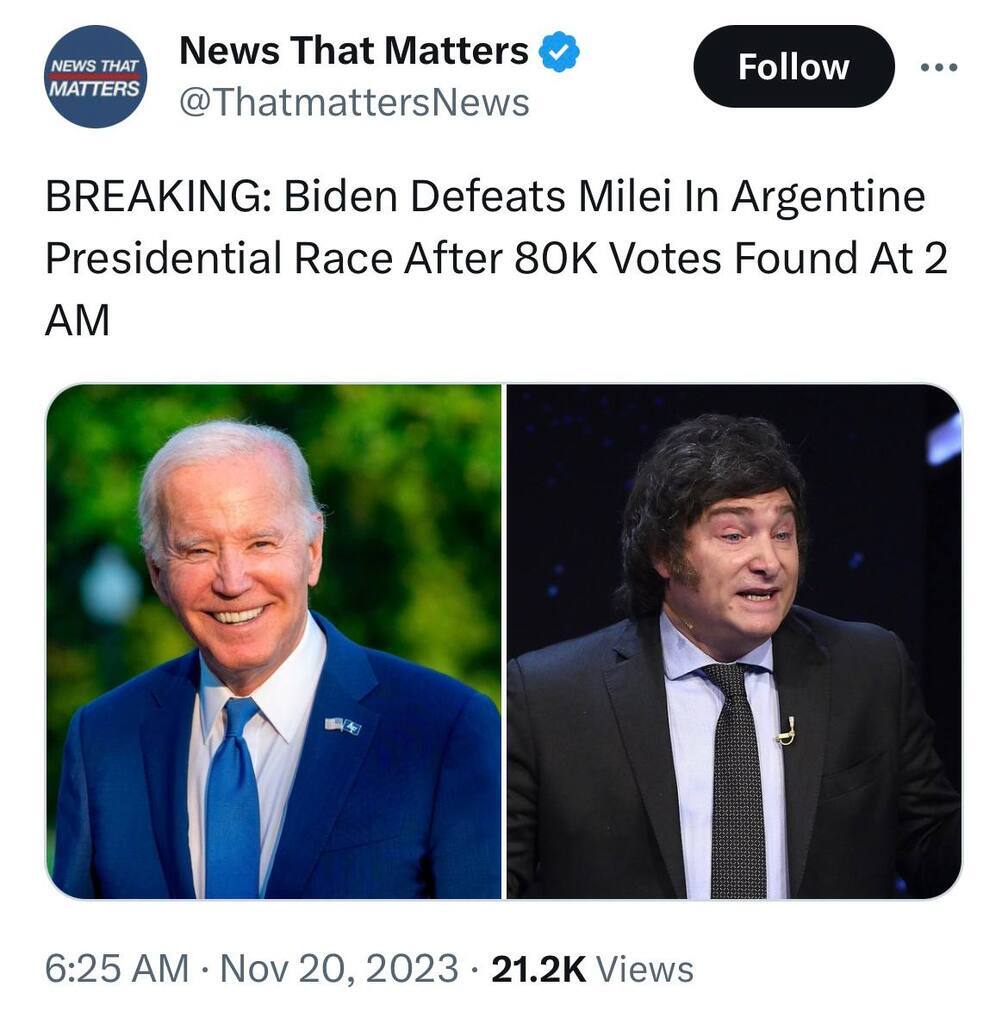
And things were going so well before 2am …

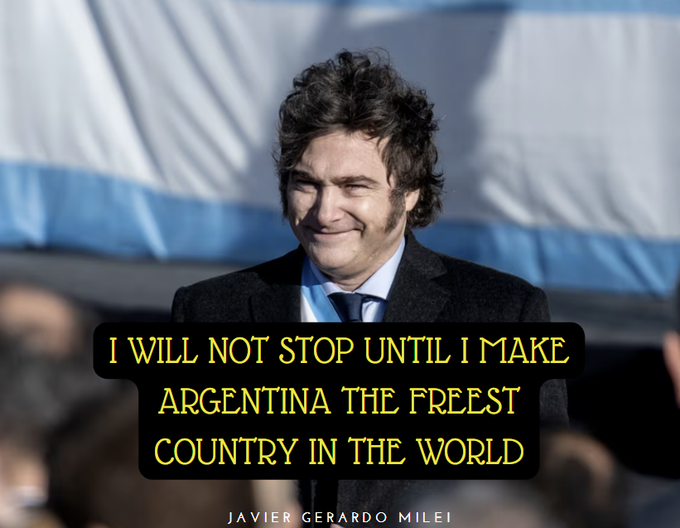
Argentina’s libertarian President Javier Milei won an important election victory on Sunday when his coalition, La Libertad Avanza (LLA), received a plurality of votes in the country’s legislative elections. With about half of the seats in the lower house up for grabs and a third of the Senate, LLA didn’t gain a majority, but it dramatically increased its share enough to block repeals of presidential decrees by lawmakers from other parties and to support presidential vetoes.

As Reason‘s César Báez commented, the results give Milei and his allies crucial time to continue needed free-market reforms and, hopefully, restore the fortunes of a country once held up as a model of prosperity, but which has been driven into poverty by decades of statist misrule.

In what it calls “a shocking electoral victory”, La Nacion reports that LLA pulled 40.66 percent of the vote. That’s well ahead of the opposition Peronists, who have long dominated the country and drew 31.7 percent of votes. Importantly, LLA won the populous province of Buenos Aires (home to 40 percent of voters), a Peronist stronghold where Milei’s allies were recently trounced in local elections.

From Wealth to Poverty Under Government Economic Meddling

This is good news for anybody who hopes for the advance of freedom, of course. But it’s especially encouraging for Argentines who, over the course of generations, have seen their country reduced from one of the wealthiest in the world to an impoverished basket case.

“At the end of the 19th century, economists agreed: Argentina, the ‘land of silver’, had a golden future ahead of it,” Deutsche Welle noted in 2020. “‘Rich like an Argentine’ was a common phrase at the time.”

The German broadcaster added, “in an unprecedented fall, Argentina went from ranking among the world’s top economies to one at the very bottom of the list. Today, economists simply roll their eyes at the fate of Argentina, which is now a developing country.”

The reason is simple enough: Argentines handed their political fates to a man named Juan Peron. In the 1930s, Peron served as a military observer in Europe, traveling to countries including Germany, Italy, and the Soviet Union. He was deeply impressed by some of the worst ideas to ever motivate a government and blended them into his own “justicialist” ideology. Through decades of political dominance, first Peron and then successor justicialists demonstrated that, in practice, there’s no real difference between fascism and socialism and that statist economics by any name are destructive.

To illustrate just how destructive Peron’s legacy has been, it’s worth pointing out that after Sunday’s election, The Wall Street Journal reported that Milei’s free-market, smaller-government policies “have restored some credibility to Latin America’s third-largest economy, but about one in three people still live in poverty”. One-third of the population living in poverty is horrifying, but what’s remarkable is that this is an improvement over what went before. At the end of the preceding Kirchner presidency, poverty stood at 41.7 percent and then briefly rose to 52.9 percent before falling to its current level.

In Spiked, Hugo Timms points out that the success of La Libertad Avanza is almost diametrically opposed to what most mainstream media reports were saying in the days leading up to the elections:

Argentine president Javier Milei has won a significant victory in Argentina’s midterm elections, held on Sunday. His libertarian party, La Libertad Avanza (Liberty Advances), claimed more than 40 per cent of the vote, effectively doubling its share of seats in the senate and lower house to 37 (out of 72) and 64 (out of 257) respectively.

The result came as a bitter shock to much of the mainstream Western press. Milei’s assault on established economic orthodoxies since his election in December 2023 led many “experts” to take it for granted that Milei’s party was in for a hiding.

In a primer for the election published last weekend, the Observer had already begun salivating over the prospect of Milei’s defeat. “Argentina is counting the cost of its turn to Javier Milei”, wrote economics editor Heather Stewart. Glum portraits of Nigel Farage and Donald Trump behind Milei loomed above the article. “Politicians around the world are closely watching what happens when populist economic prescriptions collide with reality”.

This was a comparatively soft take compared with what the Guardian published earlier in October. “Farage, Trump, Musk: your boy Javier Milei just took one hell of a beating. Why so quiet?”, blared the headline when Milei’s party was defeated in a provincial election in the capital Buenos Aires. The Guardian said Milei’s “hard right” administration was “melting away”, along with his “once-packed international throng of cheerleaders and wolf-whistlers”.

Unsurprisingly, the BBC struggled to get to grips with Milei’s victory on Sunday, even though its only job was to convey the results impartially. Apparently, the president made gains despite Argentina “hurtling towards an economic collapse”, it editorialised. It said the voter turnout of 68 per cent reflected “widespread apathy”. This might be lower than past midterm elections in Argentina, but it was still higher than turnouts at last year’s US presidential election (65 per cent) and the most recent UK General Election (60 per cent).

None of this should come as a shock. Since Milei’s rise to power in 2023, most of the commentariat has been eager to see him fail. His promises to radically cut public spending and deregulate key industries were seen in the eyes of many economic experts to only mean one thing: the dreaded return of Thatcherite “neoliberalism”, from which, they claim, Britain and America have never truly recovered.

The antipathy is mutual. In a speech to the World Economic Forum in January 2024, Milei famously referred to the world’s political classes as “parasites who live off the state”. That his speech was shared approvingly by Elon Musk on X confirmed, in the eyes of the Western establishment, Milei’s status as a dangerous insurrectionist.

October 26, 2025

The financial gap between Zohran Mamdani’s promises and what NYC can afford

Short of a couple of political earthquakes, Zohran Mamdani is going to be the next mayor of New York City. He has, as Andrew Sullivan admits, a lot going for him with Democratic voters, but he’ll have to get some special magic formula working to fund all the things he’s promising:

New York State Assemblymember Zohran Mamdani photographed in Assembly District 36, 10 February 2024.
Photo by Kara McCurdy via Wikimedia Commons.

It is not hard to see the appeal of Zohran Mamdani. He is, after all, not Andrew Cuomo — another corrupt, old, Democratic sexual harasser who’s already spent years in power and thinks he’s entitled to be mayor because of his last name. He doesn’t appear steeped in petty corruption like Mayor Adams. He’s not as obviously nutty as Sliwa seems to be. And he has done politics, pace Ezra, the right way: listening to the other side, earning people’s votes one by one, talking to people on the street, and, of course, mastering our new collective replacement for civil discourse: 30-second videos on TikTok.

Those videos are fantastic. Check out this one in favor of freezing rents in NYC, with the man, in full suit and tie, jumping into a freezing bay and out again. Or this one about “Halalflation” — on how licensing food carts has become a grift for middlemen. Or this one, when he sits down with two old white men — one for Adams and one for Cuomo — and tries to talk them into an alternative. If I were a Democrat, I’d be thrilled to see someone this fresh, this approachable, and this likable as a new face of the party. He’s young and charming and upbeat in a party lacking in all three.

He’s also right to focus his campaign on the question of affordability. New York City is ridiculously expensive in every way; the toll that high taxes and inflation have taken on working-class residents has been huge. Capitalism isn’t working the way it should, and we need to reboot our economic policies to address that as a priority. Trump has promised this but is delivering the opposite. Just this morning, we see an accelerating inflation rate. An opening beckons.

So I get why Mamdani is popular. And I have little doubt he will be the next mayor, as well as a major national figurehead for the Democrats — a nice dose of youth to a party debilitated by seniorityitis. He will define the Democrats nationally — certainly if the GOP has any say in it. And in many ways, he is the perfect candidate for today’s Dem elites: wealthy, woke, with a degree in “Africana studies.” His only problem is not being female — but since he denies that the category of female exists, no big deal I suppose. He will give the MSNBC/Bulwark crowd a new lease on self-righteousness.

But to be honest, when I read his proposals, at first I thought I was reading a high-schooler’s essay. Free everything! I mean: why not? Free universal childcare for kids as young as six weeks old. Free buses for everyone. Rent control for everyone already privileged by it. Subsidized collective supermarkets. $30-an-hour minimum wage by 2030 — up from $16.50. Woohoo! And arresting Bibi as an added bonus. (I have to say the last plank might even tempt me to vote for him.)

The problem, of course, is how to pay for it. And a NYC mayor, quite simply, cannot. Mamdani simply won’t have the power. None of the tax hikes he proposes — a new 2 percent tax on everyone earning over $1 million a year, and jacking up the corporate tax to 11.5 percent — can be passed by his council. Albany has the final say, will almost certainly say no, and the Democratic governor, Hochul, opposes the hikes.

So a lot of this is purely performative, no? He has a good chance to create his Soviet bodegas and, in all likelihood, freeze rents if he replaces members of the board. (That will, of course, make housing availability and expense even worse.) He may be able to wangle some increase in NYC’s minimum wage — by trying to bypass Albany. But doubling it in five years? Meh. All of the economic stuff is iffy because of the very probable lack of funding. Maybe a big victory will change the dynamics and allow a big tax hike in one of the most highly taxed cities on earth. But it’s hard to believe it.

So what’s left? What’s left is cultural leftism on hormones. You may get daycare — but it will come with full woke indoctrination of kids from the earliest years on. No more “boys” or “girls” allowed! Mamdani, as we all know, regards the police as the enforcers of “white supremacy“, supports the end of Israel as a Jewish state, will subsidize the transing of children with no safeguards, and has erased gays and lesbians from our own history, re-marginalizing us as “queers”. There’s no one the woke left hates more than an empowered and integrated person who just happens to be gay or lesbian.

Like all good critical-theory racists, Mamdani believes in a racial hierarchy with whites, Jews, and Asians as oppressors, and blacks and Hispanics and “queers” as victims; he wants to make NYC “the strongest sanctuary city in the country” — i.e. go to war with ICE — and kill the educational programs that help gifted poor kids in kindergarten — because most turn out to be of the oppressor races. A racist, in other words — to his fingertips.

And he is a near-perfect foil for Trump. “Queer liberation means defund the police,” he once tweeted — though he says he no longer wants to defund the cops. It’s the kind of 2020 slogan almost designed to ensure MAGA control of the national discourse forever. And if I were a show-runner on the Trump show, Mamdani would be central to provoking the kind of real fascist putsch that Trump and Miller are itching for, if they can find a suitable provocation. Mamdani is that provocation. He will go to war with ICE in NYC, and Trump will go to war with him. And broadcast it every day.

“Canada’s elections used to mean something. Now they’re a joke”

Filed under: Cancon, Government, Politics — Tags: , , — Nicholas @ 03:00

Dan Knight on the recent presentation by former Elections Canada head Jean-Pierre Kingsley and current Quebec electoral officer Jean-François Blanchet to the Procedure and House Affairs Committee in Parliament:

“2019 Canadian federal election – VOTE” by Indrid__Cold – CC BY-SA 2.0

What we just witnessed in Ottawa last Tuesday wasn’t a hearing, it was a slow-motion autopsy of Canadian democracy. The Procedure and House Affairs Committee gathered to talk about the so-called “Longest Ballot Committee,” a group of self-styled activists who decided to “protest” the electoral system by flooding ridings with hundreds of fake candidates, turning the act of voting into a bureaucratic endurance test. And what did the political class do about it? They shrugged. They nodded solemnly. They said “shared responsibility.”

In other words: nothing.

Former Elections Canada chief Jean-Pierre Kingsley and Quebec’s electoral officer Jean-François Blanchet were the adults in the room, the only people who seemed to understand what’s actually at stake when you weaponize procedure to destroy trust. Kingsley, who’s been overseeing elections since before most MPs had a LinkedIn page, didn’t mince words: “The Long Ballot Initiative is unjustified and exceedingly disruptive“. In other words, a circus.

He called voting the act that “establishes the very legitimacy of Parliament”. That used to mean something in this country. Now? It’s a joke being played on the people who still believe their vote matters.

Blanchet gave the numbers that should have every Canadian furious, 40 candidates in one riding, 91 in another, 214 in a third. Two hundred and fourteen names. That’s not democracy, that’s sabotage. He called it “a movement to challenge the voting system, not to get candidates elected”. Exactly. It’s the bureaucratic version of an online troll farm.

He told MPs what voters already know: “Overly long ballots irritate voters”. You think? Imagine trying to fold a sheet the size of a blueprint just to cast a vote for your MP. And yet, for this — for actively undermining elections — no one’s been charged, fined, or even reprimanded.

Then Conservative MP Blaine Calkins finally asked the question everyone else was too polite to touch: Should there be penalties for those who make a mockery of our electoral system? Kingsley didn’t hesitate: “Yes“. He said it should go to a court of law, not a bureaucrat, not some anonymous commissioner. A judge. A real trial. Because that’s how serious this is.

Meanwhile, the Liberals on the committee did what they always do, changed the subject. Instead of talking about ballot fraud, they went off about “AI misinformation” and “deepfakes”. Liberal MPs Élisabeth Brière and Arielle Kayabaga wrung their hands about artificial intelligence like it was the Terminator coming for democracy. Never mind that the real problem was sitting right in front of them: a political culture that treats fraud as performance art.

October 25, 2025

Foreign interference? In our elections? Say it ain’t so …

Filed under: Cancon, China, Government, India, Media, Politics — Tags: , , , — Nicholas @ 04:00

Oh, but it is, fellow Canadians, and it’s going to continue because our government can’t or won’t lift a finger to stop it:

The cover of the NSICOP special report on foreign interference (PDF – https://nsicop-cpsnr.ca/reports/rp-2024-06-03/special-report-foreign-interference.pdf )

[Vancouver-East MP Jenny Kwan]’s recent comments, which correctly noted the incredible hardship that Canadians targeted by foreign regimes endure, typically with no help from an apathetic Canadian government, are important and deserve amplification — we must all hammer home just how vicious a foreign influence campaign can be for those on the receiving end, and how little help they can normally expect from Canadian officials.

But mystifying? I wish.

A recap of the timeline is useful: The Liberals were “actively considering” such a registry as early as 2021. Late the next year, the magnificent Marco Mendicino, living embodiment of Trudeau-era ministerial excellence, was talking about launching a consultation, to see if it was an idea worth pursuing. A few months later, Justin Trudeau himself said that Mendicino would be “moving forward” to study “various proposals” in the coming weeks.

And then, well. You know. Nothing happened. In short order the government had the foreign interference scandal blow up in its face. A public inquiry was eventually called, after a long, drawn out process of increasingly pathetic attempts to dodge the issue. The initial report by Justice Hogue was released in May of 2024, and that month, the House unanimously passed Bill C-70, the Countering Foreign Interference Act. This gave the government the legal tools to establish the registry, a process they said would take about a year. That year ran out five months ago, and at that point … the office wasn’t even operating yet, even just in preparation for eventually going live. The Carney government then said they’d appoint a commissioner by September of this year. This would mark the beginning of the registry’s work.

It’s now late October, with nary a new-fangled commissioner to be found.

The Hill Times article places Kwan’s comments, and the government’s overall lackadaisical effort on this front, in the specific context of the Carney government’s efforts to offset our lopsided reliance on trade with the United States by improving relations with China and India. These are not countries with which we have lately been swapping friendship bracelets, and a foreign influence registry would largely — not exclusively, but largely — be intended to address their interference. “I am constantly worried about [foreign interference], but that doesn’t mean I’m not also worried about affordability issues for Canadians; I can do both,” Kwan is quoted as telling The Hill Times. “The Carney government needs to be able to walk and chew gum at the same time; they need to address both with the level of seriousness and attention they require.”

Later in the article, Dan Stanton, a former senior CSIS official and current national security expert at the University of Ottawa, adds that the Carney government has likely postponed any further announcements on the registry to avoid complicating ongoing talks with the Asian giants.

Well, yeah. That’s pretty clearly an issue. Kwan and Stanton have the government about dead to rights on that one. You can see the proof of that everywhere — Foreign Affairs Minister Anita Anand’s recent trip to India and China, after which she called China a “strategic partner”, is a pretty clear signal. The latest blowup in U.S.-Canada relations, with Trump cancelling all trade negotiations with Canada because (or so he claims) Ontario ran anti-tariff ads on U.S. TV, will only increase the desire in Ottawa to realign our economy toward literally anyone else but the Americans.

October 23, 2025

Alberta considers rule changes to get rid of the “Longest Ballot” pranksters

Filed under: Cancon, Media, Politics — Tags: , , — Nicholas @ 05:00

The last couple of elections Pierre Poilievre has fought attracted the attention of a group of activists who claim their shenanigans are directed at effecting changes in our electoral system, by flooding the field with frivolous candidates to somehow change how we elect our members of parliament. It’s odd that these serial efforts were directed at the leader of His Majesty’s Official Opposition, who has no power to change the electoral system rather than, say, the Prime Minister or his cabinet ministers who, theoretically, do:

Pierre Poilievre’s riding had an insane number of protest candidates registered for the last general election. Oddly, the same wasn’t true in any other riding in the country. This was an organized protest for electoral reform, supposedly.

On Monday, Alberta Conservative House Leader Joseph Schow mentioned to reporters that the province’s government has legislation in the works to protect the Alberta electoral system from the shenanigans of the Longest Ballot Committee (LBC). That’s the protest group that has been flooding some federal election ballots with spurious candidates — most recently in the federal riding of Battle River-Crowfoot, where Elections Canada had to desperately improvise an all-new write-in system after the LBC persuaded more than 200 people to contest an August by-election.

Kieran Szuchewycz, one of the whimsical conspirators behind the committee, was the person who successfully (and without hired legal counsel) persuaded an Alberta Queen’s Bench judge in 2017 to eliminate statutory election-deposit requirements as unconstitutional. Justice Avril Inglis accepted that the purpose of deposits — which had already been made unconditionally refundable — was to deter frivolous candidates, and that this was desirable and rational.

But she concluded that “it makes little sense to suggest that the deposit requirement achieves any filter other than for those that cannot part with $1,000 for the duration of the election.” Deposits, which had been part of Canadian elections since before Confederation, had suddenly failed the Oakes test. Inglis’s ruling immediately led to an intentional explosion in openly frivolous federal candidacies, engineered by the very same gifted amateur who had talked her into it.

With deposits proclaimed unconstitutional, the only remaining defences against the Longest Ballot Committee’s DDoS attacks on democracy were the requirements for candidates to gather a hundred signatures of constituency residents on their nomination forms and to hire an official agent. The LBC skates around those by recruiting nominators who are willing to endorse anybody, using the same hundred signatures for many candidates, and by providing the same official agent, often somebody named Szuchewycz, to multiple candidates.

These days Mr. Szuchewycz’s brother Tomas is the public face of the LBC: earlier this month he appeared before the House of Commons procedure committee, which has dedicated a few meetings to the subject of LBC tomfoolery. (Kieran, the original smooth talker who got rid of election deposits, is currently listed as “on leave” from the board of electoral-reform group Fair Vote Canada.) There was a heated but unenlightening contretemps between Szuchewycz and Conservative MP Michael Cooper over whether the LBC had used unlawful techniques in their signature-harvesting efforts.

Szuchewycz explained the goals of the LBC ballot-fouling. The group’s supporters and leaders are obviously garden-variety election-reform nerds, but they now focus on the need for taking election design away from the House of Commons and delegating it to an “independent, non-partisan” body. Election reformers have an absolutely terrible track record of advancing their ideas when they’re put to direct referendum tests, and they were hilariously betrayed by Justin Trudeau in the Commons itself, so it is natural that they would seek a side door to the reforms they want. Even if that side door itself has an anti-democratic rule-by-expert character, which it absolutely does.

Update: Added missing URL to the main story.

The Liberal-funded legacy media all chorus that the Conservatives are collapsing

Filed under: Cancon, Media, Politics — Tags: , , , , — Nicholas @ 03:00

On his Substack, Brian Lilley contrasts what the legacy media are all pushing with the actual conversation among Conservatives:

Pierre and Ana Poilievre at a Conservative leadership rally, 21 April, 2022.
Photo by Wikipageedittor099 via Wikimedia Commons.

Pierre Poilievre stood before his caucus Wednesday morning and was contrite. The Conservative leader has caused himself and his party headaches since his comments about Justin Trudeau and the RCMP on the Northern Perspective podcast last week.

Will it be enough?

Time will tell but his Conservative MPs who are upset will have forgiven him long before the media will. The stories about Conservative MPs or supporters being upset have not abated and hours before Poilievre did his mea culpa, Radio-Canada, the French wing of CBC had a story with MPs sniping at Poilievre.

Of course, none of them were on the record.

Later in the day, the rumour mill started that at least one Conservative MP, most likely a Quebec MP, would cross the floor by the end of the day. I’ll tell you from experience that when rumours start on Parliament Hill, they can take on a life of their own.

Will someone cross the floor?

Perhaps, and I’ve been given names of the potential floor crossers by Liberals, but none of them have done it so far.

We wait.

It’s all part of crafting a larger narrative…

If you only consumed legacy media, you might think the Conservative Party was falling apart, that the Conservatives were falling in the polls and that fundraising had dried up. None of that is true no matter how often they tell you it is while the facts tell a different story.

Were Poilievre’s comments helpful with swing voters? Absolutely not, and while he’s not focussed on them yet, he will need to be one day so he needs to be more careful.

As I’ve stated though, Poilievre was right on the RCMP dropping the ball on SNC-Lavalin and someone should have been charged with obstruction of justice in that case.

But none of this means the Conservatives are falling apart at the seams.

Will you get people grumbling, absolutely. Will some of them turn to the media as anonymous sources, considering many turned to me months ago, sure, it’s going to happen.

I also have my own anonymous sources telling me there is no one in caucus organizing against Poilievre. Speaking to veterans of the Scheer and O’Toole palace coups, they say this is a very different feel.

People are tired, they are tired of losing, but they aren’t looking to replace Poilievre. That’s not just because there is no one waiting in the wings, they genuinely want to give him a second chance.

Given the latest Abacus poll, I’d say he’s doing okay. That poll would show a minority government if an election were held today, one that could go Liberal or Conservative.

October 15, 2025

Hamburg votes to secede from industrial civilization

Despite my always plummetting hopes for Canada I have to admit that I do enjoy a little soupçon of schadenfreude with every new bit of evidence from eugyppius that Germany is determined to ostentatiously self-destruct even before the demented Dominion can:

Hamburg is German’s leading industrial city. Its companies add 20 billion Euros in gross value every year. Much of this economic output is related to Hamburg’s happy location on the Elbe and the fact that the city is home to Europe’s third-largest port. All of this has made Hamburg extremely prosperous, which prosperity has filled it with rafts of clueless virtue-signalling morons who have no idea how anything works, why they find Hamburg attractive in the first place or how their hip urban lifestyles are maintained.

In this photo, published by BILD, you can see some of these unmitigated retards having a happy because they’ve just scored cheap virtue points by voting in their own personal energy apocalypse.

Photo from BILD via eugyppius

Specifically, these dumbasses are celebrating because their completely insane popular referendum passed with 53.2% of the vote on Sunday. This referendum, the so-called Zukunftsentscheid (“future decision”), binds the Free and Hanseatic City to achieving total carbon neutrality by 2040, five years earlier than the 2045 goal set by the almost equally insane Germany-wide Climate Protection Law as emended in 2021, which is in turn five years earlier than the 2050 goal established by the selfsame law as it originally passed the Bundestag in the year of the child-saint Greta Thunberg 2019.

Turnout was pretty low in Hamburg last Sunday, with less than 44% of eligible voters bothering to cast a ballot, most of them by mail. Thus just 23% of the most deranged Hamburgians could take their city hostage and commit its government to destroying all of its industry and most of its economic activity inside the next decade and a half. The biggest joke is that when Hamburg has finally achieved the sacred Net Zero, it will make absolutely zero net difference to anything. Hamburg is responsible for something 0.022% percent of CO2 emissions globally. The city is not even a rounding error.

The referendum was an initiative of Fridays for Future, but it gathered the support of various social and environmental organisations, among them Greenpeace, the union Verdi and even FC St. Pauli. It will successively cap annual CO2 emissions sector-by-sector, imposing a slow and relentless strangulation in turn on transit, households, commerce and industry.

September 3, 2025

“Once is happenstance. Twice is co-incidence” … but SIX?

Filed under: Germany, Media, Politics — Tags: , , — Nicholas @ 03:00

I depend on eugyppius to keep me up to date on German affairs, and despite the eyebrow-raising total of six AfD candidates dying unexpectedly, he doesn’t think it’s actually “enemy action” as Ian Fleming once wrote in Goldfinger, but it is statistically boggling:

I had plans to write about something else today, and I even have a half-finished post, but the story of the mysteriously dying AfD candidates is everywhere …

… and I feel compelled to address it.

The West German state of Nordrhein-Westfalen (NRW) is slated to hold municipal elections in just under two weeks, on 14 September. Eighteen million Germans scattered across thirty-one districts and 393 municipalities will elect councillors, board members, mayors and district administrators.

It’s important to understand the scale of these elections and the enormous numbers involved: Tens of thousands are presently running for office in NRW. The exact number isn’t certain, but it may be as great as 90,000. Most of these candidates are totally ordinary people. They are not professional politicians and they are not widely known outside their communities.

Four days ago, the German press began reporting on bureaucratic chaos stirred up by a series of unexpected deaths in late stages of the NRW campaign. Each of these deaths happened so late in the game that ballots had to be reprinted and the postal vote repeated. The German economist and social media personality Stefan Homburg picked up the story and called the deaths “statistically almost impossible“. AfD co-chair Alice Weidel retweeted Homburg’s suspicions, ultimately attracting the attention of Elon Musk.

Despite the widespread interest in this story, I really think it’s a nothingburger. We may be looking at an unusual cluster of AfD deaths in the upcoming elections, but we don’t know enough to say for sure how improbable this cluster is. All we can really say is that the deaths themselves are not unexplained and that their coincidence doesn’t look that improbable on its face.

August 30, 2025

German politicians in Cologne come up with a bold strategy … let’s see if it pays off for them

Filed under: Europe, Germany, Media, Politics — Tags: , , , — Nicholas @ 04:00

Whenever I think I’ve got a vague idea of what’s going on in German politics, eugyppius can be counted upon to show me I still don’t have the first clue:

“German flag” by fdecomite is licensed under CC BY 2.0 .

From BILD:

    Bizarre muzzling agreement in Cologne’s local election campaign!

    The CDU, SPD, Greens, FDP, Die Linke, and Volt have signed an agreement initiated by the Cologne Round Table for Integration to refrain from speaking negatively about migration during the election campaign …

    In consequence: the only relevant party in the Cologne campaign that will address the negative aspects of migration is the AfD.

That’s right:

Everybody from the rebranded ex-communists in Die Linke to the centre-right Christian Democratic Union have agreed to give Alternative für Deutschland a political monopoly over the most important issue of our era ahead of municipal elections in Cologne on 28 September.

Specifically, the dumbass signatories have agreed “to respect the diversity of our society”; “to promote … tolerance and peaceful coexistence among people of different origins, cultures, and religions”; “not to campaign at the expense of people with a migrant background”; “not to stir up prejudice” and “not to blame migrants and refugees for negative social developments such as unemployment or threats to domestic security”. They have done this because it makes them feel warm and fuzzy inside even though it is plainly and objectively retarded.

Should any signatory violate this agreement, the other signatories can cry to teacher by contacting designated “arbitrators”, in this case the chairman of the Cologne Catholic Committee or the superintendent of the Cologne Protestant Church Association. These people will then … I don’t know, have a sad and the tell the press about it, I guess.

Amusingly, the CDU already stand accused of violating the agreement for circulating flyers in which they critique state plans to establish a 500-spot refugee intake centre in Cologne. Their transgression has given the spokesman of the Cologne Round Table for Integration – the excessively named Wolfgang Uellenberg-van Dawen – occasion to publish the following fatwa press release […]

July 5, 2025

NYC selects its own Justin Trudeau clone

Filed under: Media, Politics, USA — Tags: , , , , , — Nicholas @ 03:00

The winner of the Democratic primary is almost always subsequently elected as the mayor of New York City, so it’s fair to assume that Zohran Mamdani is going to be NYC’s next mayor. And he’s an American version of ultra-progressive former Prime Minister Justin Trudeau:

New York State Assemblymember Zohran Mamdani photographed in Assembly District 36, 10 February 2024.
Photo by Kara McCurdy via Wikimedia Commons.

American politics often seem to balance themselves out in the worst possible way. Even as the GOP sheds its last vestiges of affection for limited government and free markets, the opposition Democrats openly embrace bigotry and crazy economic nostrums. Case in point: the rise in New York City of Zohran Mamdani, an avowed socialist who flirts with antisemitism, to represent the Democratic Party in this year’s mayoral election.

The primary race in New York was a snapshot of the Democratic Party’s woes. Despite the presence of other candidates seeking the mayoral nomination, the race ultimately came down to two candidates: Mamdani and Andrew Cuomo, the disgraced former governor of New York.

Before resigning over allegations of sexual harassment, Cuomo, the 67-year-old son of another former governor, was best known for a “controversial directive that told nursing homes they couldn’t deny patients coming from hospitals admission based on a COVID-19 diagnosis”, according to StatNews. He then covered up the large number of ensuing deaths. He was the favoured candidate of the Democratic establishment and the early front-runner for the nomination.

Standing out from the pack of political hopefuls facing Cuomo was Zohran Mamdani, the 34-year-old son of an Oscar-nominated filmmaker and a Columbia University political science professor. Before being elected to the state legislature as a Democrat and a socialist, Mamdani tried his hand as a government employee and a rapper. His musical output included the song “Salaam”, which, as The Independent put it, “praised the ‘Holy Land Five’ — five men convicted in 2008 of donating over $12 million to Hamas”.

To say that New Yorkers are tired of Cuomo is a wild understatement. Like most Americans, New Yorkers are deeply sick of the old party establishment that rallied around Cuomo as well as the man himself. Yet, he was expected to walk away with the nomination and then cruise to victory in a largely one-party city.

But Mamdani sweetened the pot in the expensive metropolis with promises to freeze rent, make buses free, offer no-cost childcare, lower grocery prices with city-owned grocery stores, and use “public dollars” to build 200,000 apartments. He swears that he “knows exactly how to pay for it, too” with higher taxes on those making more than $1 million per year. Not explicitly part of his campaign, but on the record as his intention, is “the end goal of seizing the means of production”.

In the 2021 recording in which he advocated seizing the means of production, Mamdani endorsed BDS as an issue “that we firmly believe in”. The BDS movement — shorthand for “Boycott, Divestment, and Sanctions” — aims to economically pressure Israel into withdrawing from so-called “occupied territories” and allowing Palestinians to settle throughout Israel. At its extremes, BDS seeks to eliminate the world’s only Jewish-majority state. It’s inspired by the movement against South Africa’s old apartheid regime.

June 26, 2025

NYC doubles down on Luxury Beliefs

Filed under: Media, Politics, USA — Tags: , , , , , — Nicholas @ 05:00

New York City voters appear to have selected the ultimate “luxury beliefs” candidate as the presumptive next mayor of NYC in Zohran Mamdani:

The luxury belief class has just done the equivalent of plucking a random grad student from an Ivy League Hamas encampment and nominating them for mayor.

Take the New York City subway early in the morning from the outer boroughs and you’ll find it packed with cleaners, nannies, restaurant staff, hotel workers and construction workers coming off the night shift. Some are heading home. Some are just starting their day. It’s “the help” arriving and departing.

Like many other large cities, New York runs on a two-tier system. There’s the professional class clustered in the centre, and there are the people who keep the centre running but can’t afford to live in it.

And so they must endure long rides on public transportation to get to work. They keep their heads down and ignore the trash, the smell, the homeless men passed out across the seats. Working-class commuters see the sprawled-out bodies and try to make it through the ride without being harassed or stepping in puddles of urine.

Many politicians and media outlets act like the public disorder problem is overblown. But fare evasion, open drug use and serious mental illness on the subway are still part of daily life.

It’s in this polarised environment that the mayoral candidate Zohran Mamdani has gained traction among the city’s richest voters. At only 33, Mamdani is one of the youngest people ever to run for mayor of America’s largest city. Mamdani, a self-proclaimed nepo baby who has spent four years as an Albany assemblyman and is described by The New York Times as a “a TikTok savant”, has virtually no experience for the job.

And yet, what’s really worrying about this candidate is that he’s a poster child for luxury beliefs.

“Luxury beliefs” — a term I coined years ago — means opinions that confer status on the upper class at little to no cost for them, while inflicting serious cost on the lower classes. And the very people who back Mamdani are the ones who most resemble him: affluent, overeducated, and eager to prove their virtue at someone else’s expense.

As is often true of those who embrace luxury beliefs, Mamdani purports to care most about the working class. He says he wants free buses, government-run grocery stores, and a freeze on rent increases.

But his platform would hurt the working classes a lot more than it would help them.

May 21, 2025

Canadian voters got fooled again

Filed under: Cancon, Media, Politics, USA — Tags: , , , , — Nicholas @ 03:00

Roxanne Halverson on Canadian voter gullibility that Mark Carney and the Liberals took full advantage of in the election campaign:

Offer not applicable in Canada, apparently.

Liberals voters on your elbows up crusade — do you feel foolish, do you feel shamed? Are you ready to admit that you were duped? That you were played like the fiddle in the Devil went down to Georgia. How does it feel to know that you fell for Mark Carney’s fear mongering fabricated crisis that made him Prime Minister. Or is your Trump Derangement Syndrome so severe that you cannot recognize how the Liberals used it and used you to win an election they didn’t deserve to win. It wouldn’t be so bad if only you had to pay the price, but unlike the phony COVID mantra, of we’re all in this together, we really are all in this nightmare together for another possible four years of Liberal rule and corruption, and we’re all going to pay the price. That includes those of us who didn’t get fooled again, but most of us are the same ones who also didn’t get fooled in the last three elections that gave the country the Liberals under Justin Trudeau for a decade of destruction.

Did you see the interview Prime Minister Mark Carney did with Sky News Australia?

You really should watch it. Because in it he admits what those of us who didn’t vote for him knew, and what he, himself also knew. There was never any real threat from Trump to annex Canada. And when pushed on it by the Sky News interviewer Samantha Washington who asks if he inflated the threat as political tool to inflame voters who hated Donald Trump, Carney dances around it saying one minute it wasn’t a threat and the next minute, well he thought it was and so did the Canadian people and well maybe he did use it to kind of stir them up. Essentially he was trying to dodge the fact that he lied and knew all along that Trump wasn’t really going to make Canada the 51st state.

So, let’s begin with the Trump threat — the existential threat to the existence of our country! According to Carney, Trump “wanted to take Canada, he wanted to break it“. But when asked by Washington about that ‘existential threat’, Carney walked it back. In his words, “No the existence is not at stake, it was more of economic crisis, and had a heavy element of national security comes with it, the extent to which we will be cooperating with others, particularly with the United States“.

Now wait a minute, Carney told voters — the elbows uppers — that Canada’s existence was at stake. And now he’s adding in a national security element? I don’t recall Trump ever saying anything about invading Canada or threatening our national security, in fact it was quite the opposite, he said the United States would always protect Canada for any foreign threat. His interest in national security had to do with Canada’s porous border and the fentanyl trade that the Liberals chose to ignore. This response is a typical Carney word salad dancing around answering the question. Something he seems to have in common with his predecessor Justin Trudeau. But at its core, he says, no Canada’s existence was never in danger.

Yet, he repeatedly told crowds at rallies that the US wanted to break us, when it was really just an economic crisis — something Canada has faced many times before, often due to bad Liberal policies.

But that’s what Mark Carney, with the help of his cartel media echo chamber, drummed into the heads of the elbows up crowd during his leadership campaign and during his entire election campaign. Trump was going to come and take our country — “he wants our resources, he wants our land, and he wants our water“.

Now here’s another word salad, walking back the ‘threat’ from Trump. When Washington asked him why he met with Trump when he was still disrespecting Canada by talking about making it the 51st state, even during their meeting in the Oval Office, which he said it, as she described it, “right to your face“. According to Carney this was ‘different’, and then he delivers another word salad because apparently, “Trump was expressing a desire … he had shifted from an expectation to a desire for that to happen. He was also coming from a place where he recognized that that wasn’t going to happen. I made it clear to him in that context.”

May 5, 2025

Post-election Bullshit Bulletin from The Line

Filed under: Books, Cancon, Media, Politics — Tags: , , , , — Nicholas @ 05:00

Last week’s federal election has left us in the weird, unresolved situation of being not significantly different than the situation before the writ dropped. We still have a Liberal minority government, probably supported by the rump of the NDP caucus (minus Jagmeet Singh) and a reliable vote from the Green MP, which is enough to pass at least an initial confidence vote in the Commons. Before The Line‘s editors put the Bullshit Bulletin back into mothballs, we get a useful wrap-up post:

Pierre and Ana Poilievre at a Conservative leadership rally, 21 April, 2022.
Photo by Wikipageedittor099 via Wikimedia Commons.

We want to now offer some advice to Pierre Poilievre: grow up.

Seriously. Because not calling your opponent to congratulate him is bullshit.

We don’t mean Mark Carney! We do think Poilievre should call Carney and offer congratulations and also test the waters to see what extent, if any, there is room for cooperation. We aren’t naive idealists. We know neither man is going to want to hop into the sack — politically speaking — with the other. But there are still norms in a democracy, and they should be observed. Poilievre did congratulate Carney in his remarks on election night, and did so with professionalism and grace, and that’s good.

But we’re actually talking about Bruce Fanjoy, the newly elected Liberal MP for Carleton, the riding that had been held for many years by … Pierre Poilievre. Fanjoy defeated Poilievre on Monday, and by a decisive margin. In an interview with NewsTalk 1010 in Toronto, Fanjoy said that he hadn’t received a call from Poilievre to congratulate him. Calls to the winners of a riding race by the opponents in that riding are routine. Fanjoy doesn’t seem much fazed by the lack of a call, but still. It’s not a great look.

Indeed, we might go so far as to say that not making a call will be seen as confirmation in the eyes of some voters of what they already thought about Poilievre. We aren’t the first to note that the Conservative leader is polarizing and has high “negatives” — Canadians tell pollsters that they dislike him. We understand that congratulating the guy that beat you must be like pulling your own teeth out. We also think we have a good enough read on Poilievre’s personality to know why this is particularly difficult for him.

Too bad. A would-be national leader is expected to sometimes do unpleasant things. And we’re calling about a two-minute phone call here, not making a decision to send troops into battle (some of whom will die) or a decision that will alter the trajectory of our national history.

Make the call, offer congratulations, wish him well, offer any cooperation you can, and get it over with. And if you don’t, Canadians will be right to call bullshit on that.

In the latest SHuSH newsletter, Ken Whyte notes the oddly incurious attitude of the Canadian mainstream media toward the man who became Trudeau’s successor as PM and leader of the Liberal Party:

Then-Governor of the Bank of Canada Mark Carney at the 2012 Annual Meeting of the World Economic Forum in Davos, Switzerland.
WEF photo via Wikimedia Commons.

Mark Carney became prime minister of Canada in March without our media delivering a single meaningful profile of him.

There was a time, only recently ended, when every party leader and most prospective party leaders (and most senior cabinet ministers and chiefs of staff) were subjected to scrutiny the moment they were deemed serious players. A reporter, usually a high-ranking feature artist, would be assigned by Maclean’s, Saturday Night, Report on Business, The Walrus, The Globe & Mail, The National Post, a CBC documentary desk, or any number of other outlets, to dig into the person’s past, read everything on the record, speak to friends and enemies and knowledgeable observers, weigh all the evidence and craft a narrative to give readers (or audiences) a sense of what made the person tick, and some idea of how to think about him or her in relation to public office. At their best, these profiles would provide a welcome counterpoint to how political actors chose to define themselves and how they were defined by their opponents. They were an arbiter of sorts, a first draft of history depended upon by participants in the political process, other media, and the informed public.

No one bothered to profile Carney, even though his advent in our politics had been rumoured for years. It was as though the press gallery in Ottawa assumed he was a known quantity because he’d shown up at the Politics & The Pen Gala for several years in his capacity as governor of the Bank of Canada.

Carney was not only sworn in as prime minister without sustained scrutiny, he made it all the way to the last week of a national campaign before the Globe landed what read like a well-intentioned but hastily assembled and not terribly revealing profile of him. Also in the last week, The Logic, a very good upstart business news site, produced a better one, but for a relatively tiny audience behind an expensive paywall.

Thinking and reporting in depth about the careers and characters of our leaders is perhaps the most important thing that journalists do. Yet Carney’s experience is not unique. If you want to know anything about our last two prime ministers, Stephen Harper and Justin Trudeau, you won’t find much in newspapers, magazines, or documentaries. You’ll need to read the books about them: Stephen Harper by John Ibbitson, Right Side Up and The Longer I’m Prime Minister by Paul Wells, Party of One by Michael Harris; Trudeau by John Ivison, Promise and Peril by Aaron Wherry, The Prince by Stephen Maher, Justin Trudeau on the Ropes by Paul Wells. There is a whole other shelf of aggressively critical takes on the two leaders which offer valuable insights amid their axe-grinding: Tom McMillan’s Not My Party (Harper), Mel Hurtig’s The Arrogant Autocrat (Harper), Brooke Jeffrey’s Dismantling Canada (Harper), Mark Bourrie’s Kill The Messengers (Harper), Yves Engler’s The Ugly Canadian (Harper), Ezra Levant’s Libranos (Trudeau), Candice Malcolm’s Losing True North (Trudeau). Additionally, there are books by the leaders themselves, Harper’s Right Here, Right Now, and Trudeau’s Common Ground, and a range of others written about particular issues or by other participants in their governments.

The past year has brought a wealth of books on our political leadership. Justin Trudeau on the Ropes (Sutherland House) and The Prince (Simon & Schuster) chronicled the last days of Trudeau’s prime ministership. Catherine Tsalikis’s Chrystia (House of Anansi) profiled the woman who ultimately brought him down. Andrew Lawton’s Pierre Poilievre (Sutherland House) and Mark Bourrie’s Ripper (Biblioasis) treated the Conservative leader who sought to replace him. Carney, seemingly intent on dominating the conversation about himself, was ready with another book this spring. The election delayed it until summer.

May 2, 2025

Trump’s victory lap after getting his preferred PM elected in Canada

In the National Post, Tristin Hopper rounds up American reactions to the Liberal victory in the Monday election, as many Americans seem to agree that Carney’s win was at least partly their doing:

As the U.S. awoke to a renewed Liberal government on their northern border, Americans of all political persuasions embraced the view that they — for better or worse — had caused it.

“Carney owes his job to President Donald Trump,” was the Tuesday view of the Washington Post editorial board, declaring that the U.S. president had singlehandedly thwarted the election of a populist Conservative government in Canada.

The Centre for American Progress Action Fund — a left-wing Washington, D.C.-based think tank — framed Carney’s win as a model for how anti-Trump rhetoric can win elections.

“Prime Minister Carney’s success demonstrates that resistance to President Trump’s bullying has mass popular appeal,” read a statement.

Actor Billy Baldwin, a perennial backer of progressive causes, cheered Carney’s victory with a viral social media post declaring “Trump singlehandedly delivers the election for the liberals in Canada with his 51st state bullsh-t.”

Even Rolling Stone, which put Justin Trudeau on the magazine’s cover in 2017, opined that Canada’s newest Liberal government was effectively a Trump creation. “Donald Trump single-handedly elected a new Canadian Liberal Government that was down 25 points in January with his endless ’51st State’ bloviation,” wrote the publication.

Conservative podcaster Ben Shapiro broke down the Canadian election in an extended segment on his Tuesday show, framing it as a direct failure of Trump’s foreign policy.

“Let’s be real about this; the rhetorical attacks on Canada have not actually resulted in a net good for the United States,” said Shapiro. A perennial critic of Trump’s tariff policy, Shapiro said that the White House’s habit of “yelling at Canada” had helped install a “far left-leaning internationalist” hostile to U.S. interests.

“All of this started off as a joke, and I think President Trump is so committed to the bit at this point that he couldn’t get off the train,” said Shapiro, in reference to Trump’s repeated pledges to turn Canada into the “51st state”.

A Republican consultant quoted anonymously by Politico on Tuesday was of a similar view, saying the outcome in Canada was a “pretty specific result based on the tariffs and 51st state trolling.”

On his Substack, Paul Wells offers some advice to Mark Carney about his dealings with Pierre Poilievre at this awkward time for the Conservative leader:

Stornoway in the Rockcliffe Park area of Ottawa, Ontario. It has been the official residence of the leader of the Official Opposition in Parliament since 1950.

One danger for Mark Carney is that he will be taught how to be a terrible politician by terrible politicians. A low-stakes test case is at hand. In this as in all things, a decent guiding principle should be: Don’t be like your opponent, and don’t be like your predecessor.

The test at hand is the uncomfortable predicament of Pierre Poilievre, who used to be a Member of Parliament and may want to be one again. In the meantime he is still the leader of the Conservative Party of Canada.

Poilievre lost his seat in Carleton on Monday night. This is not entirely his fault. Liberal campaign teams from neighbouring ridings were invited to spend part of their time door-knocking in Poilievre’s riding. But candidates should try to win even when their opponents work hard to defeat them. I bet this thought has occurred to Poilievre since Monday.

The usual route to the Commons, for a leader who is not yet an MP, is to run in a by-election. Often new leaders find a sitting MP somewhere to vacate their seat and enable a by-election. Brian Mulroney ran in Central Nova in 1983, Jean Chrétien in Beauséjour in New Brunswick in 1990, Stephen Harper in Calgary Southwest in 2002.

Assume Poilievre can find some Conservative MP-elect willing to abandon a seat they just won so Poilievre can try his chance (again). How should Carney react?

It’s really a question in three parts. Should a by-election be held quickly or much later? Should the Liberals run a candidate? Should the Poilievre family keep living at Stornoway, the Opposition leader’s official residence, in the meantime?

I’m hearing from a lot of people who say Carney should wait as long as the law permits — up to a half year after a seat opens — before calling the by-election; that the Liberals should definitely run a candidate; and that Poilievre and his family should be evicted from their current fancy abode.

I spent part of Wednesday debating these questions with readers on Substack Notes. Most of the people offering this advice — let him twist, then hit him hard — pointed out that if Poilievre had a say about an adversary’s career plans, he would do everything in his power to make that adversary hurt.

I think it’s bad advice. It manages to be bad tactics and bad for the soul. The two considerations don’t always line up, but here they do.

Carney should call a by-election as soon as possible after a sitting MP resigns — 11 days after the notice of vacancy is received, the minimum permitted in law. If asked, he should prefer that the Poilievre family stay at Stornoway in the meantime. And while the third question is less clear, I’d argue that the Liberals should refrain from running a candidate in the by-election.

This plan would have Poilievre back in the Commons as soon as possible, with minimal risk and discomfort. He’ll be lucky to receive such generous treatment and, while I’m less confident than ever that I know how he thinks, what he should feel is gratitude. I suspect the feeling would confuse him.

May 1, 2025

Canada’s Conservative Party – every silver lining has a cloud

Filed under: Cancon, Media, Politics — Tags: , , , , , — Nicholas @ 05:00

In the National Post, Colby Cosh considers the state of the party for the federal Conservatives after an election campaign that looked radically different than the one they had prepared to fight for more than a year:

Pierre Poilievre’s riding had an insane number of protest candidates registered for the election. Oddly, the same wasn’t true in any other riding in the country. This was an organized protest for electoral reform, supposedly.

The Conservative opposition is now bound to have a difficult year, with their leader inexplicably, inexcusably ejected from the Commons. Dedicated haters of Pierre Poilievre won’t find anything at all inexplicable about the Carleton disaster, but there will need to be a proper autopsy. Especially since Poilievre’s party gathered more vote share nationally than any right-wing party — or combination thereof! — has achieved since the days of Mulroney.

Even in Ontario, Poilievre’s Conservatives got over a million more votes than the hyper-critical Ford PCs did in a provincial election 60 days earlier, and they are headed toward a higher vote share within the province. So is Poilievre a generational leader potentially on the brink of a dynasty, or an unloved boob who got caught flat-footed by a change in public mood? I promise you that the quarrelling over that question is well underway.

I assume the CPC will keep its unlucky leader, which leaves only the question, “So then what?” The Liberals don’t have to call a by-election until six months after someone decides to resign to make way for Poilievre. And maybe I ought to say “if someone decides”. It’s not essential for a party leader to have a Commons seat, but it would certainly be ideal, especially with the Commons hung.

The Conservatives are bound to find themselves adopting more of a team approach to the Opposition job by default, and maybe this ought to have been considered while it was still optional. Even by Canadian standards, the CPC campaign was very leader-focused, and was obviously predicated on the idea that the people really wanted Poilievre and would like him more as they saw more of him. (And, again, this may actually have happened!) Now there’s a chance the CPC’s House leadership performs well over the next year or so — and then has to fade into the wallpaper behind the guy who already lost.

« Newer PostsOlder Posts »

Powered by WordPress