Quotulatiousness

January 8, 2025

Canada – “Absurd people facing an absurd political crisis”

Filed under: Cancon, Media, Politics — Tags: , , , , — Nicholas @ 03:00

At Reason, Liz Wolfe shows her worldly sophistication and disdain for her inferiors as she takes on the emotional labour of thinking about Canada for a brief moment:
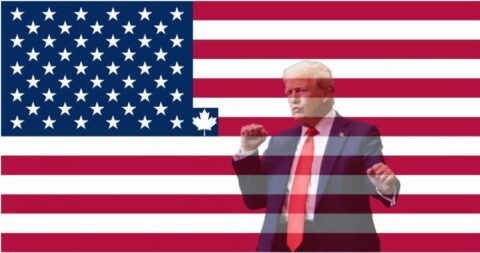
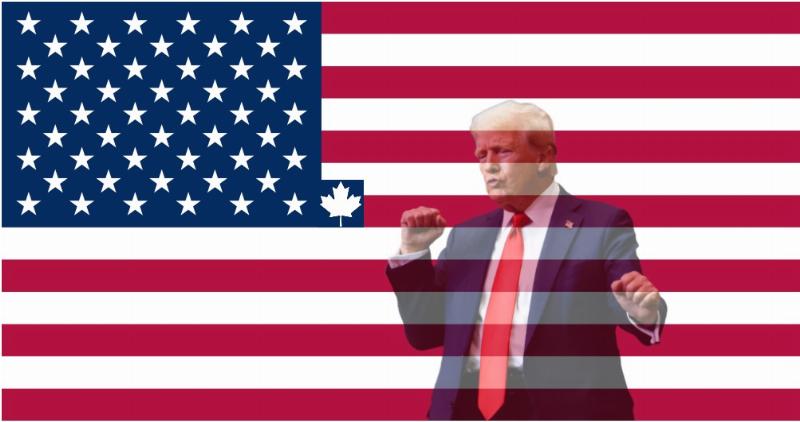
US President-elect Donald Trump successfully trolled Justin Trudeau about Canada becoming the 51st state of the union.

I cannot believe I am being forced to care about Canada right now. They call their cops Mounties you know. Absurd people facing an absurd political crisis. Let’s dig in.

Prime Minister Justin Trudeau has, over his nine-year reign, become terribly unpopular. He resigned yesterday. This was semiexpected because all relevant opposition parties had vowed to mount challenges to his leadership come late January/early February, and because Trudeau’s finance minister quit last month after the two clashed.

Canadians are pissed off, like so many others around the world, with the high cost of living, which they attribute to Trudeau. Earlier in his term, he prioritized climate change–related initiatives (like a costly carbon tax) and catering to Indigenous groups. He’s prioritized letting in lots of immigrants, which many Canadians have soured on. When the pandemic hit, provincial governments imposed economically ruinous lockdowns, and Trudeau himself imposed a vaccine mandate for all those entering the country, as well as the entire federal work force. The vaccine mandate for all border-crossers, which was in place from October 2021 to October 2022, spurred the Canadian trucker convoy, an occupation of Ottawa that attempted to protest the government to change this freedom-trampling policy. Trudeau’s response was to freeze the bank accounts of people involved, in an attempt to suppress the peaceful dissent.

When he first came to power in 2015, the nepo baby (son of another former prime minister) was widely admired due to his purported good looks and charm. When Donald Trump took office in the U.S. in January 2017, Trudeau quickly positioned himself as a foil to Trump, earning adoration from America’s #Resistance left. Now, those people’s opinions don’t really matter (if they ever did at all), and normal Canadians have seen first-hand the impacts of Trudeau’s policies. He sees the writing on the wall and is attempting to minimize the damage to his party.

“This country deserves a real choice in the next election and it has become clear to me that if I’m having to fight internal battles, I cannot be the best option in that election,” he said in a press conference yesterday. In order to do that, he’s prorogued Parliament — suspending it without dissolving it.

“To allow his party’s thousands of members to choose his successor, a lengthy process that will involve campaigning, Mr. Trudeau suspended Parliament until March 24. A general election is expected to follow,” reports The New York Times. “Holding a party leadership election before a general one is par for the course in countries with parliamentary systems like Canada’s. Suspending Parliament to hold such an election is far less common. By doing so, Mr. Trudeau wards off the likely collapse of his minority government and gives the Liberals time to choose a leader unburdened by his dismal poll numbers.” In other words: Suspending Parliament is a political ploy to stop the bleeding and help his allies stay in power.

This final act seems par for the course for a man who prefers playing politics to crafting sound policy. It’s possible someone more freedom-appreciating will replace him (though I’m pretty sure 90 percent of the population qualifies as more freedom-appreciating than Trudeau). But this comes at a difficult time for Canada, as Trump mulls slapping 25 percent tariffs on all Canadian goods, partially blaming our northern neighbors for an influx of migrants and fentanyl. It remains to be seen whether Trudeau will be replaced with someone better and whether Canadians can dig themselves out of this terrible economic hole that’s been wrought by seemingly endless government spending.

On the social media platform formerly known as Twitter, John Carter links to a thread by Julius Ruechel on the Canadian system of governance:
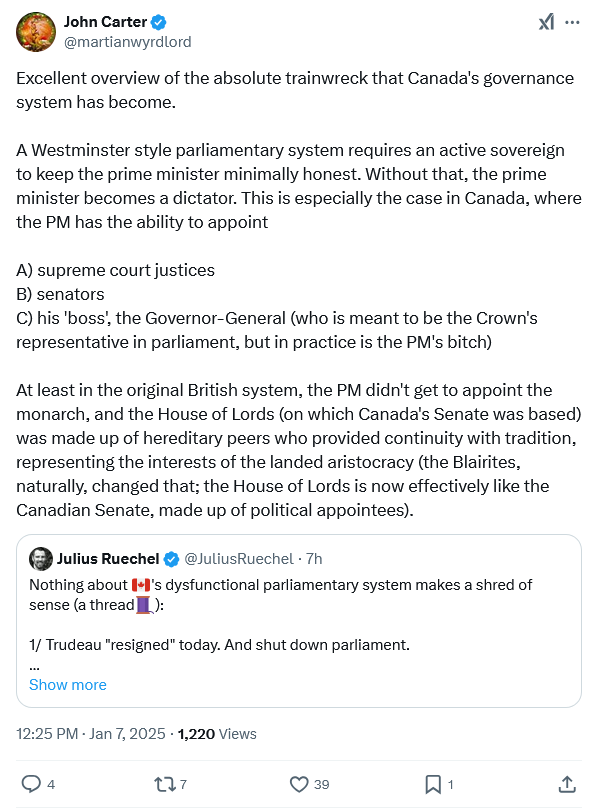
What Julius Ruechel said:

Nothing about [Canada’s] dysfunctional parliamentary system makes a shred of sense (a thread🧵):

1/ Trudeau “resigned” today. And shut down parliament.

So, now we effectively have a kind of custodial govt for the next few months. Run by Trudeau.

2/ Only now, with parliament shut down, Trudeau and his cabinet continues to run the govt, issue govt contracts, control the treasury, and negotiate on the world stage on Canada’s behalf … but without any parliamentary oversight.

How do you hold a govt to account without a parliament? The police won’t do it — they’ve more than proven that over 9 years of rampant govt corruption and abuse.

3/ The Governor General (who is supposed to ensure that Canada has a functioning government) gave Trudeau the green light to shut down (prorogue) parliament without triggering an election. Even as the country continues to unravel and as Canada’s finances continue to spiral towards an inflationary debt and currency crisis … “go ahead, get your party in order, Canada can wait (paraphrasing)”

4/ What a lovely gift from the Governor General … all so that the same party that could have ousted Trudeau for 9 disastrous years, but didn’t, has time to pick a new leader to continue to govern us.

Remember, Trudeau’s resignation does not automatically trigger an election, only a leadership race within the Liberal Party (lasting a minimum of 3 months during which Trudeau still remains as Prime Minister). The winner of that race emerges to govern the country without having to face a general election open to all Canadians.

Throughout all of this fiasco, there has not been a non-confidence vote to trigger the fall of the govt. The Liberal Party retains its mandate to govern Canada (despite their leadership race) because the other left-wing parties (NDP, Greens, and Bloc Quebecois) continue to prop up Trudeau’s Liberal govt.

And now, with parliament prorogued, the other parties couldn’t trigger a non-confidence vote even if they wanted to. Parliament would need to sit again before that can happen.

5/ In other words, the Governor General (the only one who currently has the power to trigger an election) is keeping Canada in crisis in order to accomodate a political party that has lost all its legitimacy to govern.

But guess who appointed the Governor General … yup, Trudeau.

It gets worse …

6/ Voting in the Liberal leadership race is open to children as young as 14. And to foreign nationals living in Canada that don’t even have citizenship or residency. How is that even legal? What could possibly go wrong?

7/ By shutting down parliament, Trudeau has also effectively shut down the ongoing parliamentary investigation into foreign interference. Based on a govt report, there are at least 11 MPs (plus multiple support staff) who have been compromised yet continue to work in our govt. But, the Liberals have refused to release their names. Or to fire them.

And now, thanks to Trudeau’s prorogation stunt, we won’t know their names ahead of the next election.

8/ The Conservative party is likely to challenge the proroguation of parliament to try to trigger an immediate election. But 7 of Canada’s 9 Supreme Court judges were appointed by … you guessed it again … Trudeau.

9/ And if the Conservatives come to power under Pierre Poilievre when we finally do get another election, the legislation they want to pass requires the Senate to sign off on it.

But 90 of Canada’s 105 senators are appointed by Trudeau, with another 8 open seats that will likely also be filled by Trudeau during this “transition” period. Yes, he still has the power to do that … without parliamentary oversight.

10/ At the 1:15:50 mark of his January 2nd YouTube interview with Jordan Peterson, Pierre Poilievre even openly admitted that (because of the Liberal bias in the Senate) the Conservatives need Canadians to help him pass legislation by becoming much more politically active — specifically he needs them to put pressure on their senators to “motivate” them to support his economic reforms.

That might work in the US where senators are elected. But how do Canadians “put pressure on senators” when Canadian senators are appointed by the Prime Minister and serve for life (until age 75)?

11/ Nonetheless, at the 24:35 mark of the same interview with Jordan Peterson (https://youtu.be/Dck8eZCpglc?si=y268pZaYSBG0gPKR&t=1475), the leader of Canada’s official opposition party, Pierre Poilievre, proudly proclaimed that :

we have … the best system of govt in the history of the world — the parliamentary system. Not the best govt, but the best system of govt.”

How reassuring … 🤦‍♂️

In the National Post, Carson Jerema argues for the abolition of the Liberal Party of Canada, the self-imagined “National Governing Party”:

The corrupting influence of the Liberal party has become all encompassing. When this or that cabinet minister gets uppity about being responsible with public money (Bill Morneau), or about interfering in criminal prosecutions (Jody Wilson-Raybould), they are simply replaced with someone more pliant, until that replacement is no longer useful, and is then kicked to the curb (David lametti, Chrystia Freeland). Ministers who had distinguished, or at least not humiliating, careers before politics, say a Bill Blair or a Marc Garneau, have been reduced to the role of yelping sycophant.

The illness radiates outward turning anything even remotely connected to government into a client or an arm of the Liberal party.

The explosion in the size of the federal bureaucracy, the vast expansion of corporate welfare into preferred Liberal businesses (read, green), Ottawa’s aggressive invasion into what’s left of provincial jurisdiction (dental care, pharmacare, energy and natural resources), has all been conducted for the benefit of the party.

Nothing happens in this country unless it benefits the Liberals. No one is hired, no cavity is filled, no money is invested and no child is educated, without partisan approval. And, it is only approved, if there is some electoral gain, however narrow. The rapid increase in immigration over the past decade could, as it has in the past, create a longterm base of Liberal voters. It is hard to believe the Liberals being as enthusiastic about immigration, if it didn’t have this prospect.

As government grows and grows and grows, it isn’t meeting any sort of public service need, or any ideological end, it is simply patronage on a grand scale. The entire state, and everyone in it has been turned into a beneficiary of the Liberals, all of us, part of the machine. Even Sir John A. Macdonald, fresh off the Pacific Scandal, would be embarrassed by this state of affairs.

All governments advance policies for electoral advantage, but there is something otherworldly about what the Liberals have done. Moreover, when what they do is plainly indefensible, such as dismissing Chinese election interference, or subordinating foreign policy to the preferences of Jew hating-pro-Hamas protesters, they can’t understand why anyone would ever question them. Large segments of the news media are always happy to comply and help the government gaslight the electorate.

January 7, 2025

Justin Trudeau announces his resignation … and a nation rejoices!

Rather than letting Canadians have an election, Justin Trudeau announced that he is resigning as Liberal party leader but that Parliament will be prorogued for long enough for the Liberals to run a full leadership campaign. This means that Trudeau’s replacement will likely be prime minister for roughly as long as it takes for Parliament to come to order after prorogation and not a minute longer. Nice work, Justin!

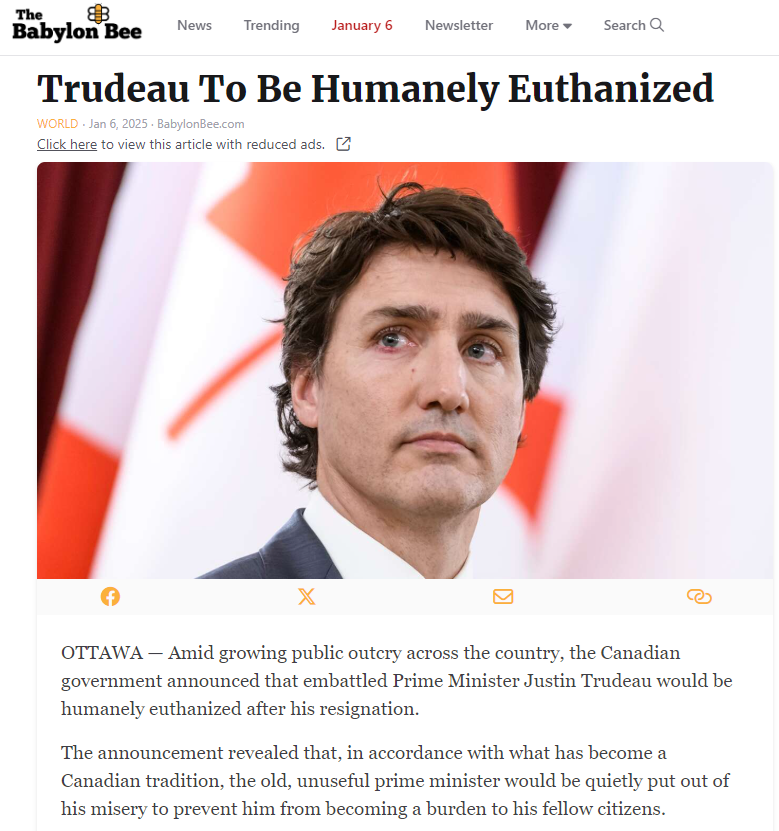
Full credit to the Babylon Bee for their coverage:

It’s impossible not to feel that Trudeau’s ego has been the biggest player in our national psychodrama over the last few months (years, actually), as it seems inevitable that Trudeau’s hapless successor is going to be the Liberal Party’s version of former PM Kim Campbell, although probably not being reduced to a caucus of two seats in a landslide, as Campbell endured.

The Line‘s immediate response quite properly describes Trudeau as “an absolute Muppet”, and I think that’s pretty unkind … to Muppets:

There was only one major thought that crossed your Line editors’ minds when watching Prime Minister Justin Trudeau’s resignation speech on the porch of Rideau Cottage on Monday morning: “Jesus Christ, the absolute self regard of this fucking Muppet.”

Yes, that’s harsh. We’re even almost sorry about it. And we’ll touch on the humanity of it all in a moment. But for now, like, gosh. This isn’t good.

We are well aware that much of the media will be replete with mopey paeans to the decade-long service of this prime minister, even as he announces his entirely hypocritical plan to prorogue Parliament until March 24 in order to enable his party to assemble a chaotic and hasty leadership race. You’ll get none of that from us here at The Line. Trudeau deserves no such consideration — at least not at the top. From where we sit today, the sheer arrogance of this man, and the party that has enabled him, has just locked the nation into months of parliamentary paralysis in the midst of what is likely to shortly become an economic trade war and a broader international geopolitical realignment.

While we fully expect news of Trudeau’s resignation to lead many of our readers to sound the bells, we share none of their relief. The decision he announced on Monday demonstrates a total lack of respect for voters, an utter disregard for the good of the nation, and a profound obliviousness to the realities of the international environment we are about to find ourselves in.

And while we’d like to give Trudeau some credit for demonstrating an ounce of genuine humility in his resignation speech, too much of it was crammed with statements of breathtaking, overweening egotism; he pegged his decision to leave squarely on internal divisions — a fantastic parting “fuck you” to his caucus that abrogates any attempt at accountability for his own policy or leadership failures.

Trudeau repeatedly justified his decision to ask for the house to be prorogued by noting that Parliament had become dysfunctional, the opposition parties had stalled business of the house on process questions, and the government was in need of a “reset”.

This blithely ignores a few points, including the fact that part of the reason Parliament has been stuck in a procedural quagmire is because Trudeau’s own government has refused to hand over a potentially incriminating dossier that may demonstrate thwacks of taxpayer cash being siphoned off to well-connected businesses and insiders via what the opposition has deemed a “green slush fund”.

This is a matter upon which the Commons’ Liberal speaker ruled against his own party. The Liberals could have stopped the pseudo-filibuster by turning over to Parliament the documents that they are required to turn over. They didn’t.

The very foundations of the Westminster parliamentary system are rooted in the concept of confidence: if you can’t maintain the confidence of the house, you cannot rule Parliament. Prorogation is a procedural tool intended to govern ordinary logistics. It should never be used to circumvent a matter of confidence — and while it was delicious to watch Trudeau squirm on this point during his resignation speech, defending Stephen Harper’s 2008 use of it in order to justify his own, the fact remains that both leaders have now set and affirmed a dangerous norm that undermines one of the foundational democratic concepts of our democracy and how it functions.

When a government finds itself this battered and unpopular, and when a long-serving leader has announced that he’ll step down, while prorogation may be legal, there’s only one politically and even morally right thing to do. There is only one way to “reset” parliament. Only one.

Call an election.

Paul Wells says “The Liberals give themselves three months to save the furniture”:

He was late as usual. He sounded sad. The wind blew his script away. He said more or less what you expected. When his time in office ends at the end of March, he’ll have been prime minister for a few months less than Stephen Harper was. His party has very little chance of recovering, but more than it had yesterday. It would have been so easy to pick his own time, maybe at the end of 2022, but apparently these decisions are hard to make.

Things happen fast. It’s been six weeks, Monday to Monday, since Donald Trump threatened 25-per-cent tariffs on everything Canadian. Three weeks since Chrystia Freeland resigned from cabinet. In two weeks Donald Trump will be sworn in as President of the United States. Justin Trudeau’s resignation is a pure product of this crisis.

I see a straight line from Trump’s Truth Social outburst of Nov. 25 to this week’s events. Trudeau’s circle once thought a second Trump victory would help them make the case against Pierre Poilievre. It’s fair to say the results are not up to their hopes. With Elon Musk continuing his hobby kibbitzing in the politics of countries around the world, Canada will now stand as a warning to governments elsewhere: Trump and his crew can take you down.

Having stalled until he ran out of options, Trudeau will now become incidental to events. There’s a lot going on. Wistful tribute speeches in the House of Commons will have to wait. The Trudeau succession will play out quickly, in four arenas at once: Parliament; the Liberal Party; the electorate; and Canada’s national security. Events in each venue will influence the others.

Some people accuse Trudeau of doubling the national debt during his time in office — from C$612B in 2015 to C$1.2 trillion currently — but as mathematically inclined commentators have noted, Trudeau also successfully engineered the decline of the value of the Canadian dollar so that the actual increase in national debt is less than 55%! Success!

At Spiked, Tom Slater bids farewell to “Canada’s first black prime minister”:

Yes, Justin Trudeau – the man who proved that in these topsy-turvy political times you can be a liberal and an authoritarian, and painfully woke while also having spent much of your youth in black face – has finally resigned.

The writing’s been on the wall for some time now. After historically low poll ratings, came the resignation before Christmas of his deputy, Chrystia Freeland, who clashed with Trudeau about how to tackle president-elect Donald Trump’s imperious threats of a 25 per cent tariff on Canadian goods. In the end, Justin jumped before he was pushed.

After almost a decade in power, he will step down as prime minister and Liberal leader as soon as a successor can be found. Polls suggest that, such is the hole he has left his party in, whoever replaces him will likely face a shellacking in the upcoming election.

Where did it all go wrong? When Trudeau took the reins of his nation back in 2015 – following in the footsteps of his father, Fide … sorry, Pierre – he rode on a wave of popular support and corporate-media swooning.

With the election of another pampered rich kid south of the border a year later, Trudeau was praised in the international media as the anti-Trump – progressive, pro-migration and drop-dead gorgeous, to boot!

Indeed, the next time an establishment scribe slurs Trump supporters as doe-eyed dolts dazzled by celebrity, point them in the direction of the gushing coverage of “hunky” Trudeau, who seemed to govern as if he was in a budget version of The West Wing.

Soon enough, he began carrying on like an unsubtle caricature of a cringe, establishment liberal, chiding women for saying “mankind”, instead of “peoplekind”, and declaring that he was insisting on a 50:50 male-to-female cabinet “because it’s 2015“.

Trudeau is the apotheosis of a hectoring style of politics that assumes voters are terrible bigots in need of lecturing, and women and minorities are perennial victims in need of his paternalistic assistance.

I’m frankly amazed it took the good people of Canada almost 10 years to wipe that smug look off his face.

December 31, 2024

No matter what Poilievre does, it’s still Trudeau’s decision to stay or go

Filed under: Cancon, Government, Media, Politics — Tags: , , , — Nicholas @ 04:00

Conservative leader Pierre Poilievre has been doing a masterful job of staying on top of the Canadian news cycle even through the normally dormant holiday period, but he does not have a way to eject Justin Trudeau ahead of the inauguration of US President Donald Trump or for many weeks afterwards:

During a time of year when Canadian politics typically descend into a semi-coma, the Conservatives are leading an all-out drive to bring down the Liberal government before Prime Minister Justin Trudeau has a chance to save it.

Whatever they do, though, Trudeau continues to hold all the cards. The Tories can shame him, they can rally the opposition against him and they can call for the intervention of the Governor General. But – as per every available constitutional precedent – this only ends when Trudeau says it does.

Just before Christmas, Conservative leader Pierre Poilievre called on Governor General Mary Simon to recall Parliament before New Year’s Eve in order to hold a vote of non-confidence in the Liberal government.

When that didn’t work, the Conservatives announced an early recall of the Public Accounts Committee. It’s one of the more influential House of Commons committees headed by a Conservative, New Brunswick MP John Williamson, and it’s thus one of the only organs of state that the Conservatives can order back to work.

The committee obviously has no power to decide the Liberal government’s future, but the idea is to have them draft a shovel-ready non-confidence motion that can be fast-tracked to the House of Commons when it reconvenes on Jan. 27.

This campaign all makes political sense: Just as NDP leader Jagmeet Singh is finally signalling a willingness to bring down the Trudeau government, the Conservatives are hammering on him to actually make good on the pledge.

“Conservatives are now presenting the NDP with this first opportunity to bring down the Liberal Government and force an election,” reads a Friday statement outlining the Conservatives’ Public Accounts Committee plan.

But whatever else the Tories do between now and Jan. 27, Trudeau’s ability to head them off is virtually absolute.

There was never any realistic chance of Governor General Mary Simon calling Parliament back to work. And if Trudeau ultimately decides to prorogue Parliament past Jan. 27 to prevent a confidence vote, it’s extremely unlikely that she or any other occupant of Rideau Hall would stop him.

December 29, 2024

QotD: Churchill as author and Prime Minister

Filed under: Books, Britain, History, Quotations — Tags: , , , — Nicholas @ 01:00

“Writing a book is an adventure. To begin with it is a toy, an amusement; then it becomes a mistress, and then a master, and then a tyrant.” Those owning a business plan, devising an advertising proposal, plotting a military stratagem, drafting an architectural blueprint, painting a picture, crafting sculpture or ceramics, penning a volume, sermon or speech — or editing The Critic — will, I suspect, be nodding in recognition of this.

The words were those of Winston Churchill, the 150th anniversary of whose birthday, 30 November 1874, falls this year. In addition to submitting canvases to the Royal Academy of Arts under the pseudonym David Winter — which resulted in his election as Honorary Academician in 1948 — and twice being Prime Minister for a total of eight years and 240 days, he has merited far more biographies than all his predecessors and successors put together. This summer I completed one more volume to add to the vast collection. My purpose here is less to blow my own trumpet than to ponder why Churchill remains so popular as a subject and survey what is new in print for this anniversary year.

It is tempting to see his career through many different lenses, for his achievements during a ninety-year lifespan spanning six monarchs encompassed so much more than politics, including that of painter. The only British premier to take part in a cavalry charge under fire, at Omdurman on 2 September 1898, he was also the first to possess an atomic weapon, when a test device was detonated in Western Australia on 3 October 1952. Besides being known as an animal breeder, aristocrat, aviator, big-game hunter, bon viveur, bricklayer, broadcaster, connoisseur of cigars and fine fines (his preferred Martini recipe included Plymouth gin and ice, “supplemented with a nod toward France”), essayist, gambler, global traveller, horseman, journalist, landscape gardener, lepidopterist, monarchist, newspaper editor, Nobel Prize-winner, novelist, orchid-collector, parliamentarian, polo player, prison escapee, public schools fencing champion, rose-grower, sailor, soldier, speechmaker, statesman, war correspondent, war hero, warlord and wit, one of his many lives was that of writer-historian.

Most of his long life revolved around words and his use of them. Hansard recorded 29,232 contributions made by Churchill in the Commons; he penned one novel, thirty non-fiction books, and published twenty-seven volumes of speeches in his lifetime, in addition to thousands of newspaper despatches, book chapters and magazine articles. Historically, much understanding of his time is framed around the words he wrote about himself. “Not only did Mr. Churchill both get his war and run it: he also got in the first account of it” was the verdict of one writer, which might be the wish of many successive public figures. Acknowledging his rhetorical powers, which set him apart from all other twentieth century politicians, his patronymic has gravitated into the English language: Churchillian resonates far beyond adherence to a set of policies, which is the narrow lot of most adjectival political surnames.

“I have frequently been forced to eat my words. I have always found them a most nourishing diet”, Churchill once quipped at a dinner party, and on another occasion, “history will be kind to me for I intend to write it”. Yet “Winston” and “Churchill” are the words of a conjuror, that immediately convey a romance, a spell, and wonder that one man could have achieved so much. It is an enduring magic, and difficult to penetrate. In 2002, by way of example, he was ranked first in a BBC poll of the 100 Greatest Britons of All Time — amongst many similar accolades. A less well-known survey of modern politics and history academics conducted by MORI and the University of Leeds in November 2004 placed Attlee above Churchill as the 20th Century’s most successful prime minister in legislative terms — but he was still in second place of the twenty-one PMs from Salisbury to Blair.

Peter Caddick-Adams, “Reading Winston Churchill”, The Critic, 2024-09-22.

December 20, 2024

Imagine if Chrystia Freeland had done as well as finance minister as she did emasculating the Prime Minister

Filed under: Cancon, Media, Politics — Tags: , , , — Nicholas @ 05:00

I was no fan of Chystia Freeland but like Mitch Heimpel, I have to admire how artistically she sliced off the Prime Minister’s balls on her way out of cabinet:


Screencap from a CPAC video of Chrystia Freeland speaking in 2022.

One thing that is obvious from the former finance minister’s now infamous Monday morning letter is that she internalized the lessons of Jody Wilson-Raybould and Jane Philpott and Bill Morneau. If you do not immediately put out your version of your demotion or dismissal, it will be done through anonymous leaks to the Parliament Hill Toronto Star or CBC bureau. Ottawa will wonder what really happened. There will be murmurs and whispers about whether you were ever much of a “team player.”

[…]

She left no doubt about what happened, how it happened, or how she feels about it.

In doing so, she did something remarkable. She made it impossible for the PMO’s spinners and issues managers to put the prime minister out to address the media after her letter. He couldn’t answer for anything in the letter without having to answer for everything in the letter. Trudeau may be the most impressive communicator the Liberal party has produced since his father. And he was of no use to the PMO to try and counter Freeland’s narrative on Monday. He could only make matters worse. His one public appearance was in front of a big money Liberal fundraising event, with a pool camera. A bit like an Eastern-bloc gymnast performing before the East German judge.

Even when TIME magazine had him in full blackface, he still addressed the press from the plane. But not Monday.

Never in his almost 10 years as prime minister has Justin Trudeau had a day like that. Supposedly, nominally, the Liberal’s party’s best campaign and communications asset was rendered functionally useless to a television audience. To mix sports metaphors, she beat him in the paint. She drove the lane on him, and he could do nothing. And he did nothing. As of this writing, the prime minister has still not addressed either the media or the country, and is, in fact, cancelling previously scheduled interviews.

And then, Freeland went to the caucus meeting. Anything he wanted to say there, he had to say it to a crowd that could get her version by simply looking over to gauge her reaction. She sank a three pointer on him at the end of the day, just to prove she could.

We can debate her record as finance minister later. Lord knows I have my own qualms with it. But this isn’t about that. Everything else on Monday, the $62-billion deficit and the tanking loonie, are about that.

But her resignation was something unexpected. She bested Justin Trudeau in an air war. She didn’t just beat him, she ran him over. She silenced him.

She may have ended him. That much we still don’t know yet. But she ensured she won’t be remembered for either Disney+ or the “vibecession.”

The first line of her political history is now Chrystia’s Version. And we’ll remember it all too well.

December 19, 2024

Paul Wells – “I found myself telling La Presse, ‘”What the f—k?” has replaced “Hello” as the standard greeting in Ottawa since Monday'”

Filed under: Cancon, Media, Politics — Tags: , , , , — Nicholas @ 03:00

Paul Wells shares some thoughts on the unsettled waters of normally placid (if not catatonic) Ottawa in the wake of Chrystia Freeland’s dramatic resignation on Monday:

Image from Blazing Cat Fur

I want to write 5,000 words of narrative in the wake of Chrystia Freeland’s resignation, but we’re still in the middle of the story. Thoughts kind of pour out. I found myself telling La Presse, “‘What the f—k?’ has replaced ‘Hello’ as the standard greeting in Ottawa since Monday.” We’ll see whether they use that quote.

Here are some thoughts, from different angles. I don’t know whether Freeland’s resignation will blow over, the way Justin Trudeau’s last 20 messes did, because I don’t have a crystal ball, but I think Justin Trudeau hopes it’ll blow over. Because he always hopes it’ll blow over. I hear, as you do, rumours that the PM will resign.

[…]

I resist biography as an analytical tool. People outgrow their backgrounds all the time.

But just about everybody who follows politics has been wondering how Trudeau could fire his most loyal lieutenant by a Zoom call three days before he needed her to deliver a crucial fall economic statement. If the Globe‘s latest story is true, and he told her Mark Carney would take the job without knowing whether Carney will take the job, that’s even wilder. Who does that?

The short answer is, somebody who is used to getting his way. Then you look at Trudeau’s life and you think, why wouldn’t he expect to get his way?

The rich kid always knows the normies will cover for him. If he needs a ride, some kid with stars in his eyes will wave his keys and volunteer. If he’s hung over he can borrow the lecture notes. He shows up in racist makeup to yet another party — forcing every other person in the venue to decide how to respond — and once again nobody stands up to him or makes a fuss. Indeed, when the record of that behaviour threatens his political career decades later, there’ll be plenty of volunteers to criticize anyone who mentions the record, rather than criticizing the guy who acted like that.

He runs for the leadership of a national political party on a platform of “I’ll tell you what I stand for after I win”. He mentions carbon pricing precisely one time at his first national leaders’ debate. He dumps his electoral-reform promise at the first hurdle, and later, when asked about it, he blames the person who asks. He gaslights Canada’s first Indigenous attorney-general for months, but he is not particularly kinder to her replacement, who is ejected from Cabinet because, I don’t know, it’s Wednesday or whatever. He lets a 72-year-old man run for re-election and only after it’s over does he let the guy know he’s getting dumped from Cabinet.

He fires the Clerk of the Privy Council by news release while travelling.

In particular, if there’s anyone in the world he might have expected to tolerate the kind of high-handedness we’re hearing about Friday’s Zoom call, it’s Chrystia Freeland. Her eagerness to endorse him in the immediate aftermath of his latest cockup has been such a reliable feature of Canadian public life it’s devolved into a kind of shtick. SNC-Lavalin, 2019: “she has absolute confidence“. Blackface, six months later: “tremendous confidence“. WE Charity, 10 months after that: “The prime minister has my complete confidence“.

Perhaps only Jagmeet Singh has shown more confidence than Freeland, over the years, in Trudeau’s leadership. Given that record — and his own much longer record of taking advantage of others’ generosity — it’s not too much of a stretch to think that at some point he decided his deputy prime minister was just another easy mark.

Turns out that’s the kind of mistake he only needed to make once.

December 18, 2024

Justin Trudeau at bay

However much you may dislike the man — and there’s just so much to dislike — it’s impossible to write him off no matter how bad the situation may look. In The Free Press, Rupa Subramanya explains to non-Canadian audiences what has been going on in the Deranged Dominion lately:

Justin Trudeau’s government could be at the point of collapse. And a social media post from Donald Trump about tariffs may have set off the latest in a chain of dominoes for Canada’s prime minister.

On November 25, Trump posted on his platform Truth Social that, as one of his first executive orders, he would “sign all necessary documents to charge Mexico and Canada a 25% Tariff on ALL products coming into the United States, and its ridiculous Open Borders”. Four days later, Trudeau flew to Mar-a-Lago to meet Trump for dinner. Although the content of their discussion has not been made public, Trump’s tariff threat may have landed a death blow to Trudeau’s cabinet.

On Monday morning, Trudeau’s most important ally — his number two, finance minister Chrystia Freeland — resigned in a fiery letter directed at her boss, which she posted on X.

“Our country today faces a grave challenge,” she wrote. “The incoming administration in the United States is pursuing a policy of aggressive economic nationalism, including a threat of 25 percent tariffs. We need to take that threat extremely seriously.” She continued: “That means pushing back against ‘America First’ economic nationalism with a determined effort to fight for capital and investment and the jobs they bring”.

The same morning, Trudeau’s housing minister Sean Fraser also announced his departure, saying he wanted to spend more time with his family. This brings the total number of cabinet members who’ve resigned under Trudeau in 2024 to nine. But a walkout from Freeland, his most trusted lieutenant, who was expected to release her fall economic statement Monday, is by far the biggest. That such a loyal servant who has worked for Trudeau since 2015 would resign so publicly shows just how deep the rot is these days. Freeland stood by the prime minister as his popularity began to tank in February 2022 when Canadian truckers protested his harsh Covid vaccine mandates. She even authorized the debanking of those protesters, freezing their bank accounts as a means of punishment [NR: with no legal authority, it must be noted].

Now, her resignation is feeding feverish speculation that the longtime progressive darling could finally be on his way out, amid his sinking popularity and the country’s economic slump. By Monday night, a prominent member of Trudeau’s Liberal Party, Anthony Housefather, went on TV to say the prime minister is “past his shelf life“.

December 17, 2024

Canada’s deputy prime minister heads for the exits

Filed under: Cancon, Economics, Government, Media, Politics — Tags: , , , — Nicholas @ 03:00

After being informed by Justin Trudeau that he no longer wanted her to be the finance minister on Friday, but still apparently expecting her to present the fall economic statement on Monday, Chrystia Freeland instead submitted her resignation from cabinet:

In the National Post, John Ivison calls it her “gangster move” against Trudeau:

Who saw Chrystia Freeland pulling a gun, after Justin Trudeau unsheathed a knife?

The finance minister is an unlikely champion of the Chicago Way, but she has just pulled off a coup that may end up toppling this government.

Just hours before she was due to give her fall economic statement, she quit.

Despite the widespread media speculation about a falling out between Freeland and Trudeau, it’s a good bet that no one was more surprised at the finance minister’s gangster move than the prime minister.

Her resignation letter was savage. She said that on Friday, Trudeau had told her he no longer wanted her as finance minister and offered her another job in cabinet.

She said that she concluded she had no option but to resign because she had lost the prime minister’s confidence.

The casus belli was the multi-billion-dollar affordability package that included a two-month GST holiday and mailing $250 cheques to nearly 19 million working Canadians.

As the National Post reported late Sunday, Freeland had already reversed the government’s position on the rebate cheques that would have cost an estimated $4.68 billion. One person with knowledge of the plans said that the measure will not be in the fiscal update but the government hopes to take another look in the new year, if it can find another party to support it.

Oh, and the financial update Freeland was still expected to deliver after being underbussed by Trudeau? It apparently did get released:

You can always count on the Babylon Bee to find the most accurate and tasteful way to present the news:

December 13, 2024

Kemi Badenoch … a Thatcher for the 2020s?

Filed under: Britain, Media, Politics — Tags: , , , , — Nicholas @ 05:00

In The Free Press, Oliver Wiseman wonders if new British Conservative Party leader Kemi Badenoch will do for her party what Margaret Thatcher did after she was elected leader in 1975:

“I like fixing things that are broken,” says Kemi Badenoch in her interview with Bari on the latest episode of Honestly. Badenoch, 44, was elected as the new leader of the UK’s Conservatives last month. And luckily for her, there are a lot of things that are broken.

One of them is her party.

In July, after fourteen years in office, the Tories were unceremoniously booted from power. They lost more than 250 of their Members of Parliament in the biggest electoral defeat in the party’s history. On the long road back to power, Badenoch must contend not only with a Labour government with a huge majority in Parliament, but also Nigel Farage — the Brexit-backing populist is on a mission to supplant the Conservative Party as the main alternative to Labour.

If Badenoch somehow manages to fix her party and return to power, she must then figure out a way to fix Britain — a country where wages have stagnated for a generation, public debt has ballooned, and there’s widespread anger at high rates of immigration. As another Brit, Free Press columnist Niall Ferguson, put it recently in these pages: “Lately it seems that mine is a country with a death wish.” (Read his full account of what ails the UK here.)

In other words, Badenoch has a daunting in tray. And yet many — including Niall — are bullish on Badenoch, who he believes could be a “black Thatcher”.

As a woman in charge of the Conservative Party, Badenoch was bound to be compared to the Iron Lady. But in this case there are undeniable parallels. Much like Thatcher, Badenoch mixes steely determination with charm and charisma. She also, like Thatcher, knows what she believes. Her diagnosis of her party’s problems is straightforward: It has strayed too far from the values that have historically made it — and Britain — so successful.

And while Thatcher and Badenoch’s backgrounds are very different — one grew up in provincial England, the other spent most of her childhood in Nigeria — they are both self-made women with an appetite for hard work. Badenoch’s own story, and her family’s, is central to her politics. “I know what it is like to be wealthy and also to be poor,” she says today on Honestly.

There’s one other Badenoch–Thatcher parallel: the circumstances in which they took over their party’s leadership. Thatcher became Tory leader in 1975 — then, like today, a malaise had descended over the country, one that would lift during her time in office. These comparisons may be unavoidable, but does Badenoch welcome them? Bari asked her that in their conversation. “She is a heroine of mine. So it’s very flattering,” said Badenoch. “But it’s also quite heavy and she’s a different person. I admire her. But I want people to recognize that I’m not a pastiche of this person, that I am my own person.”

December 8, 2024

President Hindenburg dissolves the Reichstag – Rise of Hitler 07, July 1930

World War Two
Published 7 Dec 2024

July 1930 sees the Weimar Republic facing unprecedented turmoil. From Brüning’s budget crisis and the Reichstag‘s dissolution to Nazi and Communist clashes with state governments, Germany braces for a pivotal election in September. This episode unpacks the month’s chaos, political maneuvers, and the rising tensions tearing the Republic apart.
(more…)

December 3, 2024

David Starkey’s view of history

Filed under: Britain, Europe, History — Tags: , , , , — Nicholas @ 03:00

At the Daily Sceptic, James Alexander summarizes how historian David Starkey’s views of history — British history specifically — provide a useful way to analyze British political issues today:

David Starkey, 2004.
Screenshot via IMDB.com

What David Starkey is trying to do is deliver to the British (or English) public a jeremiad informed not by moral posturing or theoretical commitment but by a sense of history. This is so valuable it should almost come without criticism. I think that Starkey’s vision of history is so arresting it deserves to be expressed in short form and so I will attempt a summary of the position. Starkey is an admirably entertaining speaker, and offers a vision that is several dimensions more complicated than we hear from anyone else at the moment. He is full of prepared lines, and has a ready mind: “Niall Ferguson, the good Niall Ferguson, not the bad Neil Ferguson …”; “All bad ideas begin with the French”; “The Union of England and Scotland made the modern world”; “The monarch changes religion as he crosses the border: he begins Anglican, and becomes Presbyterian”; “The Labour party is the equivalent of the Nomenklatura of Soviet Russia: a privileged class”; etc.

I have some criticisms. But first, his vision of our history.

Let me begin by summarising Starkey’s view of history as it conditions the present. He argues the following:

1. On the nature and relevance of history. History is fundamental. We cannot understand ourselves using theory. Avoid abstraction. Use history instead. It is concrete. He suggests that we have always studied history for the sake of the present, though in recent centuries we have also studied it for its own sake. He adds that we should make analogies between past and present.

2. On English history. Starkey says that we were first part of Greater Scandinavia, then, from 1066, were part of an Anglo-French order. The third stage of our history began with the Reformation. Starkey likens the Latin Christendom of the Papacy to the European Union: and so calls Henry VIII the first Brexiteer. The consequence of the Reformation was that Britain and Europe become antagonists. For the first time the sea was reconfigured as a barrier, defended by the navy: and this happened at the same time that energies were thrown outward to the rest of the world. What the English managed to do, along with the Scots, was build something out of the strong language that rises from Chaucer to Shakespeare: the two home countries united to make it impossible to be invaded; they united to make an empire in the world; and they united to make use of remarkable innovations in finance and later industry.

One of Starkey’s great themes is this Union of England and Scotland: first by King in 1603 and second by Parliament in 1707. Starkey says England is not a nation. It lacks a ridiculous national dress (since its national dress, of coat and trousers with tie, was given to the world as universal official dress). And the Union was wholly original, as it subjugated Scotland to England’s Parliament, abolishing the Scottish Parliament, while leaving Scottish law, religion, military tradition and heraldry alone. England and Scotland are politically united, but only politically united. Starkey’s point about all this is that it was never about “identity”. There was no such thing as a “Briton”. There was no national system of education. So there was no nonsense of any modern-style post-French Revolution nationalism. Instead, we were natural liberals, able to take in immigrants without difficulty. However, throughout all this England is politically dominant in Great Britain and in the Empire.

3. On the present time. Starkey has two points of reference. One is the 1970s, when things went wrong, with a short reversal under Thatcher, and in the 1990s, when things went even more wrong, and perhaps permanently wrong, because constitutionally wrong. The 1970s was the culmination of the Labour politics of welfare, accepted weakly by Macmillan and Heath, but the 1990s was worse because political and constitutional. Labour took things in the wrong direction by making the Bank of England independent and by enabling a new Scottish Parliament to emerge: also by bringing about the Equality Act of 2010 (actually an innovation of Gordon Brown); also by creating a Supreme Court. Then, finally, Charles III removed Parliament from the Coronation, and there was no mention of politics: whereas, since 1688, the Coronation had been a political act. Political power has been fragmented and dispersed from the King-in-Parliament to the quangos, to the Bank of England, to the lawyers. The principle of balance is lost, as every institution has become an interest group, pursuing single issues: an entire raft of Anti-Corn Law Leagues.

Starkey suggests that England will remain an idea, much as the idea of Rome survived the decline and fall of the Roman Empire. This is pessimistic judgement. His optimistic judgement, or hope, is that some sort of “restoration”, like the Glorious Revolution, can be enacted. As far as I have heard, he has not yet sketched the form of his restoration, though it has been promised.

Is this clear? Henry VIII broke the monasteries, threw out the Papists, built Oxford and Cambridge in new form, fortified the coast and began the story of Greater England. If we fill the gaps, there were difficulties with the consequences, religious and political, through the reigns of Mary, Elizabeth, James and Charles, but these were resolved in 1688 and then 1707. Then Great Britain became a great power. This remarkable creation was politically and constitutionally destroyed by the theorists and politicians of the late 20th century, since they demoted England within Britain, unleashed petty nationalisms in political form, and, in passing, did not do enough to restrain the welfare state or, we might add, enough to prevent English tolerance being twisted to accommodate net immigration of 700,000 people of fairly antagonistic cultures per year. Britain is now ruled not by Government-in-Parliament but by delegated arbitrary powers and influences which offer sops to partial interests and mean that nothing can be done. No one has an adequate conception of the entire state.

November 26, 2024

Crony Capitalist Canada – “Conservative Leader Pierre Poilievre … has vowed to protect Big Dairy just like every other party leader”

In the National Post, Chris Selley discusses the latest attempt to further protect the outrageous profits our dairy companies make by overcharging Canadians for milk, butter, cheese, and other dairy products:

That unelected senators should not overrule the will of the House of Commons has always struck me as a rule most Canadians could agree on, whatever they think ought to happen with Canada’s upper chamber. Senators can propose amendments to bad bills, rake ministers over the coals at committee, call witnesses the House wasn’t interested in for whatever reason, raise red flags that haven’t yet been raised, all to the good. But gutting a bill, as the Senate has done with proposed legislation that would protect supply management in Canadian dairy, poultry and eggs even more than it’s already protected, is not kosher.

Not all violations of this policy are equally appalling, however. When the House of Commons is clearly not operating for the benefit of Canadians, when its focus demonstrably isn’t the public good but rather coddling and currying favour with special interests, it behooves the Senate to intervene as strenuously as possible while still at the end of the day respecting the lower chamber’s democratic legitimacy.

Coddling and currying favour is exactly what C-282, a private member’s bill from Bloc Québécois Luc Thériault, does: It proposes to make it illegal for a future government to lower the tariff rate for foreign products in supply-managed industries. You could call it the “no to cheaper groceries act.” Some senators wish to neuter it, such that it wouldn’t apply to any existing trade deals or deals already in negotiation. Bloc Leader Yves-François Blanchet had originally demanded the bill passed as one condition of keeping the Liberals afloat (although his deadline to do so has passed).

Fifty-one MPs of 338 opposed the pricey-groceries act at third reading. I would have said “only 51” except that’s a shocking number: 49 Conservatives and two Liberals, Nathaniel Erskine-Smith and Chandra Arya. It’s almost reason for hope … except of course that Conservative Leader Pierre Poilievre voted for it, and has vowed to protect Big Dairy just like every other party leader. It goes without saying that Prime Minister Justin Trudeau not only supported it, but has come out against the Senate’s amendments.

“We will not accept any bill that minimizes or eliminates the House’s obligation to protect supply management in any future trade agreement,” Trudeau reassured Blanchet in the House on Wednesday. ” No matter what the Senate does, the will of the House is clear.”

I mean, what elected politician in Ottawa gives a shit about Canadians being gouged on grocery staples every week? They’d rather get the support of the milk, poultry and egg crony capitalists than help ordinary Canadians, and they’re terrified of being portrayed as anti-Quebec in an election year. Spineless cowards, the lot of them.

November 21, 2024

Canadian defence priorities – don’t listen to what they say, watch what they spend the money on

The Hub provides an edited transcript of what retired Lieutenant General Andrew Leslie (and former Liberal whip in the Commons) said to the Standing Committee on National Defence earlier this month, which shows very clearly where national defence ranks in Justin Trudeau’s world:

My intent is to offer some criticism of the status quo so that we can learn and then perhaps some sort of question period to get into some solutions. Essentially, in my opinion, “Strong, Secure, Engaged“, the precursor to the current defence policy, delivered nothing substantive in terms of modern military equipment, which saw Canada, in fact, become weaker, more insecure, and essentially absent from the deployable stables of troops required for either United Nation missions, or, of course, NATO.

The 2024 defence policy update of “Our North, Strong and Free” is no better, unfortunately, in that it promises some urgently needed equipment years from now, but nothing today. Indeed, the 2024 defence spend will be less than that of 2023. Of course, we’re well aware of what just happened down [in the] United States. Both Republicans and Democrats are united and increasingly vocal about telling Canada how disappointed, frustrated and fed up they are with Canada’s failure to defend itself and their allies, with a special mention on the Arctic.

Meanwhile, as we know, and I was involved in the last NAFTA renegotiations, that’s coming due at a time when a variety of key players down south have articulated clearly the base of 3 percent [of GDP spending on defence] looms on the horizon, and how defence, security, trade, and border security are all intertwined. At this time of crisis internationally, with what’s happening in the Middle East, in Ukraine, Canada’s military readiness is at its lowest level in 50 years. Canada spent last year, in 2023, more money on consultants and professional services than it did on the Army, Navy, and Air Force combined — which quite frankly, is madness.

The Army has over 50 percent of its vehicle fleets, which are awaiting spare parts and technicians. The Navy is struggling mightily — bless them — to keep elderly warships, a handful of them at sea, specifically in the Indo-Pacific, and they’re desperately short of trained sailors. The Air Force has been unable to participate in significant NATO deterrent exercises, either up north or over the oceans, in conjunction with our friends and allies, because they don’t have the pilots, the spare parts, or the money to fly the aircraft.

In the Arctic, which is many times larger than Europe, Canada has fewer than 300 military support staff who are not a deterrent — they’re essentially unarmed. Some of them are part-time, bless them, and about 1,600 Ski-Doos equipped with rifles, and Canadian Rangers who are not combatants. Their role is to observe and report.

The bottom line is that Canada has no permanently assigned combat elements to deter potential presence by the Russians or the Chinese, who are showing up in our waters with increasing frequency. But other people do. Russia specifically has between 25,000 to 35,000 combat troops deployed in their Arctic with huge amounts of operational equipment — air, land and sea. The United States, bless them, has 22,000 full-time military and part-time military professionals with more equipment than the entirety of the Canadian Forces in terms of combat delivery. So really, thank you America for defending our Arctic.

We are facing unprecedented dangers and challenges, and quite frankly, I see no sense of urgency to change, to modify, to re-guide the efforts of the government towards supporting and assisting in the Canadian Forces.

Some facts. We have less than 35 military personnel deployed on UN missions; in 2003, we had close to 2,500. We are the only NATO nation whose level of military operational readiness is going down when everyone else is skyrocketing up. We have the longest and least efficient procurement system in NATO; indeed, in any nation that I can find. We are the only nation in NATO that does not have a costed plan to get to 2 percent of GDP, which was first agreed to by the minister of defence in 2008 and reiterated in 2014, 2015, 2016, 2017, and I could go on. We are the only NATO nation whose defence minister has publicly admitted that he could not convince his fellow cabinet members of the importance of NATO defence spending, and the 2 percent GDP. And, as mentioned already, we’re the only NATO nation whose defence budget decreased this year.

Emphasis mine.

November 9, 2024

Bill C-413 “is aimed at preventing her fellow Canadians from saying anything positive about Indian residential schools”

Filed under: Cancon, History, Law, Liberty — Tags: , , , , — Nicholas @ 03:00

Nina Green suggests that Bill C-413’s sponsor might be the first person in Canada to face criminal charges in that piece of legislation if her private member’s bill gets Royal Assent:

On 31 October 2024 Member of Parliament Leah Gazan called a press conference to lobby for Bill C-413, her private member’s bill designed to criminalize her fellow citizens for disagreeing with her views.

Gazan led off the press conference with this statement:

    Good morning, everybody. I’m Leah Gazan, and I’m the Member of Parliament from Winnipeg Centre, and we’re here to discuss support of Bill C-413 to amend the Criminal Code to include the willful promotion of hate against Indigenous peoples by condoning, downplaying, justifying the residential schools.

To evoke an emotional response, Gazan used the word “violence” a dozen times during her press conference, falsely equating speech with violence, although violence by definition involves physical force.

Gazan’s bill is obviously not aimed at preventing physical violence against Indigenous people. It is aimed at preventing her fellow Canadians from saying anything positive about Indian residential schools.

Earlier, on 27 September 2024, Gazan made the bill personal, telling CTV News that “my family has been impacted by residential school”, implying that she had been motivated to introduce her bill because of the serious harm residential schools had inflicted on her own family.

In fact, the exact opposite is true. Residential schools had a positive effect on Leah Gazan’s family.

On her father’s side, Gazan is Jewish, and her maternal grandfather was Chinese. Thus her only possible connection to Indian residential schools is through her maternal grandmother, Adeline LeCaine, the daughter of Leah Gazan’s great-grandfather, John LeCaine (1890-1964).

What we learn about John LeCaine turns out to be surprising. He was the son of a white North West Mounted Police officer, William Edward Archibald LeCain (1859-1915), and Emma Loves War, whose Lakota Sioux family sought refuge in Canada with Chief Sitting Bull and 5000 of his people after the massacre of Custer and his men at the Battle of the Little Big Horn. […]

Since he had a white father and an American Indian mother, John LeCaine was, in the terminology of the day, a half-breed, and ineligible to attend a residential school since federally-funded Indian residential schools were reserved for status Indians under the Indian Act. However an exception was made, and both John LeCaine and his sister Alice LeCaine (1888-1976) were admitted to the Regina Industrial School. John LeCaine attended for seven years, from 1899 to 1906 when he was 9 to 16 years of age. While there he learned to read and write English proficiently, and mastered agricultural and carpentry skills which equipped him to apply, like white settlers at the time, for a homestead, which he proved up in 1913. In 1914 he wrote to the Department of the Interior asking for a ruling on whether his two half-brothers — who were full-blooded Sioux — could also apply for homesteads.

The proficiency in English he acquired at the Regina Industrial School enabled John LeCaine to became a writer and a historian of the Lakota people. In later years he mapped the places he and his stepfather, Okute Sica, had visited on a journey to the Frenchman River in 1910, and wrote a collection of stories told to him by Sioux Elders, Reflections of the Sioux World, as well as other articles, including some published in the Oblate journal, The Indian Record.

November 8, 2024

QotD: David Lloyd George and the British Liberal Party

Filed under: Britain, History, Quotations, WW1 — Tags: , , , , , — Nicholas @ 01:00

Lloyd George is one of the most obviously fascinating figures in modern British political history, for three reasons. The first is his background. The Liberal Party, since its formal inception in 1859, had always responded to a touch of the purple. Lord Palmerston was a viscount; Lord John Russell was the son of a duke; William Gladstone was Eton and Christ Church; Lord Rosebery was Lord Rosebery; Henry Campbell-Bannerman and H.H. Asquith at least went to Trinity, Cambridge and Balliol, Oxford respectively.

Lloyd George was from nowhere. He grew up in Llanystumdwy, Caernarfonshire, where he lived in a compact cottage with his mother, uncle, and siblings, and was trained as a solicitor in Porthmadog. He rose to dominate British politics, and to direct the affairs of the most expansive empire the world had known, seeing off thousands of more privileged rivals, on the basis of truly exceptional native gifts, and without even speaking English as his first language.

How he got into the position to direct World War I is one of the most remarkable personal trajectories in British history. Contemporaries everywhere saw it as an astonishing story, even in the most advanced democracies. As the New York Times asked when Lloyd George visited America in 1923, “Was there ever a more romantic rise from the humblest beginning than this?”

The second reason why Lloyd George is fascinating is his extraordinary command of words. Collins is good on this. The book is full of speeches that turn tides and smash competitors. Lloyd George could exercise an equally mesmeric command over both the Commons and mass audiences, typically rather different skills. Harold Macmillan called him “the best parliamentary debater of his, or perhaps any, day”.

Biblical references and Welsh valleys suffused his speeches. As another American journalist put it, when Lloyd George was speaking, “none approaches him in witchery of word or wealth of imagery”, with his “almost flawless phraseology” communicated through a voice “like a silver bell that vibrates with emotion”. Leading an imperial democracy through a global war demanded rhetorical powers of the rarest kind. Asquith lacked them. That, amongst other reasons, is why Lloyd George was able to shunt him aside.

The last reason we should all be interested in Lloyd George — as readers will have anticipated — is that he was the last British politician to inter a governing party. His actions during the war split the Liberals into Pro-Asquith and pro-Lloyd George factions, and the government he led from 1916 until 1922 was propped up by the Conservatives. Though the Liberal split was partly healed in 1923, it was all over for the party as a governing force. By the time Lloyd George at last became leader of the Liberal Party (in the Commons) in 1924, he had only a rump of 40 MPs left to command.

By the 1920s, Lloyd George’s shifting ideologies could not easily accommodate the old party traditions or the new forces reshaping allegiances and identities in the aftermath of the war. In 1918 he described his political creed to George Riddell, the press magnate, as “Nationalist-Socialist”. The consequence was an unprecedented redrawing of the map of British party politics, producing the Labour/Conservative hegemony we have lived with ever since.

The rot had arguably begun to set in for the Liberals in the elections of 1910, when they lost their majority. Fourteen years later, in 1924, Lloyd George stepped up to the Commons leadership of an exhausted, defeated party, and neither he nor his successors could arrest the slide into irrelevance. […] The Liberals could not come back because they were left with no clothes of their own. What had once been distinctive lines on economics, religion, welfare, the constitution, foreign policy and even “progress” were either appropriated by their competitors or ceased to be politically relevant. The party’s history as the dominant political force of the last near-century was no proof against radical structural change.

Alex Middleton, “Snapshot of the PM who killed his party”, The Critic, 2024-08-01.

« Newer PostsOlder Posts »

Powered by WordPress