
It’s interesting to contrast today’s mainstream porn actresses, with their breast augmentations and Brazilian waxes, with the variety of natural bodies from earlier years. These women have breasts, bellies and hips. They have body hair. Some are skinny, some are fat, most are somewhere in between.
And they’re beautiful.
They pose nude or in skivvies, alone and in groups, as pinups and in hard-core activities that prove the internet generation didn’t invent kink — our great-grandparents did.
Regina Lynn, “This Old Porn Is New Again”, Wired News, 2005-09-09.
May 31, 2026
QotD: Pornography, old school
Comments Off on QotD: Pornography, old school
November 7, 2025
“BookTok on its own sounds innocent enough”
I’ve seen occasional references to BookTok on other platforms but as it seemed to be as female-coded as an online community can be, I’d never bothered to pay close attention to it. If Zoomertea is to be believed, it’s a weird and disturbing space for the unprepared to visit:

Image from “The Female Gooner Epidemic” at Zoomertea
If you’re smart enough to have never downloaded TikTok, then you’ve probably never heard of BookTok and the resulting epidemic of female gooners (a term borrowed from porn culture to describe obsessive arousal and fixation). BookTok on its own sounds innocent enough, women rediscovering the joys of reading, romanticising cozy nights in, or even joining a book club. In theory, what could be more wholesome? However, the reality is more concerning. It turns out the bookish girls have traded the likes of Pride and Prejudice for highly pornographic dark fantasy erotica, stories that make Fifty Shades of Grey seem tame.
Women have always enjoyed a flair for romance. Once it was the slow burn longing of Romeo & Juliet or Wuthering Heights – the stories weren’t explicit, yet still roused deep, passionate feelings. By the 2000s, romance had evolved into “chick lit” – breezy novels about friendship, love and self-discovery. Books like Bridget Jones and the Devil Wears Prada swapped tragic love for witty realism, capturing the struggles of modern women navigating careers, dating, and independence. It seems like in all aspects of modern culture, people have been pushing for the “reliability factor” – they wanted to see themselves in the characters and storylines. But somewhere along the way, the realism and reliability factor lost its appeal.
During the pandemic, while the virus spread and the world stayed home, TikTok spread too, surpassing 2 billion downloads by mid-2020. With endless free time, people picked up new hobbies: some tried Chloe Ting’s “Get Abs in 2 Weeks” workouts, others turned to BookTok and rediscovered their love for literature. Booktok isn’t just for explicit romantasy novels, however it’s become synonymous with women who obsessively consume dark romance. On BookTok, desire isn’t intimate anymore; it’s performed.
While Fifty Shades of Grey, a book very explicitly about sex, came almost ten years before BookTok, it wasn’t exposed to the algorithmic amplification loop we see today. Although its release did shock readers and spark feminist critiques about patriarchal relationships and sexual themes, it still felt more like a dirty secret. Its eroticism was discussed privately, even sheepishly. It was a book club secret, not a TikTok performance. Now, even the most unassuming women are flocking to BookTok and demanding books with a maximum “spice rating”, without an ounce of shame. But how did this happen?
Somewhere between the isolation and scrolling, the lines between fantasy and reality began to blur. The algorithm on TikTok can be very dangerous for enforcing unhealthy habits on its users. When a woman watches or likes just one “spicy book” video, even just out of curiosity, TikTok interprets it as interest in similar content. Without the user’s knowledge, suddenly their ForYou page is filled with similar videos, “books with a max spice rating”, “extreme taboo book recommendations” or “Top five dark romance recs”. The more they see, the more they engage, the more the algo pushes darker more extreme content. Essentially, the algorithm learns: You like desire, here’s more. Louder. Darker
Comments Off on “BookTok on its own sounds innocent enough”
October 8, 2025
QotD: Porn is always in the vanguard of new technologies
I remember seeing something years ago that commented on how soon after the development of photography we got pictures of naked women.
5 Florins says after Gutenberg invented the printing press and mass printed the Bible, guys were buying presses and cranking out copies of Thee Hornee Shepard and Thee Shye But Readye Milkmaide. 😍
(“T’would say it be a bodice ripper, but we’ve not invented bodices yet” – Johannes of Cologne, Ye Cologne Courier Newspapere)
mmack, commenting on “Why the Internet Stinks Now”, Founding Questions, 2025-07-03.
Update, 9 October: Welcome, Instapundit readers! Please do have a look around at some of my other posts you may find of interest. I send out a daily summary of posts here through my Substack – https://substack.com/@nicholasrusson that you can subscribe to if you’d like to be informed of new posts in the future.
August 12, 2025
Britain warns online platforms about “overzealous” interpretation of online safety law
“Ben the Layabout” posted a note over at Founding Questions linking to a Telegraph article [archive.ph link] that seems to indicate the British government is demanding that online services both enforce the letter of the law and the spirit … whatever that might mean at any given moment in time:
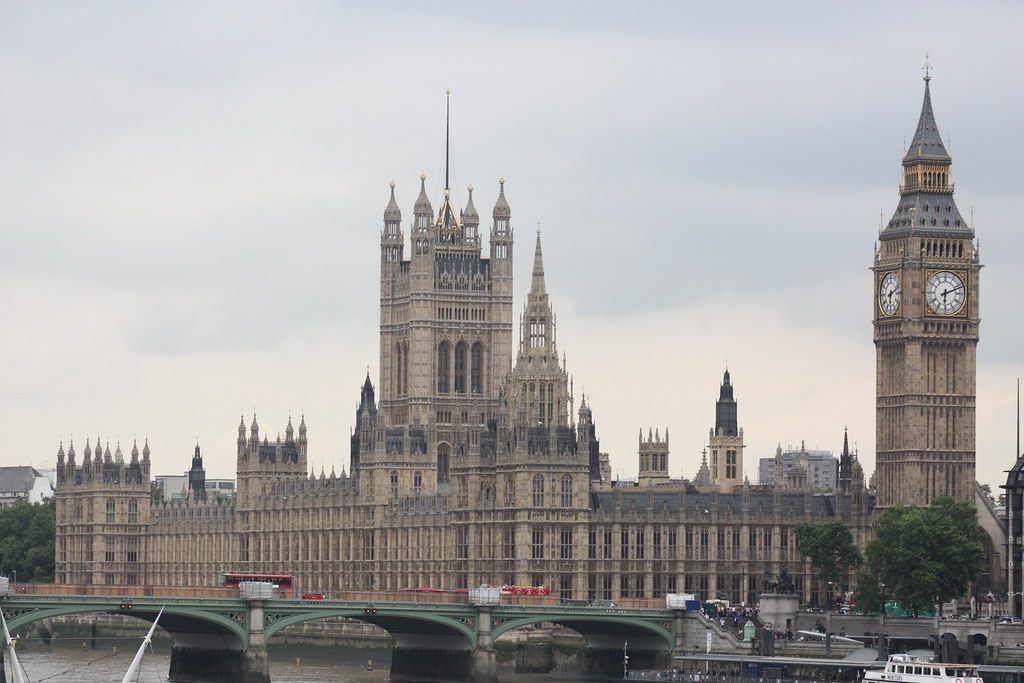
“Palace of Westminster”by michaelhenley is licensed under CC BY-NC-SA 2.0


Social media giants face huge fines for curbing free speech by “overzealous” enforcement of online safety laws.
Ministers have told platforms including Facebook, X, Instagram and TikTok they must not restrict access to posts that express lawfully held views.
The warning, in an apparent change of tone from ministers, comes amid a backlash over websites blocking users from viewing material, including parliamentary debates about grooming gangs.
Campaigners have said that free speech is threatened by the Government’s application of the Online Safety Act, which is meant to protect children from harmful content.
JD Vance, the US vice-president, used a visit to the UK this week to warn ministers against going down the “dark path” of censorship.
Whitehall sources have expressed concern that social media firms, some of which have criticised the law, “have been overzealous” in enforcing it and must be “mindful” of the right to freedom of expression.
The Science Department, which oversees the legislation, told companies they could face fines if they failed to uphold free speech rules.
A spokesman said:
As well as legal duties to keep children safe, the very same law places clear and unequivocal duties on platforms to protect freedom of expression.
Failure to meet either obligation can lead to severe penalties, including fines of up to 10 per cent of global revenue or £18m, whichever is greater.
The Act is not designed to censor political debate and does not require platforms to age gate any content other than those which present the most serious risks to children such as pornography or suicide and self-harm content.
Platforms have had several months to prepare for this law. It is a disservice to their users to hide behind deadlines as an excuse for failing to properly implement it.
So online sites big and small are required to obey the British law, but only as and how the British government wants it enforced or they’ll levy massive punishment. Too lax? Punishment. Too strict? Also punishment. It’s almost as if Britain wants to be cut off from the rest of the internet …
Comments Off on Britain warns online platforms about “overzealous” interpretation of online safety law
July 29, 2025
“The free and open internet has now ceased to exist in the UK”
Britain, like Canada, has been moving toward a less free internet experience for ordinary users, the key bit of legislation in the UK being the Online Safety Act, which like Canada’s proposed Online Harms Act, provides tools to the government to clamp down on online activities they deem “unsafe”:

The free and open internet has now ceased to exist in the UK. Since Friday, anyone in Britain logging on to social media will have been presented with a censored, restricted version – a “safe” internet, to borrow the UK government’s language. Vast swathes of even anodyne posts are now blocked for the overwhelming majority of users.
The Online Safety Act was passed by the last Conservative government and backed enthusiastically by Labour. Both parties insisted it is necessary to protect children. Supposedly, its aim is to shield them from pornography, violence, terrorist material and content promoting self-harm. Age-verification checks, we were assured, would ensure that children would not be exposed to inappropriate content, but adults could continue using the internet as they please. Yet as we have seen over the past few days, on many major tech platforms, UK-based adults are being treated as children by default, with supposedly “sensitive” content filtered from everyone’s view.
Predictably, what is deemed “sensitive” and therefore censored goes well beyond pornography and obviously illegal or adult material. Already UK users of X have been blocked from viewing footage of an anti-asylum protest, a tweet calling for single-sex spaces and a video of a speech in parliament on the grooming-gangs scandal. Historical trivia, such as a thread on Richard the Lionheart, and classic artworks like Goya’s Saturn Devouring His Son have been shielded by the tech censors. A thread on X of examples of what has been censored under the Online Safety Act, collated by Benjamin Jones of the Free Speech Union, has itself been partially censored due to the Online Safety Act. Open, political debate online is now a thing of the past.
When the Online Safety Act was first put before parliament, supporters from all parties insisted that fears about its impact on free speech were overblown. “The worst misrepresentation I’ve heard is that the [Online Safety Act] will force tech companies to censor legal social-media posts”, insisted Chris Philp, the then minister for tech and digital economy, now the shadow home secretary, back in 2022. Anyone who warned that this vast new architecture of online speech regulation was obviously going to curtail free speech was presented as a friend of paedophiles, terrorists or the far right. This gaslighting was kept up right until the point the age filters were implemented. “The UK’s online safety regime is here. Will anybody notice?”, asked Politico the day before much of the internet disappeared. The Guardian, on the same day, pondered whether the new rules would be censorious enough.
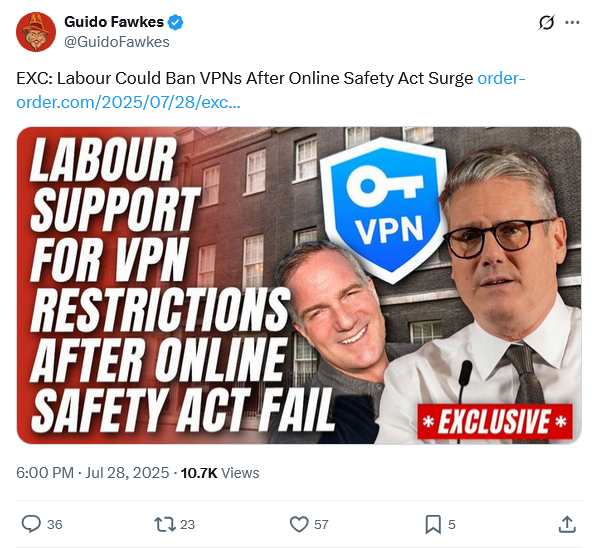
Despite my financial plight, I’d been considering getting a VPN subscription in advance of the Canadian government getting some version of the Online Harms Act onto the books. Clearly many Brits had already gone that route, and the British government reacts with the care and subtlety one would expect:
July 22, 2025
Age verification schemes are just another attempt to control everyone’s internet usage
Marian Halcombe is specifically discussing the British age verification provisions of their Online Safety Act, but similar schemes are popping up all over the west, and they’re only pretending to be about protecting young people from online content:



The British State, in its infinite filth and hypocrisy, would like you to believe that it is deeply concerned about what you do with your penis. Or more precisely, what you look at while your hand is on it. The latest wheeze — part of the Online Safety Act — is mandatory age verification for all pornographic websites. We’re told it’s to stop children from seeing naughty videos. In reality, it’s a spyware regime disguised as child protection, devised by a ruling class that snorts coke with one hand while signing surveillance warrants with the other.
Let’s start with the pretence. No one in Westminster cares what children watch online. These are the same people who presided over the industrial-scale rape of working-class girls in Rotherham, Telford, Rochdale, and elsewhere — refusing to intervene for fear of “racism”. The idea that they now lie awake worrying about a Year Eight boy glimpsing a MILF thumbnail on Pornhub is an insult to the intelligence. They don’t care about children. They care about you.
The age-verification scheme isn’t just about proving you’re eighteen. It’s about linking your name and your age, and your IP address to your viewing habits. Whether it’s ID upload or facial recognition or some third-party database, the outcome is the same: a digital file that knows what you watch and when you watch it.
In a normal country, this would be recognised as deeply perverse. In ours, it’s dressed up as safety. The State that can’t fix the trains, that can’t keep the hospitals clean, now wants the power to log whether you’re big-enders or little-enders. And all under the banner of protecting the kiddies.
Yes, of course it’s technically possible to anonymise verification. But only if you believe that governments, regulators, and their corporate collaborators are incapable of abuse. That’s a belief I do not share. This is the same British government that let GCHQ harvest your webcam feeds and your phone calls under the TEMPORA programme. You didn’t vote for that. You weren’t told about it. You found out because Edward Snowden blew the whistle.
Do you really think the same regime won’t take an interest in which adult videos you watch? Anyone with an ounce of memory knows how this goes. Every intrusive policy begins with “think of the children”. The Video Recordings Act. The Dangerous Dogs Act. The Terrorism Act. And now the Online Safety Act. Once the infrastructure is in place, it never stays limited to its original purpose.
The definition of “harmful content” is vague for a reason. It can grow. It can stretch. Today it’s Pornhub. Tomorrow it’s Twitter. Then it’s dissident blogs, pro-life websites, or even a dodgy meme about immigration statistics. In the end, the target isn’t porn — it’s dissent.
Comments Off on Age verification schemes are just another attempt to control everyone’s internet usage
July 14, 2025
The “War of the Sexes” is over … men now expected to surrender and go back to doing what women want
The more I read about the state of male-female interactions on the dating scene (such as it is), the more grateful I am that I’m decades out of that killing ground. Male survivors have clearly decided that the risks are far greater than the potential relationship rewards and individually withdrawn in large enough numbers that the “dating scene” is a shadow of what it once was in the pre-swipe-left era. Janice Fiamengo responds to a “men, come back!” plea from Rachel Drucker in the New York Times:
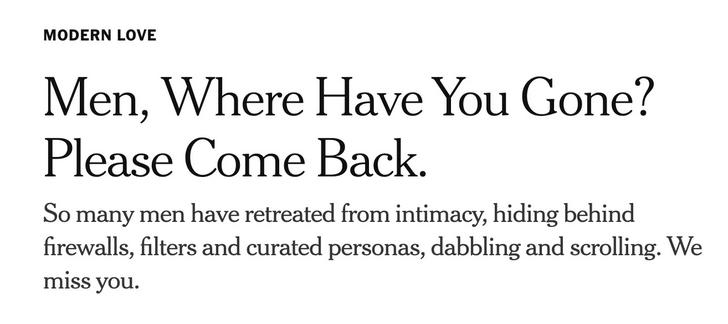
The question of where men have gone, in the title of Rachel Drucker’s New York Times op/ed, is surely disingenuous. Drucker thinks she knows: men have disappeared into social media posting, digital lurking, uncommitted sexting, and porn. Allegedly afraid of emotional intimacy, they are no longer “showing up” for women. Drucker addresses men directly, diagnosing their feelings: “You’ve retreated — not into malice, but into something softer and harder all at once: Avoidance. Exhaustion. Disrepair.”
Well, maybe. Maybe not.
Drucker’s article is part social lament, part personal ad, and like many statements by modern women about men, it is notable for its presumption. Drucker seems to think she can call off the sex war simply by saying she’s had enough. Men were never supposed to stop being available to women. Drucker mourns a lost time when men “asked questions and waited for the answers”, when they “listened — really listened — when a woman spoke”. It doesn’t seem to occur that men have been listening and have heard women’s messages, loud and clear.
Drucker goes so far as to express nostalgia for a time of male sexual pursuit, when having a woman on one’s arm was a way for a man to prove himself and impress other men. “It wasn’t always healthy”, she says in one of her many massive understatements (ignoring the barrage of condemnation leveled against such men) “but it meant that men had to show up and put in some effort”.
Drucker produces no evidence of men’s lack of effort, and it is not clear that her personal anecdotes — all culled, it seems, from her monied Chicago milieu — are representative. I know many men, including young men, who are still willing to pursue romantic relationships with women; many put in a lot of time and thought. But it does ring true that at least some portion of men are far more wary than in previous eras, unwilling to risk the potential hell of divorce or of a false accusation in a culture that believes women and belittles men.
Some men have simply come to the conclusion that modern women aren’t, in general, all that likable — neither marriage material nor viable candidates for motherhood.
As far as female pronouncements about men go, Drucker’s piece is not the worst. It does not hector or accuse (at least, not much), and Drucker expresses some genuine liking for men. But it’s not clear how much that is worth when she is so oblivious to men’s points of view and unaware that at least some of the onus for re-engaging men must fall on women. Drucker’s blind spots and unearned certainty turn her wistful dirge into a tone-deaf commentary on contemporary sexual politics.
The article begins with a restaurant, where Drucker notes the absence of men. There are women together, doing what women do, but almost no coupled men. And in her own life, Drucker notes, there has been retreat. It isn’t just her, she’s sure: it’s a collective act in which men are removing themselves from women’s lives, no longer “trying to connect”.
Drucker is part of the problem, though she doesn’t seem to recognize it. She admits that she “spent over a decade” working for Playboy and more hardcore sites to get men addicted to digital pornography. Part of her job was “to understand exactly what it took to get a man to pay for content he could easily find for free”. She does not seem to regret this work or recognize its damage; on the contrary, she exults that it helped her understand men’s deepest selves.
Her characterization is simplistic and contemptuous: “We knew what worked”, she boasts. “It wasn’t intimacy. It wasn’t mutuality. It was access to stimulation — clean, fast and frictionless. In that world, there’s no need for conversation. No effort. No curiosity. No reciprocity.”
If this is what men fundamentally are to Drucker — sex bots without emotion or desire for reciprocity — why is she so disappointed that they are no longer around?
July 10, 2025
Mandatory online age verification
Michael Geist discusses the rush of the Canadian and other governments in the west to try to impose one-size-fits-all age verification schemes on the internet:

The Day I Knew I Was Old 😉 by artistmac CC BY-SA 2.0
When the intersection of law and technology presents seemingly intractable new challenges, policy makers often bet on technology itself to solve the problem. Whether countering copyright infringement with digital locks, limiting access to unregulated services with website blocking, or deploying artificial intelligence to facilitate content moderation, there is a recurring hope the answer to the policy dilemma lies in better technology. While technology frequently does play a role, experience suggests that the reality is far more complicated as new technologies also create new risks and bring unforeseen consequences. So too with the emphasis on age verification technologies as a magical solution to limiting under-age access to adult content online. These technologies offer some promise, but the significant privacy and accuracy risks that could inhibit freedom of expression are too great to ignore.
The Hub runs a debate today on the mandated use of age verification technologies. I argue against it in a slightly shorter version of this post. Daniel Zekveld of the Association for Reformed Political Action (ARPA) Canada makes the case for it in this post.
The Canadian debate over age verification technologies – which has now expanded to include both age verification and age estimation systems – requires an assessment of both the proposed legislative frameworks and the technologies themselves. The last Parliament featured debate over several contentious Internet-related bills, notably streaming and news laws (Bills C-11 and C-18), online harms (Bill C-63) and Internet age verification and website blocking (Bill S-210). Bill S-210 fell below the radar screen for many months as it started in the Senate and received only cursory review in the House of Commons. The bill faced only a final vote in the House but it died with the election call. Once Parliament resumed, the bill’s sponsor, Senator Julie Miville-Dechêne, wasted no time in bringing it back as Bill S-209.
The bill would create an offence for any organization making available pornographic material to anyone under the age of 18 for commercial purposes. The penalty for doing so is $250,000 for the first offence and up to $500,000 for any subsequent offences. Organizations can rely on three potential defences:
- The organization instituted a government-approved “prescribed age-verification or age estimation method” to limit access. There is a major global business of vendors that sell these technologies and who are vocal proponents of this kind of legislation.
- The organization can make the case that there is “legitimate purpose related to science, medicine, education or the arts”.
- The organization took steps required to limit access after having received a notification from the enforcement agency (likely the CRTC).
Note that Bill S-209 has expanded the scope of available technologies for implementation: while S-210 only included age verification, S-209 adds age estimation technologies. Age estimation may benefit from limiting the amount of data that needs to be collected from an individual, but it also suffers from inaccuracies. For example, using estimation to distinguish between a 17 and 18 year old is difficult for both humans and computers, yet the law depends upon it. Given the standard for highly effective technologies, age estimation technologies may not receive government approvals, leaving only age verification in place.
Comments Off on Mandatory online age verification
June 5, 2025
The Liberals believe this time they’ll keep kids away from internet porn
Sometimes it’s hard to get a grip on what Liberals actually believe, as on the one hand they’re actively resisting pulling literal pornography out of school libraries (because it’s “LGBT friendly”) and on the other hand, they’re all gung-ho for yet another attempt to pass legislation that will try to prevent kids from seeing porn on the internet:
How does a website automatically, “responsibly” prove someone’s age down the end of an internet connection, without actually verifying their ID? Answer: It doesn’t. Obviously
There is another legislative effort afoot to keep Canadian children away from pornography. It’s well-intentioned effort, I suppose, but such efforts didn’t work very well when pornography was printed on glossy paper and distributed on VHS tapes and pay-per-view, so it seems particularly improbable in the internet age.
Bill S-209 is Independent (Liberal-appointed) Senator Julie Miville-Dechêne’s second attempt at a private member’s bill on the topic. It is predicated on the notion that it’s easier to verify age automatically than it used to be: “Online age-verification and age-estimation technology is increasingly sophisticated and can now effectively ascertain the age of users without breaching their privacy rights”, the bill’s preamble avers.
It is absolute rubbish, to the extent that even the Liberals under former prime minister Justin Trudeau seemed to realize it the first time it was tried. We can only hope Mark Carney’s Liberals are of similar mind. Early signs are not positive. The reappointment of Steven Guilbeault as heritage minister (now called Canadian identity and culture minister, for some reason) doesn’t bode well. He seems genuinely to dislike the online world on principle.
Or, maybe it does bode well. Guilbeault did a singularly terrible job trying to sell the Liberals’ anti-internet agenda in English Canada. I’m not sure he could give away ice cream in a Calgary heatwave. So if you think laws targeting “online harms” are doomed to fail at best — and could lead to dystopian outcomes — then maybe Guilbeault is exactly the fellow you want in charge.
When it came to online porn, the Trudeau Liberals seemed to have some sense of the Sisyphean proposition before them. Miville-Dechêne’s first attempt at a bill received support from MPs of all parties in the House of Commons last year, but the Liberal leadership cited privacy concerns in refusing to get behind it.
In large part that might just have been because Conservative Leader Pierre Poilievre supported the idea and, to Liberals, anything Poilievre supports must obviously be a serious threat to humanity’s survival. But still, Trudeau was pretty unequivocal in rejecting the idea.
Comments Off on The Liberals believe this time they’ll keep kids away from internet porn
April 28, 2025
A potential positive to the explosion of AI-generated fake porn
The one thing we have always been able to predict with 100% confidence is that every new media will be used for pornography and crime, often in the same product. However, No Pasaran makes a case for there being a socially useful side to the ever-increasing realism of fake porn from popular LLM generators:
Seriously?! Am I the only person that sees the benefits of this “troubling trend” of online bullying?!
Think about it.
Blackmail is now a thing of the past.
That’s it.
It’s over.
Whether you are a teen or an adult, whether the photos are real or not, you can simply pass all of them off — indeed, you can do so nonchalantly — as fakes or deepfakes. To your classmates, to your spouse, to your constituents. Who will know whether you are fibbing or telling the truth? (Maybe you hardly know yourself …)
(In a totally different context, of course, that is exactly what Joe Biden’s White House did …)
As it happens, a considerable size of the audience for these sex photos/videos — maybe far more than half — will already be assuming that they’re fakes … (Thanks for the Instalink, Sarah.)
Depression at 16? Suicide at 17? Why fear sextortion at this point? Compliment instead the (anonymous) photo/video creators for doing a good job — for doing an outstanding job.
On my phone I keep receiving photos of Donald Trump tenderly cuddling with Joe Biden or Vladimir Putin or Stormy Daniels. Lots of apps now make you “repair” snapshots that are decades or (over) a century old, colorize them, and make them into mini-movies (the latest one I saw delighted me as it involved Civil War daguerreotypes from the 1860s).
I also keep receiving AI ads where, by combining a couple of photos of myself and of any girl (someone I know and am perhaps infatuated with or some rock or movie star or someone — Marilyn Monroe? Rudolph Valentino? Che Guevara? Queen Victoria? — who has been dead for decades) I can make myself hug or kiss that person — hungrily — on the mouth.
Years ago (long before AI), I was writing a TV script imagining a politician who was on national television and who was all of a sudden ambushed with private photos of him in a compromising position (with a woman other than his wife, with a man, with many women, with many men, at an orgy, in a BDSM cave, with a money shot, whatever …). Talk of falling victim; talk of bullying; talk of harassment (justified or otherwise)!
How should he react?
Ignore the content. And, with an admiring voice, let out a whistle and praise the work: “Wow, that’s well done!”
“What do you mean?!” interrupts the TV presenter, visibly frustrated. “No no no! Don’t tell me you are claiming they’re fake?! We have proof that you were seen at—”
Again, this was before AI, needless to say, which only made the politician’s next words even more startling: “It is so how admirable the degree to which studios have made progress with special effects!”
Comments Off on A potential positive to the explosion of AI-generated fake porn
April 25, 2025
What Were Georgian Attitudes Towards Sex? | Georgian Pleasures
History Hit
Published 12 Sept 2024Historian Dr Kate Lister removes Bridgerton‘s rose-tinted glasses, unlaces the corsets and unbuttons the breaches of the Georgians. Join Kate as she investigates how s*x and the world of celebrity were a big thing long before the 20th century.
The fabulous wealthy elite of Bridgerton look perfectly preened, their teeth, hair, make up, even their sex scenes are all filled with opulent glamour! But in reality a lot of people in Georgian society, including the wealthy, were dealing with a myriad of issues, from syphilis, teeth decay and scandals to laudanum and gin addictions. All of this would have been rife and incredibly visible on the big city streets during the booming industrial revolution.
Kate uncovers what went on betwixt the Georgian sheets: who’s doing what, where, how and with whom. Along the way she’ll explore extraordinary guides to s*x work in London and Edinburgh and unwrap the world of 18th century condoms, syphilis and even high profile and hidden sex clubs. All of this will help to unearth the real lives of the people stomping the streets, pubs and back alleys of these lavish Georgian cities. No stone is left unturned in the quest to reveal the real lives of Georgian society!
(more…)
Comments Off on What Were Georgian Attitudes Towards Sex? | Georgian Pleasures
April 24, 2024
What Were Victorian Attitudes Towards Sex?
History Hit
Published Dec 15, 2023They’re famously thought of as a buttoned up prudish bunch, but we all know they loved to bump uglies as much as anyone today.
Were the spanking punishments of boarding schools really the origins of brothels? Who were the pin-ups of Victorian women? And what did the saucy portrait Queen Victoria gave to Prince Albert look like?
Today we go Betwixt the Victorian Sheets with Dan Snow, from History Hit sister podcast Dan Snow’s History Hit, to find out all about Victorian relationships.
(more…)
Comments Off on What Were Victorian Attitudes Towards Sex?
December 15, 2023
Bill S-210 “isn’t just a slippery slope, it is an avalanche”
You sometimes get the impression that the only person in Ottawa who actually pays attention to online privacy issues is Michael Geist:
“2017 Freedom of Expression Awards” by Elina Kansikas for Index on Censorship https://flic.kr/p/Uvmaie (CC BY-SA 2.0)
After years of battles over Bills C-11 and C-18, few Canadians will have the appetite for yet another troubling Internet bill. But given a bill that envisions government-backed censorship, mandates age verification to use search engines or social media sites, and creates a framework for court-ordered website blocking, there is a need to pay attention. Bill S-210, or the Protecting Young Persons from Exposure to Pornography Act, was passed by the Senate in April after Senators were reluctant to reject a bill framed as protecting children from online harm. The same scenario appears to be playing out in the House of Commons, where yesterday a majority of the House voted for the bill at second reading, sending it to the Public Safety committee for review. The bill, which is the brainchild of Senator Julie Miville-Duchêne, is not a government bill. In fact, government ministers voted against it. Instead, the bill is backed by the Conservatives, Bloc and NDP with a smattering of votes from backbench Liberal MPs. Canadians can be forgiven for being confused that after months of championing Internet freedoms, raising fears of censorship, and expressing concern about CRTC overregulation of the Internet, Conservative MPs were quick to call out those who opposed the bill (the House sponsor is Conservative MP Karen Vecchio).
I appeared before the Senate committee that studied the bill in February 2022, where I argued that “by bringing together website blocking, face recognition technologies, and stunning overbreadth that would capture numerous mainstream services, the bill isn’t just a slippery slope, it is an avalanche”. As I did then, I should preface criticism of the bill by making it clear that underage access to inappropriate content is indeed a legitimate concern. I think the best way to deal with the issue includes education, digital skills, and parental oversight of Internet use including the use of personal filters or blocking tools if desired. Moreover, if there are Canadian-based sites that are violating the law in terms of the content they host, they should absolutely face investigation and potential charges.
However, Bill S-210 goes well beyond personal choices to limit underage access to sexually explicit material on Canadian sites. Instead, it envisions government-enforced global website liability for failure to block underage access, backed by website blocking and mandated age verification systems that are likely to include face recognition technologies. The government establishes this regulatory framework and is likely to task the CRTC with providing the necessary administration. While there are surely good intentions with the bill, the risks and potential harms it poses are significant.
The basic framework of Bill S-210 is that it creates an offence for any organization making available sexually explicit material to anyone under the age of 18 for commercial purposes. The penalty for doing so is $250,000 for the first offence and up to $500,000 for any subsequent offences. Organizations (broadly defined under the Criminal Code) can rely on three potential defences:
- The organization instituted a “prescribed age-verification method” to limit access. It would be up to the government to determine what methods qualify with due regard for reliability and privacy. There is a major global business of vendors that sell these technologies and who are vocal proponents of this kind of legislation.
- The organization can make the case that there is “legitimate purpose related to science, medicine, education or the arts”.
- The organization took steps required to limit access after having received a notification from the enforcement agency (likely the CRTC).
The enforcement of the bill is left to the designated regulatory agency, which can issue notifications of violations to websites and services. Those notices can include the steps the agency wants followed to bring the site into compliance. This literally means the government via its regulatory agency will dictate to sites how they must interact with users to ensure no underage access. If the site fails to act as instructed within 20 days, the regulator can apply for a court order mandating that Canadian ISPs block the site from their subscribers. The regulator would be required to identify which ISPs are subject to the blocking order.
Comments Off on Bill S-210 “isn’t just a slippery slope, it is an avalanche”
January 6, 2023
QotD: The weird economics of “Onlyfans”
Given that I am not in the target audience for OnlyFans, then, perhaps all my speculations are hilariously wrong. And obviously there’s a robust market for porn, so it stands to reason that a la carte porn would have, if anything, an even bigger market …
… but do we trust those numbers? Everything in Clown World is fake and gay, and everything to do with the Internet has always been … how shall we put this? Factually dubious. This was true even when the Internet was a Libertarian paradise (for the young guys out there: Back in the build-your-own-modem days, I’m told, the Internet was hardcore Libertarian. By the time I got there, it was still very, very Right. Which stands to reason — you needed patience, discipline, and a little savvy to be online back then, and those are not Leftist qualities). OnlyFans claims a subscriber base of X, with revenues of Y. Do we have any reason to believe those are even within shouting distance of reality?
Money laundering seems like a live option.
My other guess was kompromat. I understand that Chinese Intelligence has all but openly admitted that TikTok is part of a targeted program to spread deviance, and if it has some intel benefit that’s a bonus. I figure OnlyFans had some sort of similar function. We all know that the classic “honey pot” is alive and well — Eric Swalwell and of course Hunter Biden say hi — but why bother running a real agent at somebody when he’s perfectly willing to put all his deviant desires in writing, backed by his credit card number?
I checked out OnlyFans — on Wikipedia; for research — and hey, whaddaya know, they got in on The Current Thing in Ukraine. Given what we know about Vladimir Putin, I’m sure he’s real broken up about that. It probably works pretty well as “open source” domestic intelligence, too — just as your enemies are busy uploading their own blackmail photos, so your domestic deviants are busy outing themselves on the other side of the transaction. Indeed, the only thing that surprises me is that the usual (((retards))) aren’t blaming it on the Mossad …
… actually I’m sure they are, and I do NOT want to know about it, but the point is, the whole thing seems really sketchy. So what are your thoughts? Money laundering scheme? PsyOp? Really obvious intelligence ploy? Or is it exactly what it seems like, desperately horny betas doing their thing?
(Based on what I saw on Facebook etc., I’m almost willing to believe the latter. All a recognizably human female has to do is post a cleavage shot on Facebook and she’ll get a hundred thirsty simps complimenting her. It’s the money thing that gets me, though. Being a simp in the Facebook comments is free).
Severian, “The E-Thot Economy”, Founding Questions, 2022-10-05.
Comments Off on QotD: The weird economics of “Onlyfans”
November 30, 2022
James Gillray
In The Critic, James Stephens Curl reviews a new biography of the cartoonist and satirist James Gillray (1756-1815), who took great delight in skewering the political leaders of the day and pretty much any other target he fancied from before the French Revolution through the Napoleonic wars:
During the 1780s Gillray emerged as a caricaturist, despite the fact that this was regarded as a dangerous activity, rendering an artist more feared than esteemed, and frequently landing practitioners into trouble with the law. Gillray began to excel in invention, parody, satire, fantasy, burlesque, and even occasional forays into pornography. His targets were the great and good, not excepting royalty. But his vision is often dark, his wit frequently cruel and even shockingly bawdy: some of his own contemporaries found his work repellent. He went for politicians: the Whigs Charles James Fox (1749-1806), Edmund Burke (1729-97), and Richard Brinsley Butler Sheridan (1751-1816) on the one hand, and William Pitt (1759-1806) on the other. Fox was a devious demagogue (“Black Charlie” to Gillray); Burke a bespectacled Jesuit; and Sheridan a red-nosed sot. But Gillray reserved much of his venom for “Pitt the Bottomless”, “an excrescence … a fungus … a toadstool on a dunghill”, and frequently alluded to a lack of masculinity in the statesman, who preferred to company of young men to any intimacies with women, although the caricaturist’s attitude softened to some extent as the wars with the French went on.
As the son of a soldier who had been partly disabled fighting the French, Gillray’s depictions of the excesses of the Revolution were ferocious: one, A Representation of the horrid Barbarities practised upon the Nuns by the Fish-women, on breaking into the Nunneries in France (1792), was intended as a warning to “the FAIR SEX of GREAT BRITAIN” as to what might befall them if the nation succumbed to revolutionary blandishments. The drawing featured many roseate bottoms that had been energetically birched by the fishwives. He also found much to lampoon in his depictions of the Corsican upstart, Napoléon.
[…]
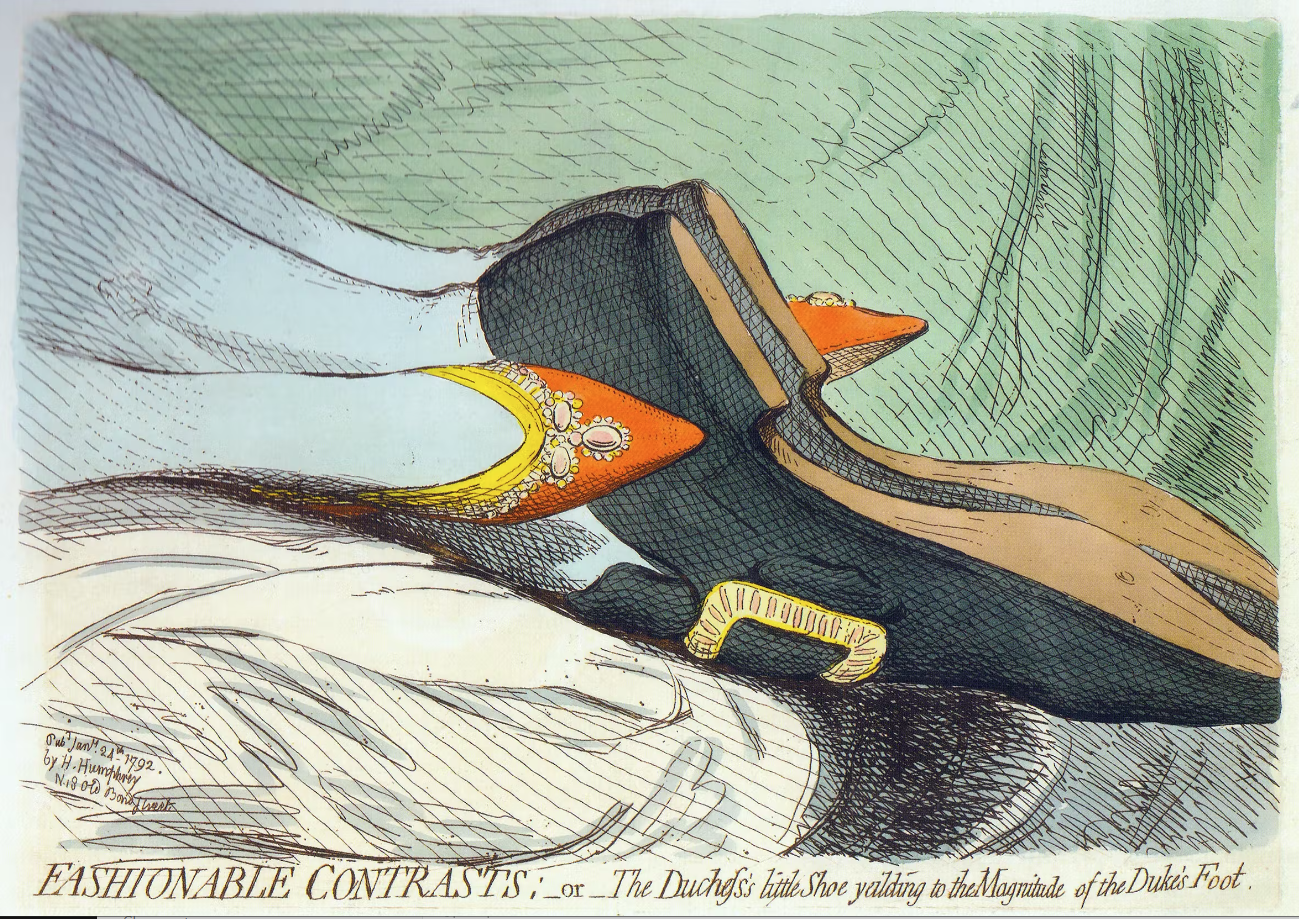
Some of Gillray’s works would pass most people by today, thanks to the much-trumpeted “world-class edication” which is nothing of the sort: one of my own favourites is his FASHIONABLE CONTRASTS;—or—The Duchefs’s little Shoe yeilding to the Magnitude of the Duke’s Foot (1792), which refers to the remarkably small hooves of Princess Frederica Charlotte Ulrica Catherina of Prussia (1767-1820), who married Frederick, Duke of York and Albany (1763-1827) in 1791: their supposed marital consummation is suggested by Gillray’s slightly indelicate rendering, in which the Duke’s very large footwear dwarfs the delicate slippers of the Duchess.
“In 1791 and 1792, there was no one who received more attention in the British press than Frederica Charlotte, the oldest daughter of the King of Prussia, whose marriage to the second (and favorite) son of King George and Queen Charlotte, Prince Frederick, the Duke of York set off a media frenzy that can only be compared to that of Princess Diana in our own day.”
Description from james-gillray.org/fashionable.htmlAll that said, this is a fine book, beautifully and pithily written, scholarly, well-observed, and superbly illustrated, much in colour. However, it is a very large tome (290 x 248 mm), and extremely heavy, so can only be read with comfort on a table or lectern. The captions give the bare minimum of information, and it would have been far better to have had extended descriptive captions under each illustration, rather than having to root about in the text, mellifluous though that undoubtedly is.
What is perhaps the most important aspect of the book is to reveal Gillray’s significance as a propagandist in time of war, for the images he produced concerning the excesses of what had occurred in France helped to stiffen national resolve to resist the revolutionaries and defeat them and their successor, Napoléon, whose own model for a new Europe was in itself profoundly revolutionary. What he would have made of the present gang of British politicians must remain agreeable speculation.
Comments Off on James Gillray


