
Lorenzo Warby discusses the charming illusion that “international law” is a real thing and must be treated as a real thing:
In domestic (“municipal”) law, questions of illegality arise. They arise because states have laws. They have laws because their laws come with remedies — consequences for breaking the law.
So, it is a genuine question whether President Trump is exceeding his constitutional authority in his attack on Iran. But that is a genuine question because the US has a Constitution that matters. The US is a rule-of-law state, no matter how much other common law jurisdictions may point and laugh at how politicised US law is.
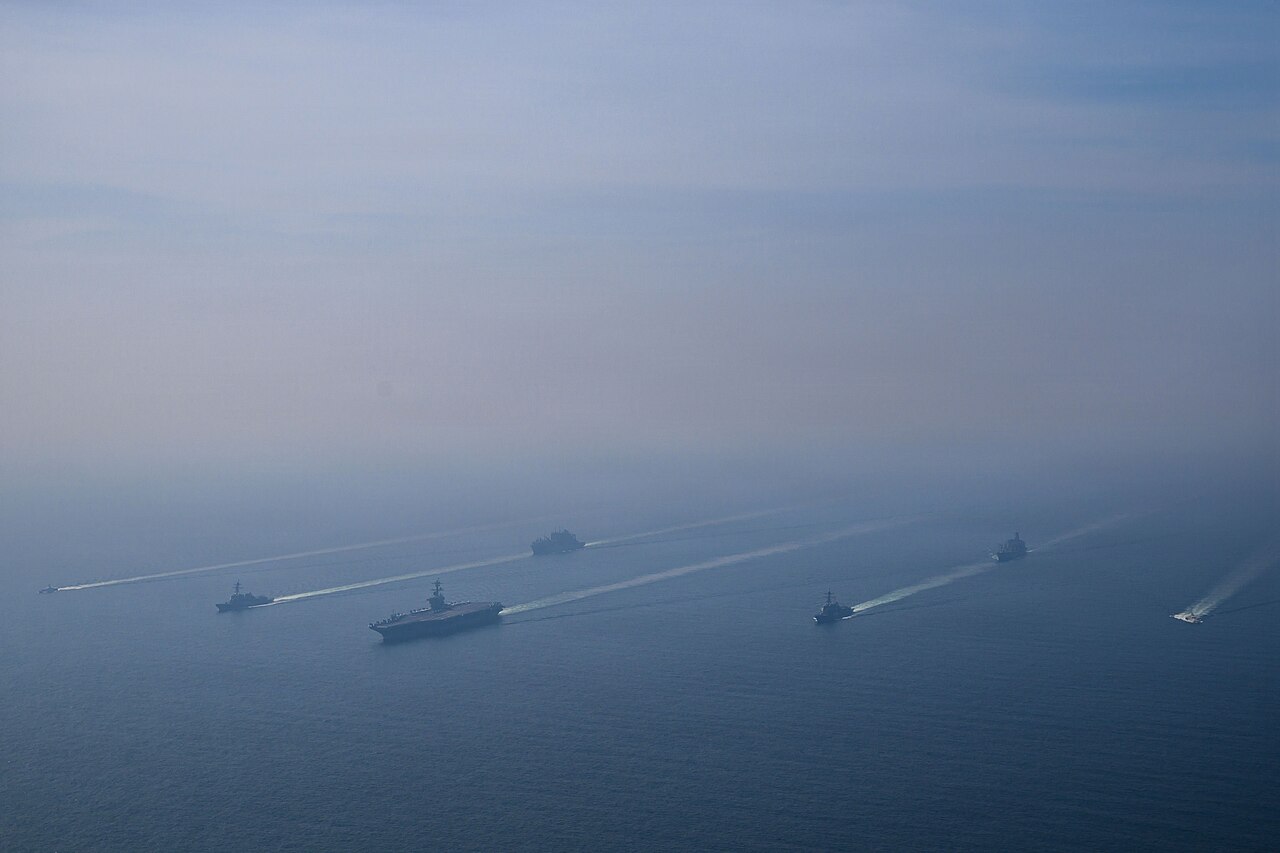
Nimitz-class aircraft carrier USS Abraham Lincoln (CVN 72), Arleigh Burke-class guided-missile destroyers USS Michael Murphy (DDG 112) and USS Frank E. Petersen Jr. (DDG 121), Henry J. Kaiser-class fleet replenishment oiler USNS Henry J. Kaiser (T-AO-187), Lewis and Clark-class dry cargo ship USNS Carl Brashear (T-AKE 7) and U.S. Coast Guard Sentinel-class fast-response cutters USCG Robert Goldman (WPC-1142) and USCGC Clarence Sutphin. Jr. (WPC-1147) sail in formation in the Arabian Sea, Feb. 6, 2026. The Abraham Lincoln Carrier Strike Group is deployed to the U.S. 5th Fleet area of operations to support maritime security and stability in the Middle East.
U.S. Navy photo by Mass Communication Specialist 1st Class Jesse Monford via Wikimedia Commons.In terms of the international order, however, there is no such thing as an illegal war, because (public) international law is not law. It is a set of rules and claims that pretends to be law. It only pretends to be law as it has no remedies — apart from declarative statements, which are not enough to make it law. (Private international law does have enforceable and enforced remedies, so is law.)
One of the consequences of this is that (public) international law, as an academic discipline, has no substantive reality-tests. There are no decisions by judges that are enforceable and enforced. This has led to academic international law being the vector by which the toxic ideas of the Critical Theory magisterium, that increasingly dominates Anglo-American universities, have infected Law Schools.
(Public) International law should not be taught at Law Schools, because it is not law. It should be taught in International Relations or Political Science Departments. A PhD in International Law should not qualify you to teach in Law Schools. Indeed, if you cannot tell the difference between actual law — with genuine remedies — and a simulacrum of law, you should not be teaching students at all.
Rules-based international order
When folk refer to the rules-based international order, they are not referring to nothing. There are various rules and conventions it is convenient for states, and other agents, to follow.
There is also a difference between the mercantile maritime order and continental anarchy. It is not an accident that the original international conventions pertained to sea travel and trade.
Within continental anarchy, it is relative power that matters. A war that depletes your resources and capacities, but depletes those of your neighbours more, is a winning proposition, within the state-geopolitics of continental anarchy. The geopolitics of continental anarchy leads states to seek weak or subordinate neighbours. The mercantile maritime order, on the other hand, is all about creating win-win interactions.
Russia, India and China are all continental Powers that live, at least to some extent, in a situation of continental anarchy. But they are also trading States that benefit from the mercantile maritime order maintained by the US-and-allies maritime hegemony. The tension between China as a trading nation becoming the biggest single beneficiary of the mercantile maritime order maintained by the US-and-allies maritime hegemony, and the interests of the CCP (the Chinese Communist Party), is the central strategic difficulty that CCP China faces.
Israel faces the strategic dilemma of operating in a region of continental anarchy but seeking support from states deeply embedded in the mercantile maritime order. Whether the Middle East has to be a region of continental anarchy, or can it become far more embedded in the mercantile maritime order, is precisely what is at stake in the latest conflict.
Any social order has to be enforced. This is even more true of international orders. As there is no such thing as international (public) law, enforcing an international order is not a matter of rules, it is a matter of those who actively support and enforce that order and those who seek to subvert it.
A vivid example of how central enforceability is to any international order is given by comparing the treatment of Germany after the two World Wars. Germany was treated far more harshly after the Second World War than after the First World War. The crucial difference was that the Versailles order was not enforceable by the victors and the Potsdam order was.
Update, 6 March: Welcome, Instapundit readers! Have a look around at some of my other posts you may find of interest. I send out a daily summary of posts here through my Substack – https://substack.com/@nicholasrusson that you can subscribe to if you’d like to be informed of new posts in the future.



When not avoiding dinsaurs back in 1988, I took an Intro to Int’l Law for fun (my degree was Systems Engineering). The prof was an old Bolshevik with tweed jacket, elbow pads, and wire-rimmed glasses. It was my contention there was no such thing. We hated one another from day one. For my small group’s concluding presentation, we won the debate that the US owes Canada not a damn dime over so-call greenhouse gases and acid rain. I still got a grade of C.
Comment by Clayton Barnett — March 5, 2026 @ 12:42
Just based on your description of the prof, I’d have thought a C would be the highest grade you could achieve, unless you went full hypocrite.
Comment by Nicholas — March 5, 2026 @ 12:53
[…] THEY’RE NOT LAWS SO MUCH AS SUGGESTIONS: “[I]nternational law is not law; it is a set of rules and claims that pretends to be law”. […]
Pingback by Instapundit » Blog Archive » THEY’RE NOT LAWS SO MUCH AS SUGGESTIONS: “[I]nternational law is not law; it is a set of rules — March 6, 2026 @ 02:28
There is one principle of international law that is unquestionable.Once a state has a government which is recognised,that state is sovereign over its territory to the exclusion of others.The attack on Iran is because it has interfered in the sovereignty of other nations,so breaching Iran’s isovereignty is permitted.
Comment by Sabena — March 6, 2026 @ 02:42
#3, Sabena. Not quite. One thinks of how France persisted in backing English Pretenders Old and Young for over 50 years. Conversely the sovereigns of England and Great Britain persisted until 1801 in maintaining the legal fiction that they were the rightful sovereigns of France. There is a lot of that sort of thing going on in what passes for “international law”
Comment by Nathan Redshield — March 6, 2026 @ 04:03