Quotulatiousness

March 13, 2026

Argentina shedding decades of mal-investment in uncompetitive industries

Filed under: Americas, Business, Economics, Government — Tags: , , , , — Nicholas @ 05:00

Argentine President Javier Milei didn’t promise an economic revival for all of Argentina, because significant chunks of the Argentine economy were invested in low-profit or even loss-making industries as the country followed “traditional” South American economic advice. Tim Worstall celebrates some of the belated losses in those deadweight areas of the economy:

Argentina has, for decades now, been making itself poorer by following — effectively — fascist economic policy. That whole process of trying to make everything at home, not importing, being self-reliant in manufactures and so on. The effect being that everything is made by companies of sub-optimal size and therefore consumers can only gain access to expensive shite.

So along comes a liberal — Milei — who lets consumers buy what they wish to buy from whoever, whereever. The result is that those inefficient, expensive, manufacturing firms close down as people buy the better, cheaper, stuff from abroad. The people are better off because they get better, cheaper, stuff. Not that expensive shite from the domestic producers.

Now, true, those jobs go. But those workers can go and do something else. Which they will too. In fact, they are — the unemployment rate is falling.

So, who loses out here? Obviously, the domestic capitalists, the people who own the now bust factories. Which, well, the correct reaction is probably Har Har. If your wealth is based upon producing expensive shite your customers are forced to buy then why shouldn’t we celebrate when you lose the lot?

We can — and should — take our analysis that one step further too. If the absence of the trade restrictions harms the domestic capitalists then who benefitted from the trade restrictions? The domestic capitalists, obviously. Which is how that infant industry protection, that insistence upon self-reliance, how fascist economics always does work out — the people who benefit are the domestic capitalists. And why in buggery would we want to protect them from the effects of free trade?

The Raj – a cut-and-dried case of plunder?

Celina considers the claim that the period of British rule over India was a period of British plunder of Indian resources:

The historical evaluation of the British Raj has increasingly become a battleground for competing political and academic narratives. In the 21st century, the discourse has shifted significantly toward an oppression narrative that characterises the period from 1757 to 1948 as one of singular depredation. This perspective, popularised by public intellectuals such as Shashi Tharoor and economic historians like Utsa Patnaik, posits that British rule was defined by systematic deindustrialisation, engineered genocide, the intentional dismantling of educational systems, and the looting of wealth on a scale that defies standard economic modelling.1 However, when subjected to the rigours of aggregate statistical data, comparative institutional analysis, and a sense of historical proportion, these claims frequently reveal themselves as founded on misleading anecdotes and founding myths rather than objective economic realities.2 To accurately understand the trajectory of India under British influence, it is essential to move beyond evocative stories, such as Winston Churchill’s peevish marginal notes and examine the underlying population trajectories, industrial output figures, and the structural transition from a traditional to a constructed capitalist economy.3

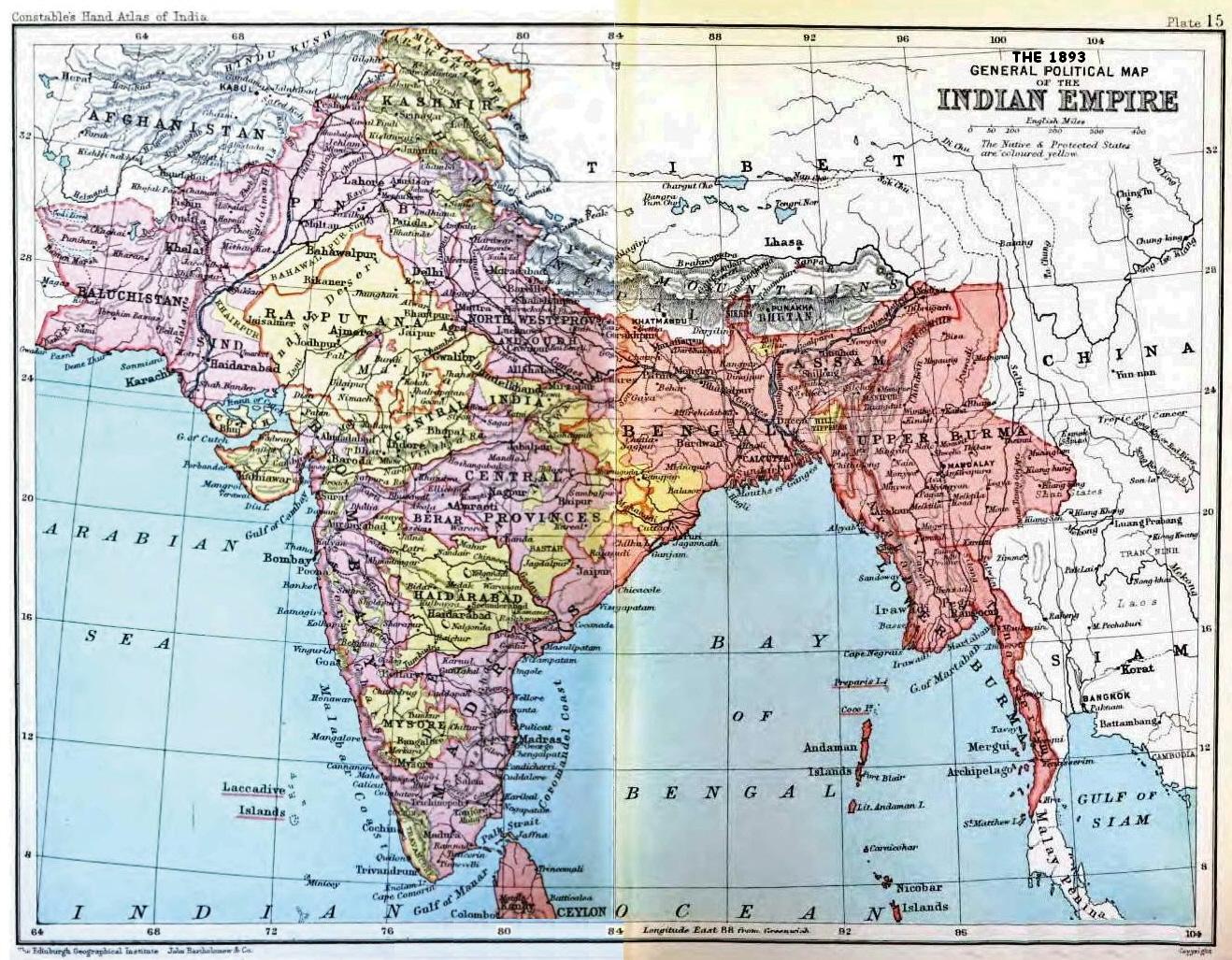
“Political Map of the Indian Empire, 1893” from Constable’s Hand Atlas of India, London: Archibald Constable and Sons, 1893. (via Wikimedia)

Chronology and the Context of the Great Divergence

A critical assessment must begin with a precise periodisation of Indian history. The interaction between Europe and the subcontinent can be divided into four distinct phases: the pre-European period (before 1505), the era of initial coastal contact and Portuguese outposts (1505–1757), the transition under the East India Company (1757–1818), and the era of English domination and formal Raj rule (1818–1948).4 The central contention of modern critics centers on the final period, arguing that India’s share of the global economy collapsed from approximately 24.4% in 1700 to roughly 4.2% by 1950.5

While these proportions are grounded in data, most notably the work of Angus Maddison, the interpretation of this decline as evidence of absolute impoverishment is a fundamental statistical fallacy. The decline in India’s share of world GDP was not the result of a shrinking absolute economy, but rather the consequence of the Great Divergence. During this period, Western Europe, North America, and eventually Japan experienced explosive, intensive growth through the Industrial Revolution, while India remained largely stationary.6

Between 1850 and 1947, India’s absolute GDP in 1990 international dollar terms actually grew from $125.7 billion to $213.7 billion, representing a 70% increase.7 The stagnation in per capita terms, GDP per capita was approximately $550 in 1700 and $619 in 1950, reflects a classic Malthusian trap.8 The unprecedented population growth stimulated by the introduction of Western medicine, increased land cultivation, and the relative political stability of the Raj absorbed almost all economic gains.9 Far from being genocided, the Indian population expanded from 165 million in 1700 to nearly 390 million by 1941.10


  1. https://en.wikipedia.org/wiki/Shashi_Tharoor%27s_Oxford_Union_speech
  2. https://winstonchurchill.hillsdale.edu/tharoor-inglorious-empire/
  3. https://www.reddit.com/r/AskHistorians/comments/l9nve2/he_peevishely_wrote_on_the_margins_of_the_file/
  4. https://en.wikipedia.org/wiki/Economic_history_of_India
  5. Ibid
  6. https://winstonchurchill.hillsdale.edu/tharoor-inglorious-empire/
  7. https://www.rug.nl/ggdc/historicaldevelopment/maddison/
  8. Ibid
  9. https://winstonchurchill.hillsdale.edu/tharoor-inglorious-empire/
  10. https://www.rug.nl/ggdc/historicaldevelopment/maddison/

Enacting the original proposed 12th Amendment

Filed under: Government, History, Law, Politics, USA — Tags: , — Nicholas @ 03:00

At Astral Codex Ten, guest writer David Speiser discusses the two “extra” proposed amendments that didn’t make it into the Bill of Rights, but crucially, didn’t have an expiration date. The 11th did eventually make its way into the Constitution as the 27th Amendment in 1992, leaving only the 12th original still in limbo. The proposed 12th was a doozy:

Here is the text of the Congressional Apportionment Amendment, the sole unratified amendment from the Bill of Rights:

    After the first enumeration required by the first article of the Constitution, there shall be one Representative for every thirty thousand, until the number shall amount to one hundred, after which the proportion shall be so regulated by Congress, that there shall be not less than one hundred Representatives, nor less than one Representative for every forty thousand persons, until the number of Representatives shall amount to two hundred, after which the proportion shall be so regulated by Congress, that there shall not be less than two hundred Representatives, nor more than one Representative for every fifty thousand persons.

In other words, there will be one Representative per X people, depending on the size of the US. Once the US is big enough, it will top out at one Representative per 50,000 citizens.

(if you’ve noticed something off about this description, good work — we’ll cover it in the section “A Troublesome Typo”, near the end)

The US is far bigger than in the Framers’ time, so it’s the 50,000 number that would apply in the present day. This would increase the size of the House of Representatives from 435 reps to 6,6412. Wyoming would have 12 seats; California would have 791. Here’s a map:
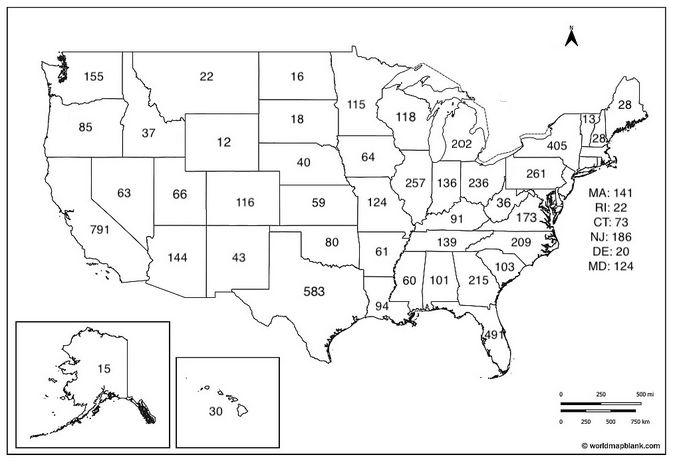
This would give the U.S. the largest legislature in the world, topping the 2,904-member National People’s Congress of China. It would land us right about the middle of the list of citizens per representative, at #104, right between Hungary and Qatar (we currently sit at #3, right between Afghanistan and Pakistan).

Would this solve the issues that make Congress so hated? It would be a step in the right direction. Our various think tanks identified three primary reasons behind the estrangement of Congress and citizens: gerrymandering, national partisan polarization, and the influence of large donors. This fixes, or at least ameliorates, all of them.

Gerrymandering: Gerrymandering many small districts is a harder problem than gerrymandering a few big ones. Durable gerrymandering requires drawing districts with the exact right combination of cities and rural areas, but there are only a limited number of each per state. With too many districts, achievable margins decrease and the gerrymander is more likely to fail.

We can see this with state legislatures vs. congressional delegations. A dominant party has equal incentive to gerrymander each, but most states have more legislature seats than Congressional ones, and so the legislatures end up less gerrymandered. Here are some real numbers from last election cycle1:

So for example, in Republican-dominated North Carolina, 50.9% of people voted Trump, 60% of state senate seats are held by Republicans, and 71.4% of their House seats belong to Republicans. The state senate (50 seats) is only half as gerrymandered as the House delegation (14 seats).

In many states, the new CAA-compliant delegation would be about the same size as the state legislature, and so could also be expected to halve gerrymandering.

As a bonus, the Electoral College bias towards small states would be essentially solved. Currently, a Wyomingite’s presidential vote controls three times as many electoral votes as a Californian’s. Under the CAA, both states would be about equal.

Money: This one is intuitive. If you can effectively buy 1/435 elections, you’ve bought 0.23% of Congress. If the same money only buys you 0.02% of Congress, you’re less incentivized to try to buy House elections and more incentivized to try to buy Senate seats or just to gain influence within a given political party. Money in politics is still a thing, but it becomes much harder to coordinate among people. This makes it easier for somebody to run for Congress without having to fundraise millions of dollars. Because it’s less worth it to spend so much money on any one seat, elections to the House become cheaper2.

Polarization: Some of the think tanks that want to increase the size of Congress by a few hundred members rather than a few thousand claim that this increase will fix political polarization by making representatives more answerable to their constituents who tend to care more about local issues than national ones.

I’m more skeptical of this claim, mainly because it seems that all politics is national politics now. There’s one newspaper and three websites and all they care about is national politics. My Congressional representative ran for office touting her background in energy conservation and water management, arguing that in a drying state and a warming climate we really need somebody in Congress who knows water problems inside and out. Now that she’s actually in Congress, it seems that her main job is calling Donald Trump a pedophile3. The incentives here are to get noticed by the press and to go viral talking about how evil the other side is, so that people who are angry at the evil other side will give you money and you can win your next election.

But maybe Big Congress can solve that. Maybe in a district of less than 50,000 there will be less incentive to go viral and more incentive to connect with your constituents. At the very least, it seems that people trust their state representatives more. And when my state representative and my state Senator tell me about the good work that they’ve done and ask for me to vote for them again, they point to legislation that they’ve passed, not clips of them calling their opponents pedophiles.


  1. In case this smacks of cherry-picking, here is a breakdown of the “error” in every state’s Congressional delegation, state house delegation, and state senate delegation. “Error” here is defined as the difference between the representation of each state’s delegation and the percentage of that state that voted for Trump over Harris (or vice versa). In only two states, Florida and Virginia, is the error greatest in the largest body, and both of those states would have Congressional delegations larger than that largest body. In the case of Florida, their delegation would be nearly quadruple the size of their state house.
  2. There could also be an effect from the structure of the TV market. Stations sell ads by region, and each existing media region is larger than the new Congressional districts. So absent a change in market structure, a candidate who wanted to purchase TV advertising couldn’t target their own district easily; they would have to overpay to target a much larger region.
  3. And just to harp on this more, we just blew by the Colorado River Compact agreement deadline and now the federal government is going to start mandating cuts; everybody’s going to sue everybody else. Lake Powell is quite possibly going to dead pool this year, and as far as I can find the congressperson who ran on water issues is saying nothing about it.


What did ordinary Tudors do for work? Inside the 16th-century daily grind

Filed under: Economics, Europe, Food, History, Quotations — Tags: , , , , , — Nicholas @ 02:00

HistoryExtra
Published 4 Nov 2025

From sunrise in the fields to the heat of the brew house, Ruth Goodman reveals the untold story of how the Tudors really worked.

Forget silk-clad courtiers – most people in the 16th-century toiled from dawn to dusk just to keep food on the table. Men ploughed, hedged, and hauled in the fields while women brewed ale, milked cows, churned butter, and raised children – often all at once. Every Tudor household was a finely balanced machine of survival.

In this episode of her new series on Tudor Life, historian Ruth Goodman explains how every pair of hands mattered. It wasn’t as simple as “men’s work” and “women’s work”. You’ll hear how the two worlds were completely intertwined. And what about those who were unable to work? This video sheds light on an innovative 16th-century welfare scheme that made all the difference.

Filmed on location at Plas Mawr – an Elizabethan townhouse in Conwy, North Wales, now in the care of Cadw – this series with Ruth looks beyond the royals who often dominate the headlines, and considers the everyday routines of those living in England and Wales in the Tudor era.

00:54 How did Tudors earn money?
03:20 Where did men work?
08:15 What if you were unable to work?

QotD: “I was one-shotted in my teens by Guns, Germs, and Steel

Filed under: Books, History, Quotations — Tags: , — Nicholas @ 01:00

I was one-shotted in my teens by the way Guns, Germs, and Steel ✨explained everything✨ and I’ve been chasing that dragon ever since. At this point honestly half the books I’ve reviewed could probably be described as arguments against Jared Diamond. But that’s okay. I can stop any time. Just one more sweeping transdisciplinary exploration of global history. Just let me see a map of British coalfields next to a chart of GDP per capita and I promise I’ll go back to that book about esoteric writing. C’mon, bro, I won’t ever talk about the Hajnal Line again, I swear. Just let me have one more study of an under-appreciated causal factor for the differing trajectories of human societies and I’m done. I have this under control.

Jane Psmith, “BRIEFLY NOTED: Further Arguments Against Jared Diamond”, Mr. and Mrs. Psmith’s Bookshelf, 2025-11-03.

Powered by WordPress