Quotulatiousness

March 21, 2026

The second naval battle of Narvik

Filed under: Britain, Germany, History, Military, WW2 — Tags: , , , , — Nicholas @ 05:00

On his Substack, James Holland recounts the events of April, 1940 when British and German ships fought savagely for the port of Narvik in the north of Norway. The first battle had resulted in the loss of several destroyers on each side and the deaths of the commanders as well. A couple of days later, the Royal Navy sent in a more powerful force to eliminate the surviving ships of the Kriegsmarine and secure the port for landing allied troops:
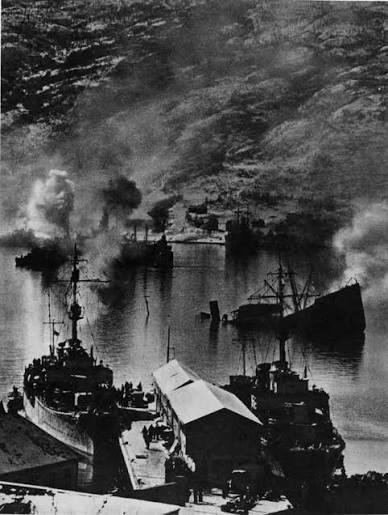
Narvik harbour after the first battle, April 1940.

The next few days were marked by caution and ponderousness by both sides. Now commanding the German flotilla was Kapitän Erich Bey. His remaining ships were trapped unless he moved them swiftly. This meant refuelling as soon as possible from the surviving oiler, making the damaged ships seaworthy, then using bad weather, darkness and supporting U-boats to sneak out past the British in the Vestfjord beyond the Ofotfjord. Although the ships were all refuelled and engines repaired, he then suffered a further calamity when the Zenke damaged her propellers manouevring around the wrecks in Narvik harbour, and the Köllner also caused debilitating damage while refuelling and made herself unseaworthy. Difficult though it was to manoeuvre in the narrow confines of Narvik, these were entirely avoidable and self-inflicted own goals. The British, meanwhile, reeling from the rapid German advances through southern Norway and uncertain what plan to now pursue, dithered from a lack of clear, unified and determined decision-making, so that it was not until the morning of 13th April that they returned, this time with four larger tribal-class destroyers, five further destroyers and the mighty battleship, HMS Warspite, all under the command of Admiral Whitworth.

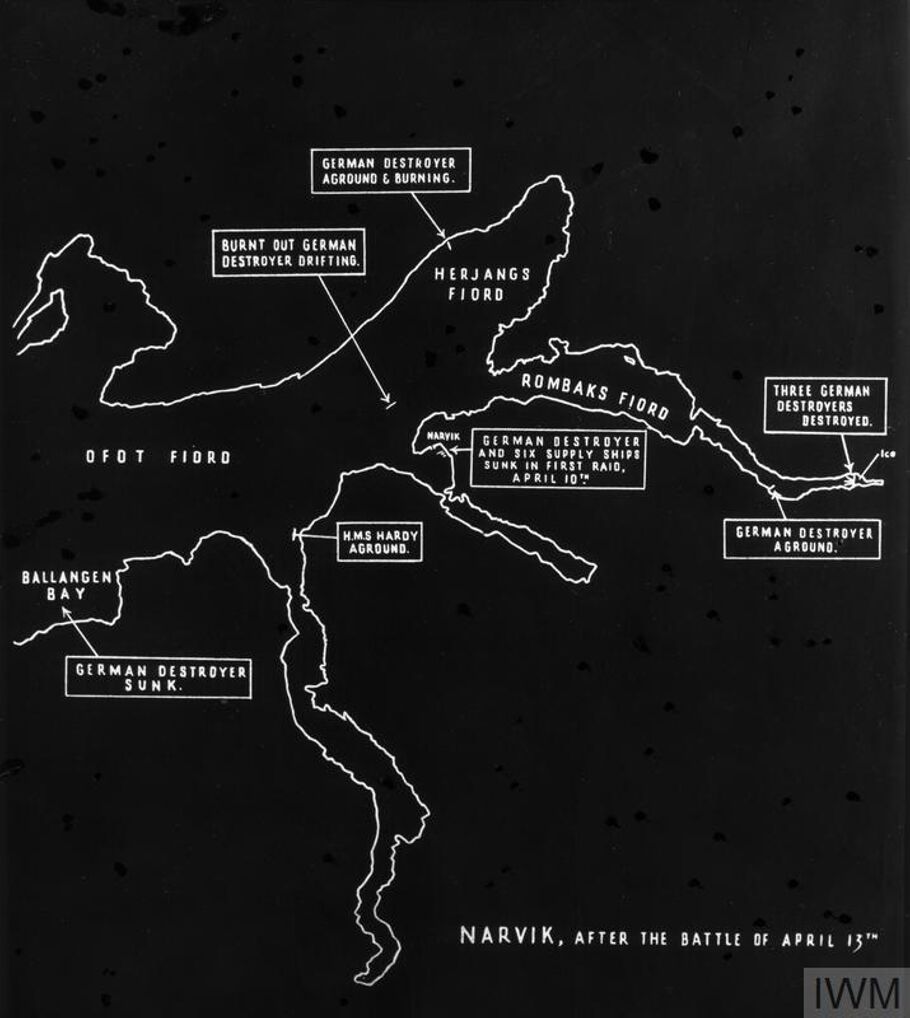
Kapitän Bey had known the Royal Navy were coming, partly because German cryptanalysts had deciphered British naval codes, but also because it was blindingly obvious they would do. He tried to deploy his ships as well as he might but knew in his heart the situation was hopeless. The crippled Köllner was towed to Taarstadt, an inlet beyond Ballangen, where it was to lie in wait, unseen, for the arrival of the British then fire her torpedoes and guns and hope for the best. She had only reached the inlet at Djupvik, some 20 miles west from Narvik, when she was spotted by the Warspite‘s Swordfish floatplane late in the morning of 13th April. As the leading British ships, Bedouin and Eskimo, turned the headland, their guns and torpedoes were trained and ready. Köllner‘s bow was ripped off by the first torpedo and the rest of her sunk soon after. That was three of the ten now at the bottom of the fjord. The remaining seven had barely begun moving before the rest of the British force were bearing down upon them through the mist, frost and snow. First, though, ten Swordfish, flown from the aircraft carrier, HMS Furious, swooped down. Their orders were to dive-bomb the German ships, a role for which they were not suited; Swordfish, slow, ungainly biplanes, were designed to fly in low and drop torpedoes, a role to which they were, in fact, very well suited. As dive-bombers, however, they hit nothing but lost two of their own in an entirely fruitless attack.

It was also completely unnecessary as Whitworth’s force had the matter firmly in hand. The German destroyers, still nursing the damage of four days earlier, swiftly fired all their remaining ammunition and were now effectively sitting ducks. Bey ordered them into the narrow Rombaksfjord, east and to the north of Narvik, where they were hotly pursued by Eskimo, Bedouin and even Warspite. Here the fjord narrowed to a few hundred yards before widening to half a mile but with the high mountain sides looming over this gloomily dark and slender channel, there was nowhere for the surviving German destroyers to go. The Künne was dispatched by Bedouin, and although the Georg Thiele fired one last torpedo that blew off the bow of Eskimo, her captain then ran her aground like the Hardy, while the surviving three, the Zenke, Von Armin and Lüdemann, steamed to the head of the fjord where they, too, deliberately ran themselves aground. The crews all then made good their escape into the mountains to join the Gebirgsjäger [mountain troops] that had disembarked five days earlier and who were still holding a shallow bridgehead around Narvik.

The second British naval action off Narvik. A diagram of the battle of 13 April 1940.
Imperial War Museum

Amazingly, Eskimo remained afloat, sailing stern-first back out of the fjord and to safety. She was repaired and would fight again, not least against the Bismarck in May 1941. But here in the waters around Narvik, the naval battle was now over, with half the Kriegsmarine‘s destroyer fleet sunk and lost — a disaster from which it could not hope to recover. A golden opportunity to send in decisive numbers of Allied troops to fight and defeat the beleaguered German troops in Narvik was now laid out on a plate. Southern Norway might have already been lost but the north — and, crucially, the iron-ore railway line and port — lay there for the taking — on paper, at any rate. British, French and Polish troops were eventually landed but this was not a part of the world where landing and maintaining supplies was at all straightforward. Britain had only a few basic landing craft at this early stage of the war, there were few beaches and its geographical remoteness and weather made a difficult task even harder. As it happened, by early June, the Allies did have victory there within their grasp, but by then, France was being overrun and facing defeat and the Allies decided the better part of valour was to pull out while they had the chance and consolidate in Britain instead. The Allied expedition to Norway was over.

The ramifications of the naval battle were significant, however. The Kriegsmarine not only lost half their destroyer fleet, but also one of two heavy cruisers, two of six light cruisers and six U-boats, leaving their navy woefully depleted. It also meant their plans for a successful surface fleet marauding in the Atlantic had been left in tatters. The U-boats, withdrawn from the Atlantic for the campaign, hit not a single vessel, largely due to problems with the magnetic ignition pistols on their torpedoes. For the three months they were tied up in the waters around Norway, they were not in the Atlantic, giving Britain a vital free pass as convoys sailed unimpeded. During the critical summer months of 1940, this was to prove a hugely important lifeline. Norway had been clinically subdued by Germany but it would cost Hitler more than half a million troops, all told, as well the costly construction of the Atlantic Wall in the years to come — a series of bunkers, coastal gun batteries and barracks in some of the remotest outposts of Europe and at an untold cost in men, resources and money. Norway would become an albatross around Nazi Germany’s neck, while its value to the Kriegsmarine was negligible.

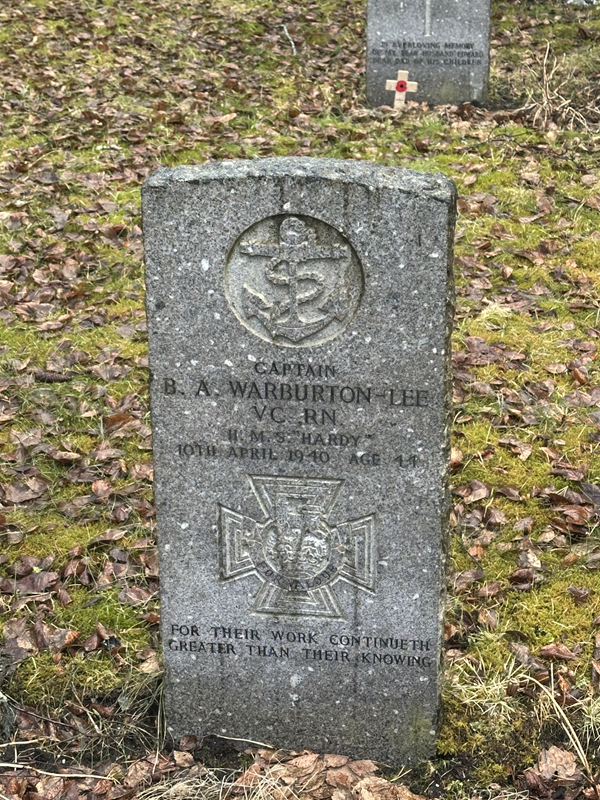
The grave of Captain Bernard Warburton-Lee, VC, RN, in Narvik.
Photo by James Holland
The Complete Chieftain Tank

Filed under: Britain, History, Military, Weapons — Tags: , , , , , — Nicholas @ 04:00

The Tank Museum
Published 20 Mar 2026

Chieftain. The world’s first main battle tank. An icon of the Cold War, it served the British Army for more than 30 years. Yet, it had something of a Jekyll and Hyde reputation. It was prized for having the best gun in the world but, for the British, it never fired a shot in anger. Loved by gunners. Loathed by mechanics. The Chieftain was often referred to as the best tank in the world as long as it broke down in the right place.

But was the gun truly as good as the stats make it out to be? And was the engine really that bad? It’s time to take a dive into the heart of the Iron Triangle to find out.

00:00 | Introduction
00:36 | Gun
03:44 | Engine
06:19 | Armour
11:07 | Just Deserts
13:53 | A Tragic Hero

In this film, join James Donaldson as he delves into the good, the bad, and the ugly sides of the Chieftain tank. With a great gun, revolutionary armour, and a misunderstood engine, Chieftain’s service with the British ensured the Cold War never turned hot. And hear from Chieftain veterans, Bob and Steve, as they share their experiences with this iconic tank.
(more…)

“None of the artistic -isms lasted very long. Today’s -ism soon becomes yesterday’s was-ism”

Filed under: History — Tags: , — Nicholas @ 03:00

Ted Gioia on “the shock of the old”:

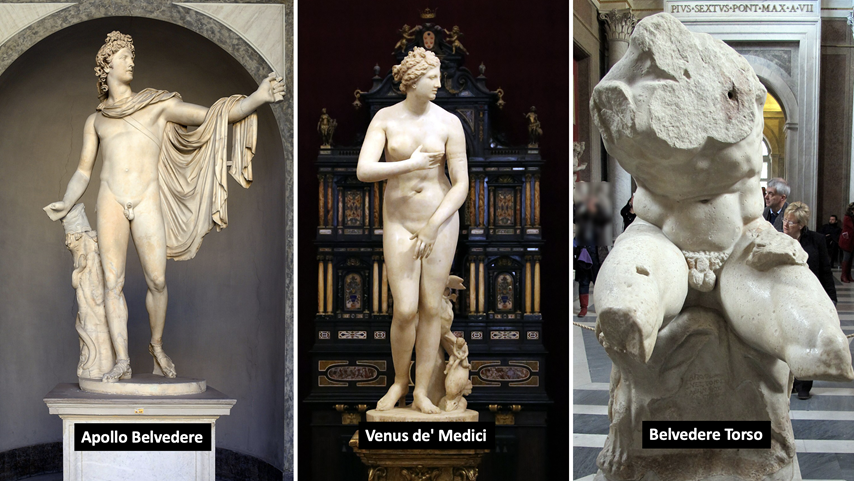
During the 15th century, the leading critics all agreed that the greatest works of art came from an unusual place. No, not a museum or church or palace — they were found, instead, underground and amid ruins, literally covered in dirt.

Before you could see them, you first had to dig them up.

Can we even imagine this attitude today? Our whole hierarchy of aesthetics would need to be reversed. Just consider the shame of admitting that our most cherished cultural legacy had been buried and forgotten by our ancestors. Art appreciation gets turned into some kind of exhumation.

But the reaction to this rediscovered art was just as interesting as the sculptures themselves. How do you feel when you look at these works?

You probably aren’t shocked by the nudity. You’ve seen more salacious stuff on Netflix. In fact, you probably aren’t shocked by anything here — these statues feel very old fashioned and antiquated.

That’s an interesting word, antiquated. It means “old, and no longer useful”. If the plumbing in your house is antiquated, you’re in big trouble. And it’s even worse if you are antiquated.

The word comes from the same root as antiquities — a term applied to arts and artifacts from the past. And most observers today would put the two ideas together, and say that these old statues might be charming to see in a museum, but have little or no relevance to us today.

But that’s not how Michelangelo, Raphael, and other Renaissance artists saw them.

These works were more than a thousand years old, but the leading 16th century artists believed they were worthy of study and imitation. Even more shocking, the great minds of the Renaissance believed that such works represented timeless standards of artistic excellence that could not be erased by the passing centuries.

In other words, evaluating art was like pursuing the good life. After you discovered the pathway to do that, you kept to the course. It didn’t go stale like a loaf of bread. It wasn’t a fad or a trend, but something enduring. The same thing is true of good health or a good marriage — you want them to endure, not get replaced by the next new thing.

Five hundred years later, leading critics believed the exact opposite. Standards were not timeless, but constantly in flux. During the 20th century, art was supposed to disrupt the standards from the past. If a work made you uncomfortable, all the better — you needed a kick in the ass. If the Venus de Milo hadn’t already lost her arms, some witty critic would probably suggest that we cut them off. That would give you a jolt, huh?

This notion of disruption was already prevalent a hundred years ago. And the kicks aimed at your posterior came from all directions. Critic Robert Hughes called this the “Shock of the New”.

The individual asskicks were the -isms.

There’s surrealism, dadaism, cubism, futurism, brutalism, fauvism, abstract expressionism, deconstructionism, postmodernism, serialism, minimalism, and so forth and so on. You could make a patter song from all of them.

Critics placed wagers on them, as if they were horses at the track. If they made a smart bet, they could reap a windfall. Their reputation was enhanced, and also their wallet. I’m reminded of the elite art critic who launched the careers of painters, and sent the market price of their works skyrocketing — but only after he had accumulated some choice specimens for his own collection. In the finance world, this is called insider trading.

The suffix -ism originally denoted a doctrine, theory, or worldview. Or even a religion, such as Judaism or Buddhism. These aesthetic -isms were also a bit like religions, inspiring fervent loyalty.

But there was a big difference. Religions like Judaism or Buddhism last for thousands of years. But aesthetic theories come and go. None of the artistic -isms lasted very long. Today’s -ism soon becomes yesterday’s was-ism.

That’s a little strange, because the advocates of the -isms all promised that they were delivering the blueprint for the future. And then we finally get to the future — and what do we see?

Colt LE-901 Modular Multi-Caliber AR: A Well-Designed Failure

Filed under: History, Military, USA, Weapons — Tags: , , , — Nicholas @ 02:00

Forgotten Weapons
Published 29 Oct 2025

Colt originally developed the 901 as part of the US Army SCAR program, with the intention being to create a 7.62x51mm rifle that could also use unmodified 5.56x45mm upper assemblies. This would allow special operations units to customize a single weapon to a variety of different configurations for different mission profiles. Mechanically, the system Colt devised to do this was quite clever, and very effective. However, the rifle ultimately failed to win a military contract.

Moved to civilian sales, the system was unsuccessful fundamentally because the modular concept is just not very desirable. A single modular rifle like this inevitably sacrifices some capability in every specific configuration in exchange for the modular capability and most people would rather have two dedicated rifles in different configurations than one swappable one. It sounds appealing on paper, but almost always fails economically in practice.
(more…)

QotD: Rejectionism

Filed under: Business, Quotations, USA — Tags: , , , , — Nicholas @ 01:00

… you can, and should, do this little “What is it in itself?” exercise for everything. What is Amazon in itself? Speed. Information velocity. Consumerism. I noticed a funny thing when I moved from the bigger city to a smaller town on the outskirts: All of a sudden I had a lot more money in the bank at the end of the month. I pulled my statements, and found out that I wasn’t spending nearly as much on impulse buys. I had to plan shopping trips to the grocery store, so not only did I save money, I ate better — in the old days, when I was hungry, I’d swing by the drive thru, because it was right there. Or I’d zip down to the store to grab a few things to cook, which ended up grabbing a bunch of other things, because it was right there.

Amazon works the same way. If you have to plan your trips to the grocery store, you have to ask yourself: Do I really need this? There are many fewer chances for impulse buys. When the store’s right there, you just run down and satisfy whatever momentary craving you happen to have. Same with Amazon — if you had to make a special store to get that piece of Chinese junk, you wouldn’t. But Amazon is right there, on the phone …

Haste. Impulsiveness. The instant, unexamined gratification of each and every urge. Those are the things the Left encourages. That’s what all that stuff is fundamentally for — Amazon, Twitter, smartphones, the whole deal.

That, therefore, is what we must reject. Call it “Rejectionism” if you want to make it into a sales pitch (or something better; I suck at titles). The Left’s “morality” is to treat everything — health, beauty, pleasure, the Economy, politics, people — as means to one and only one end: The instant, unthinking gratification of each and every momentary impulse.

We reject it. We reject the Internet. It’s a tool, nothing more, and remember what they say about hammers: When a hammer’s all you’ve got, everything looks like a nail. Reject it. Reject it all, for your soul’s sake.

Severian, “Rejectionism”, Founding Questions, 2022-05-24.

Powered by WordPress