On his Substack, James Holland recounts the events of April, 1940 when British and German ships fought savagely for the port of Narvik in the north of Norway. The first battle had resulted in the loss of several destroyers on each side and the deaths of the commanders as well. A couple of days later, the Royal Navy sent in a more powerful force to eliminate the surviving ships of the Kriegsmarine and secure the port for landing allied troops:
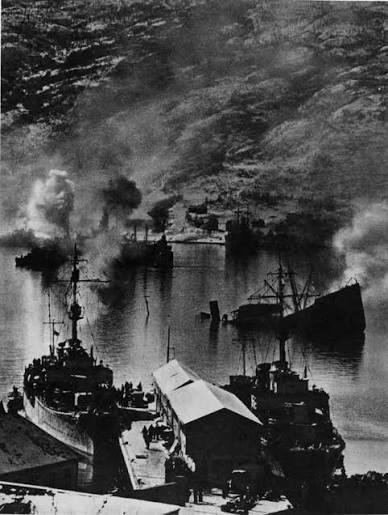
Narvik harbour after the first battle, April 1940.
The next few days were marked by caution and ponderousness by both sides. Now commanding the German flotilla was Kapitän Erich Bey. His remaining ships were trapped unless he moved them swiftly. This meant refuelling as soon as possible from the surviving oiler, making the damaged ships seaworthy, then using bad weather, darkness and supporting U-boats to sneak out past the British in the Vestfjord beyond the Ofotfjord. Although the ships were all refuelled and engines repaired, he then suffered a further calamity when the Zenke damaged her propellers manouevring around the wrecks in Narvik harbour, and the Köllner also caused debilitating damage while refuelling and made herself unseaworthy. Difficult though it was to manoeuvre in the narrow confines of Narvik, these were entirely avoidable and self-inflicted own goals. The British, meanwhile, reeling from the rapid German advances through southern Norway and uncertain what plan to now pursue, dithered from a lack of clear, unified and determined decision-making, so that it was not until the morning of 13th April that they returned, this time with four larger tribal-class destroyers, five further destroyers and the mighty battleship, HMS Warspite, all under the command of Admiral Whitworth.
Kapitän Bey had known the Royal Navy were coming, partly because German cryptanalysts had deciphered British naval codes, but also because it was blindingly obvious they would do. He tried to deploy his ships as well as he might but knew in his heart the situation was hopeless. The crippled Köllner was towed to Taarstadt, an inlet beyond Ballangen, where it was to lie in wait, unseen, for the arrival of the British then fire her torpedoes and guns and hope for the best. She had only reached the inlet at Djupvik, some 20 miles west from Narvik, when she was spotted by the Warspite‘s Swordfish floatplane late in the morning of 13th April. As the leading British ships, Bedouin and Eskimo, turned the headland, their guns and torpedoes were trained and ready. Köllner‘s bow was ripped off by the first torpedo and the rest of her sunk soon after. That was three of the ten now at the bottom of the fjord. The remaining seven had barely begun moving before the rest of the British force were bearing down upon them through the mist, frost and snow. First, though, ten Swordfish, flown from the aircraft carrier, HMS Furious, swooped down. Their orders were to dive-bomb the German ships, a role for which they were not suited; Swordfish, slow, ungainly biplanes, were designed to fly in low and drop torpedoes, a role to which they were, in fact, very well suited. As dive-bombers, however, they hit nothing but lost two of their own in an entirely fruitless attack.
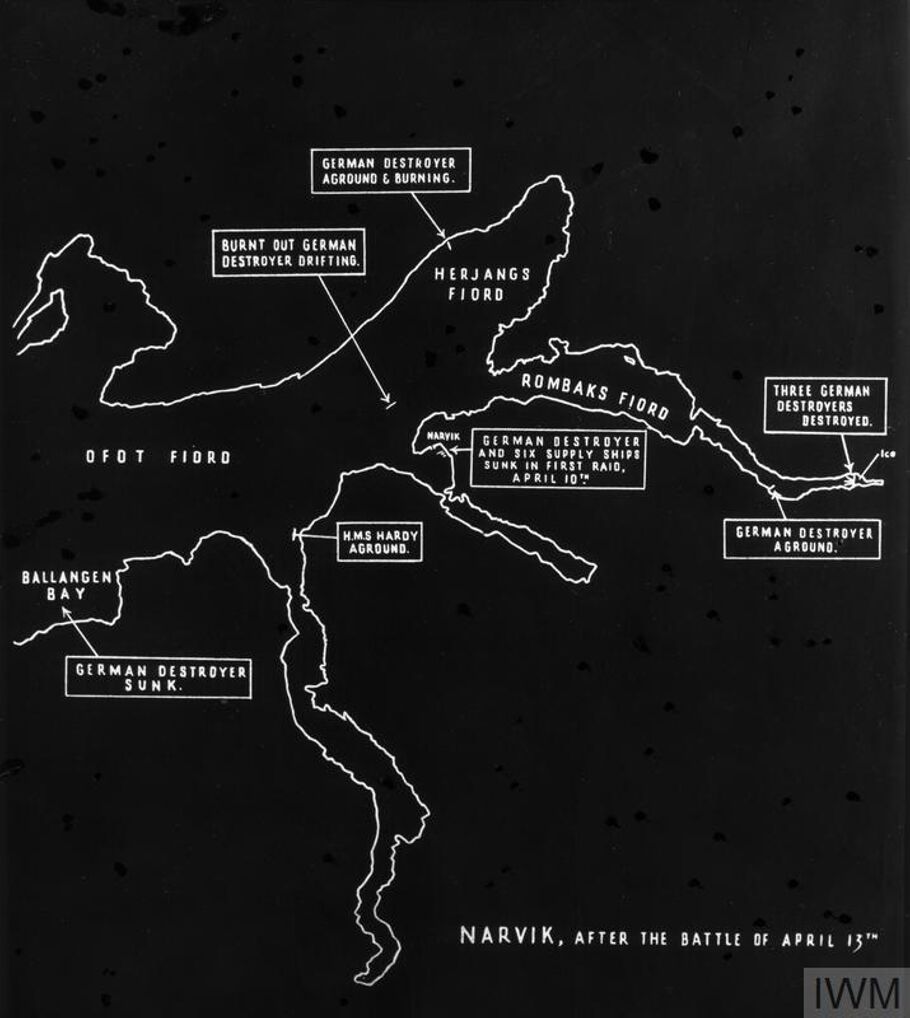
It was also completely unnecessary as Whitworth’s force had the matter firmly in hand. The German destroyers, still nursing the damage of four days earlier, swiftly fired all their remaining ammunition and were now effectively sitting ducks. Bey ordered them into the narrow Rombaksfjord, east and to the north of Narvik, where they were hotly pursued by Eskimo, Bedouin and even Warspite. Here the fjord narrowed to a few hundred yards before widening to half a mile but with the high mountain sides looming over this gloomily dark and slender channel, there was nowhere for the surviving German destroyers to go. The Künne was dispatched by Bedouin, and although the Georg Thiele fired one last torpedo that blew off the bow of Eskimo, her captain then ran her aground like the Hardy, while the surviving three, the Zenke, Von Armin and Lüdemann, steamed to the head of the fjord where they, too, deliberately ran themselves aground. The crews all then made good their escape into the mountains to join the Gebirgsjäger [mountain troops] that had disembarked five days earlier and who were still holding a shallow bridgehead around Narvik.
The second British naval action off Narvik. A diagram of the battle of 13 April 1940.
Imperial War MuseumAmazingly, Eskimo remained afloat, sailing stern-first back out of the fjord and to safety. She was repaired and would fight again, not least against the Bismarck in May 1941. But here in the waters around Narvik, the naval battle was now over, with half the Kriegsmarine‘s destroyer fleet sunk and lost — a disaster from which it could not hope to recover. A golden opportunity to send in decisive numbers of Allied troops to fight and defeat the beleaguered German troops in Narvik was now laid out on a plate. Southern Norway might have already been lost but the north — and, crucially, the iron-ore railway line and port — lay there for the taking — on paper, at any rate. British, French and Polish troops were eventually landed but this was not a part of the world where landing and maintaining supplies was at all straightforward. Britain had only a few basic landing craft at this early stage of the war, there were few beaches and its geographical remoteness and weather made a difficult task even harder. As it happened, by early June, the Allies did have victory there within their grasp, but by then, France was being overrun and facing defeat and the Allies decided the better part of valour was to pull out while they had the chance and consolidate in Britain instead. The Allied expedition to Norway was over.
The ramifications of the naval battle were significant, however. The Kriegsmarine not only lost half their destroyer fleet, but also one of two heavy cruisers, two of six light cruisers and six U-boats, leaving their navy woefully depleted. It also meant their plans for a successful surface fleet marauding in the Atlantic had been left in tatters. The U-boats, withdrawn from the Atlantic for the campaign, hit not a single vessel, largely due to problems with the magnetic ignition pistols on their torpedoes. For the three months they were tied up in the waters around Norway, they were not in the Atlantic, giving Britain a vital free pass as convoys sailed unimpeded. During the critical summer months of 1940, this was to prove a hugely important lifeline. Norway had been clinically subdued by Germany but it would cost Hitler more than half a million troops, all told, as well the costly construction of the Atlantic Wall in the years to come — a series of bunkers, coastal gun batteries and barracks in some of the remotest outposts of Europe and at an untold cost in men, resources and money. Norway would become an albatross around Nazi Germany’s neck, while its value to the Kriegsmarine was negligible.
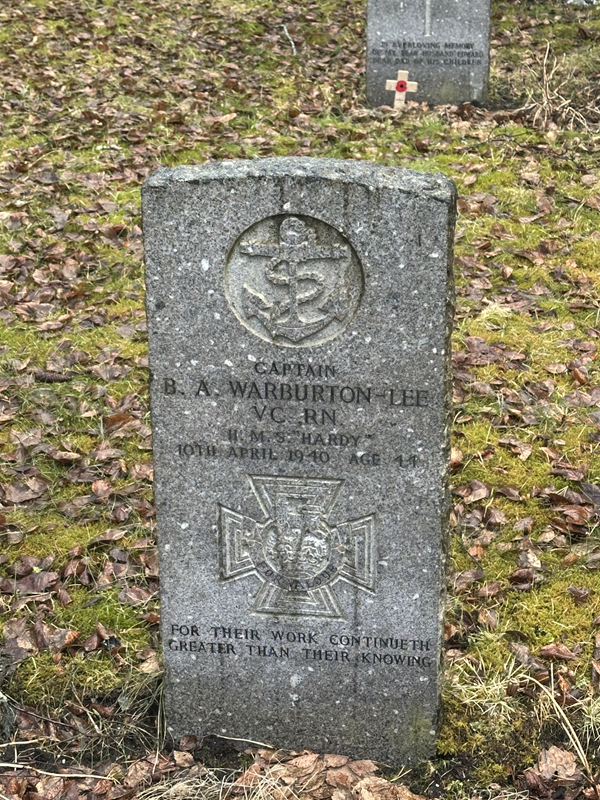
The grave of Captain Bernard Warburton-Lee, VC, RN, in Narvik.
Photo by James Holland