Quotulatiousness

March 12, 2026

“It is precisely the embracing of such inconsistency that shows your commitment to the cause”

Filed under: Media, Politics, USA — Tags: , , , , , , — Nicholas @ 05:00

Many, many people have called attention to the incongruity — if not total absurdity — of progressives agitating and protesting for what appear to be thoroughly anti-progressive causes. And all of those people have discovered that most progressives are in accord with Emerson’s opinion that “a foolish consistency is the hobgoblin of little minds”. As Lorenzo Warby explains, “the issue is never the issue; the issue is the revolution”:

There is a common “culture war” sport where more conservatively-minded folk, and various liberal ones, point out how inconsistent it is for various ideological/identity groups to make a thing of supporting organisations and regimes which are very much against — even murderously against — the ideals those ideological/identity groups allegedly stand for.

Queers for Palestine, and feminists for Hamas/Hezbollah/Iran, are particularly blatant examples of this. Hamas in Gaza and the Islamic regime in Iran literally kill homosexuals and violently repress women’s rights: they are religiously committed to women having less rights than men and being subordinate to them.

The inconsistency between who Hamas and the Islamic regime are, what they do, and the alleged ideals of Queers for Palestine and the feminists supporting Hamas/Hezbollah/Iran is obvious. Pointing out such inconsistency has, however, no purchase on Queers for Palestine, feminists for Hamas/Hezbollah/Iran, or similar groups.

On the contrary, pointing out the inconsistency brands one as not merely an outsider, but an enemy. It is precisely the embracing of such inconsistency that shows your commitment to the cause; to the shared political goals; to the shared politicised moralised status games. Doing all the required not-noticing, the required rationalisations, is a signal of commitment.

If they can make people ignore — or, even better, embrace — such inconsistency, that manifests their social and political dominance. The propensity of academics to be “risk averse“, and be conformist in various ways, has enabled motivated zealots to create the Critical Theory magisterium that has come to dominate more and more of Anglo-American academe.

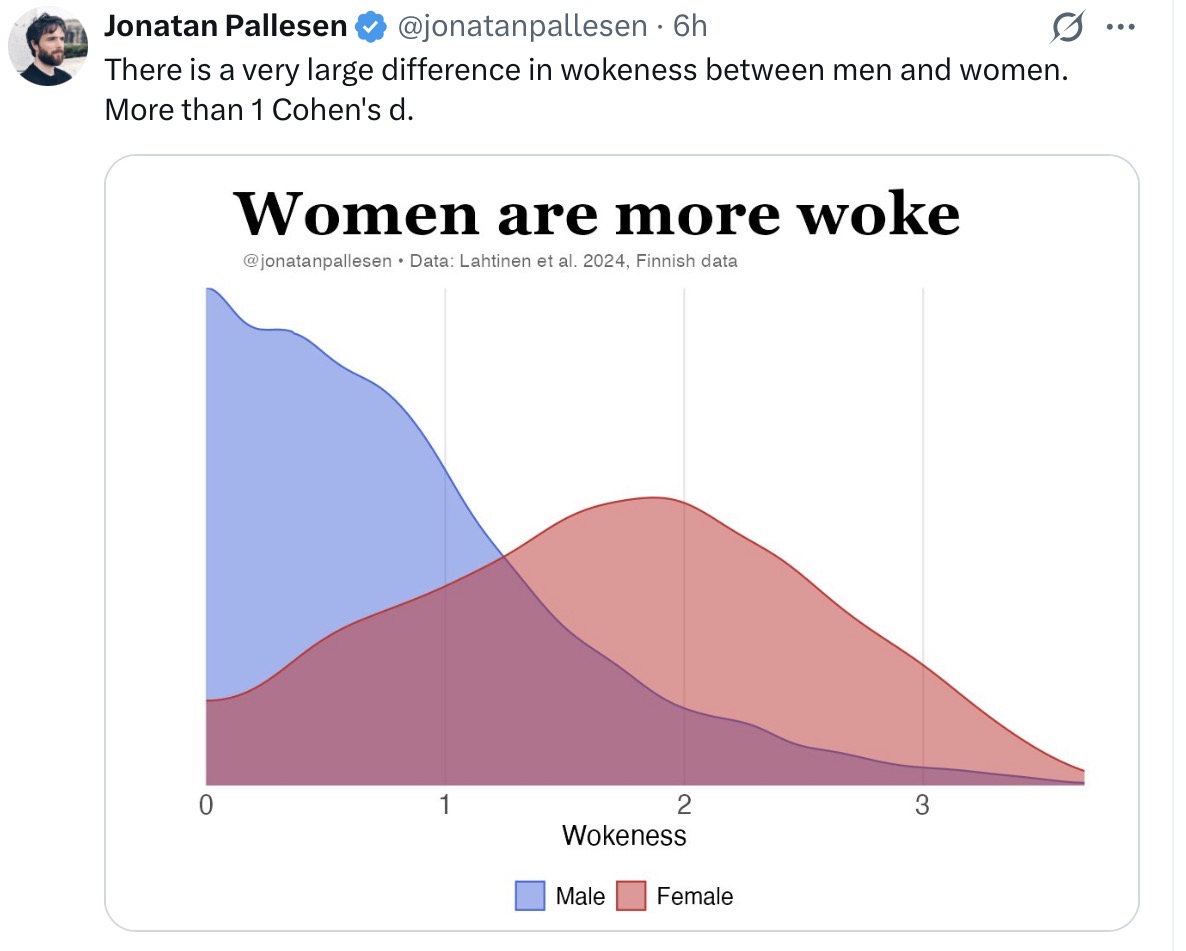
As women are more risk averse and conformist than men, this has gathered steam as academe has feminised. This effect is all the stronger when they generate an accompanying elite status strategy based on “good people believe X”, turning beliefs into moralised cognitive assets. Assets to be defended — and defended together — as shared assets in a shared status game.

By attacking such inconsistency, one is simultaneously signalling one’s outsider status and attacking the signal they are using the show commitment to the cause; to the moral in-group.

As part of such signalling commitment, believers produce commentary shorn of all inconvenient context. We saw plenty of that in commentary blaming NATO and the US for the Russian attack on Ukraine. We are seeing plenty of the same on Iran.

Even more important than this—at least among the core believers — is that, at the foundational belief level, it is not inconsistent at all. The question is not what Hamas or Hezbollah or the Islamic Regime actually stands for: the question is, who they are enemies of.

Carney’s Liberals buy gain another seat in Parliament

Filed under: Cancon, Government, Media, Politics — Tags: , , , — Nicholas @ 04:00

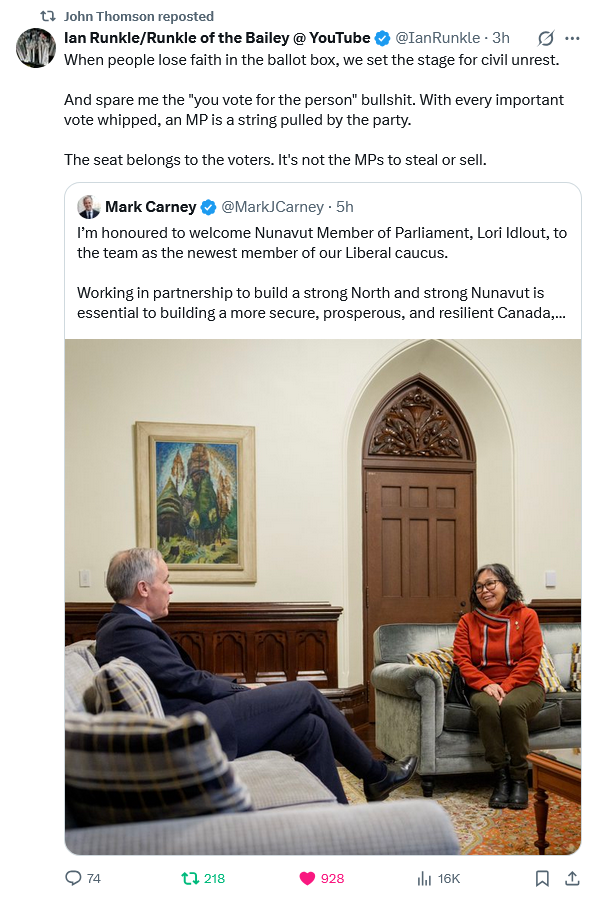
What couldn’t be obtained at the ballot box can apparently be constructed through non-electoral methods. After the Liberals fell short of a majority in the 2025 federal election, they’ve now gained four more seats through attracting opposition MPs to join their caucus:

Image from Melanie in Saskatchewan

Consider several ridings from the last election where Conservatives defeated Liberals by extremely small margins. Terra Nova–The Peninsulas was decided by only a handful of votes. Milton East–Halton Hills South by just a few dozen. Windsor–Tecumseh–Lakeshore by fewer than a hundred. In Markham–Unionville and Edmonton Riverbend the margins were still narrow by federal election standards, measured in the low hundreds.

In ridings with tens of thousands of ballots cast, those margins are not ideological fortresses.
They are statistical coin flips.

Now imagine you are a strategist trying to change the parliamentary math without calling another election. Would you target MPs who defeated your party by twenty thousand votes? Or would you look at ridings where the electorate was already split nearly fifty fifty? Where persuading one individual changes everything!?

That is where the Moneyball logic appears.

Instead of persuading fifty thousand voters, you persuade one MP. The scoreboard shifts instantly. No campaign. No election. No voters trudging through snow to mark an X. Just a quiet change of jersey on the House of Commons floor.

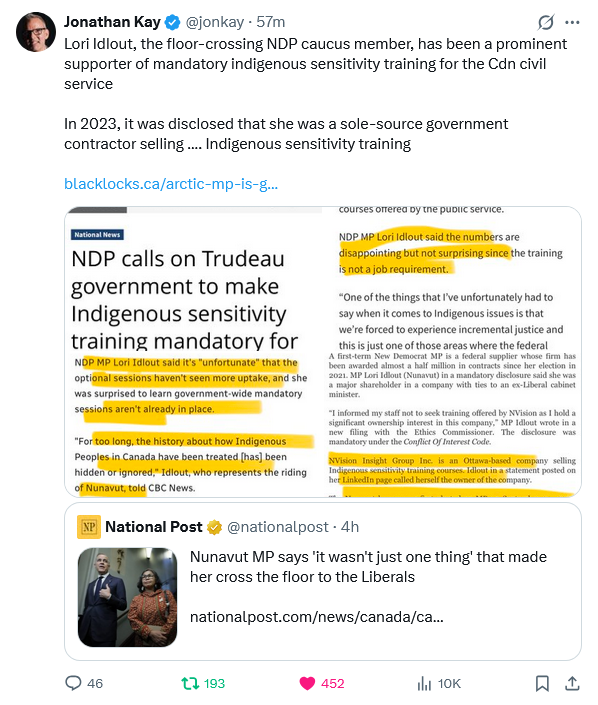
Now consider the MPs who have crossed the floor or whose ridings are currently the focus of speculation. Seats like Edmonton Riverbend held by Matt Jeneroux and Markham–Unionville represented by Michael Ma sit squarely in that category of competitive swing ridings. Even Nunavut, represented by Lori Idlout, illustrates how single seats in geographically unique ridings can dramatically affect parliamentary arithmetic.

Notice the pattern.
Not massive strongholds.
Swing ridings.
Seats where the Liberal candidate already came within striking distance.

Which raises an uncomfortable question.

Is this coincidence?
Or strategy?

Because if a riding was decided by one hundred votes, persuading the MP to change parties is dramatically easier than persuading fifty thousand voters to change their minds. The parliamentary math changes instantly.

The voters never get another say.

    Just like Canadians did not get a say when 131,674 votes from Liberal Party members at Mark Carney’s leadership race installed Mark Carney as defacto Prime Minister. He effectively became the Prime Minister of Canada through installation, not election.
    That is 0.33 percent of Canadians.
    Or, put another way, roughly one third of one percent of the country’s population participated in choosing the Liberal leader who then became Prime Minister through the parliamentary system without being elected by the people of the country.
    • 131,674 people chose the leader
    • out of about 41 million Canadians

Of course nobody in Ottawa will describe it this way. Politics prefers softer language. You will hear phrases like cooperation, evolving priorities, responsible leadership, and national unity.

Politics prefers poetry.
Arithmetic prefers patterns.

Individually every floor crossing can be explained. Each one comes with its own “so-called” story, its own “so-called” reasoning, its own “so-called” justification.

But collectively something else begins to emerge.
A seat here.
Another seat there.
Nothing dramatic.
Until one day the standings look different.

Exactly the way Moneyball worked. No blockbuster moves. Just quiet arithmetic accumulating advantage until the outcome changed.

In the past I’ve been comfortable with the Parliamentary tradition that voters elect individuals as their representatives so if that MP leaves the party they were elected for, it doesn’t change the representation of the constituents. Historically, when most MPs were free to vote their conscience except for a minority of “whipped” votes, where they were obligated to vote on party lines, this made sense. I’m becoming less comfortable as this pattern of “recently elected opposition MPs suddenly discovering they’d run for the wrong party” repeats, indicating that it’s not just ordinary politics, but a deliberate strategy on the part of the Liberals.

Some have speculated that a major factor in the latest defection was a recent federal financial benefit to the territory, but it might perhaps have been something more concrete:

Homelessness can’t be solved by just throwing more money at the problem

Filed under: Cancon, Government, Health, Media, Politics, USA — Tags: , , , — Nicholas @ 03:00

On the social media site formerly known as Twitter, L. Wayne Mathison responds to someone explaining their family’s tragic problem of a homeless relative:

The post hits a nerve because it exposes the part of the homelessness debate people prefer not to talk about.

A lot of the public story says homelessness is mainly about housing and compassion. If we build more units and remove stigma, the problem fades. That sounds humane. The trouble is that it ignores what families dealing with severe addiction and psychosis actually face.

Emily Baroz describes the reality many relatives know too well. The person on the street is often not just poor. They are deeply mentally ill, addicted, paranoid, sometimes violent, and frequently refusing help. Families try everything. Housing. Money. Treatment. Support. The illness itself destroys the ability to cooperate. Meanwhile the legal system often blocks intervention until someone gets hurt.

So the public debate becomes strange theatre. Compassion is defined as leaving the person alone. Authority is treated as cruelty.

That brings us closer to home. Manitoba’s NDP government is now moving toward supervised consumption sites. The argument is harm reduction. The idea is that if people are going to use drugs anyway, the state should at least make it safer.

The problem is that the evidence across Canada is far from comforting. Vancouver, Toronto, and other cities expanded harm-reduction sites over the last decade. Yet overdoses, street disorder, and visible addiction kept rising. Recovery rates did not suddenly surge. In many neighbourhoods the result was more normalization of drug use without a clear path back to stability.

If a policy is supposed to reduce harm, the basic question is simple: are fewer people addicted, dying, or trapped in the street?

If the answer is no, the policy deserves scrutiny.

Safe consumption sites may prevent some immediate overdoses. But they also risk locking people into a long-term cycle where the system manages addiction instead of helping people escape it. Families who are begging for treatment beds, detox spaces, psychiatric care, and recovery programs often watch governments invest more energy in enabling use than in ending it.

That’s the tension people feel but rarely say out loud.

A compassionate society does not abandon people to addiction while calling it care. Compassion sometimes means structured treatment, involuntary intervention when someone is clearly incapable of making rational choices, and serious investment in recovery infrastructure.

Otherwise we are simply managing decline.

And families like the one in that post already know it.

Update, 14 March: Welcome, Instapundit readers! Have a look around at some of my other posts you may find of interest. I send out a daily summary of posts here through my Substackhttps://substack.com/@nicholasrusson that you can subscribe to if you’d like to be informed of new posts in the future.

Update, the second: Devon Eriksen had a relevant-to-this-topic aside on a longer post –

One of the most common sources of confusion is “using the wrong word”.

For example, if you have a drug zombie problem, and you call it a “homeless” problem, then you spend a lot of tax money giving houses to drug zombies, who turn them into rat-infested drug dens.

The wrong word implies the wrong understanding.

Deep Diving: Bit Sharpening | Paul Sellers

Filed under: Tools, Woodworking — Tags: , , — Nicholas @ 02:00

Paul Sellers
Published 14 Nov 2025

Auger bits need sharpening from time to time, and they can seem complicated when, in fact, they are not. With a small saw file, auger bits of any size can be readily sharpened with just a few file strokes.

In this short video, I explain the process and walk you through what to look for in buying secondhand and how they will work for you.
(more…)

QotD: Roman armies of the middle and late Republic

Filed under: Europe, History, Military, Quotations — Tags: , , , — Nicholas @ 01:00

Polybius remarks both on the superior flexibility of Roman soldiers (18.31.9-11) and the intensity and effectiveness of Roman rewards and punishments (6.35-38). Josephus, a Greek-speaking Jewish man from the province of Judaea who first rebelled against the Romans and then switched sides offers the most famous endorsement of Roman drills, “Nor would one be mistaken to say that their drills are bloodless battles, and their battles bloody drills” (BJ 3.5.1).

It is hard to tell if the Roman triple-line (triplex acies) fighting system created the demand for synchronized discipline or if the Romans, having already developed a tradition of drill and synchronized discipline, adopted a fighting style that leveraged that advantage. Probably a bit of both, but in any event our evidence for the Roman army before the very late third century is very poor. By the time we truly see the Roman army clearly (c. 225 BC) the system seems to already [have been] in place for some time.

A Roman consular army was a complex machine. It was composed of an infantry line of two legions (in the center) and two socii “wings” (alae) to each side, along with cavalry detachments covering the flanks. Each of those infantry blocks (two legions, two alae) in turn was broken down into thirty separate maneuvering units (called maniples, generally consisting of 120 men; half as many for the triarii), which were in turn subdivided into centuries, but centuries didn’t really maneuver independently. In front of this was a light infantry screening force (the velites). So notionally there were in the heavy infantry of a standard two-legion consular army something like 120 different “chess pieces” that notionally the general could move around on their own and thus notionally the legion was capable of fairly complex tactical maneuvers.

You may have noted that word “notionally” because now we get into the limits of drill and synchronized discipline, because this isn’t a system for limitless tactical flexibility of the sort one gets in video games. Instead, recall that the idea here is to create coordinated movement and fighting (the synchronized discipline) through rigorous, repeated practice (drill). Of course one needs to practice specific things. Some of those things are going to be obvious: a drill for marching forward, or for turning the unit or for advancing on the charge.

In the Roman case, a “standard” battle involved the successive engagement and potentially retreat of each heavy infantry line: first the hastati (the first line) formed a solid line (filling the gaps) and attacked and then, if unsuccessful, retreated and the next line (the principes) would try and so on. Those maneuvers would need to be practiced: forming up, then having each maniple close the gap (we don’t quite know how they did this, but see below), the attack itself (which also involved usually throwing pila – heavy javelins), then retreat behind the next line if things went poorly. It’s also pretty clear from a battle like Cynoscephelae (197) or Bibracte (58) that individual maniples or cohorts (the Romans start using the larger 480-man-cohort as the basic maneuver unit during the second century BC) could be “driven” over the battlefield to a degree so there were probably drills for wheeling and turning.

Now even in this “standard” battle there is a lot of movement: maniples need to open and close gaps, advance and retreat and so on. This is what I mean by saying this army is a complex machine: it has a lot of moving parts that need to move together. The men in a maniple need to move together to make that mutually-supporting line and the maniples need to move together with each other to cover flanks and allow retreats. In terms of how the individual men moved, I’ve tended to think in terms of a “flow” model akin to this video of South Korean riot police training, rather than the clunkier Spartacus (1960) model.

But once an army has practiced all of these drills, it creates the opportunity for great improvisation and more complex tactics as well. Commanders, both the general but also his subordinates, can tell a unit to perform a particular maneuver that they have drilled, assuming the communication infrastructure exists in terms of instruments, standard shouted commands and battle standards (and note [that] Roman methods of battlefield communication were relatively well developed). That, for instance, allowed Aemilius Paullus to give orders to his first legion at Pydna for each of those maneuver units to either push forward or give ground independently, presenting the Macedonian phalanx with a tactical problem (an unevenly resisting line) it did not have a good solution for (Plut. Aem. 20.8-10). Having good junior officers […] was required but it wasn’t enough – those officers needed units which were already sufficiently drilled so that their orders (to press hard or retreat and reform in this case) could actually be carried out by soldiers for whom the response to those calls had become natural through that very drill.

At the same time I don’t want to give the wrong impression: even for the Romans battles where there was this sort of on-the-field improvising led by the general were uncommon (though not extremely rare). For the majority of battles, the legionary “machine” simply pushed forward in its standard way, even when – as at Cannae (216) – pushing forward normally proved to be disastrous. Just because an army can fight flexibly doesn’t mean it will or even that it should.

Bret Devereaux, “Collections: Total Generalship: Commanding Pre-Modern Armies, Part IIIa”, A Collection of Unmitigated Pedantry, 2022-06-17.

Powered by WordPress