
Rex Krueger
Published 18 Mar 2026All my plans!: https://www.rexkrueger.com/
Patrons saw this video early: / rexkrueger
Compass Rose Toolworks: https://www.compassrosetools.com/
Join the Mailing List: http://eepurl.com/g3rkmv
Take a course: https://www.rexkrueger.com/courses
Get my woodturning book: http://www.rexkrueger.com/book
Follow me on Instagram: @rexkrueger
March 19, 2026
The Two-Handed Chisel Technique You Should Learn
Comments Off on The Two-Handed Chisel Technique You Should Learn
Government creates a problem – yet the solution is always “more government!”
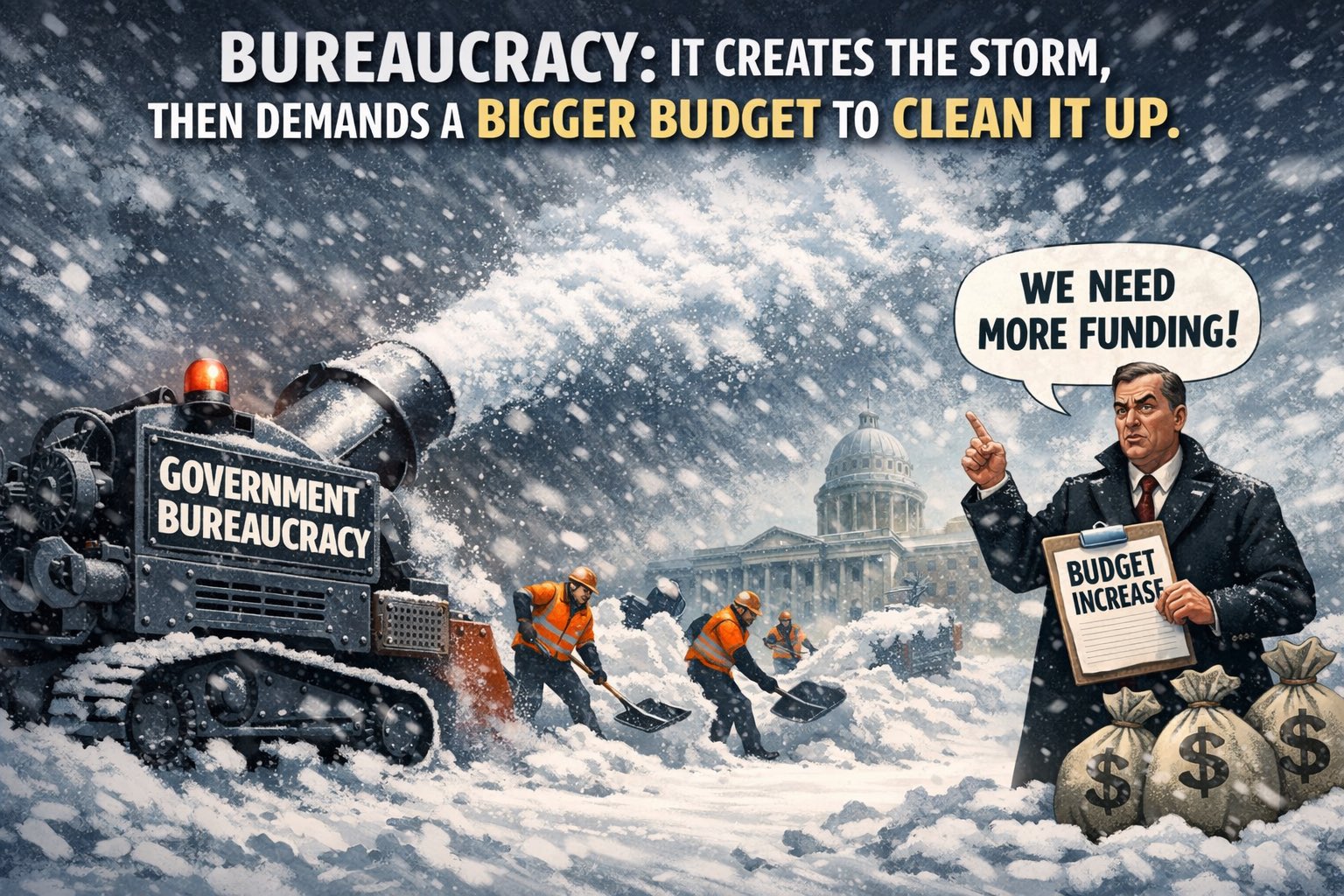
On the social media site formerly known as Twitter, L. Wayne Mathison explains the vast drawbacks of asking governments to solve problems:
Government bureaucracy is like a snow machine that keeps blasting, then hires more people to shovel the mess it just made.
We’re told it exists to help. To protect. To serve. Nice story. But in practice, it behaves more like a self-preserving organism. It doesn’t solve problems cleanly. It multiplies them, then offers to manage the mess it helped create.
Here’s the part most people miss. Bureaucracies don’t grow because problems get bigger. They grow because complexity gets rewarded. The more tangled the system, the more valuable the people who run it. That’s not a bug. That’s the incentive structure.
William Niskanen called this decades ago. Bureaucrats maximize budgets, not results. Bigger department, bigger influence. If a problem gets solved too efficiently, the machine loses a reason to exist. So problems don’t disappear. They get “managed”.
Then comes the language game.
Confusion gets dressed up as compassion.
A program no one understands becomes “comprehensive”.
A policy that creates dependency becomes “support”.
Failure becomes “underfunding”.It’s like hiring a mechanic who loosens parts just to bill you for tightening them later.
Now zoom in on Canada. Then zoom in tighter on Manitoba.
We don’t just have bureaucracy. We have an oversized public sector that’s crowding out the very engine that pays for it. In Manitoba especially, government employment makes up a huge slice of the workforce compared to the private sector that actually generates wealth. More administrators, fewer producers.
And here’s the quiet problem. Public sector growth doesn’t face the same discipline as the private sector. If a business bloats, it dies. If a department bloats, it asks for more funding.
So the balance drifts.
More people administering. Fewer people building, investing, risking.
More rules. Less output.
More spending. Slower growth.It creates a kind of economic inversion. The part of society that redistributes wealth starts to outweigh the part that creates it. That’s not sustainable. It’s like living off the interest of a bank account you’ve stopped contributing to.
Politicians don’t fix this because growth is easy to sell. Cuts are not. No one gets applause for saying, “We’re going to do less”. So the system expands in one direction only.
Forward. Always forward. Never back.
Meanwhile, taxpayers are handed the bill and told it’s the price of caring.
Here’s the hard reframe. Bureaucracy isn’t malfunctioning. It’s doing exactly what it’s rewarded to do. Expand. Protect itself. Justify its existence.
If you want a different outcome, you need different incentives.
Measure outcomes, not spending.
Reward efficiency, not headcount.
Shrink what doesn’t work, no matter how “important” it sounds.Because if you don’t trim the machine, it doesn’t stay the same size.
It learns to eat.
District 9 and the Story of “Race”
Feral Historian
Published 14 Nov 2025Modern society has become a bit obsessed with the idea of race. District 9 subverts some of these assumptions and points at some of the ways that the entire concept of race is a product of the modern era. This one meanders a bit, but I suppose there’s no way around that.
00:00 Intro
02:45 Meet Wikus
05:42 Subverting Race
08:35 Bacon’s Rebellion and Trans-Racial Wikus
12:32 Let’s Talk About Rhodesia
14:48 Perspectives and Narratives
(more…)
Comments Off on District 9 and the Story of “Race”
QotD: From the fall of the Soviets to the rise of the Wokerati
… for 50 years the Soviet nuclear threat provided […] an Armageddon to fear, and a reason to rally round the state in the free countries of the West. It provided an unexpected bonus, which protected us all though we did not realise it at the time. Since the USSR was the arsenal of repression, political liberty in the Western lands was under special protection as long as the Kremlin was our enemy. Freedom was, supposedly, what we fought and stood for. Governments claiming to be guarding us from Soviet tyranny could not go very far in limiting liberty on their own territory, however much they may have wanted to.
That protection ended when the Berlin Wall fell. In the same extraordinary moment, the collapse of Russian communism liberated revolutionary radicals across the Western world. The ghastly, failed Brezhnev state could not be hung round their necks like a putrid albatross any more. They were no longer considered as potential traitors simply because they were on the left. Eric Hobsbawm, and those like him, could at last join the establishment. Indeed, fortresses of the establishment such as the BBC now welcomed political as well as cultural leftists onto their upper decks.
Antonio Gramsci’s rethinking of the revolution — seize the university, the school, the TV station, the newspaper, the church, the theatre, rather than the barracks, the railway station and the post office — could at last get under way. At that moment, the long march of 1960s leftists through the institutions began to reach its objective, as they moved into the important jobs for the first time. And so one of the main protections of liberty and reason vanished, exactly when it was most needed.
The BBC’s simpering coverage of the Blair regime’s arrival in Downing Street, with its North-Korean-style fake crowd waving Union Jacks they despised, and new dawn atmosphere was not as ridiculous as it looked. May 1997 truly was a regime change. Illiberal utopians really were increasingly in charge, and the Cultural Revolution at last had political muscle.
Then came the new enemy, the shapeless ever-shifting menace of terrorism, against which almost any means were justified. To combat this, we willingly gave up Habeas Corpus and the real presumption of innocence, and allowed ourselves to be treated as if we were newly-convicted prisoners every time we passed through an airport.
Those who think the era of the face-mask will soon be over might like to recall that the irrational precautions of airport “security” (almost wholly futile once the simple precaution of refusing to open the door to the flight deck has been introduced) have not only remained in place since September 2001: they have been intensified. Yet, by and large, they are almost popular. Those who mutter against them, as I sometimes do, face stern lectures from our fellow-citizens implying that we are irresponsible and heedless.
Now a new fear, even more shapeless, invisible, perpetual (and hard to defeat — how can you ever eliminate a virus?) than al-Qaeda or Isis, has arrived in our midst. There is almost no bad action it cannot be used to excuse, including the strangling of an already shaky economy for which those eccentric or lucky enough to still be working will pay for decades. Millions have greeted this new peril as an excuse to abandon a liberty they did not really care much about anyway.
As a nation, we now produce more fear than we can consume locally, hiding in our homes as civil society evaporates. We queue up happily to hand in our freedom and to collect our muzzles and our digital IDs. And those of us who cry out, until we are hoarse, to say that this is a catastrophe, are met with shrugs from the chattering classes, and snarls of “just put on the frigging mask” from the mob. If I hadn’t despaired long ago, I would be despairing now.
Peter Hitchens, “Democracy muzzled”, The Critic, 2020-09-25.
Comments Off on QotD: From the fall of the Soviets to the rise of the Wokerati


