
Quotulatiousness

March 20, 2026

When pursuit of knowledge shifts to sharing of feelings instead

Filed under: Education, Media, USA — Tags: , , , , , — Nicholas @ 05:00

Institutes of higher learning were once places where academic careers involved research, analysis, and logical pursuits to advance human knowledge (in theory, at least, and mostly in practice). Today’s groves of academe are apparently much more about “the feels” than the facts:
An expected and obvious consequence of the Great Effeminization of the Academy is that a great deal of academic output is now about the feelings of academics.

From the peer-reviewed paper “What’s Racial About Matter? A Conversation on Race and ‘New’ Materialism Past, Present, and Future” in Catalyst: feminism, theory, technoscience. (They mean matter in the same sense as a physicist, only they are much vaguer.) My emphasis:

    What follows is an informal, at times undisciplined, conversation about Asian American racial matters between interlocutors who have been in generative dialogue for several years now. This roundtable is the constellation of many other discussions from conference panels to shared meals, reflecting the relational nature of our inquiry. We hope this roundtable can open entry points for those exploring intersections of feminist new materialisms, STS, and studies of race — from its genealogies to its animating new directions. How did we get here, and where do we go from here?

The text itself reads like it was produced by one of those postmodern text generators that were passed around as jokes in the late 1990s.

From the Abstract of “After Hybridity: The Biological Life of the Mixed Race Child” (same journal):

    I argue that renderings of the mixed race child as a metaphor for assimilation and multicultural progress obscure how racial science continues to shape the very definition of mixed raceness. Instead, I frame the mixed race Asian American child as hybrid matter to explore the slippages between their figuration and other abnormally reproduced objects: the genetically modified food organism and cancer.

From the Abstract of “Racial Atmospherics: Greenhouses, Terrariums, and Empire’s Pneumatics” (same journal):

    What happens when we understand air as racial matter? This paper takes up this question by tracking the political, architectural, and artistic genealogies of Cold War phytotrons, or computer-controlled climatic laboratories.

From the Abstract of “Disrupting the Whitened Lemur: Reading Black Trans* Considerations in Feminist Primatology” (same journal):

    In this article, I trace the evolution of female dominance studies in lemurs to explore how logics of cis-heterosexuality and whiteness are embedded in the study of the nonhuman … Following recent theories of trans* and the nonhuman, this essay argues that such critiques illustrate the trans* potential of the nonhuman, which was prefigured by decades of critique in feminist primatology. However, by engaging with recent Black trans scholarship, this essay suggests that such trans* critiques of the nonhuman have stopped short by ignoring the racialized nature of the dyad as a social unit. I thus propose a feminist science studies that attends to Black trans* theory to work against colonial taxonomies and the forced assimilation of the nonhuman world into rigid ontologies for material gain — or what I refer to as whitening processes.

The punchline is that not only are these all from the same journal, but they are all from the same issue of that organ. And that this is only one of many such diaries (the proper word) — funded largely by you via our great benevolent government.
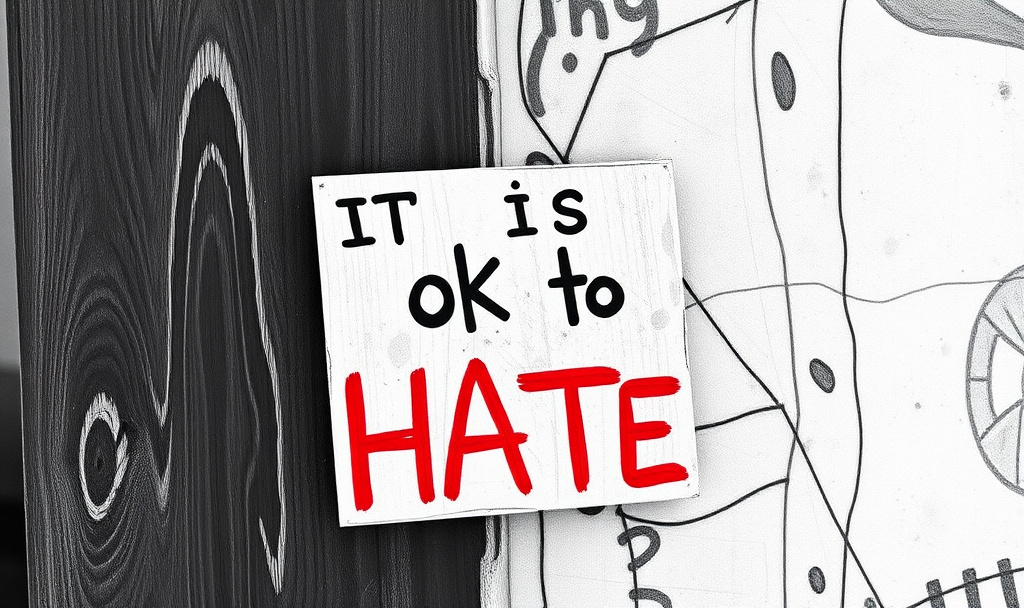

It’s okay to hate …

Filed under: Liberty, Media, Politics — Tags: , , , , — Nicholas @ 04:00

On his Substack, Frank Furedi defends the right to hate:

In recent decades hate has become thoroughly politicised to the point that the mere mention of the word serves as a prelude to discrediting, delegitimating and criminalizing its target. In public life the charge of practising the politics of hate is frequently deployed by leftist promoters of identity ideology against their opponents. The claim promoted by The Guardian that states that “a Tory party that stokes hatred is the real threat to our democracy” is illustrative of the attempt to associate conservatives and other critics of identity ideology with the politics of hate.1

The project of transforming hate into a malevolent ideological standpoint is underpinned by the assumption that all displays of the emotion hate are potentially malevolent. In effect the very human emotion of hate is now frequently demonised as a pathology.

In recent decades hate has been transformed into a stand-alone cultural stigma. According to dominant cultural conventions it is sufficient to use the word hate without any reference to the object of this emotion. It is now common to use the word, Haters. It is not necessary to indicate who the Haters hate. The term Hater serves as a negative identity. As one study acknowledged, “persons branded as ‘haters’ are effectively excommunicated from the polity”.2 The use of the term hater morally contaminates its target.

According to the cultural script that prevails in the West, hate serves as a secular form of moral evil. One expression that captures this evil is that of “The Hate”. By placing a definitive article in front of hate a permanent threat to society is invented. This reified public threat demands vigilance and willingness to mobilise to defeat its manifestations. For example, this is the approach of the campaigning group Stop The Hate.3 The content of The Hate is deliberately left vague so that it can serve as the target of a variety of different campaigns.

The politically motivated designation of hate to describe the behaviour of an individual or a group is not simply an act of description but also a boundary-setting manoeuvre. It basically works as a warning that signals the claim that The Hater cannot be included within the confines of a democratically governed public space. The Hater exists on the wrong sides of the boundary between legitimate and illegitimate politics. This sentiment is frequently communicated by the slogan “Hope Not Hate”, which establishes a moral boundary between legitimate and illegitimate politics. From this perspective hate serves as a diagnostic label for illegitimate public life. Imposing a moral quarantine on those branded as haters is regarded is necessary for the maintenance of a just democratic society.

The frequent use of the slogan “Hope not Hate” smuggles a moralising ethos into public discourse. Through the drawing of a moral contrast between the secular evil of hate, hope emerges as a progressive political virtue. The transformation of hate into a morally toxic antithesis of hope assists the political polarisation that afflicts society. Since haters are regarded as beyond redemption dialogue with them is pointless. The only appropriate response to their words is to criminalise it. Hence the proliferation of rules and laws criminalising Hate Speech.


  1. https://www.theguardian.com/politics/2024/mar/04/a-tory-party-that-stokes-hatred-is-the-real-threat-to-our-democracy
  2. Post, Robert, “Concluding Thoughts: The Legality and Politics of Hatred”, in Thomas Brudholm, and Birgitte Schepelern Johansen (eds), Epilogue, in Thomas Brudholm, and Birgitte Schepelern Johansen (eds), Hate, Politics, Law: Critical Perspectives on Combating Hate, Studies in Penal Theory and Philosophy (New York, 2018; online edn, Oxford Academic, 21 June 2018), https://doi.org/10.1093/oso/9780190465544.003.0013, accessed 12 Mar. 2026.
  3. https://www.stopthehate.uk

Update, 21 March: Welcome, Instapundit readers! Have a look around at some of my other posts you may find of interest. I send out a daily summary of posts here through my Substackhttps://substack.com/@nicholasrusson that you can subscribe to if you’d like to be informed of new posts in the future.

The BBC is cheerleading Britain’s “baby bust”

Filed under: Britain, Media — Tags: , , , , — Nicholas @ 03:00

In The Conservative Woman, Dr. Tony Rucinski reports on a recent BBC programme that clearly takes a dim view of parenting:

ON March 13 – the Friday before Mother’s Day – the Centre for Social Justice published Baby Bust, a report projecting that 600,000 British women alive today may miss out on motherhood they actually wanted. Nine in ten young women still hope to become mothers. The ONS confirms the total fertility rate fell to a record low of 1.41 in 2024. The CSJ calculates a “birth gap” of 30 per cent, with 831,000 people turning 50 in 2024 but only 595,000 babies born.

You probably did not hear about it. No identifiable standalone BBC News website article or feature covering the report has appeared. Our national broadcaster had other priorities. Namely a 1,500-word feature headlined “Like a trap you can’t escape: The women who regret being mothers“. It promoted the piece on social media, where it drew hundreds of critical replies. Instead of covering a demographic crisis, the BBC gave prominent space to a piece whose own evidence undermines its thesis – and thus revealed something important about the role it plays in the very crisis it should be reporting.

Its maternal regret article relies on a 2023 study conducted in Poland which estimates some 5 to 14 per cent of parents regret their decision to have children, a review article which synthesises several methodologically incomparable surveys – different countries, different age groups, different question wordings.

The more important point is its arithmetic. If 5 to 14 per cent of parents experience some regret, then 86 to 95 per cent do not. But the BBC devoted a feature-length article to the minority experience and ignored the majority one entirely. The lead case study featured is of a pseudonymous woman, Carmen, who came from a background of violence and dysfunction. But further data unsurprisingly finds the regret rates to be higher among single parents than married ones: 27.3 per cent versus 9.8 per cent. And that adverse childhood experiences, depression, and anxiety were also strongly associated with parental regret.

The BBC’s article however did not mention marriage once. Even the therapists quoted made the case against the BBC’s framing without apparently realising it. They repeatedly stated that regret often reflects “isolation, exhaustion, or lost identity” – failures of support, not failures of motherhood as a vocation.

The far larger and more painful form of regret that the BBC also ignored is the regret of women who wanted children and never had them, the highest figures among those who experienced fertility treatment failure. Or the similar regret found among couples whose fertility treatment did not result in a child. Or that involuntarily childless women’s regret intensifies with age.

The CSJ’s huge figure of 600,000 “missing mothers” just did not fit the narrative the BBC wants to tell.

Nor is this an isolated editorial misjudgment. Between 2023 and 2026, the BBC published a series of prominent features sympathetic to negative experiences of motherhood or to child-free lifestyles, among them: “I felt like a freak because I didn’t want children” (April 2024). “The adults celebrating child-free lives” (February 2023). “True cost of becoming a mum highlighted in new data on pay” (October 2025).

In the same period, not a single piece of the BBC’s coverage of Miriam Cates – the most prominent parliamentary advocate for pro-natalist policy – featured conversion therapy, smartphones and the trans debate, or substantially addressed her work on demographics or declining birth rates.

The Revenge Plot: Orestes’s Foreshadowing in The Odyssey

Filed under: Books, Europe, History — Tags: , , — Nicholas @ 02:00

MoAn Inc.
Published 4 Dec 2025

This video was filmed in July of 2025. I wasn’t going to upload it due to the weird not-really-focused-but-also-kinda-focused-thing my phone camera was clearly going through, but decided I didn’t care that much because the content itself was fine x
(more…)

QotD: The lameness and sameness of modern science fiction novels

Filed under: Books, Politics, Quotations — Tags: , , , — Nicholas @ 01:00

I’ll confess, though: I almost didn’t read this book. Actually, for several years I didn’t. I was vaguely aware of its existence, but I’d pretty much stopped reading new speculative fiction because I finally admitted to myself that it was pure masochism that kept me beating my head against the wall of newly-published extruded genre product when I had sixty-plus years of Hugo and Nebula nominees to choose from. Sure, every novel will reflect something of its age’s concerns (there’s a lot of nuclear war in those old Hugo winners!), but it’s gotten much worse in the last ten or fifteen years: every book that gets any buzz is so deeply inflected with questions of personal liberation from oppressive structures, so little nuanced and so obsessed with identity and representation, that I find it borderline unreadable. A few books like that, done well — fine, that’s part of life, that’s certainly a kind of story you can tell. But when it’s everything, when it becomes a precondition for publication, you’re left with a tragically denuded sample of the human experience. It’s not that I don’t want to read a book where I disagree with the underlying politics, it’s that an unsubtle obsession with the “correct” politics makes a book boring and cringe. One-dimensionally “right-wing” fiction written in reaction to the contemporary mainstream is just as bad — worse, perhaps, because if done well it’s the sort of thing I would really enjoy.1

Jane Psmith, “REVIEW: The Powers of the Earth, by Travis J.I. Corcoran”, Mr. and Mrs. Psmith’s Bookshelf, 2024-04-29.


  1. There’s nothing worse than poor execution of an incredible idea, because it means no one else will come along and do the incredible idea right. Austin Grossman’s Crooked, for instance, is Richard Nixon vs. Cosmic Horrors, which is a brilliant premise (yes, the Interstate Highway System is definitely an eldritch sigil designed to protect America, I will not accept any argument) but falls apart on the totally ahistorical version of our 37th President designed to justify making him the “good guy”. The real Nixon is such a fascinating and compelling figure — why not keep him as weird and twitchy and striving as he actually was and have him be the good guy anyway?
  2. Or, say, the Napoleon movie.

Powered by WordPress



