
Quotulatiousness

March 22, 2026

Four million books published in North America during 2024

Filed under: Books, Business, Cancon, USA — Tags: , , — Nicholas @ 05:00

In the latest SHuSH newsletter, Ken Whyte considers the size of the North American book market at most recent count:
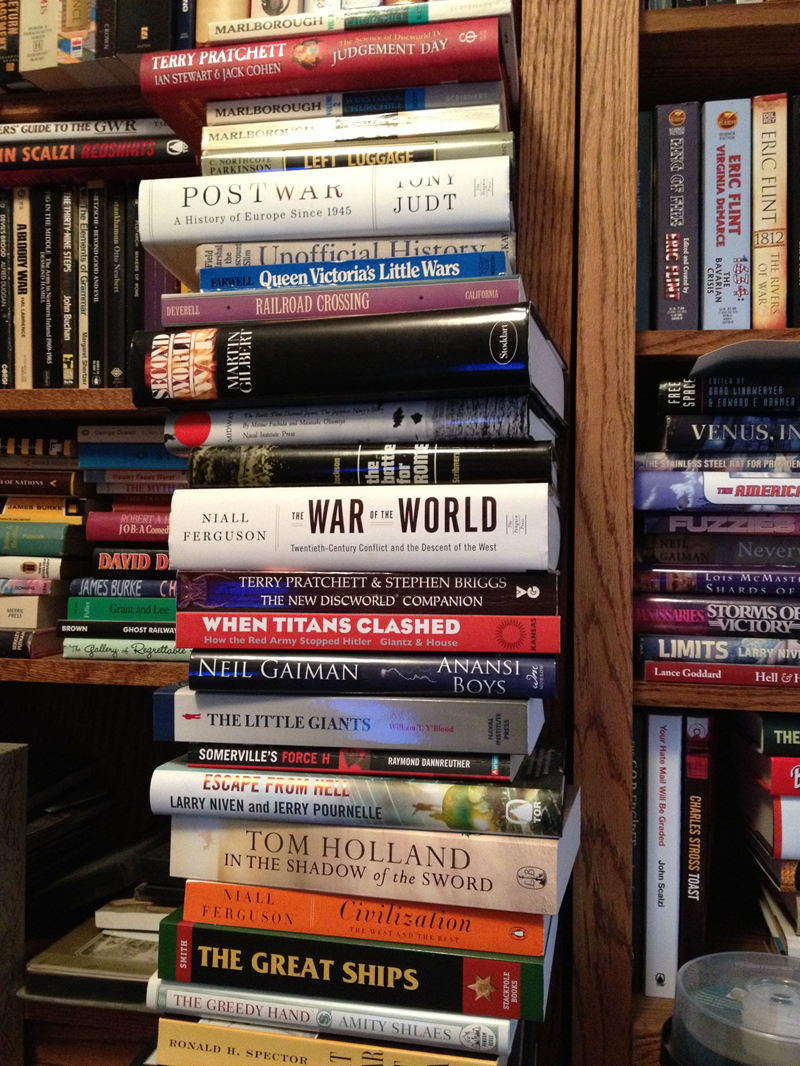
Random photo of books stacked in my office about 15 years ago.

I’m often asked by writers about the prospects of a particular book. I try to be encouraging. If it’s a good book, there’s undoubtedly an audience for it. At the same time, I try to be realistic. It’s a crowded market and it’s often difficult even for a good book to find its audience.

If asked to explain just how crowded the market for books is today, I usually say something like, there are about two million books published in North America every year. I’m not sure where I got that figure from. Probably from some research I read five years ago.

Turns out it’s wrong. “The total number of books published in the US in 2025 with ISBN numbers jumped 32.5% over 2024 to more than four million books,” announced Publishers Weekly on March 17.

I can’t get over that number. Four million books.

An average reader might get through about 2,000 books in a lifetime. A long-lived super-reader churning through 70 or 80 a year may exceed 5,000. Gladstone’s reading logs suggest that he engaged with more than 20,000 books, but it’s not clear he read them all.

A large independent bookstore might carry between 10,000 and 30,000 books. A suburban chain store, 60,000 to 120,000. The Barnes & flagship at Union Square in Manhattan has hundreds of thousands of books on four massive floors. Powell’s City of Books in Portland, occupying an entire city block—you need a map to get from room to room—has at least a half million books, and by some counts a million. New York’s The Strand, which boasts 18 miles of books, new and used, is probably the world’s biggest bricks-and-mortar retailer: it has 2.5 million books on incredibly dense shelving. You’d need a Powell’s, a Strand, and a couple of B&N Union Squares to hold four million titles.

Four million books is equivalent in volume to the holdings of a good-sized university library system, or a large public library system—collections built over a century. And these are published in a single year.

In 1939, the year Margaret Atwood was born, The Library of Congress, widely recognized as the largest library in the world, home to a civilization’s worth of books, boasted about six million titles, including pamphlets. It’s now holding about 25 million, and the US alone is on pace to produce that many titles between now and the end of the decade.

Four million books. That’s 11,000 books a day. Four hundred and fifty books an hour.

A year ago, there were “only” 3.15 million books, traditional and self-published, released. So 2025 represents an increase of 32.5 percent. Self-publishing was up just under 39 percent. Traditional publishing about 6.6 percent. Publishers Weekly doesn’t offer much of an explanation for the explosion of new titles. AI has to be a major factor (see this week’s publishing sensation in The New York Times.)

Of course, most of the four million books are not worth your time. Only 642,242 of the titles were released by traditional publishers. A traditional publisher doesn’t guarantee quality, but it suggests a minimum of vetting. The search for merit among self-published books is easily frustrated.

Bowker, the service that counts the ISBNs (the unique thirteen-digit identifiers attached to each book), does not distinguish among formats. Many of the four million were published only as ebooks. And some books published as print, ebook, and audiobook are triple-counted. There may only be about 2.5 million distinct works in that total.

If one were to take the colouring books, planners, puzzle books, and AI-generated garbage out of the equation, we might be down to 1.5 million meaningfully distinct books. And of all those, maybe 1 to 3 percent, or 20,000 to 50,000, will sell over 1,000 copies. That puts some perspective on the four million.

How To Indoctrinate the Children – Death of Democracy 08 – Q4 1934

Filed under: Germany, History — Tags: , , , , , , — Nicholas @ 04:00

World War Two and Spartacus Olsson
Published 21 Mar 2026

In this episode of Death of Democracy, we examine Germany in the final quarter of 1934, as Adolf Hitler tightens his grip on power after Hindenburg’s death and prepares the Reich for the next stage of Nazi rule. Behind a façade of order, the regime accelerates secret rearmament, deepens propaganda and youth indoctrination, pushes Jews further out of public life, and turns universities, schools, and culture into instruments of ideological control.

This documentary explores Nazi Germany in late 1934 through the looming Saar plebiscite, the growth of the Hitler myth, rising public frustration with local Nazi officials, and the regime’s deeper preparation for dictatorship, expansion, and war. If you are interested in Hitler, Nazi propaganda, rearmament, antisemitism, the Saar vote, and the collapse of democracy in Germany, this episode provides the critical context.
(more…)

“In 1800, most people worked the land. By 1900, most didn’t. … That’s a psychological earthquake”

Filed under: Education, Europe, Health, History, USA — Tags: , , — Nicholas @ 03:00

On the social media site formerly known as Twitter, L. Wayne Mathison points out just how vast the disruption of normal, traditional lives over less than a century has torn most of us from our historical moorings:

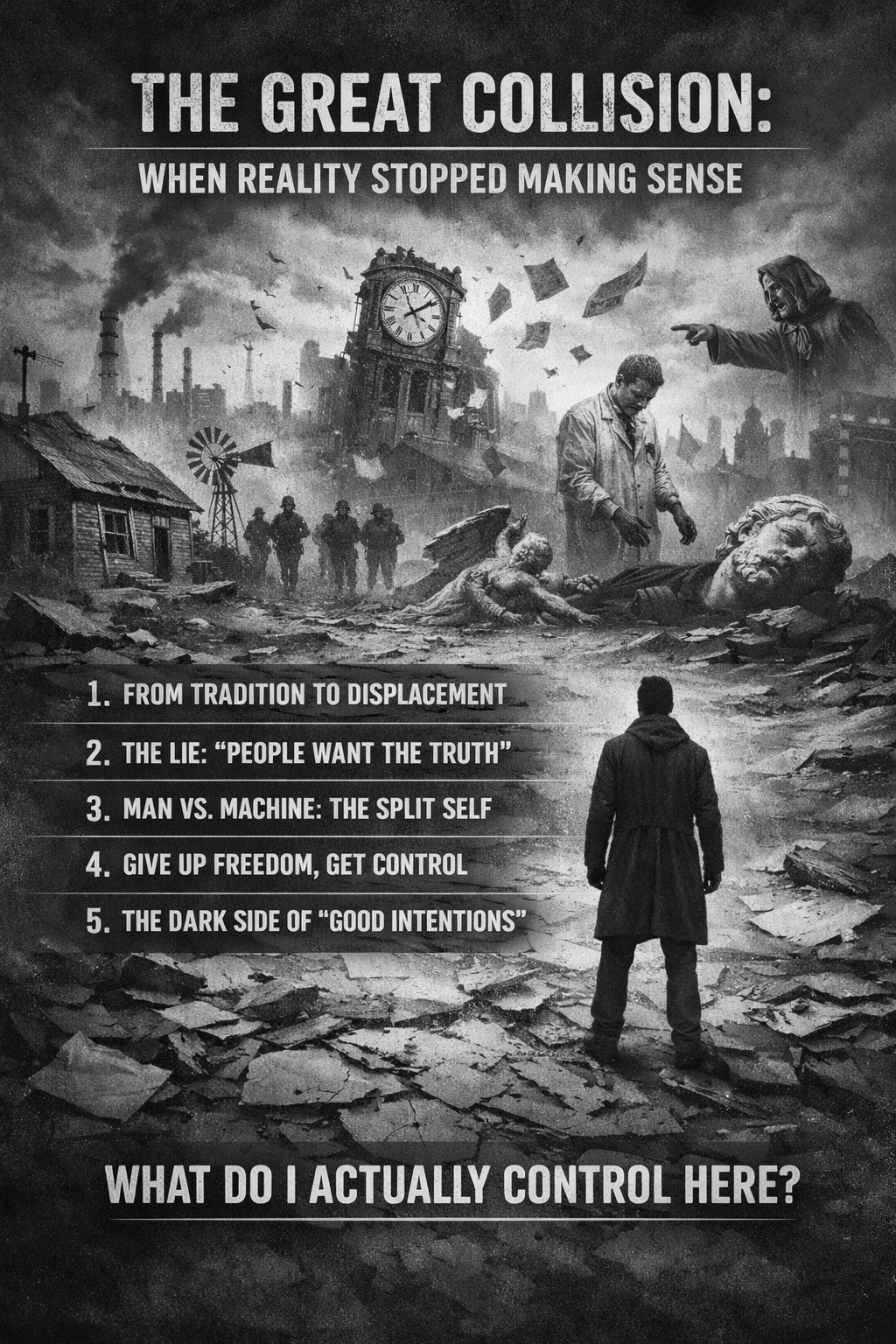
Image generated with AI

The Great Collision: When Reality Stopped Making Sense

For most of human history, life wasn’t confusing. It was hard, yes. Brutal, often. But simple.

You were born into a pattern. You followed it. You died in it.

Then the 20th century showed up like a wrecking ball.

What people call “progress” was really a mass psychological dislocation. We didn’t just move from farms to cities. We lost the structure that told us who we were.

We solved survival. Then immediately created a meaning crisis.

That’s the trade nobody advertises.

1. The Shock: When Life Broke Its Own Pattern

People think industrialization was about better tools. It wasn’t. It was about ripping people out of identity.

In 1800, most people worked the land. By 1900, most didn’t. That’s not a statistic. That’s a psychological earthquake.

Tradition vanished faster than people could adapt. So the state stepped in and did what states always do. Standardize. Educate. Normalize.

Mass schooling didn’t just teach reading. It replaced lost culture with manufactured culture.

Useful? Yes.

Neutral? Not even close.

You don’t remove a thousand-year identity system and expect people to just “figure it out”.

They don’t. They drift.

2. The Lie We Tell Ourselves: “People Want the Truth”

No, they don’t. They want to feel right.

Semmelweis proved it. Doctors were killing women by not washing their hands. When he showed them, they didn’t thank him. They rejected him. Destroyed him.

Why?

Because truth wasn’t the problem. Identity was.

If the facts say “you’re causing harm”, and your identity says “I’m a healer”, most people will reject the facts. Not update the identity.

That’s the Is vs Ought gap in plain terms:

The world is what it is
You believe what should be
When they collide, you protect the belief

Not truth. Belief.

That’s not stupidity. That’s self-preservation.

3. The Split: Are You a Person or a Machine?

Here’s the quiet tension nobody resolves.

You experience yourself as a decision-maker. You choose. You judge. You act.

But science describes you as chemistry and electrical signals.

Both are true. And they don’t fit together cleanly.

The old world said: you are a moral agent.

The modern world says: you are a biological system.

So which one is responsible when something goes wrong?

If you lean too far into “machine”, responsibility disappears.

If you lean too far into “agent”, you ignore constraints.

Most people bounce between the two depending on what excuses them fastest.

4. The Dangerous Shortcut: Let Someone Else Decide

Freedom sounds nice until it demands something from you.

Dostoevsky nailed this. People don’t just want freedom. They want relief from it.

So they trade it. Quietly.

Security, comfort, certainty. Those become the new gods.

And then comes the predictable move. Someone steps in and says:

“I’ll decide what’s good for everyone.”

History has a word for those people. It’s not flattering.

Once you remove any higher standard, the only thing left is preference backed by power.

That’s when things get ugly fast.

5. When “Good Intentions” Go Off the Rails

This is where it usually collapses.

When there’s no fixed standard, people start building their own. Then enforcing it.

George Bernard Shaw is a perfect example. Smart. Influential. Completely untethered.

Once you decide some people are “in the way”, the logic gets dark very quickly.

Not because people are monsters.

Because they think they’re right.

That’s always the justification.

Final Reframe: You Don’t Get Meaning for Free

Here’s the uncomfortable truth.

The old systems that gave people meaning are gone or weakened. They’re not coming back in their original form.

So now you’re left with a choice most people avoid:

Drift and absorb whatever narrative is loudest
Or build your own framework and take responsibility for it

There is no neutral ground.

You’re either shaping your values, or inheriting someone else’s without noticing.

Most people think they’re thinking.

They’re not. They’re echoing.

Simple Stoic Move

Strip it down.

Ask one question:

“What do I actually control here?”

Then act there. Only there.

Everything else is noise.

And right now, there’s a lot of noise.

[NR] – minor formatting added.

The Original AR-15: Serial Number 6 in Original Configuration

Filed under: History, Military, USA, Weapons — Tags: , , , , , — Nicholas @ 02:00

Forgotten Weapons
Published 1 Nov 2025

The very first AR15 rifles submitted to US government trials were extremely lightweight, with an assortment of interesting features that did not last long. They had top-mounted charging handles, one-piece hand guards, very thin barrels with plain muzzles, and a different safety selector configuration than became normal later one. Updates and modifications were made to virtually all of the original rifles, but today we have a chance to look at serial number 6 in the Springfield Armory collection — which is still in completely original configuration.

Thanks to the Springfield Armory National Historic Site for giving me access to this truly unique specimen from their reference collection to film for you! Don’t miss the chance to visit the museum there if you have a day free in Springfield, Massachusetts: https://www.nps.gov/spar/index.htm
(more…)

QotD: The treason of the scientists

Filed under: Media, Politics, Quotations, Science — Tags: , , , — Nicholas @ 01:00

    Luca Barbato @lu_zero_
    Research is not taking money and then creative-write whatever fits the political faction you align with.

    And that’s why there are at least some people, that value science a lot, that consider burning down or starve “institutions” the correct first step to amend course.

One of those people is me.

I can still keenly remember my first feelings of crushing disappointment back in the 1980s when I started reading the “scientific” literature on gun policy and realized how utterly fraudulent much of it was.

I had grown up loving The Science, thinking of research scientists as the best of humanity, carrying us forward into a better future with honesty and courage. Discovering that there were people who would violate this sacred trust to push a political agenda hurt me.

But it only started with the gun policy literature. Sociology, psychology, political “science”, climatology. Learning how far the rot had spread was deeply dispiriting to me.

And the worst of it wasn’t even the hacks and partisans. The worst was noticing the cowardice of the people who failed to oppose them. Because that part isn’t just an indictment of the successful activists and manipulators, it’s an indictment of almost all scientists, everywhere.

Which is why I now contemplate rude, ignorant populists proposing to burn down large swathes of research funding and find myself rooting for the populists, not the scientists.

Because the lesson needs to be learned. It’s not just about driving out the hacks and partisans. Scientists, as a culture, need to learn the hard way that cowardice has a price — that if you don’t call out politicization when it’s happening, you don’t deserve the trust of the rest of our society, or the funding and privileges that come with it.

ESR, The social media site formerly known as Twitter, 2025-12-21.

Update, 23 March: Welcome, Instapundit readers! Have a look around at some of my other posts you may find of interest. I send out a daily summary of posts here through my Substackhttps://substack.com/@nicholasrusson that you can subscribe to if you’d like to be informed of new posts in the future.

Powered by WordPress


