Quotulatiousness

March 31, 2026

Japan’s navy … uh, I mean the “Japan Maritime Self-Defense Force”

Filed under: Japan, Military, Pacific, Weapons — Tags: , , , — Nicholas @ 04:00

On Substack, Francis Turner discusses what serious countries do (so you know the topic isn’t anything to do with Canada), and part of the post is about the Japanese Navy Japan Maritime Self-Defense Force and its latest ship building program:

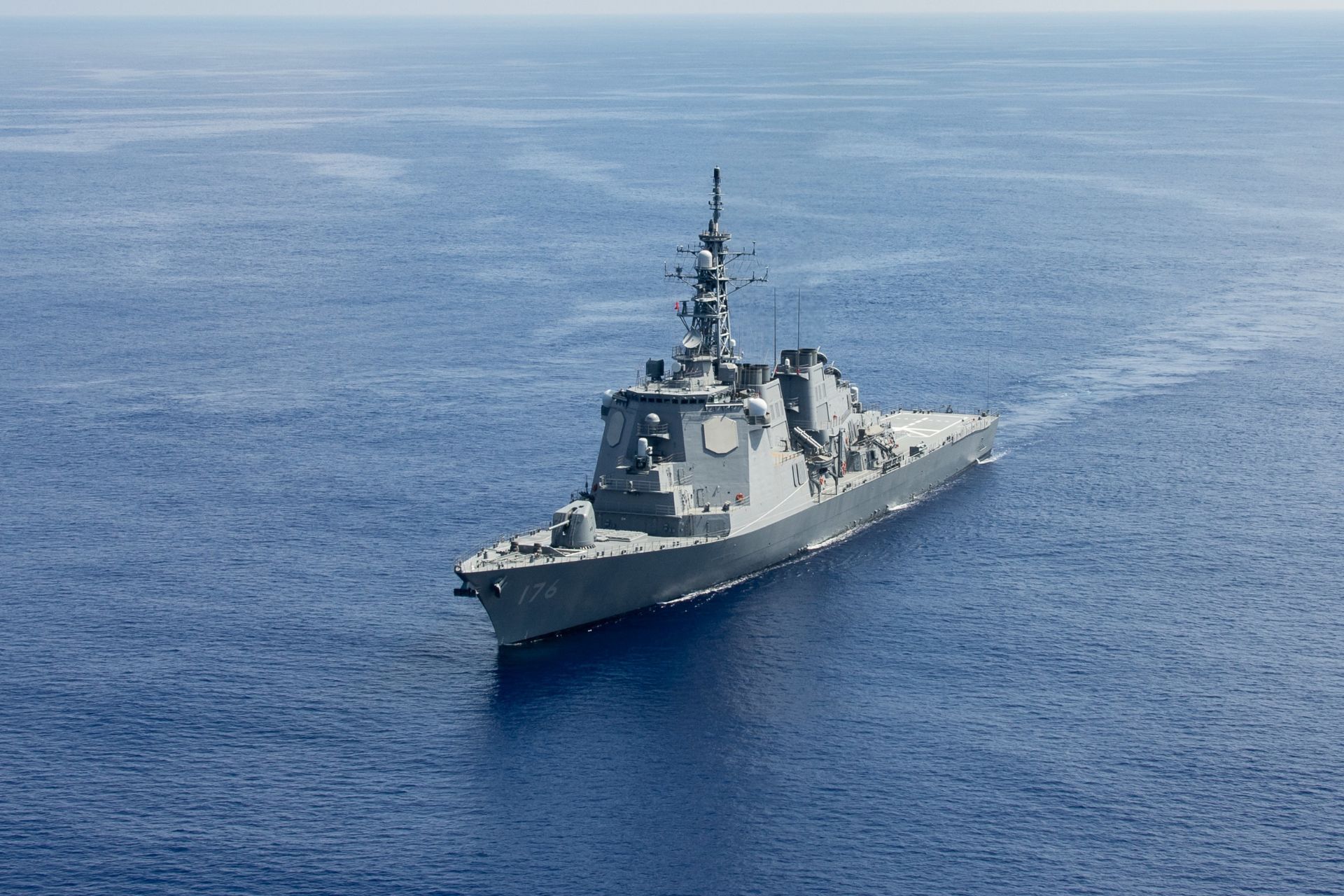
Last month Japan started work on its second ASEV (Aegis System Equipped Vessel), which should probably classed a Guided Missile Cruiser, though it is unclear if the C designation will be used (let’s face it Japan still calls its two “not really aircraft carriers, honest guv” aircraft carrying warships “Helicopter Destroyers”. Though apparently it plans to change that soon).

At 190m long and 25m broad, the ASEVs will be some of the largest non-aircraft carrier ships being built by anyone this century1 until the Trump battleships start construction. The Trump battleships are projected to be about 50% larger but they haven’t yet been funded let alone contracted. The USN’s Zumwalts are roughly the same size.

It isn’t just the size that is impressive, it is also the speed of construction. The ASEV as a concept showed up in ~2020 when Japan decided the land based Aegis Ashore program was a failure and cancelled it. In October 2024, after about four years, plans had been made, budget allocated and contracts awarded for the two ships. Construction of the first started last July (2025) and the second last month (February 2026). Construction time is estimated to be around three years, with the first delivered/commissioned in March 2028 and the second one year later. Why one year later and not six months earlier? My guess is that the reason is to incorporate lessons learned from sea trials and operating the first in the final construction stages of the second. This seems similar to the Izumo/Kaga construction a decade ago.

Put together and you have ships that will have gone from concept to contract award in 4 years and contract award to fully-functioning delivery in under 5 years — assuming there are no delays. That seems plausible, the Izumo and Kaga were built in about the same time frame, and stands in stark contrast to the procurement speed of the US Navy and any European navy. The first Zumwalt, for example took over 5 years to go from concept to start of construction and another 5+ from there to commissioning and then another 4 to full acceptance. The ASEVs are also expected to be a lot cheaper, costing around JPY400B or about US$2.5 billion for the initial version. There will undoubtedly be upgrades — e.g. drone defenses, laser or rail guns — and there are some new features compared to previous ships — the SPY7 radar from Lockheed Martin for example — but this is an evolution of existing Japanese and US Aegis destroyers rather than a brand new concept which helps explain why I am confident about the timeline and budget.

Although the ASEV’s primary role is missile defense, there is no reason why one might not, in the fullness of time, be loaded with offensive missiles such as the TLAM or antiship missiles. Indeed the Naval News article lists both as options:

    Each vessel will feature a 128-cell Vertical Launch System (VLS) — significantly more than the 96 cells installed on Japan’s latest Aegis destroyers.

    The VLS will be capable of launching:

    – SM-3 Block IIA interceptors, jointly developed by Japan and the United States for ballistic missile defense

    – SM-6 missiles, capable of engaging advanced aerial threats, including hypersonic glide vehicles

    The ships will also support Japan’s emerging counterstrike capability.

    Planned armament includes:

    – the extended-range Type 12 anti-ship missile (ship-launched improved variant)

    – the U.S.-made Tomahawk cruise missile

Is that TLAM in your launcher or are you pleased to see me?

Notably the Tomahawk capability has already been fitted to one of the Aegis destroyers this class is supposed to replace. A 128 cell ASEV firing TLAMs could be very unpleasant for Little Rocket Man; if it fired antiship missiles that could make a Chicom invasion of Taiwan pretty miserable just on its own. It would also make a phenomenal commerce raider / blockade enforcer if such roles were needed.

[Aside: Unlike some country’s missiles I’d be pretty confident that the Type 12 anti-ship missile will work well]

As CDR Salamander observed on X, the real question is why Japan doesn’t make a few more and sell them to countries/navies that struggle with procurement. And for that matter why it doesn’t make a couple more for itself. Perhaps it will. I figure there’s a couple of years before there will be yard space to build them so there’s no hurry to make that decision.


    Russia’s Kirov class battlecruisers are larger but a) they were built in the 1970s/80s and b) only one is currently active (for some definition of active).

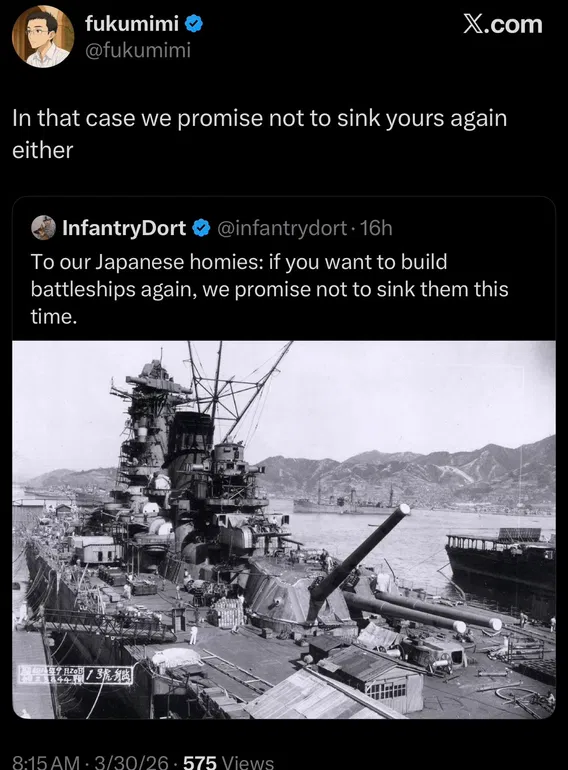
Japan’s decision to rebuild naval strength has been noted by others, too:

Reaction to Avi Lewis being elected federal NDP leader

Filed under: Cancon, Economics, Media, Politics — Tags: , , , , — Nicholas @ 03:00

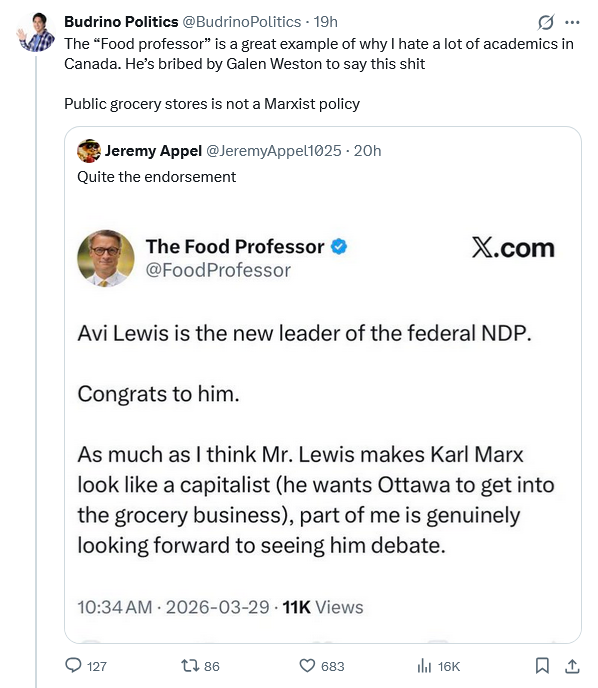
On the social media site formerly known as Twitter, L. Wayne Mathison responds to an ill-informed snipe at @TheFoodProfessor for a post about Avi Lewis:

This take reads like someone who’s never had to meet a payroll or balance a ledger under real pressure.

Accusing the “Food Professor” of being bribed is just noise. No evidence, no numbers, just a conspiracy to avoid the actual argument. Classic move when the facts aren’t cooperating.

I ran a grocery business. Not a theory. Not a model. A real one. Thin margins, constant spoilage risk, price swings, labour costs, supplier pressure, and customers who notice every 10-cent increase. Grocery isn’t some gold mine. It’s a logistics grind with razor-thin profit.

Here’s the part people like this never mention:
Canada’s total grocery profits are roughly $6 billion. Spread that across 40 million people and you’re looking at maybe $12 a month per person if you wiped out every dollar of profit.

So what’s the fantasy here?

Government steps in, runs stores “for the people”, eliminates profit… and somehow prices magically drop while efficiency improves?

Let’s test behaviour, not intentions.

What happens when you remove profit?

No incentive to optimize operations
No accountability for waste
Political hiring instead of performance hiring
Pricing driven by optics, not supply reality
Losses covered by taxpayers … meaning you, again

You don’t eliminate costs. You just hide them and move them.

I lived through high interest rates north of 20%, carried customer debt, and still had to make the numbers work. Government doesn’t operate under that discipline. It can fail indefinitely and call it policy.

Public grocery isn’t “not Marxist”. It’s not even that sophisticated. It’s just naive.

The real issue isn’t ideology. It’s a complete lack of understanding of how incentives drive outcomes.

You don’t fix affordability by replacing people who have to be efficient with a system that doesn’t.

You fix it by increasing competition, reducing regulatory drag, and letting supply actually respond.

Everything else is theatre.

In the National Post, Kelly McParland outlines the scale of challenge Lewis is facing to make the NDP electorally viable again:

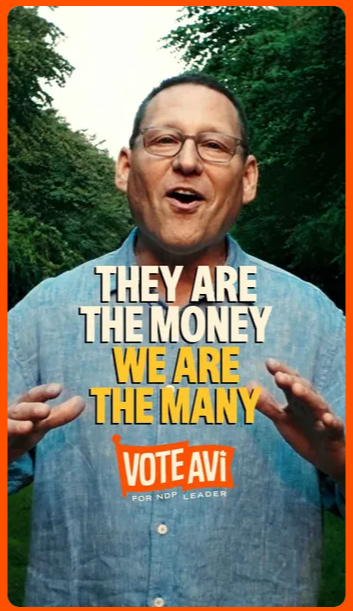
Thumbnail of one of Avi Lewis’s campaign shorts

After two weeks on the road [Jagmeet Singh] finally conceded to reality, allowing that while “I would be honoured to serve as prime minister … I don’t want to presuppose the outcome of the election”.

Maybe Lewis should start straight off with that line, since choosing him as leader saves the party from pretending it expects to find itself in power. “The return of the NDP starts today!” Lewis declared in his victory speech, but as the most out-there ideologue of the candidates he defeated he’ll have a harder time convincing ordinary Canadians than he did winning over his fourth-place party. A film-maker and activist, he’s not just left-wing, but way off in a universe of his own.

His ambitions are dazzling: a Canada powered entirely by renewable energy in which everyone gets a guaranteed income, vast infrastructure projects are built to sustain the environment, farmers produce healthier, affordable, cleaner food while homebuilders concentrate on energy-efficient homes for lower income groups. All this paid for by an economy that somehow remains vibrant while its vital energy industry is crippled, jobs are lost, taxes are raised, royalties are increased, government spending balloons, the carbon tax is re-introduced and “the rich” are somehow found to have plenty of excess revenue to cover the costs.

Voters who continue to back the NDP will now know exactly what they’re casting their ballots for. That wasn’t always clear under previous leaders. Thomas Mulcair didn’t hate trade deals or pipelines enough to satisfy party stalwarts deeply hostile to both. To the unyielding, Singh did a deal with the devil when he agreed to prop up Justin Trudeau’s Liberals, even if the decision succeeded in squeezing out some policy victories.

Small victories aren’t in Lewis’s lexicon. He wants a revolution. “This is more than a rigged economy, it is a war on working people”, he declared on Sunday. “It is immoral, it is unCanadian and we cannot let it stand.”

This Recipe Took 3 Years … Ninja Kikatsugan

Filed under: Food, History, Japan — Tags: , , , , , , — Nicholas @ 02:00

Tasting History with Max Miller
Published 23 Sept 2025

Very bitter, very sake-flavored balls that include ginseng, coix seeds, and licorice

City/Region: Japan
Time Period: 1676

Much like cowboys, pirates, and knights, ninja have been fictionalized to be a far cry from the intelligence gathering and sabotage experts of history. The term “ninja” didn’t even become popular until the mid-20th century.

Even the historical text I’m using here, the Bansenshukai, has been called into question. Because it was written over the period of several centuries, often by people who weren’t even alive during the period when ninja, or shinobi, were active, who knows if it’s an accurate portrayal of their tools and methods.

If this recipe is accurate, I feel bad for the people who had to eat them. They’re really bitter with an overwhelming sake flavor that isn’t pleasant. Really, I wouldn’t recommend making these; they’re not worth the 3 year time investment, and hyōrōgan are a much tastier ninja survival food.

    Kikatsugan
    10 ryō Asiatic ginseng
    20 ryō Buckweat flour
    20 ryō Millet Flour
    20 ryō Yam
    1 ryō Liquorice
    10 ryō Coix seed
    20 ryō Rice flour
    Grind this into a powder, soak it in three shō of sake for three years until it has dried. Afterward, roll it into balls the size of peach pits.
    Eating three of these daily will keep you healthy even when you have nothing else to eat.
    Eating three will prevent both mental and physical fatigue.

    Bansenshukai, 1676

(more…)

QotD: Slavery

Filed under: China, History, Law, Quotations, Russia — Tags: , , , , , — Nicholas @ 01:00

As sociologist Orlando Patterson (b.1940) has observed:

    It is impolite to say of one’s spouse or one’s debtor that they are part of one’s property. With slaves, politeness is unnecessary. (Slavery and Social Death, P.22)

What makes a slave different from a wife, professional player or even a serf is that a slave is in a state of social death: they have no claims of social connection that their master (or anyone else) need pay attention to beyond that to the master.

This is not to say slaves have no legal personality — all slave systems are very well aware that slaves are people. Rather, the relationship of exclusive domination was such that they had no connections that anyone had any obligation to respect other than to their master.

Other individuals might be in relationships of servitude under a master but still retained connections with others subject to presumptive respect. This was true even of serfs and is what distinguishes various forms of serfdom from slavery. Even under Russian serfdom, a serf marriage was a legally recognised marriage; a serf father had legally recognised authority over his family; a serf could legally own property. Once somebody had suffered the social death of slavery, they were utterly bereft of any such connections.

Both serf and slave lacked any choice of master or about the nature and content of that mastery: that is what makes both forms of labour bondage. Nevertheless, a serf had legally recognised relationships, and choices about them, that a slave simply did not.

Slaves are violently dominated: the whip or equivalent has been a control device in every known system of slavery. They are natally alienated: both from from any (positive) standing from their ancestors or claims over their descendants. They are culturally degraded: whether in naming, clothing, hair style, marks on the body or required acts.

All this serves to establish, mark and reinforce the relationship of domination. For that level of domination is required to turn one human into the possession, and so the property, of another. (Karl Marx’s talk of “wage slave” is not only rhetorical excess, it is contemptible rhetorical excess: a manifestation of his comprehensive mischaracterisation of commerce.)

None of these key features of domination require the acknowledgement of the wider society. There are likely slaves in every major city in the world, even in economically highly developed democracies with the rule of law.

While it can be helpful to have your relationship of domination over a slave recognised by others, the crucial thing is the acknowledgment by the slave. Slavery is a relationship between people about an owned thing, where the slave acknowledges that they are the owned thing. This is a key element in the humiliation of slavery.

The mechanisms of domination are, however, obviously much more powerful if they are embedded in wider institutional acceptance of slavery. Where there is no such wider acknowledgement, then even greater isolation from the wider society is required to establish and maintain the relationship of domination.

In social systems that openly incorporate slaveholding, a slave’s state of domination, of the social nullity of no independent connection, normally meant that they could not be a formally recognised owner of property: that they could not be a legal owner of property, not a person who could have property. They lacked the sort of legal standing that could legally own things.

To do so would require the slave to have social and legal connections, beyond the claims and decisions of their master, that others are bound to accept or respect, and that is precisely what slavery, as a structure of domination of one by other, denies. The Ahaggar Tuaregs express this feature of slavery very directly, holding that:

    without the master the slave does not exist, and he is only socializable through his master. (Slavery and Social Death, P.4.)

Slavery is, always and everywhere, a created relationship of dominion. As the Kel Gress group of the Tuareg say:

    All persons are created by God, the slave is created by the Tuareg. (Slavery and Social Death, P.4)

In a society that accepts slavery, the conventions of acknowledged possession will operate for the master about the slave in a far more complete way than any other claim of property in another human. If other mechanisms of delegated control were sufficiently absent or attenuated, then slaves became preferred agents. The use of slaves as commercial agents was surprisingly common.

In societies dominated by kin-groups, slaves could make preferred warriors or officials precisely because they had no other connection entitled to presumptive respect than that to their master — hence the slave warriors of Greater Middle Eastern (Morocco to Pakistan) Islam.

The danger of kin-groups is that they readily colonise social institutions — rulers come and go, the kin-group is forever. Slave warriors and officials were a solution to that problem in societies where suppression of kin-groups was not a practicable option.

Imperial China found kin-groups useful for economising on administrative costs and Emperors used distance — officials could not be assigned to their home counties — and rotation of officials to inhibit kin-group colonisation of their administrations. Even so, much of the appeal of eunuchs to Emperors was precisely the presumed severing of kin-group ties. (They also had the advantage of being the only males, other than the Emperor, permitted overnight residence in the imperial palace.)

Nevertheless, slavery can exist without such wider acknowledgement by laws. For turning someone into a slave requires forcing them to acknowledge the relationship of domination to the point of being a possession of another.

So, slavery is not, at its core, a matter of property but of domination. Domination to the extent that the conventions of acknowledged possession can apply to slaves entire. Slaves can be turned into property without any other connections with presumptive respect or standing. Yet, even a slave could be a beneficial participant in the conventions of acknowledged possession.

For, so powerfully useful are the conventions of acknowledged possession, that masters have, surprisingly often, allowed slaves to also be accepted beneficiaries of the conventions of acknowledged possession. To be owners of property in practice, if not in law. This was done to lessen the burdens of control, the cost of subsistence or to enable the slave to buy their freedom. The Romans acknowledged this through the concept of peculium.

The Romans, being relentlessly logical in such matters, held a slave to be an owned animal. That is, a human on which such a comprehensive social death has been imposed that they are the legal equivalent of a domesticated animal. (Yet, somewhat awkwardly, still people.)

Just as you can geld an animal, you can castrate a slave. Despite the Islamic slave trade being on a comparable scale to, and lasting centuries longer than, the Transatlantic slave trade, there is no ex-slave diaspora within Islam, unlike the Americas. All children of a Muslim father are members of the Muslim community while so many of the male slaves were castrated.

The Roman concept of property as dominium, as absolute ownership of a thing, may have transferred the domination of slavery into a more general conception of property so as to absolutely separate slave (who suffers dominium) from citizen (who possesses it). Rome ran one of the most open slave systems in human history, such that a freed slave could become a citizen. This necessitated particularly sharp legal delineation of the difference between slave and citizen.

Such dominion is not a relationship between a person and thing (despite claims to the contrary) for it is still setting up a relationship with others regarding what is owned, remembering that the crucial thing in property is not mine! but yours!: the acknowledgement by others of possession and so the right-to-decide. Hence the importance of the signals of possession for slavery.

The Greeks also had citizenship and — particularly in the case of Athens — mass slavery. Greek citizenship was, however, far more exclusive than Roman citizenship and the existence of metis, resident non-citizens, further separated citizen from slave. The Greek city-states also operated much more convention-based, and distinctly less developed, laws than did Rome. If law is a matter of such abstraction as is needed to establish functional differences, and no more, the Romans perhaps felt more need to establish that a citizen could possess dominion.

Conversely, as Romans were not moral universalists, they felt no need to generate some justificatory abstraction about slavery: a slave was simply a loser. If a slave later became a Roman citizen, then, congratulations to them, they had become a winner (and few cultures have worshipped success quite as relentlessly as did the Romans). Hence freedmen would put their status as freedman on their tombstones.

Aristotle — as his moral theory did tend towards moral universalism — came up with a clumsy justificatory abstraction (natural slaves) as to why slaves could be morally degraded. Indeed, the combination of moral universalism and slavery invariably led to justifications that held some essential flaw in the slave justified their domination by others. A process much easier to manage if slaves were from a different continental region, so with distinguishing physical markers of their continental origin.

The Romans had no need of such Just-So stories to justify slavery and did not generate them. Muslims and Christians are moral universalists and so did manifest the need to tell such Just-So stories about enslaved groups: why children of God were being enslaved. (Because that is what they were fit for, clearly.)

Islamic writers generated the first major discourses of skin-colour racism, applying them to the populations they enslaved. In their case, generating both anti-black and anti-white racism, as they systematically enslaved both Sub-Saharan Africans and Europeans, particularly Eastern Europeans. It also led to some awkward rationalisations as to why the inhabitants of South Asia could have dark skins but not suffer from any deemed inherent inferiority.

Just as slavery continues, modern totalitarian Party-States have used forced labour — labour bondage — on massive scales, starting with the Soviet Union and then wartime Nazi Germany. Such continues to the present day in CCP China — infamously of the Uyghurs — and the Kim Family Regime of North Korea. From 1940 to 1956, the Soviet Union banned workers moving jobs without the permission of their existing workforce, the key element of serfdom.

Lorenzo Warby, “Owning people, owning animals, controlling attributes”, Lorenzo from Oz, 2025-12-25.


Powered by WordPress