
Quotulatiousness

March 6, 2026

The “security clearance issue” demonstrated by, of all people, Mark Carney

Filed under: Cancon, Government, Media, Politics — Tags: , , , , — Nicholas @ 05:00

Melanie in Saskatchewan explains why the constant Liberal talking point that refusing to get a particular security clearance “proved” that Pierre Poilievre was next-door to a traitor will probably not be raised any more:
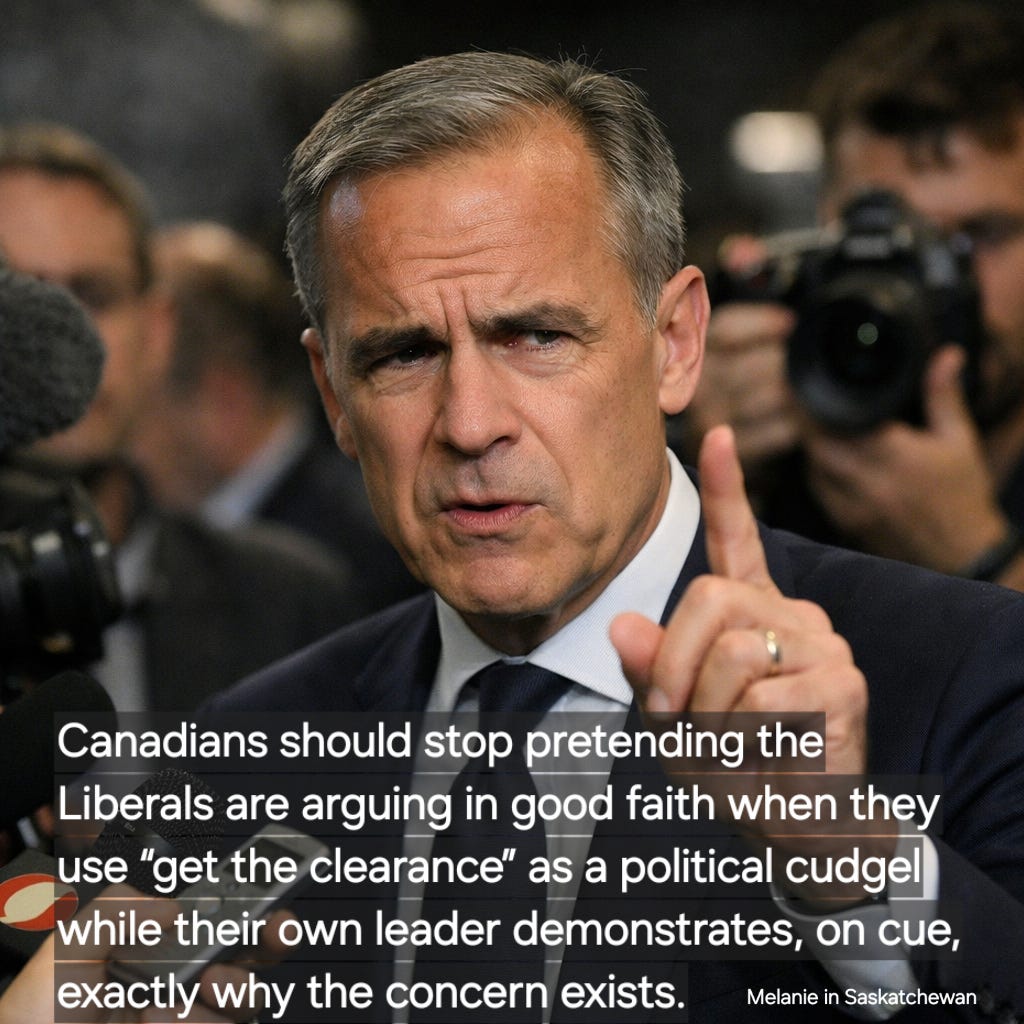
Image from Melanie in Saskatchewan

Open Letter to Canada’s Security Clearance Scolds: Carney Just Proved Pierre Right!

To every Liberal and NDP partisan who has spent the last year yelling “security clearance” like it is a magic spell that turns criticism into treason, congratulations. Mark Carney just demonstrated Pierre Poilievre’s point for him, on camera, in real time.

The moment came on March 3, 2026, during Prime Minister Mark Carney’s Indo-Pacific trip. After meetings in India with Prime Minister Narendra Modi, Carney held a press availability with Canadian media while travelling through the region. The topic journalists wanted clarified was not subtle. They asked about foreign interference linked to India and the 2023 assassination of Sikh activist Hardeep Singh Nijjar in Surrey, British Columbia, the allegation that detonated Canada’s diplomatic crisis with India.

The question came from Dylan Robertson of The Canadian Press during the media scrum. He asked directly whether Carney believed India continued to engage in foreign interference or transnational repression targeting Canadians.

Carney swerved. He was asked again. And again.

Eventually, after the careful circling that seasoned politicians deploy when a straight answer would be inconvenient, he landed on the tell. Not the kind you need a polygraph for. The kind you publish in a civics textbook.

Here is what he said, exactly:

    There will not be consequences for those officials … There are aspects of those briefings that I can’t share in public, and I’m not going to betray them. I will tell you that there is progress on these issues.

Read that again, slowly, with a spoon handy in case you choke on the irony. Because this is the whole debate in one neat little ribbon.

Pierre Poilievre’s argument, from the start, has been that the particular classified briefings being pushed would place him inside a legal box. Once inside it, the rules governing those briefings restrict what he can say publicly and how he can use the information while doing his job as Leader of the Opposition. Global News reported Poilievre’s office saying officials told them the briefing structure could leave him legally prevented from speaking publicly about certain information except in narrow ways, which they argued would “render him unable to effectively use any relevant information he received”.

Now watch what just happened.

Carney, the man with the clearance and the briefings, is asked direct questions about one of the most explosive foreign-interference files in modern Canadian politics.

And his answer, translated into plain English, is simple: I cannot share what I know.
How Not to Build a Plane – TSR2 vs F-111

HardThrasher
Published 5 Mar 2026

In the late Cold War, Britain and the United States tried to build the ultimate low-level supersonic strike aircraft. The result was two of the most ambitious aviation programmes ever attempted: the BAC TSR-2 and the General Dynamics F-111 Aardvark. Both aircraft were designed to solve the same terrifying problem. Soviet surface-to-air missiles had made high-altitude bombing almost suicidal. The next generation of bombers would have to fly low and fast, automatically following the terrain, navigating using primitive onboard computers, and delivering nuclear or conventional weapons deep inside enemy territory. In theory, these aircraft would be revolutionary.

In practice … things went wrong.

The TSR2 programme became one of the most controversial cancellations in British aviation history. Plagued by spiralling costs, technical ambition far beyond the computers of the era, and a labyrinth of government bureaucracy, the aircraft was cancelled in 1965 after only a handful of test flights. Meanwhile the American F-111 survived the same technological challenges and political battles — but only just. Development disasters, crashes, exploding engines, and staggering cost overruns nearly killed the programme multiple times before the aircraft finally entered service.

In this video we explore:

• Why the TSR-2 was so technologically ambitious

• How terrain-following radar and early flight computers nearly broke both projects

• The political battles inside Whitehall and Washington

• Why the F-111 Aardvark survived when TSR2 did not

• And what these aircraft reveal about Cold War military technology and procurement

The TSR2 and F-111 weren’t just aircraft. They were early attempts at something closer to a flying computer, built decades before modern electronics made such systems reliable. And that ambition nearly destroyed both programmes.
(more…)

Congress shrugs responsibility for declarations of war, as Trump expected

As many have noted, the President of the United States does not have the constitutional power to declare war, as that is explicitly assigned to the rights of Congress. But in this, as in many other areas, Congress is unlikely to interfere once a President has set the military machine in motion. It is convenient for both the sitting President and for the individual members of Congress, who can posture and speechify against or in favour, but won’t actually be held responsible by the voters regardless of the war’s outcome. President Trump’s use of trade war tactics against allies and enemies alike is also an area where Congress is apparently willing to turn a blind eye:

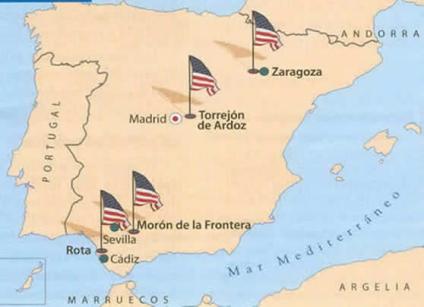
US military bases in Spain (Map from sutori.com)

No Spain, no gain? It was probably inevitable that President Donald Trump’s trade war would eventually get mixed up in his actual war.

Earlier this week, Spanish officials said they would prohibit American forces from using joint bases for war operations, unless those activities were covered by the United Nations Charter. Spanish Prime Minister Pedro Sánchez said his country would not “be complicit in something that is bad for the world”, the Associated Press reports.

On Tuesday, Trump declared that he intended to “cut off all trade with Spain”.

You might wonder: What legal authority does Trump have to unilaterally impose these sorts of revenge tariffs? After all, the Supreme Court ruled not that long ago that the authority Trump had been using to unilaterally impose tariffs based on his whims was unconstitutional. You might as well ask: On what legal authority did Trump launch a war against Iran? In theory, under the Constitution, Congress is supposed to authorize both tariffs and wars. In practice, they, uh, don’t.

Trump just does things, and the annoying constitutional worrywarts can figure it out later. (I say this as an annoying constitutional worrywart.)

In any case, yesterday, the Trump administration announced that Spain had changed its tune. “The U.S. military is coordinating with their counterparts in Spain”, White House Press press secretary Karoline Leavitt said. The implication was that the tariff threats had worked.

Spain, however, said otherwise. “I can refute (the White House spokesperson)”, Spanish Foreign Minister José Manuel Albares said. “The position of the Spanish government regarding the war in the Middle East, the bombing of Iran and the use of our bases has not changed one iota.” Maybe those tariff threats aren’t as effective as Trump thinks?

In a speech, Sánchez warned that the war could spin out of control. “Nobody knows for sure what will happen now”, he said. “Even the objectives of those who launched the first attack are unclear. But we must be prepared, as the proponents say, for the possibility that this will be a long war, with numerous casualties and, therefore, with serious economic consequences on a global scale.”

Sánchez also implicitly admonished Trump for escalating the war: “You can’t respond to one illegality with another because that’s how humanity’s great disasters begin”.

I will just note that in the Star Wars prequels, the fall of the Republic, and the descent into darkness and imperial rule, began with a planetary blockade and a trade war. At the time, people said it was wonky and boring. But here we are.

Where is Congress? The Constitution was built around the idea that each branch would fight to preserve its own powers, and this would create a system of checks and balances. But in Trump’s second term, Republicans in the legislature have been actively fighting to not preserve their power.

Yesterday, in a 47–53 vote, Senate Republicans voted against a resolution that would have required Trump to ask Congress to sign off on any further military aggression in Iran. Sen. Rand Paul (R–Ky.) voted with Democrats in favor of the measure; Sen. John Fetterman (D–Pa.) joined Republicans to vote against it.

The measure was mostly symbolic. Even a successful vote would have been subject to a House vote and a presidential veto. And the position of both the White House and the GOP Speaker of the House is that this whole situation in which America is spending billions of dollars dropping thousands and thousands of bombs on military and political targets in a foreign country is not, in fact, a war. Nothing to see here. Everyone in Congress can go home and crack open a beer.

The latest CF-188 upgrade program, Hornet Extension Project, HEP

Filed under: Cancon, Military, Weapons — Tags: , , — Nicholas @ 02:00

Polyus
Published 10 Nov 2025

The CF-18s are getting old. Designed in the 70s, they were introduced into Canadian service in 1982, so they’re basically as old as me and yet they’re still flying on the front line. Of course they’re not the same planes today that they were back in 1982. They’ve gone through some changes along the way.

This video is intended to be an overview of the most recent upgrade program to the CF-188 Hornet, called the Hornet Extension Project. And yes that’s its official name but everyone calls it the CF-18, including me.

0:00 Introduction
1:37 Capability Gap
2:30 HEP-1
3:05 HEP-2
4:36 Conclusion
(more…)

QotD: Operations, strategy, and tactics

Filed under: History, Military, Quotations — Tags: , , — Nicholas @ 01:00

Operations is the middle layer of military analysis, below strategy and above tactics. Operations concerns the movement of forces (often over multiple lines of advance to fully utilize the transportation network available) and their logistical support. Fundamentally, operations are about getting forces to the objectives specified in your strategy with sufficient supply to sustain themselves, so that once there they can employ your tactics to achieve victory. The specific task of crafting operations which will achieve a set of strategic objectives is called “operational art” in US doctrine. Operational failures typically manifest as logistics and maneuver failures – particularly operational plans with unreasonable timetables – both of which have been particularly in evidence in the initial Russian invasion [of Ukraine in 2022].

[…]

Strategy is the upper layer of military analysis. Fundamentally strategy concerns the identification of final objectives, the way those objectives can be achieved and the resources to be used to achieve those objectives; these three components of strategy in US doctrine are termed “Ends, Ways, and Means” respectively. Strategy is thus the “big picture” thinking behind an action, including the decisions to both commence hostilities and end them.

[…]

Tactics are the lowest layer of military analysis. Tactics concern the methods to be used to win battles. Things like flanking, suppressive fire, ambushes, etc. are tactics. A military’s tactical system is often spelled out in doctrine. In theory, operations is designed to deliver forces to battles in such a way (positioning, comparative force, etc.) that their tactics can win those battles, while strategy should aim to ensure that winning those particular battles will achieve the desired political end (whatever concessions are desired). It is important to distinguish actions which are strategy (designed to directly produce a desired end to the conflict) from those which are merely tactical (designed to achieve a local success or advantage in a given engagement). It is important when assessing failures in war to distinguish between strategic failures (typically a failure to come up with realistic goals and the means to reach them), operational failures (e.g. logistics failures or unreasonable maneuver timetables) and tactical failures (e.g. failure to use combined arms effectively).

Bret Devereaux, “Miscellanea: A Very Short Glossary of Military Terminology”, A Collection of Unmitigated Pedantry, 2022-03-25.

Powered by WordPress



