Quotulatiousness

March 24, 2026

More political and philosophical illusions, left and right

Filed under: Media, Politics, USA — Tags: , — Nicholas @ 05:00

Tom Kratman continues his discussion of the illusions that distort how people on the left and people on the right view reality:
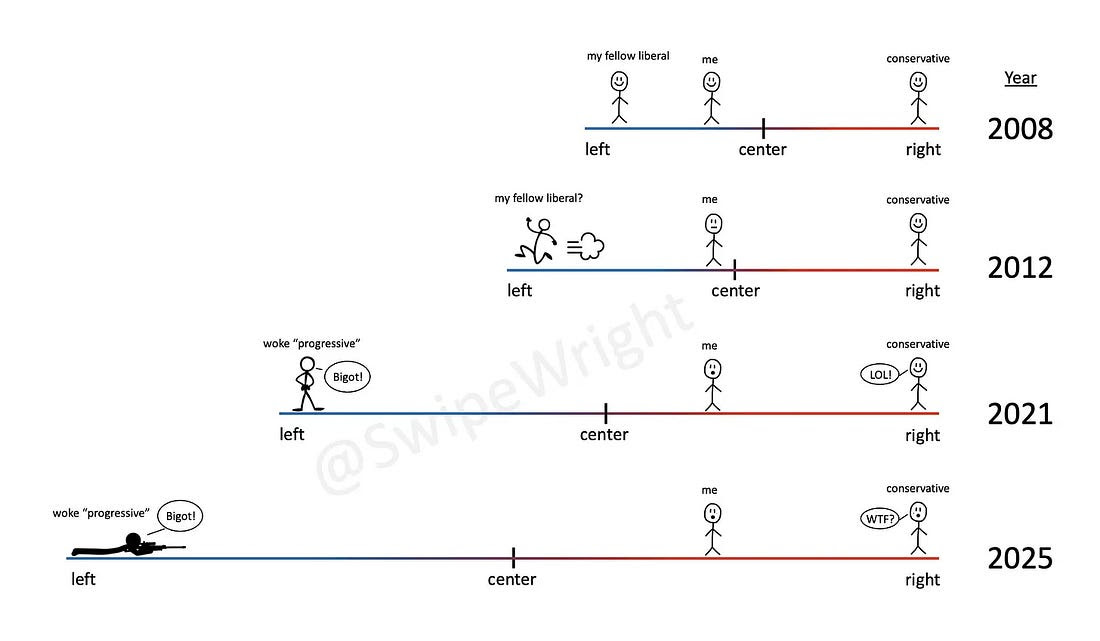
There is an illusion – yes, on both sides – of guilt by association. This is related to, but not exactly the same as, the illusion of indistinguishability. How many nail-bomb-building moral sons of Bill Ayers are over on the modern American left? Can’t be too many, I think, based on the serious dearth of Earth-shattering kabooms we hear, or rather don’t hear, lately. How many hair-shirted and sandwich board clad – with said boards reading, “Repent! The end is near!” – folks are there on the religious right? Based on how the typical Christian lives, and those being by no means a particularly bad set of men and women, there aren’t all that many. How many Christians do you really think, given a button that would make the Westboro Baptist Church and all its members go poof, wouldn’t push that button twice, the first time slowly, for the emotional satisfaction (well, that and to savor the screaming1), and the second time, quickly, to make sure. How many leftists and liberals are dead set against gun control? More than a few.

Then there’s the illusion brought on by willful blindness. For example, “No enemies to the left!” said Alexander Kerenski, Prime Minister of Russia, in 1917. Pity Kerenski wasn’t able to see that the people to his left were largely intellectual idiots and dogmatic homicidal maniacs, and that there may have been people to his right who were considerably more reasonable and sane. He said that not too long before being tossed out on his ear by the Bolsheviks, who, interestingly enough, were to his left.

You don’t see as much of this – the notion that there are no enemies to the right – on the conservative side, by the way, though there is some. Still, the next time I see an actual conservative lining up with the American National Socialist Party,2 the KKK, or Stormfront will be the first.

Part of the problem here, I think, is that we take something – civilization, actually – so much for granted that we forget how hard it is to build or to hold onto, and so forget that we have something important in common with our more moderate political opponents. Thus, taking it for granted, we forget that common ground, see the opposition, and so line up with those more extreme sorts for whom civilization is probably just a burden they’d as soon be done with.


  1. Okay, maybe some would just push it the once.
  2. Which seems to have many trivial manifestations. You can find your own links, but why bother?
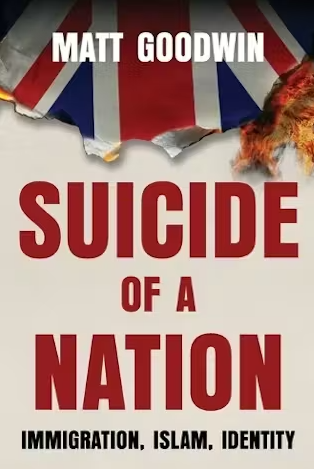
“Matt Goodwin’s Suicide of a Nation is a very bad book”

Filed under: Books, Britain, Media, Politics — Tags: , , , , , — Nicholas @ 04:00

In The Critic, Ben Sexsmith reviews a new book by Matt Goodwin, Suicide of a Nation: Immigration, Islam, Identity:

Here is an exceptionally easy argument to make:

  1. Mass migration is ensuring that the historical majority in Britain is becoming a minority.
  2. This is the result of policies that have been pursued regardless of popular opinion.
  3. This has had many kinds of destructive consequences.

The first claim is so obviously true that one might as well deny the greenness of the grass. The second is proven by decades of broken promises (see Anthony Bowles’s article “Immigration and Consent” for more). The third requires argumentation, but I think that it is clear if one considers hideous incidences of terrorism, grooming gangs and violent censoriousness, as well as broader trends of economic dependency and electoral sectarianism.

Again, this is not a difficult argument to make. So why is it made so badly?

Matt Goodwin’s Suicide of a Nation is a very bad book. It reads like the book of a political operator extending his CV. The left-wing commentator Andy Twelves caused a stir on social media by pointing out various factual mistakes and what appear to be non-existent quotes. Twelves speculates that these “quotes” are the result of AI hallucinations, which is plausible, if not proven, in the light of the fact that two of Mr Goodwin’s sparse footnotes contain source information from ChatGPT.

Inasmuch as Suicide of a Nation makes a form of the argument sketched out the beginning of this article, there is truth to it. But it contains a fundamental problem — it assumes that this argument is so true that there is no requirement to make it well.

“Slop” is an overused term but it feels painfully appropriate for a book that is spoon fed to its audience. Goodwin, who had a long academic career before becoming a successful commentator, is not a man who lacks intelligence. But he writes as if he thinks his audience lacks it. “I did not write this book for the ruling class”, writes Goodwin, “I wrote it for the forgotten majority”. Alas, he seems to think that the average member of the “forgotten majority” has the reading level of a dimwitted 12-year-old. As well as being stylistically simple, the book is full of annoying paternal asides. “In the pages ahead I shall walk you through what is happening to the country …” “In the next chapter we will begin our journey …” Thank you, Mr Goodwin. Can we stop for ice cream?

The book is terribly derivative, with a title that reflects Pat Buchanan’s Suicide of a Superpower and a subtitle — “Immigration, Islam, Identity” — that all but repeats that of Douglas Murray’s The Strange Death of Europe — “Immigration, Identity, Islam”. It is written in the humourless and colourless rhetorical style of AI. I’m not saying it was AI-generated. (Indeed, a brief assessment using AI checkers suggests that it was not.) I’m just saying that it might as well have been.

“We will no longer rely on others to defend our Arctic security”

Filed under: Cancon, Government, Military — Tags: , , , — Nicholas @ 03:00

In The Line, Matt Gurney reacts to Prime Minister Mark Carney’s unforced confession that Canada has been freeloading on US military protection for generations and yet is only now making the beginnings of moves to address it:

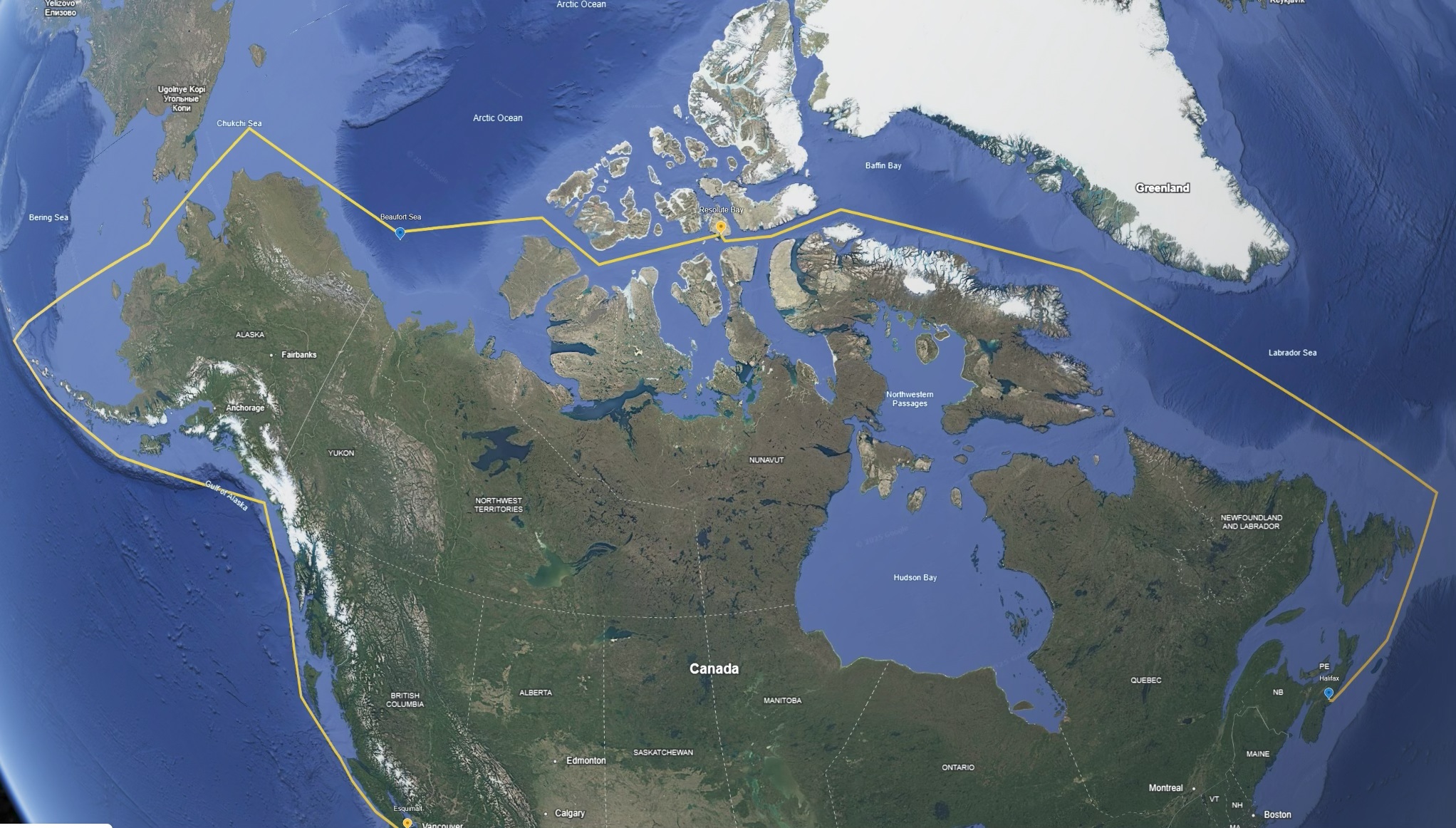
Rough transit routes to Canada’s Arctic from Esquimalt BC and Halifax NS

There is a fascinating if glum confession buried inside Prime Minister Mark Carney’s recent announcement, given in the company of Canadian Armed Forces personnel in Yellowknife, of how Canada will spend $35 billion to build and upgrade existing military infrastructure. The major spending announcement was augmented by Carney’s promise to submit four northern road, electricity and port projects to the Major Projects Office for expedited (we hope) approval and completion.

The announcements are interesting, even if the bulk of the military spending was actually just re-announcing stuff Justin Trudeau had announced years ago. Nothing new there, alas. Even so, it was the phrasing of the PM’s remarks that jumped out at me. Striking a familiar tone, Carney said, “We will no longer rely on others to defend our Arctic security or to fuel our economy. We are taking full responsibility for defending our sovereignty.”

I like it! I’m glad we’re doing it.

What the hell were we waiting for? How did we ever get to a place where no longer relying on others to defend our security and fuel our economy became a decisive shift in policy worth highlighting in an announcement?

What was wrong with us?

This is not a column aimed at Carney. I’ve been dismayed and discouraged by a lack of progress on some key files so far, but I will grant that we won’t be able to truly judge this announcement for some time, and that he does at least seem more interested than other recent PMs in getting Canada’s military capability back to where it must be. So, for all the Carney fans out there, you can sheath your swords. I get it. I’ll keep watching and waiting, but my impatience is growing.

But I still think the broader question is still worth asking, even if we agree, for now, to leave Carney himself out of it. Why were we relying on others to defend our own territory? Or fuel our economy? Why were we not taking full responsibility for defending our sovereignty? How did that even happen?

There are some admitted historical factors here, including the fact that Canada was spun up as an independent state out of the British Empire, and obviously counted on the support of that empire for much of our early history. That set a tone, clearly. In more recent generations, there was also the obvious reality that the United States’s desire for continental security was always going to involve a lopsidedly large U.S. commitment, just due to the massive disparity between our populations and economies.

Let’s grant that at the outset. Our history and geography have conditioned us to view domestic defence as a collaborative effort where we are a junior partner even in our own territory — maybe not in a legal sense, but in practical one.

The point here isn’t to lament that Canada never had a fleet as large as the Royal Navy in the 1910s, nor an air force as large as the U.S. Air Force in the 1950s. We can all agree and understand that Canada’s contribution was always going to be more modest and given our massive landmass and air and sea approaches, Canadian defence was always going to be made much simpler with the cooperation of a friendly larger ally or benefactor.

But gosh, we really leaned into the helplessness, didn’t we?

Matt is happy that the PM seems more involved in taking Canadian territorial defence seriously, and there’s no dispute that this is a national concern that has been neglected for … well … decades, generations even. I’ve heard some attribute the withering of Canada’s defence establishment to the “peace dividend” after the collapse of the Soviet Union, but it actually began in 1968 with the first Trudeau era. We’re not going to be able to rectify six decades of neglect in a couple of years, no matter how many new programs and purchases are announced.

And not to be a Debbie Downer, but remember that the federal government has been addicted to the sugar high of making announcements and getting tongue-bathed by the tame media enough that the same project would get announced and re-announced for sometimes years before anything tangible resulted. The new Arctic defence announcements were, as Matt noted, already stated government policy before Carney entered politics. How many more dips in the PR bath will it take before anything real is implemented?

Baking the Original Apple Pie from Medieval England

Filed under: Britain, Food, History — Tags: , , , , — Nicholas @ 02:00

Tasting History with Max Miller
Published 16 Sept 2025

Hot water crust pie filled with mashed apples and pears with raisins, figs, and spices

City/Region: England
Time Period: c. 1390

This is the first recorded recipe for apple pie, written in England around 1390 in The Forme of Cury. As many historical recipes are, this one is bare bones and leaves a lot of room for interpretation. The “good spices” in the recipe could mean basically any combination of spices you like. I think this is probably referring to a popular medieval spice mixture called poudre douce, whose exact contents varied from cook to cook. Popular spices included cinnamon, nutmeg, mace, black pepper, long pepper, cardamom, ginger, galangal, and cloves, so feel free to experiment and make up your own.

Whichever spices you use will affect how familiar or exotic the pie tastes, and I really enjoyed the version I made. It’s not too sweet with most of the sweetness coming from the fruit, and I found the spices to be really strong but really pleasant. Unlike modern apple pies, the filling is more of a compote texture, but it holds together nicely. It’s a perfect recipe to try for the fall.

    For to make Tartys in Applis.
    Tak gode Applys and gode Spycis and Figys and reysons and Perys and wan they are wel ybrayed coloured with Safron well and do yt in a cofyn and yt forth to bake wel.
    The Forme of Cury c. 1390

(more…)

QotD: Citizens of a polis

Filed under: Europe, Greece, History, Quotations — Tags: , , , , — Nicholas @ 01:00

A polis is most importantly made up of the citizens, the politai (singular polites (πολίτης), plural politai (πολῖται)); indeed, Aristotle says this too in his Politics (Arist. Pol. 1274b): “for the state [polis] is an assembly of citizens [politai].” Now we are used to the idea that most people in a country are citizens of it, but the idea of the politai is much narrower. In its fundamental meaning a polites is a person engaged in the running of the polis; it is an idea defined by political participation. The politai were adult, citizen men; women, children, the enslaved and free non-citizens were all excluded from this group. A bit of demographic math might suggest that a modest polis with 2000 inhabitants might thus have just 300-400 politai.

Not everyone born in a polis was a member of the politai. Women could be of citizen status (and thus able to bear citizen children in poleis where that was required), but they could not be citizens at all. Being the male child of citizen parents was generally the core requirement of citizenship and in a democratic polis that was generally enough, but oligarchic poleis typically imposed wealth qualifications for political participation so not everyone born to citizens might themselves be a polites if they ended up too poor to meet the requirements. The terms astos and aste (ἀστός and ἀστή), “townsman” and “townswoman” respectively, might be used to make this distinction between the politai and people who were “merely” natives of the polis but barred for whatever reason from political participation. These distinctions become a lot more meaningful when you realize the point Aristotle is making defining the polis this way: if the polis is a community of politai then the residents of a polis (the physical space) who are not citizens are not members of the polis (not merely, we might imagine, non-participatory members).

Now the politai themselves also existed in subdivisions. We’ve mentioned division into demes or neighborhoods; while notionally geographic, demes could become hereditary (and indeed did become so in Athens). In Sparta and some poleis on Crete, citizens were divided into mess groups (syssitia or andreia). But by far the most common and important such division was into “tribes” or phylai (φυλαί, sing. φυλή), inherited kinship groups that often formed the largest subdivision of the politai of a polis, with even very small poleis having attested divisions into phylai in some cases (e.g. Delos as noted by M.H. Hansen in “Civic Subdivisions” in the Inventory). The politai might also be subdivided by other groupings like phratria (brotherhoods) and indeed a polis might have multiple such groupings, either neatly nested (as in Athens’ demes sorted into thirty trittyes sorted into ten phylai to make up the citizen body) or they might confusingly cross-cut each other.

There’s another key distinction between the politai – or at least men who might be politai – which isn’t a legal distinction but nevertheless matters for understanding how the Greeks imagined civic governance: the distinction between the few (hoi oligoi) and the many (hoi polloi). The few were the economic elite of the politai – the wealthy landowners – and the dominant group in oligarchies. A few terms might signify this group: “the few” (οἱ ὀλίγοι – hoi oligoi) or “the best” (οἱ ἄριστοι – hoi aristoi), or “the rich” (οἱ πλούσιοι – hoi plousioi) and can also be part of the meaning of the appellation “beautiful and good” (καλὸς κἀγαθός = καλὸς καὶ ἀγαθός – kalos kagathos) which translates more idiomatically to something like “gentleman” with an implication of both good conduct (especially in war) and high status. At its broadest reach, the few might consist of those politai with enough wealth to serve as hoplites, though it seems in most cases this group is understood much more narrowly and might be defined by heredity in addition to wealth in some cases.

In contrast to the few were, of course, the many. Once again a few terms might signify this group: “the many” (οἱ πολλοί – hoi polloi or οἱ πλῆθος – hoi plethos) or “the poor” (οἱ ἀποροῖ – hoi aporoi) or the people (δῆμος – demos), the last of which gives us the word democracy – rule by the demos. At its narrowest extent, these are all of the people too poor to serve as hoplites but who would otherwise be politai; in fact in a democracy they are politai, but in closed oligarchies they may not be. More broadly the concept of the demos can encompass all of the politai, both wealthy and poor, especially in a democratic context. Nevertheless the Greeks often understand these two groups as oppositional and non-overlapping: the politai composed of “the few”, with money and high status lineages and “the many”, without that, but with far greater raw numbers.

As we’ll see, it is that distinction – between “the few” and “the many” which the Greeks used to define the different forms of polis government, what they called a politeia (πολιτεία), which we might translate as “constitution” with the caveat that these are not written constitutions. And that’s where we’ll go next: now that we have our subdivisions, we’ll discuss next week the different ways they are organized and governed.

Bret Devereaux, “Collections: How to Polis, 101: Component Parts”, A Collection of Unmitigated Pedantry, 2023-03-10.

Powered by WordPress