Quotulatiousness

March 30, 2026

Canada’s official bilingualism benefits only one of the two “founding” peoples

Filed under: Cancon, Government, Politics — Tags: , , , — Nicholas @ 05:00

Canada has been officially a bilingual country for decades, but it hasn’t made most Canadians capable of effective use of both official languages, especially in the western half of the country. Instead, with the imposition of mandatory bilingualism for most federal civil service roles, it’s functioned as a strong bias in favour of bilingual Quebeckers and against Canadians from majority anglophone provinces. Given that government jobs have been growing at a far faster rate than private-sector jobs, this injustice is fuelling anger and support for separatism in the west:
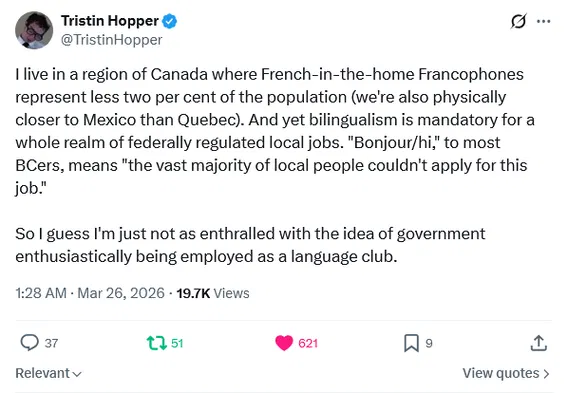
This is why French Immersion schools function as “private schools for the middle class” … it provides access to lucrative and secure government jobs for the children of the bourgeoisie, excluding most working class kids.

It’s a uniquely ridiculous Canadian story.

Two Canadian pilots were killed in a freak accident at LaGuardia airport and yet Canadian news coverage has been dominated by outrage over the fact that the CEO of the pilots’ airline, Michael Rousseau of Air Canada, released a condolence video that had French captions but no spoken French!

Though one of the two dead pilots was French Canadian, near as I can tell, none of the anger at Rousseau’s video is coming from anyone associated with the victims themselves, but rather the Canadian political class and punditocracy. Prime Minister Carney denounced the video for lacking “judgment” and “compassion,” and a bunch of other politicians have said similar things, particularly in Quebec, where the legislature passed a unanimous motion demanding Rousseau’s resignation. There have been a ton of angry anti-Rousseau editorials in all the leading Canadian papers.

It is obviously a highly performative, almost ritualistic, almost religious outrage occurring mostly so members of the Canadian establishment can collectively affirm one of their shibboleths: the country’s elite should be bilingual.

On social media, however, the reaction has been quite different, with ordinary Canadians expressing frustration and annoyance at the distasteful nature of it all. Two men are dead and this is what our betters are yapping about? An old debate — long stigmatized, but never successfully suppressed — has resurfaced: why are we doing this bilingualism thing at all?

I’ve been arguing against the Canadian elite’s cult of official bilingualism for a very long time. To the extent I have a controversial reputation in Canada and don’t get invited on things very much, it’s in large part because I’m very outspoken on this issue, which is often treated as the one line you’re not allowed to cross. Hating trans people or saying October 7 wasn’t so bad … those are edgy opinions that can be forgiven. Questioning bilingualism is a much more unforgivably toxic take, because it’s seen as offending Quebeckers, and a lot of elite Canada wants to be on Quebec’s good side.

But I also feel this is one issue where I’m very, very obviously in the right, and where I have the least self-doubt. There aren’t many issues where I feel I could hold my own in some Jubilee-style “Surrounded” debate bro type thing, but this is one.

So, with that being said, let me attempt to engage with some of the arguments you see made in favor of not just official bilingualism, but the idea of Canada requiring a bilingual ruling class in particular.

Canada is a bilingual country, so it makes sense for the Canadian government, and other Canadian national institutions, to provide nationwide services in both French and English.

Canada is a bilingual country by law, but not by fact. Canada is in fact an overwhelmingly English-speaking country. According to the 2021 census, 87% of Canadians can speak English while 11% can speak only French and about 2% can speak neither. Of this four million Canadians who can only speak French, 96% are located in the province of Quebec. Excluding Quebec, the rate of Canadians who can speak English rises to 97.8%.

It’s sensible for things in Quebec to function mostly in the French language, given about 94% of people in the province can speak it. It’s sensible for things outside of Quebec to operate mostly in English for the same reason. In both Quebec and the rest of Canada there is a very small minority of people, mostly in urban centers, who cannot speak the dominant language of where they live, so it’s reasonable for accommodations to be made for their needs on a case-by-case, community-by-community basis.

What is decidedly not reasonable, however, is to blindly organize all public (and in some cases, private) operations in this country as if there exists some substantial unilingual French-speaking minority everywhere from Newfoundland to Nunavut that is helpless without services specifically tailored to them — a minority in need of French-speaking receptionists and clerks and cops and teachers and librarians and journalists and guides and managers and lawyers and judges and HR departments and all the rest, all accessible at all times, anywhere in Canada.

For Canada’s service sector to go above and beyond in seeking to accommodate the needs of a unilingual French population in provinces and territories outside of Quebec that either barely exists or is substantially overshadowed by other linguistic minorities is to engage in a preposterous misallocation of resources simply to pay tribute to a bilingual fantasy version of Canada that’s never actually existed.
Net Zero or mass immigration, pick one (or better, pick neither)

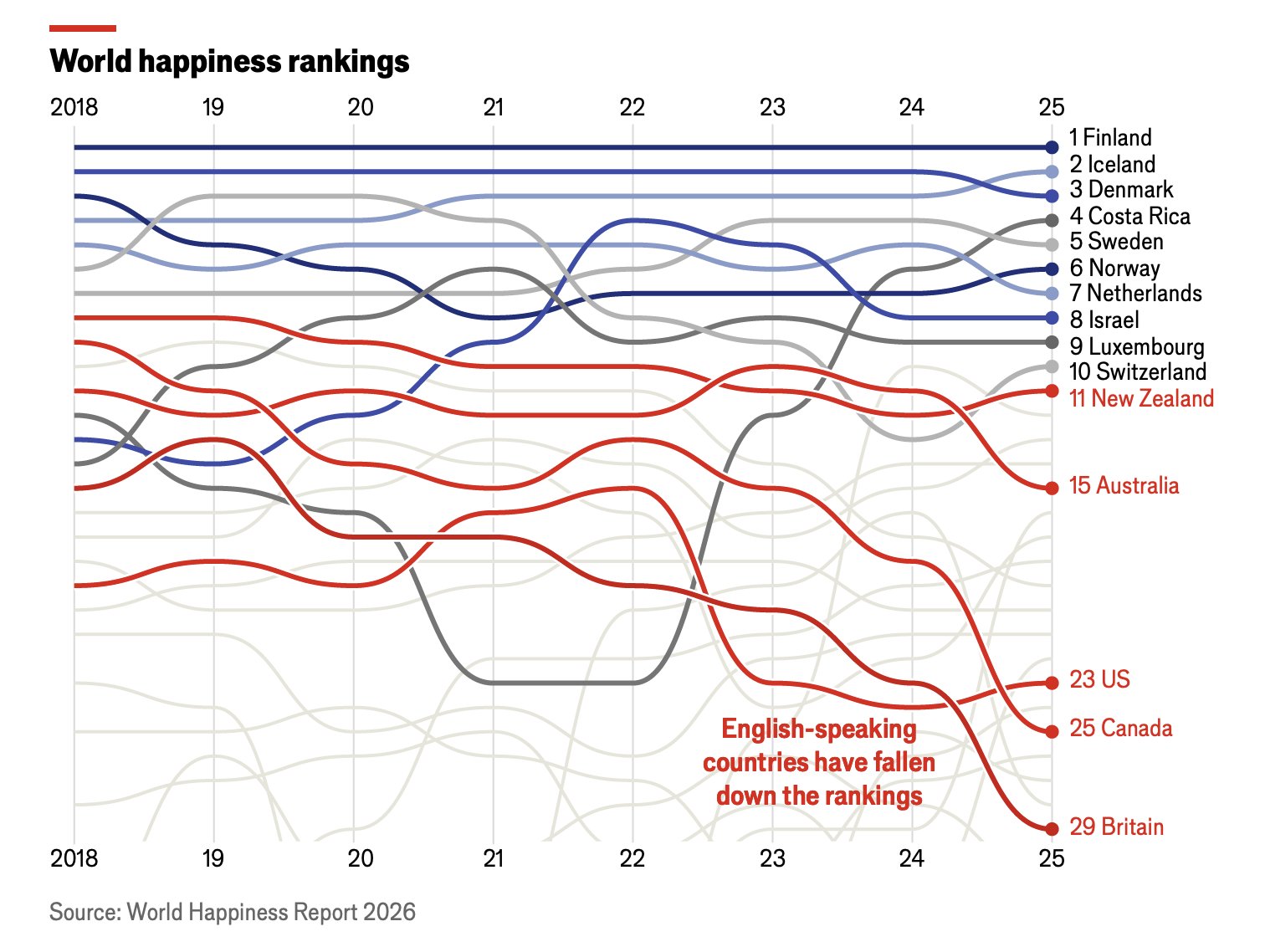
Lorenzo Warby points out the blindingly obvious (to anyone with common sense) fact that the top two pet projects of western transnationalist elites — Net Zero and mass third-world immigration — are in direct conflict with one another. But rather than choosing one form of societal suicide over the other, the healthy alternative is to absolutely reject both:

Culturally more homogeneous democracies are happier than more culturally diverse democracies. Also, in the Anglophone countries, where the centre-right won the most recent national election, happiness went up slightly. Where the centre-left won the most recent national election, happiness went down noticeably.

Australia is the latest developed democracy to experience conventional centre-right politics being threatened by a national populist surge. Just as country-club Republicans were Trumped, Gaullists were Le Penned, Forza Italia was Melonied, and the Tories are being Faraged, so the Liberal-National Party Coalition in Australia is getting Hansoned.

What Australia has in common with the pattern in the UK, and the rise of AfD (Alternative for Deutschland) in Germany, is the combination of Net Zero (or equivalent) with mass immigration leading to a national populist surge.

National populism well predates Net Zero. It does not predate the adoption of policies of elite display and elite benefit, particularly regarding immigration. The combination of Net Zero with mass immigration is, however, particularly conducive to surges electoral support for national populism, as we can see in the UK, Germany and now Australia.

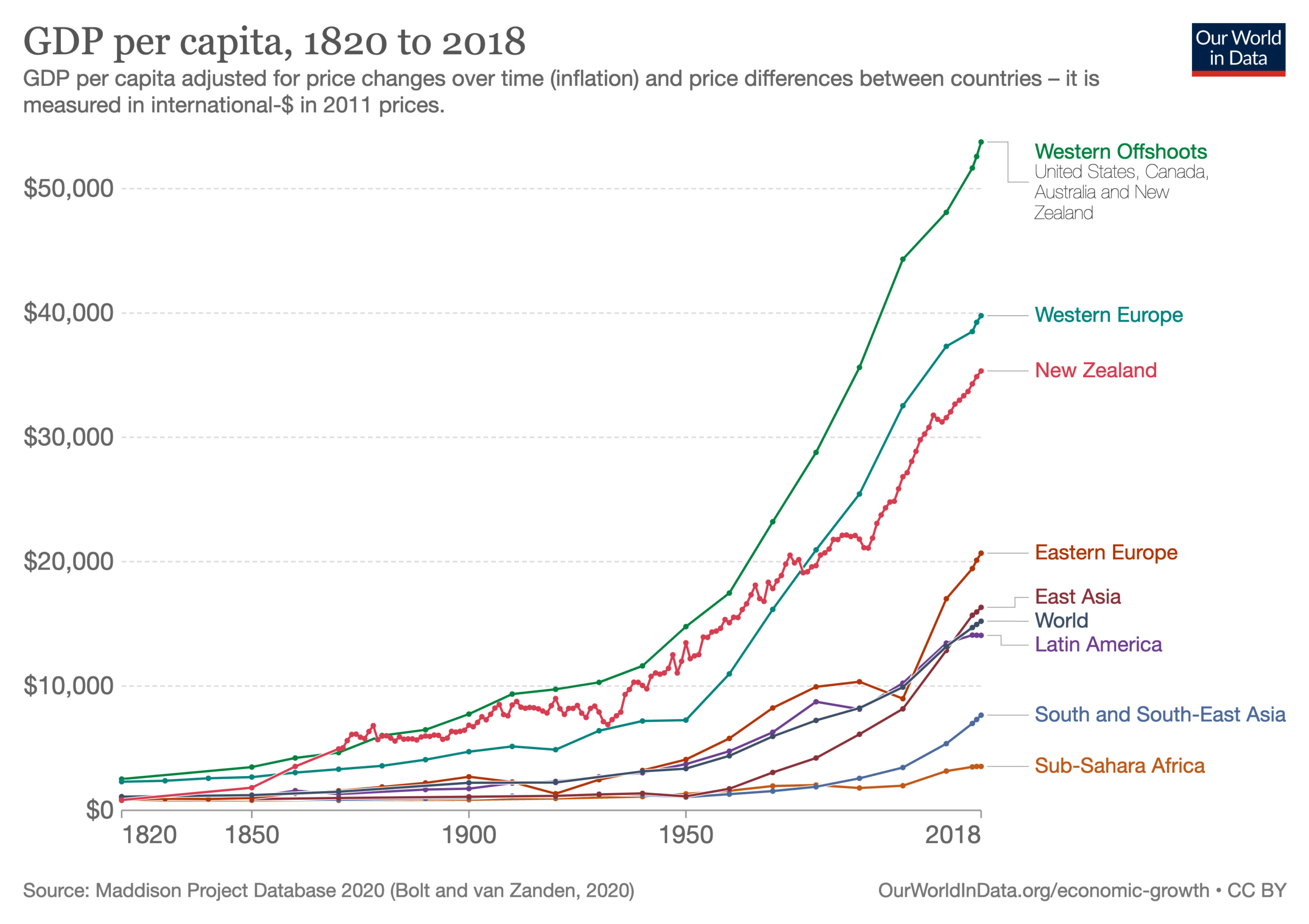
It is not hard to see why. Mass prosperity rests on cheap energy: that is much more important than, for instance, free trade. The Industrial Revolution is really the Mass Access To Cheap Energy Revolution. It is that access that is above all else responsible for The Great Enrichment.

As economic historian Jack Goldstone notes:

    by 1850 the average English person has at his or her disposal more than ten times the amount of moveable, deployable fuel energy per person used by the rest of the world’s population.

Net Zero means raising the price of energy, thereby narrowing access to it, and, in particular, narrowing the range of economic activity that is commercially sustainable. Even without increasing the population, that will increase contestation over resources.

Add mass immigration to the mix, and that contestation becomes much worse. All the experienced costs of mass immigration — higher rents and house prices; increased congestion; downward pressure on wages and increased fiscal stress (if importing significant numbers of low-capital/skill immigrants); downward pressure on social trust and corrosive effects on the norms and rules that underpin institutions (if importing lots of people from very different cultures); increased crime (if importing significant numbers of people from higher crime cultures) — are then magnified.

Canada’s immigration fraud system

Filed under: Cancon, Government — Tags: , , , — Nicholas @ 03:00

As Alexander Brown points out, “the purpose of a system is what it does”, and Canada’s immigration system produces vast amounts of fraudulent immigrants with only token attempts to detect and punish it. So Canada actually has an Immigration Fraud System, because that is what it does:

Let’s be clear about immigration fraud.

It started at the top. It was on purpose. And it’s still happening on purpose.

After a week of damning reports, and even a craven disregard for a return to decency, it has become abundantly clear that the government’s much-touted “reforms” are more about managing political perception than fixing a broken system. Behind the rhetoric lies a reality of widespread fraud, a continued lack of oversight, and an immigration department which has lost even greater control of its own bastardized mandate.

One of the most glaring failures has been the confirmed explosion of fraud within the international student program. Earlier this week, a scathing report from the Auditor General revealed that the IRCC failed to investigate the vast majority of cases flagged for potential fraud or non-compliance. Out of 153,000 cases identified in 2023 and 2024, only about 4,000 investigations were actually launched — a measly 2.6%. Even more troubling, 40% of these investigations were simply dropped because the students didn’t bother to respond to emails.

Speak to industry insiders and they’ll tell you that a “pay-to-play” market ran rampant between the years of 2021-2024, almost entirely on the basis of an understanding that fraudulent letters of acceptance, through equally dodgy institutions, would not be investigated through official immigration channels.

Let us not forget, even Ontario Premier Doug Ford touted this unvetted explosion — the worst policy decision in our nation’s history — as a success story. And yes, his office assisted in building for Conestoga, the worst offender of all the nation’s illegitimate institutions.

This culture of non-enforcement extends to the asylum system, which has seen a massive surge in claims. Since 2015, the backlog of refugee claimants has grown by a staggering 2,900%. While the government speaks of protecting the “vulnerable,” critics (read: normal people with morals and scruples) point out that the system is being exploited by those using it as a legal strategy to stall their removal from Canada. International students have spammed asylum claims after striking out in the labour force, making the trend so obvious that even then-immigration minister Marc Miller admitted it “[didn’t] smell good.”

Record levels of asylum fraud, in the six figures, is no mere matter of paperwork. The programme has become the safe haven for serial extortionists, varying degrees of triggermen from the Indian subcontinent, and those who have exploited a key loophole in the Safe Third Country Agreement: Canadian judges no longer care to enforce the law.

UOTCAF – EP 001 – The Royal Canadian Regiment – SWG

Filed under: Cancon, History, Military, WW1, WW2 — Tags: , , , , , , — Nicholas @ 02:00

Stormwalker Group
Published 24 Oct 2025

Dive into the rich legacy of the Royal Canadian Regiment (RCR) in the premiere episode of “Units of the CAF”, hosted by ex-reservist Mario Gaudet.

This 15-minute narration explores the RCR’s origins in 1883 as Canada’s first permanent infantry unit, the symbolism of their iconic “VRI” cap badge, unique uniform features, and their heroic battles from the North-West Rebellion to Afghanistan. We also spotlight some of the regiment’s most decorated soldiers.

Whether you’re a history buff, military enthusiast, or proud Canadian, this series honors the sacrifices and traditions of the Canadian Armed Forces.
(more…)

QotD: The Revenge of the Archaeologists

Filed under: Europe, History, Quotations, Science — Tags: , , , , — Nicholas @ 01:00

Before we dive into the evidence, I want to speak briefly to the nature of the evidence for these topics. “Historian” is often an odd sort of field because while there is a core discipline and skill set that basically all historians are going to have (focused on reading texts critically and assessing arguments and evidence), beyond this almost all historians end up acquiring other skill sets, often from other fields, depending on what they are investigating. I, for instance, work on military history and so I need to have some mastery of military theory, whereas an intellectual historian might instead have some training in philosophy.

It is thus relevant that over the past half-century or so, it has so happened that effectively all ancient historians have had to develop a strong grasp of archaeological data; we don’t all necessarily learn to do the excavation work, of course (that’s what archaeologists do), but pretty much all ancient historians at this point are going to have to be able to read a site or artifact report as well as have a good theoretical grasp of what kinds of questions archaeology can be used to answer and how it can be used to answer those questions. This happened in ancient history in particular for two reasons: first, archaeology was a field effectively invented to better understand the classical past (which is now of course also used to understand the past in other periods and places) so it has been at work the longest there, but also because the sources for ancient history are so few. As I like to say, the problem for the modern historian is taking a sip of meaning from the fire-hose of evidence they have; but the challenge of an ancient historian is finding water in the desert. Archaeological data was a sudden, working well in that desert and much of the last two decades of ancient history has been built around it. Other fields of history are still processing their much larger quantity of texts; why dig so deep a well when you live next to a running river?

The result, in ancient history, has been what I tend to refer to as “the revenge of the archaeologists”. Not, mind you, revenge on medievalists, but in fact revenge on a very specific ancient historian and classicist, Moses Finley. Moses Finley was, from the 1950s to the 1980s, one of the most prominent classicists and his work touched on many fields, including the study of the ancient economy. Finley, writing in the 1960s was generally skeptical of the ability of archaeology to provide useful answers about the ancient economy (he preferred to understand the question by probing the mentalities of the Greek and Roman elite). Archaeology, Finley thought, was frequently over-interpreted and could never give a representative sample anyway; as he quipped in his 1965 article “Technical Innovation and Economic Progress in the Ancient World”, “we are too often victims of that great curse of archaeology, the indestructibility of pots”, a line for which, as far as I can tell, he is still quite unforgiven by some archaeologists.

As if in response, the archaeologists have spent the subsequent almost-six-decades proving again and again the tremendous value of their discipline by, among other things, utterly burying Finley’s The Ancient Economy (1973) under a mountain of archaeological data. It turns out the mentalités of aristocrats who largely hated merchants were not a good barometer of the activities of those merchants.

But you may now guess how this is going to play out in the discussion of Late Antiquity. The ancient historians come to the question ready to think in archaeological terms and ask what archaeological data can do to clear up these questions. Scholars of Late Antiquity trained as medievalists on the other hand, may or may not be well versed in archaeological methods or data (to be clear, some medievalists very much are versed, including prominent voices on the “change and continuity” side of this debate! But it is also very possible to be a “pure text” medievalist in a way that I don’t think I know a “pure text” ancient historian younger than sixty) because their field has not been forced, by dint of the paucity of sources, to revolve so heavily around archaeological data and because the archaeological data on the Middle Ages is not yet as voluminous as that on Classical Antiquity.

As I noted in the first post, beginning in the 1970s, what James O’Donnell calls the “reformation in Late Antique studies” launched a long overdue reassessment of Late Antiquity and the impact of the Fall of Rome – what we’ve called the “change and continuity” argument. I bring up all of this to note that the “counter-reformation” – what we’re calling the “decline and fall” argument – that really emerges beginning in the 90s is in many ways an extension of the “revenge of the archaeologists” in Classical studies (and especially the ancient economy) into the field of Late Antiquity. Indeed some of the scholars are the same (e.g. Willem Jongman) and many of them enter the debate on Late Antiquity as an extension of the debate about the Roman economy (in part demanding that “change and continuity” Late Antique scholars acknowledge things now generally considered “proved” by ancient historians about the earlier Roman economy).

In my own experience, particularly in more informal conversations, the methodological difference that interaction creates between ancient historians – for whom it has long been almost entirely settled that in a “fight” between archaeological evidence and effectively any other kind, the archaeological evidence “wins” – and medievalists for whom archaeology is a much less central part of their method (in part because their textual sources are more extensive) can lead to situations where the two sides of the debate talk past each other.

But when it comes to questions of demographics, economics and the conditions of life for the sort of people who rarely figure in our sources, archaeological evidence – although it is often incomplete and hard to interpret – offers the possibility of decisive answers to questions that otherwise would have to live entirely within the realm of speculation.

Bret Devereaux, “Collections: Rome: Decline and Fall? Part III: Things”, A Collection of Unmitigated Pedantry, 2022-02-11.

Powered by WordPress