
Canada has been officially a bilingual country for decades, but it hasn’t made most Canadians capable of effective use of both official languages, especially in the western half of the country. Instead, with the imposition of mandatory bilingualism for most federal civil service roles, it’s functioned as a strong bias in favour of bilingual Quebeckers and against Canadians from majority anglophone provinces. Given that government jobs have been growing at a far faster rate than private-sector jobs, this injustice is fuelling anger and support for separatism in the west:
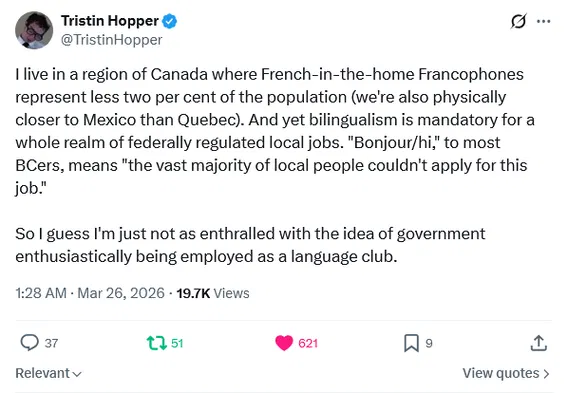
This is why French Immersion schools function as “private schools for the middle class” … it provides access to lucrative and secure government jobs for the children of the bourgeoisie, excluding most working class kids.
It’s a uniquely ridiculous Canadian story.
Two Canadian pilots were killed in a freak accident at LaGuardia airport and yet Canadian news coverage has been dominated by outrage over the fact that the CEO of the pilots’ airline, Michael Rousseau of Air Canada, released a condolence video that had French captions but no spoken French!
Though one of the two dead pilots was French Canadian, near as I can tell, none of the anger at Rousseau’s video is coming from anyone associated with the victims themselves, but rather the Canadian political class and punditocracy. Prime Minister Carney denounced the video for lacking “judgment” and “compassion,” and a bunch of other politicians have said similar things, particularly in Quebec, where the legislature passed a unanimous motion demanding Rousseau’s resignation. There have been a ton of angry anti-Rousseau editorials in all the leading Canadian papers.
It is obviously a highly performative, almost ritualistic, almost religious outrage occurring mostly so members of the Canadian establishment can collectively affirm one of their shibboleths: the country’s elite should be bilingual.
On social media, however, the reaction has been quite different, with ordinary Canadians expressing frustration and annoyance at the distasteful nature of it all. Two men are dead and this is what our betters are yapping about? An old debate — long stigmatized, but never successfully suppressed — has resurfaced: why are we doing this bilingualism thing at all?
I’ve been arguing against the Canadian elite’s cult of official bilingualism for a very long time. To the extent I have a controversial reputation in Canada and don’t get invited on things very much, it’s in large part because I’m very outspoken on this issue, which is often treated as the one line you’re not allowed to cross. Hating trans people or saying October 7 wasn’t so bad … those are edgy opinions that can be forgiven. Questioning bilingualism is a much more unforgivably toxic take, because it’s seen as offending Quebeckers, and a lot of elite Canada wants to be on Quebec’s good side.
But I also feel this is one issue where I’m very, very obviously in the right, and where I have the least self-doubt. There aren’t many issues where I feel I could hold my own in some Jubilee-style “Surrounded” debate bro type thing, but this is one.
So, with that being said, let me attempt to engage with some of the arguments you see made in favor of not just official bilingualism, but the idea of Canada requiring a bilingual ruling class in particular.
Canada is a bilingual country, so it makes sense for the Canadian government, and other Canadian national institutions, to provide nationwide services in both French and English.
Canada is a bilingual country by law, but not by fact. Canada is in fact an overwhelmingly English-speaking country. According to the 2021 census, 87% of Canadians can speak English while 11% can speak only French and about 2% can speak neither. Of this four million Canadians who can only speak French, 96% are located in the province of Quebec. Excluding Quebec, the rate of Canadians who can speak English rises to 97.8%.
It’s sensible for things in Quebec to function mostly in the French language, given about 94% of people in the province can speak it. It’s sensible for things outside of Quebec to operate mostly in English for the same reason. In both Quebec and the rest of Canada there is a very small minority of people, mostly in urban centers, who cannot speak the dominant language of where they live, so it’s reasonable for accommodations to be made for their needs on a case-by-case, community-by-community basis.
What is decidedly not reasonable, however, is to blindly organize all public (and in some cases, private) operations in this country as if there exists some substantial unilingual French-speaking minority everywhere from Newfoundland to Nunavut that is helpless without services specifically tailored to them — a minority in need of French-speaking receptionists and clerks and cops and teachers and librarians and journalists and guides and managers and lawyers and judges and HR departments and all the rest, all accessible at all times, anywhere in Canada.
For Canada’s service sector to go above and beyond in seeking to accommodate the needs of a unilingual French population in provinces and territories outside of Quebec that either barely exists or is substantially overshadowed by other linguistic minorities is to engage in a preposterous misallocation of resources simply to pay tribute to a bilingual fantasy version of Canada that’s never actually existed.


