
Ted Gioia on “the shock of the old”:
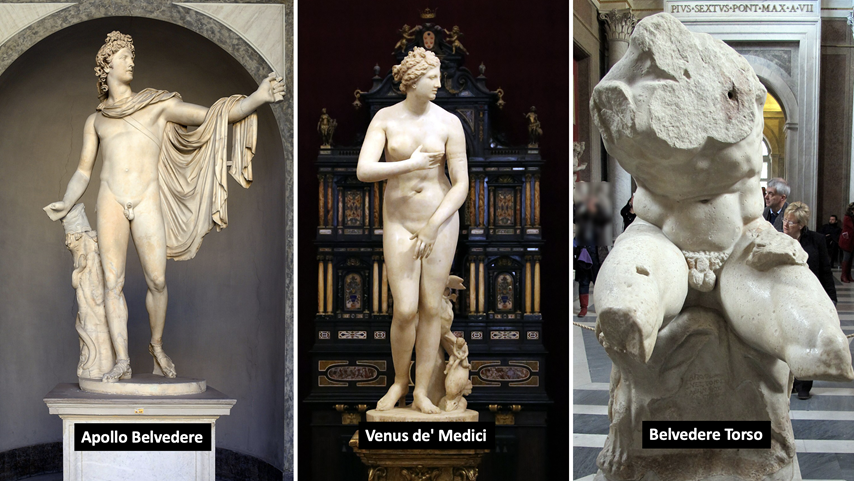
During the 15th century, the leading critics all agreed that the greatest works of art came from an unusual place. No, not a museum or church or palace — they were found, instead, underground and amid ruins, literally covered in dirt.
Before you could see them, you first had to dig them up.
Can we even imagine this attitude today? Our whole hierarchy of aesthetics would need to be reversed. Just consider the shame of admitting that our most cherished cultural legacy had been buried and forgotten by our ancestors. Art appreciation gets turned into some kind of exhumation.
But the reaction to this rediscovered art was just as interesting as the sculptures themselves. How do you feel when you look at these works?
You probably aren’t shocked by the nudity. You’ve seen more salacious stuff on Netflix. In fact, you probably aren’t shocked by anything here — these statues feel very old fashioned and antiquated.
That’s an interesting word, antiquated. It means “old, and no longer useful”. If the plumbing in your house is antiquated, you’re in big trouble. And it’s even worse if you are antiquated.
The word comes from the same root as antiquities — a term applied to arts and artifacts from the past. And most observers today would put the two ideas together, and say that these old statues might be charming to see in a museum, but have little or no relevance to us today.
But that’s not how Michelangelo, Raphael, and other Renaissance artists saw them.
These works were more than a thousand years old, but the leading 16th century artists believed they were worthy of study and imitation. Even more shocking, the great minds of the Renaissance believed that such works represented timeless standards of artistic excellence that could not be erased by the passing centuries.
In other words, evaluating art was like pursuing the good life. After you discovered the pathway to do that, you kept to the course. It didn’t go stale like a loaf of bread. It wasn’t a fad or a trend, but something enduring. The same thing is true of good health or a good marriage — you want them to endure, not get replaced by the next new thing.
Five hundred years later, leading critics believed the exact opposite. Standards were not timeless, but constantly in flux. During the 20th century, art was supposed to disrupt the standards from the past. If a work made you uncomfortable, all the better — you needed a kick in the ass. If the Venus de Milo hadn’t already lost her arms, some witty critic would probably suggest that we cut them off. That would give you a jolt, huh?
This notion of disruption was already prevalent a hundred years ago. And the kicks aimed at your posterior came from all directions. Critic Robert Hughes called this the “Shock of the New”.
The individual asskicks were the -isms.
There’s surrealism, dadaism, cubism, futurism, brutalism, fauvism, abstract expressionism, deconstructionism, postmodernism, serialism, minimalism, and so forth and so on. You could make a patter song from all of them.
Critics placed wagers on them, as if they were horses at the track. If they made a smart bet, they could reap a windfall. Their reputation was enhanced, and also their wallet. I’m reminded of the elite art critic who launched the careers of painters, and sent the market price of their works skyrocketing — but only after he had accumulated some choice specimens for his own collection. In the finance world, this is called insider trading.
The suffix -ism originally denoted a doctrine, theory, or worldview. Or even a religion, such as Judaism or Buddhism. These aesthetic -isms were also a bit like religions, inspiring fervent loyalty.
But there was a big difference. Religions like Judaism or Buddhism last for thousands of years. But aesthetic theories come and go. None of the artistic -isms lasted very long. Today’s -ism soon becomes yesterday’s was-ism.
That’s a little strange, because the advocates of the -isms all promised that they were delivering the blueprint for the future. And then we finally get to the future — and what do we see?



“the shock of the new” In other words, upset the squares. I recall a quick video clip on Igram wherein a couple of art gallery curators were hanging a painting by Basquiat. They treated the thing as though it were a holy relic, and opened the panels of the tryptic as though they were lifting the lid of the arc of the covenant. The “painting” like everything that basquiat did was deliberately, aggressively, and ostentatiously ugly. There wasn’t a hint of either talent, skill, or craftsmanship. It looked exactly like what it was: some stoned out junkie scribbling shit like a third grade kid. The comments were priceless. (condensed version:everybody just looooved it) I could go on about the garbage that passes for contemporary art, particularly the clowns who do “installations.”
Despite this, genuine Art is still being created. There are sculptors doing breathtaking work in marble and bronze. There are painters producing work of transcendent beauty. Some is purely representational. Others do abstract work that is graceful, elegant, and finely crafted. No doubt some future archeologist will look at the garbage, and wonder what the hell these people were thinking. They’ll use it as hard evidence that these pieces are artifacts of a culture in decline. On the other hand, works of The Remnant dedicated to craftsmanship, skill, and beauty will endure.
JWM
Comment by jwm — March 21, 2026 @ 10:21
When I got married, we were friends with an artist couple (she’d been one of my wife’s best friends in primary school and they’d reconnected shortly before I met my wife). She’d started off as a jeweller, but decided that the return on effort was better in the modern art field. She ranged over a wide swath of created objects, but they all seemed to require vast amounts of artistic rust, jagged edges, jarring colours and unpleasant shapes. She never became a big name in the Toronto art scene, but they had a comfortable living from selling stuff I wouldn’t even give garage space to. I figured the problem was me: I really was the classless barbarian she sometimes hinted I must be.
Comment by Nicholas — March 21, 2026 @ 10:34