Quotulatiousness

November 5, 2025

QotD: Progressive anger

This year, as last, bees — tens of thousands of them — made their home between a window in my house in France and the shutters. We called a local bee-man and he came to try to capture the bees in an artificial hive. This is not a straightforward operation and success is not guaranteed, because it is necessary to capture the queen, which is not always possible. Without the queen, the bees are lost. They fly off in a swarm, buzzing angrily (I anthropomorphize, I admit) as they search for their lost leader and somewhere new to settle.

As they did so in this case, I could not help but think of the analogy with our present situation. We have a huge fund of very angry people buzzing about in mobs looking for somewhere on which their anger can settle. It seems an epoch ago that it landed on #MeToo and turned all men into Harvey Weinstein. Then, under the direction of little Greta, who somehow managed to combine an autistic manner with hysteria, opposing tendencies reconciled no doubt by the ineffable self-pity of the privileged, global warming provided a temporary resting place. However, with the killing of George Floyd, climate change seems as passé as Mussolini’s spats. (“Too many spats, too many spats!” someone once said of him.) But if no new thing is found after all the statues have been pulled down, the books burned, and the films withdrawn from circulation, climate change could return faute de mieux. On the other hand, free-floating anger is highly inventive as to the reasons for its existence: It can attach itself to almost anything, as flies can walk upside down on ceilings. Being no prophet myself, I have no idea what will be the next object of angry righteousness by people brought up to believe in moral relativism.

Theodore Dalrymple, “Bees With Degrees”, Taki’s Magazine, 2020-07-02.

October 19, 2025

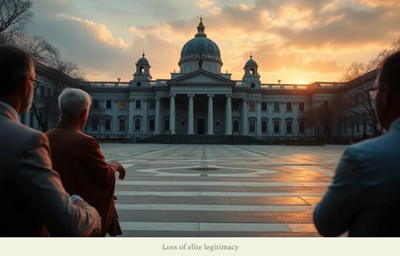
Reframing the loss of elite legitimacy as a “loss of faith in democracy”

On his Substack, Frank Furedi illustrates how the public’s declining trust in political elites across the western world is being reframed in the legacy media as declining faith in democracy itself:

No doubt you have come across commentators and legacy politicians whining about the public’s loss of trust in democracy and in the key institutions of society.

“France is not alone in its crisis of political faith – belief in a democratic world is vanishing” commented Simon Tisdall last week in The Guardian.1 He noted that “belief that democracy is the form of governance best suited to the modern world is dwindling, especially among younger people“.

The tendentious claim that the current era of political malaise is an outcome of a loss of commitment to democracy is regularly echoed by mainstream commentators. This was the message of a recent Politico headline that stated that “Europe’s democracies are in danger, warn Merz and Macron”.2 It cited the German Chancellor Friedrich Merz stating that these “threats dwarf anything seen since the Cold War”. He noted that “the radiance of what we in the West call liberal democracy is noticeably diminishing”, adding: “it is no longer a given that the world will orient itself towards us, that it will follow our values of liberal democracy”.

If anything, the French President Macron was even more pessimistic than Merz. He warns that Europe is undergoing a “degeneration of democracy due to attacks from without and from within”. He was particularly concerned about the loss of faith in democracy within France. “On the inside we are turning on ourselves; we doubt our own democracy”, he noted, before adding, “we see everywhere that something is happening to our democratic fabric. Democratic debate is turning into a debate of hatred.” This statement coming from a man, whose presidency lacks a genuine mandate and relies on bureaucratic maneuvering exposes the cynicism of his concern for the “degeneration of democracy”.

[…]

Loss of elite authority

In reality the crisis of democracy narrative serves to mystify the real issues at stake. This narrative offers a misdiagnosis of the very real loss of legitimacy of the ruling elites as a loss of belief in democracy. As far as this dominant narrative is concerned every time people vote against the representatives of the legacy political establishment democracy is in trouble. So long as they win elections and populists aspirations are confined to the margins of society democracy is represented as a big success. But the very minute people vote the “wrong way” the mainstream commentators craft alarmist accounts about democratic backsliding. That is why the Remainer lobby often represents the outcome of the Brexit Referendum as an expression of “democratic backsliding”.

In theory, the term democratic backsliding refers to the declining integrity of democratic values. In practice it means the estrangement of significant sections of the public from their political institutions. The term democratic backsliding serves to mystify a very significant development, which is the legitimacy crisis of the legacy political establishment. Once understood from this perspective it becomes evident that it is not democracy that people no longer trust but the people and the institutions that rule over society.

As it happens the narrative of “democracy is in trouble” smacks of pure hypocrisy. Those who communicate this narrative are not so much interested in the integrity of democracy but in ensuring that people vote the right way. From their perspective if people vote the wrong way than democracy becomes dispensable. That is why more and more we hear the refrain that there is “too much democracy”. “Democracy Works Better when there is less of it” warned Financial Times commentator, Janan Ganesh.3 As far he is concerned, “no global trend is better documented than the crisis of democracy”, by which he means that too often people vote against the advice of the elites.


  1. https://www.theguardian.com/commentisfree/2025/oct/12/france-crisis-political-faith-belief-democratic-world-vanishing
  2. https://www.politico.eu/article/europe-democracies-danger-warn-friedrich-merz-emmanuel-macron/
  3. https://www.ft.com/content/f68c13a4-1130-49d5-b3c6-2270711d819e

October 16, 2025

The hereditary aristocrats of the People’s Republic of China

To many western liberals, an aristocratic system is a disparaged and vestigial remnant of the distant past. An echo of the “bad old days” of anti-meritocratic wealth and privilege enjoyed by the lucky descendants of ancient conquerors and oppressors. Yet among the most well-connected and powerful people in China can only be described as “princelings”, as they are literally the children and grandchildren of the leaders of the Communist Party, especially those who took part in the “Long March”:

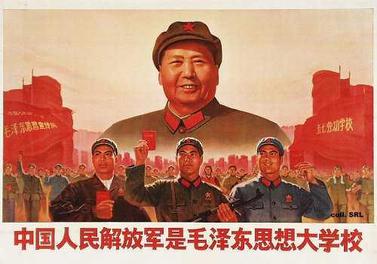
“The Chinese People’s Liberation Army is the great school of Mao Zedong Thought”, 1969.
A poster from the Cultural Revolution, featuring an image of Chairman Mao, published by the government of the People’s Republic of China.
Image via Wikimedia Commons.

In 1926, five years after becoming one of the founders of the Chinese Communist Party (CCP), Mao Zedong listed China’s enemies as “the warlords, the bureaucrats, the comprador class [businessmen dealing with foreign interests] and the reactionary section of the intelligentsia attached to them”. It is ironic that Mao would eventually create a new aristocracy, often referred to as the “princelings” (taizidang), every bit as hierarchical as that against which he had previously railed.

Perversely, when Mao Zedong came to power in China in 1949, there were not many structures of authority left to destroy. In the period of warlordism that succeeded the overthrow of the Qing dynasty by Sun Yat-sen in 2011 and ended with the consolidation of nationalist (Kuomintang) power by Chiang Kai-shek in 1936, the aristocracy of imperial China had been swept away. So too the Mandarin class, the Chinese bureaucrats selected by civil service examination, a system that started with the Sui dynasty in AD 581. As for the Chinese aristocracy, its last vestiges ended with the abolition in 1935 of the Dukedom of Yansheng which belonged to the descendants of Confucius.

So, in terms of social hierarchies, Mao inherited a clean sheet when he established the People’s Republic of China on October 1, 1949. The CCP leadership soon proved that, in the immortal words of George Orwell in his novel Animal Farm, “all animals are equal, but some animals are more equal than others”. In Beijing, Mao and China’s CCP leaders took residence in the palatial compounds located in Zhongnanhai, a waterside park established by the Yuan dynasty in the 13th century.

There is not even equality within the “red aristocracy”. Gradations are as clear-cut as if there were princes, dukes or marquises. The highest rank is accredited to the offspring of those CCP leaders who participated in the Long March. This iconic fighting retreat to a remote plateau in Shaanxi province followed the defeat of the Red Army in October 1934.

It is perhaps difficult for people in the West to understand the scale of Chinese veneration for the individuals who completed the Long March. With the possible exception of the migratory treks along the Oregon Trail, there is no comparable event in American or European history. Throughout their lives, leaders of the Long March enjoyed unparalleled prestige; it was a prestige that passed down to their children – hence the princelings.

The creation of the red aristocracy started with Mao himself. Within a few years of the establishment of the People’s Republic of China, Mao became a de facto emperor. On occasions he even referred to himself as such. He certainly lived the life of an emperor. At his commodious palace in Zhongnanhai, Mao surrounded himself with a harem of dancing girls who would occupy his bed and his swimming pool. In time-honoured fashion, China’s head of security and intelligence, Kang Sheng, procured girls for Mao as well as thousands of volumes of pornography.

[…]

My own experience of the princeling world confirmed that in China, despite its vast population a very small group of families form a governing nexus that has power far beyond its numbers. It is a group that seem to be getting stronger. The princeling proportion of the CCP central committee rose from 6 per cent in 1982 to 9 per cent in 2012. When I spoke to a princeling friend about the politburo standing committee that was elected in 2012, she told me that she personally knew five of its seven members; to her great delight three of them were princelings. It was through her that I met Deng Xiaoping’s daughters and spent a “country house” weekend with them and her princeling pals.

Here it became clear that, while most of the princelings I met were reformists in the Deng mode, there are also factions that are hard-line Maoists, like the one led by Xi Jinping. At the moment it appears that the reformist princelings have gained the upper hand. More light on Xi Jinping’s future and the outcome of this princeling tug of war may be shed at the Fourth Plenum of the 20th CCP Congress starting on October 20.

October 12, 2025

QotD: Male privilege revealed

Filed under: Books, Health, Media, Quotations — Tags: , , , , , — Nicholas @ 01:00

Self-Made Man by Norah Vincent documents the author’s 18-month experiment living as a man named Ned. She decided to embark on this experiment to explore gender dynamics from “the other side”, so to speak. Vincent, a liberal journalist with a strong feminist background, decided she wanted to understand men’s lives and social roles from within. She recognized, accurately, that men change their behavior when a woman is present, and she was curious to see how they were when no women were around.

Vincent described herself as a “bull dyke” and held strong feminist views. She expected, throughout the course of the experiment to uncover the secrets of male privilege and the societal advantages that, she was sure, are afforded to men. She anticipated that living life as a man would validate her beliefs that men lead easier lives and wield unchecked power. She figured that, at the very least, she could enjoy a couple of years as a powerful male.

Vincent disguised herself as a man by getting a new hair style and giving herself a fake five o’clock shadow, among other things. She had always been considered rather masculine in her usual feminist and lesbian circles, so she figured she could pass rather easily as a man, if perhaps a slightly effeminate one. She was right.

Her initial assumptions changed when Vincent discovered that men, contrary to her expectations of power and privilege, face their own unique set of pressures and struggles. Men, she discovered, were expected to suppress any signs of vulnerability. This quickly led to feelings of extreme isolation that she did not expect. Nobody “had her back” because, as far as they knew, she was just a man, and should “man up”. She quickly realized that men do not have inherently easier lives. Her preconceived notions of in-born male advantage evaporated. She was getting worried.

She realized that women do not have empathy for the struggles of men.

Norah, as Ned, experienced the behavior of women toward men firsthand. At one point, she tried dating women as a man. She figured this would be incredibly easy for her. Not only was she a woman herself and knew how women think, but she was also a lesbian and already liked women. She worried at first that she’d be too good at it and would have to tell interested women that she was a woman to stop them from pursuing her.

The reality was sharply different from her expectations. Her apparent femininity came across as her simply being an effeminate man. This caused women to be disinterested in her and their rejections were dismissive, cold, and often extremely brutal. Women would sometimes treat her with suspicion or outright hostility as they assumed her intent was negative.

These interactions eventually led Vincent to start developing misogynistic thoughts. That’s right: women treated her so poorly when they believed her to be a man that she started to develop misogynistic thoughts.

Interestingly, many of the supposedly straight women she had attempted to date, even those who had been brutal and cold toward her, immediately expressed interest in a lesbian “hook-up” when she told them she was a woman who had been disguised as a man for the sake of journalism.

Perhaps there’s no such thing as a “straight woman”. Is there even a such thing as a lesbian?

CTCG, “UNDERCOVER: A Feminist’s Year Living as a Man”, Codex Trivium Cosmic Genesis, 2025-06-16.

October 2, 2025

The signature politics of the unaccountable classes

Filed under: Media, Politics — Tags: , , , , — Nicholas @ 05:00

On his substack, Lorenzo Warby considers the origins of what we now call “woke” politics and how they became the predominant set of beliefs of the people who can’t be held accountable:

Western civilisation, over the last two centuries, has gone through the Emancipation Sequence whereby — taking the Anglosphere pattern — free people voted to liberate slaves, Christians to get rid of exclusions on Jews, Protestants to get rid of exclusions on Catholics, whites to get rid of exclusions on blacks, men to get rid of exclusions on women, straights to get rid of exclusions on gays and lesbians. We live in free societies of mass prosperity, yet we have highly motivated political networks that think nothing of casting our societies as marked by layers of oppression.

Yes, this is based on a monstrous (and self-serving) inflation of the concept of oppression. It also functions to channel the rage of downwardly mobile children of Western elites.

More important still, it is the signature politics of the unaccountable classes, of those paid to turn up — as distinct from the accountable classes whose income depends directly on their performance. The dominant politics of the unaccountable classes has acquired a name: it is woke politics, the politics of wokery or of being woke.

The technical name for wokery is Critical Constructivism. It is the popularisation of Critical Theory. I have labelled it Post-Enlightenment Progressivism, as it rests on critiques of The Enlightenment, and rejection of Enlightenment values, while orienting itself towards an imagined future — one where it is no longer true, as Marx and Engels wrote in The Communist Manifesto (1848), that society is based:

    on the antagonism of oppressing and oppressed classes.

That is, of oppression as they define it.

Wokery is the currently dominant form of left-progressivism. Political scientist Eric Kaufmann defines “wokery” as:

    making sacred of historically marginalised race, gender and sexual minorities.

That is how the Oppressor/Oppressed template that Critical Theory takes from Marxism is popularised in a post civil rights world, using any differences in outcomes between groups as markers of oppression. The Oppressor/Oppressed template requires oppression to be pervasive in contemporary societies, hence psychologist Steven Pinker’s observation about progressives hating progress.1

What wokery also is, is lazy self-righteousness. The self-righteousness is obvious and pervasive. These folk really do act as if they own morality; as if they can withhold the moral grace of their presence from the wicked, from wrongthinkers; as if wrongthinkers are purveyors of moral pollution. This has much to do with the dwindling of the culture of public debate.

But it is also lazy, in that it massively economises on the use of information and intellectual effort. Much of the appeal of “wokery” comes from how remarkably little accurate knowledge it demands. All one has to do is to master the lingo, the linguistic signalling, involved; the pre-set talking points; which terms of moral abuse apply and when; and be willing to engage in any required level of rationalisation and mental gymnastics. Once you do so, the moralised status game of lazy self-righteousness is open for you, with approved positions lined up for one to adopt, all based on semblances of knowing.

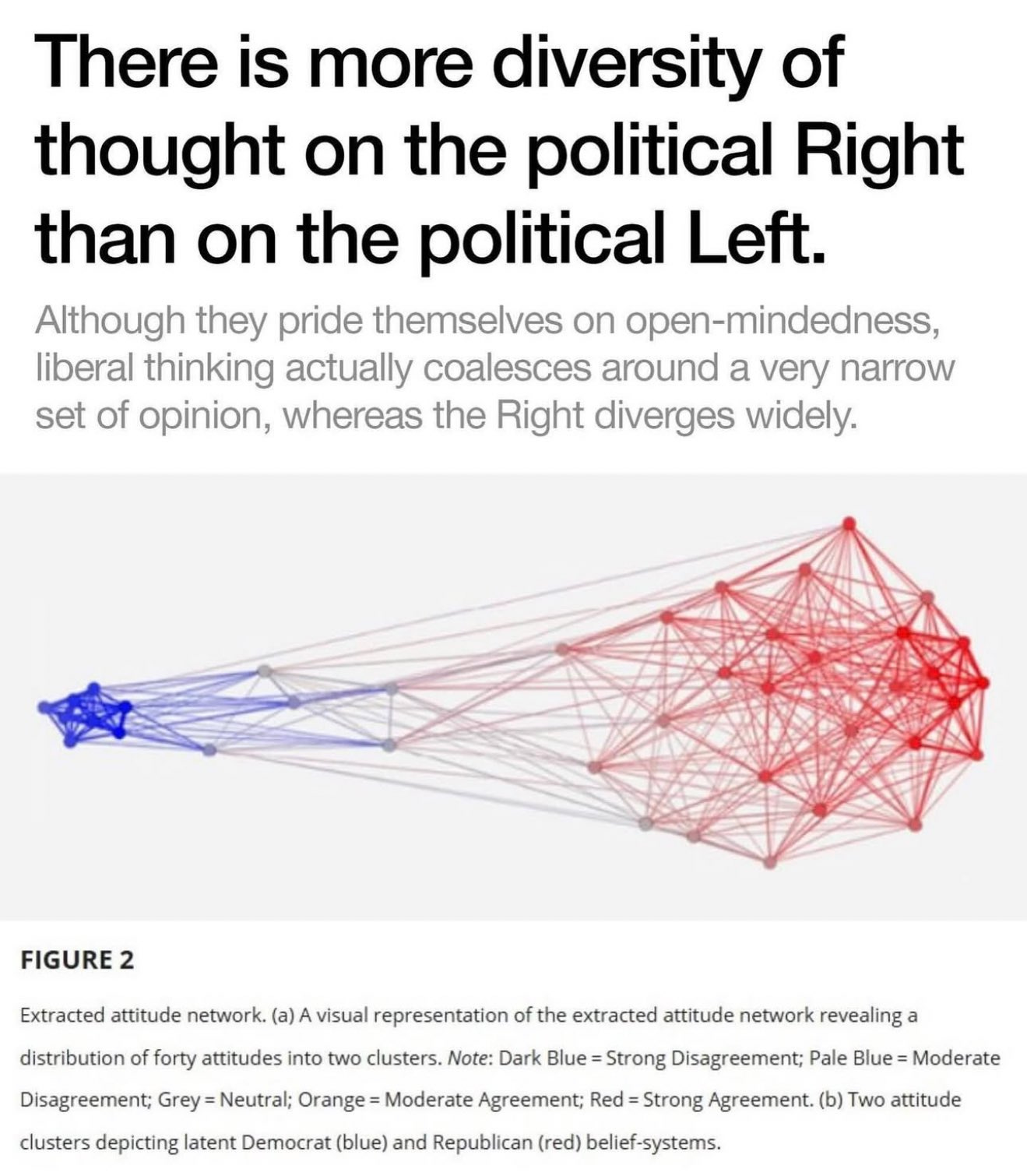
This dynamic has much to do with why one side of US politics is far more conformist in its political opinions than the other.

The underlying blank slate views about humans means you don’t have to accept any constraints from evolutionary biology. If we are all blank slates, if there are no inherent differences between groups, then all inequalities between groups can be classed as malicious — as signs of oppression — so you do not have to bother exploring differences in traits, cultures, life-strategies, etc.

Lazy self-righteousness does not require any thinking about successful and unsuccessful life strategies, about what makes things work, or not work. It does not require much in the way of statistical or mathematical understanding. The most mathematical it gets is whether social outcomes are proportional to a group’s population share or not.

If a group is doing better than average, they are oppressors. If they are doing worse, they are oppressed. Viewing society through the oppressed/oppressor mindset always ends up looking for (and finding) kulaks.

It is a simple metric to adopt, with the self-righteous status game built-in of opposing oppression and supporting the marginalised. No further intellectual effort is required.


  1. Pinker’s observation that populism is a phenomenon of older voters has not worn well. Also, it is a sign how reflexive future-orientated judgements have become, that the voters with the most experience of the EU were most likely to vote against it in the 2016 Brexit referendum passes people by.

September 30, 2025

“San Francisco [is] a sort of market-segmented scheme [extracting] the basic comforts of civilization and licensing them back as upgrades”

Filed under: Health, Politics, Quotations, USA — Tags: , , , , , , — Nicholas @ 03:00

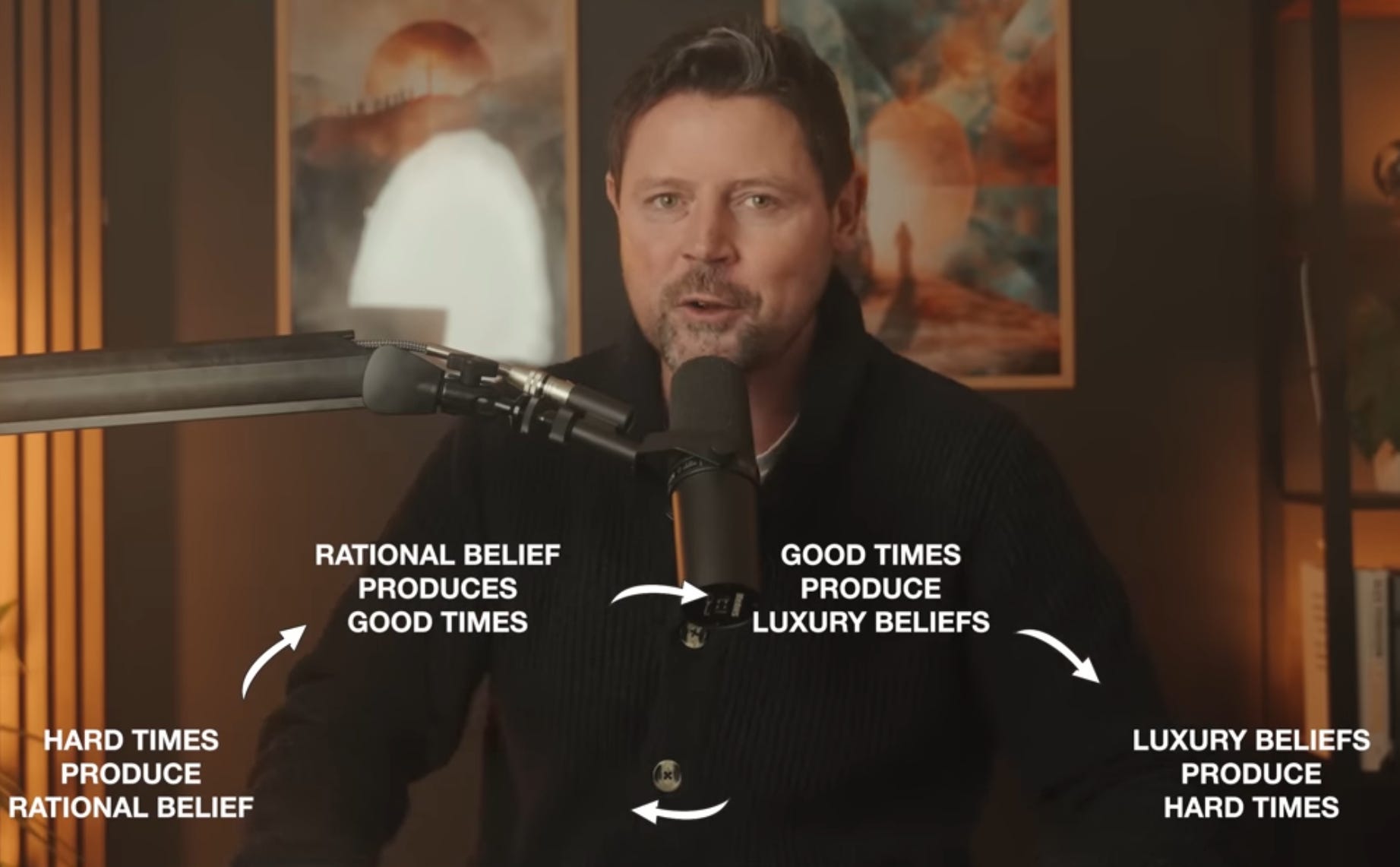
On the social media site formerly known as Twitter, Devon Eriksen describes the very comfortable lives of the very wealthy, who can support any kind of luxury beliefs because they never have to face the consequences that “the poors” who ape them do:

Dear sir,

I am not a filthy poor, and therefore conditions on the street level in Portland do not matter to me.

I drive my Jaguar to nice restaurants, give it to the valet to park, then go inside and order a fancy treat. So long as the valet parks my car, and the waiter brings my fancy treat for me to consoome in peace, I am utterly unaffected by conditions ten blocks away.

While I am technically forced to acknowledge that other humans exist — otherwise who would park my car or prepare my fancy treat? — I am not actually forced to consider what their lives are like.

And if you try to force me to confront this, I will simply point out that you are a filthy poor, who is unable to live a lifestyle that insulates you from this sort of unpleasantness.

At which point I don’t have to pay attention to you, loser.

Okay, here’s what’s really going on.

At a recent gathering in San Francisco, I listened to the tech bros I was dining with and their complaints about spending a million dollars a year on security teams, and a thought occurred to me, which I shared with the congregation.

I observed that San Fransisco, and perhaps other cities as well, seemed to be a sort of market-segmented money extraction scheme whereby the basic comforts of civilization are systematically removed from the environment, and then licensed back as upgrades to those who can afford them.

In Tennessee, it doesn’t cost me a thing to not be murdered for what I write online. Sure, I have a metric fuckton of extremely high-powered weapons and the skills to use them, but let’s be honest … I own them on principle, not because I would be murdered without them.

In SF, saying right-of-center things online while not being murdered costs a million dollars a year.

It probably costs slightly less than that to have zero drugged-out and/or schizophrenic bums urinating on your porch, but again, in Tennessee, this is a free service that comes with the “Western Civilization” package.

Also, it doesn’t cost anything go to a drugstore where nothing is locked behind glass, and be told “have a nice day” by someone at the register who actually means it.

And I’m told there is some sort of mythical beast called “graffiti”, but I have to go online to find out what it looks like.

In short, the argument that “civilization is just fine because I can still buy my way out of trouble” doesn’t hold any water, because it ignores the fact that you have to buy your way out of trouble, because civilization is shrinking.

You can’t have civilization without ass-kickings.

And if you forget that, you start having to buy your way into ever more and more exclusive clubs where the uncivilized can’t afford to go.

Until they figure out that they don’t have to pay, they can just push their way past the doorman. At which point you must be prepared to kick ass again.

All civilization rests on pillars made of violence. You are in danger until the moment you understand this.

Chris Bray also responded to the Nicholas Kristof take:

Now, here’s the hugely respectable New York Times columnist Nicholas Kristof, a very important Pulitzer Prize recipient, explaining from the heights of his journalistic perch what’s really happening in Portland:

This is as flawless a summary of the progressive cathedral classes as you could possibly manage: “‘Hell’ does not serve Pinot Noir this good”.

  1. Portland street journalist: Portland is a public graveyard
  2. Progressive New York Times columnist: Akshully, the Pinot Noir is exquisite

It’s time to shove these people onto a barge and tow them out to sea.

Like Karen Bass describing the open-air drug market of MacArthur Park as a sylvan paradise full of happy children and wonderful families having picnics, Oregon Governor Tina Kotek explained this week that Donald Trump is bizarrely intervening in a utopia, and for crying out loud look at this facial expression:

No one has ever been more lost than this. Your average good urban liberal is more insane than a psych ward full of psychotics. Akshully, the Pinot Noir is delightful. We are burdened with the existence of high-status people who have departed from earthly reality, and we can’t afford them.

Update, 1 October: Welcome, Instapundit readers! Please do have a look around at some of my other posts you may find of interest. I send out a daily summary of posts here through my Substackhttps://substack.com/@nicholasrusson that you can subscribe to if you’d like to be informed of new posts in the future.

September 22, 2025

Materially well-off but downwardly mobile

Filed under: Media, Politics, USA — Tags: , , , , — Nicholas @ 05:00

Rob Henderson considers the plight of an entire generation of kids raised in privilege, but economically incapable of improving or even barely maintaining their material condition … the downwardly mobile children of wealthy parents:

“Free Palestine/Anti-Israel protest” by Can Pac Swire is licensed under CC BY-SA 2.0 .

For generations, Americans assumed that their children would live better than they did. Today, that assumption no longer holds. In fact, the higher your parents’ income, the less likely you are to match it.

According to The Pew Charitable Trusts, fewer than four in 10 children born into the richest fifth of households stay there; more than one in 10 fall all the way to the bottom fifth. Similarly, a 2014 study in The Quarterly Journal of Economics found that while 36.5 percent of children born to parents in the top income quintile remain there as adults, 10.9 percent fall to the bottom quintile.

Sociologist Musa al-Gharbi, in his 2024 book, We Have Never Been Woke, argues that this downward mobility of children born into wealth is the psychological engine of contemporary politics. This may look like a trivial problem — the petty disappointments of a small slice of America — but the unhappiness of this group, raised to expect the world and denied it, has outsize consequences.

To be clear, this cohort has never faced genuine poverty. Still, they have experienced the sting of loss: They came of age after the Great Recession, watched job security fade as the digital economy made their skills obsolete, and learned that highly coveted jobs in academia, media, and politics were far fewer than promised. These disappointments, al-Gharbi writes, helped power the Great Awokening. Many disillusioned strivers aimed their anger at the system they believed had failed them, and at the lucky few who did manage to retain or enhance their class position.


Unlike the working classes they so often claim to represent, these downwardly mobile elites remain armed with the tools of their upbringing: degrees, contacts, cultural fluency. They may no longer have the bank accounts their parents did, but they retain platforms in media, academia, and politics through which to broadcast their grievances. Given these advantages — or perhaps the right word is privileges — it should come as no surprise that their concerns, which seem to the average American profoundly niche, have dominated the cultural conversation.

Some of this downward mobility is voluntary. Al-Gharbi notes that many young, college-educated people would prefer “to be a freelance writer or a part-time contingent faculty member rather than work as a manager at a Cheesecake Factory”. The dream is artistic freedom and flexible work. The reality is disillusionment when prosperity does not follow.

Such disappointment isn’t totally new. George Orwell’s Keep the Aspidistra Flying follows a Cambridge-educated poet who abandons his advertising career, squanders his inheritance, and slides into genteel poverty. HBO’s Girls replayed the same theme for a new generation: Brooklynites with cultural capital but precarious incomes, simultaneously privileged and resentful. The details change, but the shape of the story remains the same — raised in affluence, buoyed by expectation, they discover too late that their choices and the system cannot sustain them.

What is different today, however, is how the disillusion now manifests itself. When reality disappoints those raised in privilege, the gap between expectation and outcome produces rage. Behavioral economics has long recognized this dynamic: Satisfaction depends less on objective conditions than on whether outcomes match or exceed expectations. And today, those expectations are far from being met.

Two years before Girls ended, sociologist Lauren Rivera, in her book Pedigree, found that graduates of lesser-ranked colleges who landed jobs at elite firms were far happier than Harvard and Stanford graduates who landed the same jobs. The reason was simple: Those jobs exceeded the expectations of the former, while for the latter they fell short. The higher the expectation, the sharper the disappointment. The harsh reality, then, is that privilege itself can encourage feelings of decline. When you’re born to — and surrounded by — overachievers, even respectable achievements can feel second-rate.

In a 2018 study, Duke sociologist Jessi Streib explored why many middle-class kids falter in school and work. Her finding was counterintuitive: Entitlement often dragged them down.

It’s not too hard to see why. Success in school requires showing up, meeting deadlines, and tolerating authority. Success at work requires completing projects on time, absorbing criticism, and cooperating with colleagues. Yet the downwardly mobile, Streib found, were often convinced such requirements were beneath them. Their grandiosity and defiance hastened their slide.

Elite overproduction is real, and has real world ramifications …

September 1, 2025

QotD: The Ivy League

Filed under: Bureaucracy, Education, Government, Humour, Quotations, USA — Tags: , , , — Nicholas @ 01:00

I’ve been around Ivy Leaguers, y’all, and everything you think is true about them IS true, in spades. The Ivy League is “elite”, all right, but it’s surely not because of the education.

The Ivies are now what they’ve pretty much always been — the equivalent of those Higher Party Academies in Moscow. They’re finishing schools for the Apparat. Oh sure, you can probably find a graduate of Ohio State or some such place at Quantico or Foggy Bottom … but I promise you, he hears about it every single day of his life. If they don’t actually teach classes called “How to be a Toady in the DOJ” and “Catching a Senator’s Farts” at Dartmouth, they might as well.

Take your Basic College Girl, make her unisex, crank her up way past eleven on meth and steroids, and that’s the typical Ivy League grad. And they all go directly into Government. Just in case you still cherished some vague hope we could vote our way out of this, remember that guys like Robert McNamara and McGeorge Bundy were the absolute best the Ivy League has produced in the modern era. The Democratic People’s Republic of Vietnam says hi!

Severian, “First Mailbag of the New Year”, Founding Questions, 2022-01-07.

Update, 2 September: Welcome, Instapundit readers! Please do have a look around at some of my other posts you may find of interest. I send out a daily summary of posts here through my Substackhttps://substack.com/@nicholasrusson that you can subscribe to if you’d like to be informed of new posts in the future.

July 28, 2025

“According to elite theory our world is controlled by a ruling class”

Spaceman Spiff explores the notions of “elite theory”, which in one variant or another seems to be a bedrock belief of most dissidents in the west:

Elite theory is based on an important observation; small groups can more easily organize than large groups.

A modest number of wealthy individuals with common goals will easily run rings around a whole town, region or country because the masses cannot easily organize.

This infers enormous advantages, not the least of which is a small group can discuss and agree a strategy and then stick to it. Because of this some imagine elites as more able than they really are.

But power is tricky. All the money and all the clout in the world means nothing if you can’t project it far.

And our powerful, wealthy elites have one great weakness, they must work through others.

A hierarchy therefore exists which we occasionally glimpse adding to our confusion when we use words like “elites.”

Global rulers are ostensibly at the top. They sit above nation-states. They are truly post-national, controlling central banks and international finance. They are the closest thing we have to world controllers. Some seem to hold power over huge swathes of the globe, like gigantic economic zones.

In addition, all nations have visibly important people; kings, dictators, presidents and others. National elites are those whose power is largely confined to a territory. They lack the international reach of global elites.

The media represent power too. They are there to shape the narratives that govern our perceptions. Most traditional media outlets serve elite goals although some of their members wield tremendous power themselves.

The political class are the obvious lackeys of the powerful. Voters seem constantly amazed politicians never really improve anything once in power, but that is because they don’t serve those below them, only those above. Once you see this their behaviour makes much more sense. They dance to the tune of their paymasters. Their primary job is to pretend democracy works.

The corporate leaders are a less visible example of the same thing. They manage the commercial wing of elite interests while pretending to be businessmen.

Blackrock and others have almost completely abandoned anything resembling capitalism. They are gamers of systems, not the innovators of yesteryear. Just one reason our economies are struggling.

It is the major corporations who have helped establish diversity and climate goals, for instance, so they matter for furthering elite ambitions.

Local and regional elites exist too. Everything is replicated at ever smaller scales, including public sector employees and corporate managers.

These are the foot soldiers often oblivious to any elite goals. They just respond to the incentives and disincentives they are aware of at their level.

There is more, including academia and the major institutions. But the key idea is this is the hierarchy the powerful must work with to get anything done.

Projecting power downwards

At each stage there are numerous problems conveying information and taking action. Running the world is a demanding hobby. Power means nothing unless you can implement your schemes.

Communication is an ever-present issue. Things are misinterpreted. People misunderstand goals and aspirations.

There are probably no written plans. A lot of influence is achieved via think tanks and talking shops like the World Economic Forum, so is open to misinterpretation. It must be like herding cats as these grand ideas cascade down the hierarchy and are misunderstood or overlooked.

This process is further retarded by quotas and ideological capture. Woke brings many distortions; just ask the declining universities. Hiring for alignment does not select for the best. Elite need for control therefore leaves them with reduced options.

We’ve all seen some new appointee take over a position of authority and promptly run it into the ground. Imagine having to rely on that process to get anything done?

The lower down the totem pole we go the less able the people as a general rule. Specifically, in these benthic depths far from the centres of power, the minor lackeys run the grave risk of actually believing the claptrap used to control the masses which can be a real impediment to progress.

Those near the bottom generally lack the intellectual vigour to question anything which makes for obedient slaves, albeit dangerously detached from strategic awareness or understanding of the purpose of the narratives they uncritically embrace.

Such devotion is handy at first, it can provide real energy to make changes. Covid policies were established quickly thanks to this phenomenon. The implementation units were clearly unable to assess evidence or think for themselves; man on TV said wear mask and sit in back garden, so they did.

The price for such mindlessness is confusion and this is where control can be lost.

Anti-white animus gestated on university campuses was useful for the powerful to keep the most dangerous demographic down, and therefore less likely to form a counter-elite, but has now morphed into anti-Israel and pro-Palestine sentiment. It is evident many in academia, oblivious to the purpose of “decolonization,” have now misapplied this ethnic weapon to Israelis and Jews more generally to the horror of the powerful with plans of their own.

We see similar effects with climate zealots in positions of authority, especially in politics and media circles. It can be galling to realize some prominent person you once thought was capable actually thinks we only have twelve years to save the planet or wants to end cheeseburgers to help the coral reefs. Can they really be that impressionable?

What is frustrating for us must be maddening to the powerful as they watch brainwashed clowns misunderstand their goals. When your tools include the gullible things can get out of hand quickly.

That’s why many of the doom and gloom predictions based on some omniscient Illuminati are so off the mark despite their elevated position in society.

Projecting power is akin to shooting people in swimming pools. You can see them under the water, often very clearly, but it doesn’t necessarily help.

You fire off your rounds, but they quickly lose force as they enter some new medium of which you know very little, plus they can whizz away in unexpected directions, entirely missing their mark.

All that money and influence but you have to rely on dancing monkeys to get anything done. What use are trillions when Glenda in HR actually thinks her purpose in life is to root out systemic racism or heal the planet? Her initial zeal can quickly become a liability as ultimately happened during Covid when many began to wake up after the clownshow became too absurd to continue.

July 22, 2025

Bitter reality is coming for the laptop class

Spaceman Spiff foretells the end of the managed paradise of the “unsophisticated sophisticates” of the privileged laptop class who have been able to keep their dream alive at the expense of everyone outside their rarefied and protected bubbles:

There seems to be a section of society populated with gullible conformists who believe many of the manufactured narratives designed to manage society.

Most are the credentialed products of universities. The laptop class of professionals who operate the corporations, institutions and key organizations.

Their worldview is comprised of stories which are downloaded and stored as mental models. Adhering to these narratives can then devolve into belief systems that are placed beyond criticism. This in turn can easily degenerate into a kind of fanaticism.

Ideas like mass migration and the destruction of reliable energy sources are crazy and yet they are primarily in existence thanks to the efforts of this layer of society, the professionals who implement policies desired by the ruling class.

While some among them are cynically exploiting today’s fads for their own ends, many seem to be true believers.

How can they believe these things so completely? What is going on?

Rebels searching for causes

Most of today’s great crusades seem to have the same characteristics. They are easily downloaded and consumed, they are socially rewarded within some circles, and they are not immediately obvious as issues at all.

The most popular are pre-prepared to an almost comical degree and thoroughly focus-grouped to ensure minimal friction among their consumers.

Many even come with slogans attached. Diversity is our strength is every bit as artificial as two weeks to flatten the curve, but it goes down easily with no thought required, which is the point.

The ideas that stick are the ones most useful to demonstrate virtue. Showing off to your peers you are non-sexist, non-racist and non-homophobic helps secure your place in many professional hierarchies where visible in-group membership matters.

The most prized causes appear to be non-obvious where the conclusions are not reachable with the evidence available.

This confusing aspect makes many question some new idea or policy, but in the laptop class often triggers a sense of smugness that they see beyond the obvious to the obscure thanks to their impressive intellects. Criticism can then be dismissed as simplistic providing a rewarding sense of superiority.

Much of the above is evident in the belief systems of today’s professional classes.

[…]

What to make of all this?

Does any of this matter? Yes it does. It is this section of society that ultimately puts in place the ruinous ideas of the ruling class.

They are in the corporate offices, the local councils and the schools. They are running the television stations and the publishing houses. They are captured by groupthink. Everyone they know thinks as they do. All criticism is easily dismissed.

Very little can penetrate this bubble. Except one thing.

Over time reality intrudes. Models should be updated to accommodate new findings and observations, but that is challenging when they have been uncritically downloaded to satisfy psychological needs.

Contrary evidence threatens one’s sense of self so scrutiny is avoided. When these avoidances ultimately fail some dig even deeper. Magical thinking seems to be everywhere.

The ultimate effect is either a reassessment of one’s worldview, or a psychotic break from reality. We see examples of the latter; Trump Derangement Syndrome is one well known borderline psychosis but there are others.

June 27, 2025

QotD: The dangers of “doing too much principal component analysis”

John: I’ve never read a fashion magazine or watched a runway show, so I just naively assumed that models were stunningly attractive and feminine. But as Mears points out, the models are not actually to most men’s tastes. They tend to have boyish figures and to be unusually tall.1 Is this because the fashion industry is dominated by gay men, who gravitate towards women who look like teen boys? Whatever the origins of it, there is a model “look”, and the industry has slowly optimized for a more and more extreme version of it, like a runaway neural network, or like those tribes with the rings that stretch their necks or the boards that flatten their skulls. There’s actually a somewhat uncanny or even posthuman look to many of the models. The club promoters denigrate women who lack the model look as “civilians”, but freely admit that they’d rather sleep with a “good civilian” than with a model. The model’s function, as you say, is as a locus of mimetic desire. They’re wanted because they’re wanted, in a perfectly tautological self-bootstrapping cycle; and because, in the words of one promoter: “They really pop in da club because they seven feet tall”.

[…]

By the way, the fact that models are beautiful in a highly specific way, and that there exist women who are similarly beautiful but condemned to be “civilians”, is a good reminder of the dangers of doing too much principal component analysis.2 In so many areas of life, we are obsessed with collapsing intrinsically high-dimensional phenomena onto a single uni-dimensional axis. You see this a lot with the status games that leftists play around privilege and oppression — I feel like a rational leftist would say that a disabled white lesbian and a wealthy scion of Haitian oligarchs are just incomparable, each more privileged than the other in some senses and less in other senses. But no, instead there’s an insistence that we find an absolute total ordering of oppression across all identity categories, a single hierarchy that allows us to compare any two individuals and produce a mathematical answer as to which one is more deserving of DEI grants. My hunch is a lot of the internal tensions and bickering within American leftism are actually produced by this insistence, which makes sense because it’s totally zero sum.

But the disease of trying to pin everything to a single number is hardly confined to the left. You see it on the right in the obsession with IQ, as if a single number could capture the breathtaking range of variation of cognitive capabilities across all humanity. I mean for goodness sake, Intel learned the hard way that this doesn’t even work for computers, and human brains are much weirder and more complicated than microprocessors. But the even dumber version of this is the 1-10 scale of female beauty. There’s something so sublime about seeing a beautiful human being, because so much of it is either bound up in subtle interrelationships between different features (this is why plastic surgery often makes people uglier — there’s no such thing as a “perfect nose”, and if you pick one out of a catalog you’ll probably end up with one that doesn’t fit your face), or it’s irretrievably evanescent — a fleeting glance, or the way her hair falls across her face just so, gone the moment after it happens. Taking something so ineffable and putting it on a 1-10 scale only makes sense as a form of psychological warfare. And I get it, amongst the young people relations between the sexes have degenerated to the point of more or less open warfare, but come on, this is pornbrained nonsense.

Speaking of both the DEI olympics and the classification of female beauty, some parts of this book are really charmingly naive, and I snickered a bit at Mears’s mystification at why all of the models are white and blonde. The really funny part is that she says something like: “I expected this legacy of white supremacy to be in retreat given that so many of the big spenders in clubs these days are from Asia and the Middle East”. Is she really not aware that men of other races have an even stronger aesthetic preference for white women than white men do?3

John Psmith and Gabriel Rossman, “GUEST JOINT REVIEW: Very Important People, by Ashley Mears”, Mr. and Mrs. Psmith’s Bookshelf, 2024-03-04.


    1. In fact, an unusually high proportion of models are intersex individuals with a Y-chromosome and androgen insensitivity syndrome.

    2. Not the only danger of too much principal component analysis!

    3. Gabriel: Kimberly Hoang did an ethnography as a bar girl in several Vietnam bars. At the bar that catered to Vietnamese elites, the other bar girls made her lighten her skin with cosmetics and wear a black minidress, with the target look being tall, pale, and slender K-pop idol. When she moved to another bar catering to white sex tourists, the other bar girls told her to wear bronzer and a slutty version of traditional Asian dress with the target look being exoticized sexiness. See: Hoang, Kimberly Kay. 2015. Dealing in Desire: Asian Ascendancy, Western Decline, and the Hidden Currencies of Global Sex Work. University of California Press.

June 10, 2025

The limits of female empathy

Filed under: Books, Health, USA — Tags: , , , , , , — Nicholas @ 03:00

Janice Fiamengo discusses the 2006 book Self-Made Man: One Woman’s Year Disguised As A Man by journalist Norah Vincent. Intended as a kind of exposé of male privilege, her investigations turned into something rather different than she originally intended:

    Many men are lonely. Many don’t like the work they do. Many are unhappily married. They struggle with an at-times overwhelming sex drive. Their encounters with women, romantic or otherwise, often involve rejection and contradictory tests of their masculinity. They are the objects of blame and bigotry in their societies, yet are expected to remain stoic and put women’s needs first.

It’s a strange world in which the above observations — by a woman — are seen as outstanding insights, but it’s the one we’re in.

In 2006, American journalist Norah Vincent published Self-Made Man: One Woman’s Year Disguised As A Man, an under-cover adventure in which the author, a mannish lesbian with big feet, spent close to 18 months periodically disguised as a man named Ned, notching up about 150 episodes in drag.

With breasts flattened, fake stubble on her chin, and a stuffed jock strap in her pants, having hired a tutor to teach her how to pitch her voice low and move like a man, she set out to “infiltrate exclusive all-male environments and if possible learn their secrets” (p. 18). She joined a bowling league, went on dates, did sales calls, spent some weeks at a monastery, and attended a Robert Bly-influenced men’s wilderness retreat.

Expecting to learn something about male power, she found instead “the hidden pain of masculinity and my own sex’s symbiotic role in it” (p. 254). The planned exposé became a feminist mea culpa.

The book got a lot of attention when it was published, and many men expressed gratitude and appreciation for the empathy and insight in Vincent’s work.

Reading the many accolades, I felt sadness, tenderness, and amazement. Wasn’t this a bit much? Was it really so remarkable that a woman could develop sympathy for the opposite sex?

Most men are so unaccustomed to any empathy from a woman, even when it’s mixed with patronizing descriptions and questionable conclusions, that they respond as if to heroism. The woman who cares, even within circumscribed limits, is catapulted into the company of the saints.

Imagine the reaction if a man had masqueraded as a woman for a year or more, and then pretended to understand women (even sympathetically) using a shop-worn ideological framework? Imagine a white person putting on blackface in order to become an expert, even a well-intentioned one, on the need for black self-improvement? There would be howls of outrage and indignant rebuttals, especially by members of the impersonated group.

Not in Vincent’s case. So rare is a woman’s attempt to understand male experiences that she doesn’t need to be consistently sympathetic or accurate.

Even when someone goes beyond temporary male drag, there is a palpable surprise that mens’ lives are not a well-watered garden of male privilege:

Today, of course, there is still always a reason to look away from men’s pain. Feminist-inclined men and women routinely “bathe in male tears“. They claim that discussing men’s issues is misogynistic, and ask “Can White Men Finally Stop Complaining?” No wonder it seems that the only time men can be heard is when women speak for them.

Notably, women who “transition” to male through hormone treatments and surgery are often shocked by the indifference and unkindness they encounter in public, where men are not eager to help and women expect deference. Zander Keig wrote as a trans man in “Crossing the Divide” of a pronounced sense of aloneness: “No one, outside of family and close friends, is paying any attention to my well-being”.

March 28, 2025

QotD: Prosopography

Filed under: Europe, History, Politics, Quotations, Russia — Tags: , , , , — Nicholas @ 01:00

In the History Biz, prosopography is the study of quasi-familial relationships, a kind of “collective biography”. It’s different from genealogy, which studies direct lineal descent — So-and-So begot Wossname, like in the Bible. Your classic prosopography is Beard’s Economic Interpretation of the Constitution, which you still see Leftards on the Internet hauling out all the time, though of course they don’t know where it comes from (or that modern historians, who are far more flamingly Leftist than Beard ever dreamed of being, consider it largely discredited).

Prosopography is vital in the study of Classical Antiquity, especially the Roman Republic. The Romans, as I’m sure you recall, practiced “patronage and clientage” — a man’s clients were often in a very real way more important than his biological family. Prove that Wossname was So-and-So’s client, and you know a lot about Wossname, even if you can’t find it in the archaeological record, and what you do know about him from the record takes on a whole new meaning. For instance, under Gaius Marius (et al.), the patron / client relationship got extended to the army — coteries of officers and NCOs personally loyal to their commanding general, not to the State — and there’s your Fall of the Roman Republic.

Kremlinology required something similar. Since the important levels of the Apparat all went to the same Higher Party Schools in Moscow, the fact that So-and-So was Wossname’s roommate for a few semesters was potentially of much greater importance than anything So-and-So did as the People’s Commissar of Whatever. He might’ve looked like a real up-and-comer based on his early promotion to a prestige post, but based on his prosopography an experience Kremlinologist might deduce that this was just horse-trading — someone high up in the Politburo owed Wossname’s father a favor for something back in the Great Patriotic War, and so this was payback; Wossname wasn’t going any higher than that.

It’s even more important in a completely ideologized society like the USSR. No Roman client would ever go so far as to openly stab his patron in the back — no one in his society would ever trust him again; he’d get shanked the very minute he donned the purple — but a Roman could have a change of heart. He might get religion, of either the philosophical (Epicureanism, Stoicism) or the actual cultic sort. This would significantly change the patron / client relationship. But in a society like the USSR — ostentatiously dedicated to the World Proletarian Revolution — ideology imposed some hard limits …

Severian, “Alt Thread: A Brief Bit of Brandonology”, Founding Questions, 2021-12-01.

March 6, 2025

QotD: Old Etonians

If you’d told somebody in the mid 2000s that David Cameron would become Prime Minister, they would have laughed in your face. If you then told them that a few years later Boris Johnson would be one of his successors, they’d consider you bonkers. This was Blairite Britain – gone were the days of Macmillan, Douglas-Home, and the coterie of other prime ministers educated at that same dusty institution – the hegemony of the Old Etonian was firmly over. Yet Cameron became the 19th Prime Minister educated there, and Boris the 20th, making five out of the fourteen prime ministers elected during Queen Elizabeth II’s reign Old Etonians.

When I first started there, the traditions seemed daunting, and while you had a week of grace period to find your feet, it took a lot longer for the novelty truly to wear off. Dressed in a tailsuit that makes you look like a penguin, and that even the production team of Downton Abbey would question, it’s a complete culture shock. Teachers become “beaks”; homework becomes “EW (short for Extra Work)”, and the threat of “tardy book” (a punishment where you have to get up early to report to the School Office) is ever present. Your life is governed by a tutor, housemaster, and dame (a surrogate mother for your time there, and the most influential person in your day-to-day life), and outside of lessons (known as “schools”) you’re left to your own devices. It’s a sink or swim situation, and some can’t hack the overload of independence.

You’re constantly surrounded by things named after great men who have come before you – whether that be John Maynard Keynes (an economics society) or William Gladstone (a library) – and you can’t help but see yourself as heir to some great dynasty. Sitting in Upper School – a large schoolroom now mainly used for talks by visiting speakers – the walls are lined with marble busts of illustrious Old Etonians past, and it’s not hard to daydream about joining them. In our first ever assembly the head master put it best: “If you know that some interesting people have gone on to do some interesting things, whether it’s George Orwell or the Duke of Wellington, that does implicitly ask the question, why not you?” Success never seems far away, and often you’re regaled with tales about the time your beak caught a famous actor smoking, or how awful a pupil a noted academic once was. Neither does service, particularly when you pass the memorial boards for the First World War (as you do daily on the way to chapel): 1157 Old Etonians died, and 37 Old Etonians have won the Victoria Cross – 17 more than any other school.

In your final years, it’s fun to try and work out who’s going to be most successful after leaving, and – it never seems too outlandish – who among you could be a future prime minister. The people you consider are never confined to a particular group – it’s not “one of the debaters” or “one of the Rugby XV” – in fact, it’s often those who you can’t seem to categorize, or transverse the groups that are most magnetic. To get into Eton, you have to do well in the infamous “List Test”, composed of a computerized assessment and an interview with one of the beaks. For an eleven year old, it can be brutal (one boy left crying midway through our test), particularly as you don’t know what they want: they’re not looking for candidates that fit a particular box. Potential is valued more than current ability, and the greatest asset is that of being interesting. With only one in five getting an offer (odds stiffer than Oxbridge), and after five years of being expected to perform at the highest level, it’s unsurprising that students end up so successful.

Ivo Delingpole, “Boris and the Spirit of Eton”, Die Weltwoche, 2020-01-29.

February 28, 2025

Taking money from poor people in rich countries to give to rich people in poor countries

Filed under: Britain, Government, Media, Politics — Tags: , , , — Nicholas @ 03:00

Tim Worstall explains how government foreign aid is quite literally anti-democratic (which is why it’s rare for governments to allow the voters any input about the subject):

Obviously we need to start with the observation of Peter, Lord Bauer — foreign aid is nicking money off poor people in rich countries to give to rich people in poor countries. As the sort of people who rule us went to school with those who rule the poor countries — I did, with the President of the Philippines, Bongbong, for example. V different year but still — it’s people nicking our money to spend on making themselves look good to their peer group.

You know, elite virtue signalling.

Yes, of course 0.7% of GDP should be spent upon Official Development Aid. ODA is very important, dont’cha kno’? Every chav in Britain should have near 1% of everything they do collected up and sent off to Ol’ Bongie. Obviously. Couldn’t face an Old Boys dinner without that now, could I?

Now of course that’s not actually quite how it’s put even if that is what it actually is. But just the sometimes the truth slips out from those corridors of power.

    The former head of the Foreign Office has warned Rachel Reeves not to cut Britain’s international aid spending, amid signs the chancellor is willing to raid the development budget to help pay for higher defence spending.

    Simon McDonald, the former lead civil servant at the Foreign Office, said it would damage Britain’s global reputation if Reeves chose to reduce aid as she looks for savings across Whitehall in this year’s spending review.

Reputation? Among whom? Among those who attended Pembroke?

    He told the Guardian: “At times of financial need, development assistance is an easy target for trimming because international assistance is not generally voters’ priority”.

Remember folks, democracy is that we the people decide. We’ve even those out there insisting that all economic decisions must be made via democratic means — that true economic democracy which is to be the new socialism.

But when democracy — in the form of “We don’t give a shit about that” — bumps up against the elite desire to look good at the state banqueting table guess what? Democracy has to git to buggery and the elite get to spend our money their way all the same.

No, really. Look what he’s saying. Voters don’t care. But they must be forced to pay all the same. So much for that vaunted democracy.

« Newer PostsOlder Posts »

Powered by WordPress